The NY Times reports:
A school superintendent’s decision to suspend, and perhaps expel, about two dozen students who took part in a protest against the Iraq war at a suburban high school drew criticism Tuesday from the students and their parents, who demanded that their children be allowed to return to classes.
In a statement issued after the protest on Thursday at Morton West High School in Berwyn, a working-class suburb just west of Chicago, the district superintendent, Ben Nowakowski, said the school’s reaction had to do only with the interruption of the school day, not with the students expressing themselves.
The administration “did not say that the students could not protest,” Dr. Nowakowski’s statement said. “Rather, we asked that the students simply move their protest to an area of the school that would not disrupt the ability of the other 3,400-plus students at Morton West to proceed with their normal school day.”
Dr. Nowakowski did not return repeated calls seeking comment Tuesday.
But several students said the protesters, whose numbers had dwindled to about 25, obeyed the administration’s request to move from a high-traffic area in the cafeteria to a less-crowded hall near the principal’s office. There, they intertwined arms, sang along to an acoustic guitar and talked about how the war was affecting the world, said Matt Heffernan, a junior who took part.
“We agreed to move to another side of the building,” Matt said. “We also made a deal that if we moved there, there would be no disciplinary action taken upon us.”
Matt said the group had been told that the most severe punishment would be a Saturday detention for cutting class that day.
Police officers were on the scene, and Berwyn’s police chief, William Kushner, said no arrests were made. “It was all very peaceful and orderly,” he said.
But at the end of the school day, Matt said, Dr. Nowakowski gave the remaining protesters disciplinary notices stating that they had engaged in mob action, that they were suspended for 10 days and that they faced expulsion.
“I was shocked,” said Matt, 16. “We had the sit-in. So I had mixed feelings of confidence — of a job well done — and fright, because my whole educational future is at risk.”
School officials also sent a letter to the parents of all the school’s students calling the protest “gross disobedience” and reminding parents that any disruption to the educational process could lead to expulsion.
On Tuesday, a group of parents went to the school to demand that their children be allowed return to classes. At most, the parents said, the protesters’ behavior amounted to loitering, which should be punishable by detention or a meeting with a guidance counselor.
The parents have also asked that the district provide the students with some way to express themselves about issues like the war.
“Who’s the next group to go off to war?” said Adam Szwarek, whose 16-year-old son, Adam, faces expulsion. “These kids. The kids do a peaceful sit-in and they’re threatened with expulsion, yet the military’s running around the school trying to recruit.”
Parents also complained that deans, teachers and coaches singled out certain athletes and honor students and persuaded them to drop out of the protest.
Rita Maniotis, president of the school’s parent-teacher organization, said the school called her husband to say that their daughter, Barbara, a junior, was participating in the protest and that he should come to get her. He did so, and she was suspended for five days. But other parents were not called and not able to intervene, Ms. Maniotis said. “There’s no rhyme or reason to the punishment doled out,” she said.
The executive director of the A.C.L.U. of Illinois, Colleen K. Connell, said she could not comment on the case because her organization was investigating to determine whether it will take it up. In general, public school students have constitutional rights, she said, but they can be limited in a school setting.
Tuesday, November 6, 2007
| [+/-] |
Students Call Protest Punishment Too Harsh |
Wednesday, October 10, 2007
| [+/-] |
There Goes The Neighborhood |
Roll Call reports:
One might think it would be great to have Speaker Nancy Pelosi (D-Calif.) as a neighbor (imagine the block parties!). But the Speaker apparently is not making herself popular in her high-dollar 'hood, telling reporters on Tuesday that protesters have taken up residence outside her house and are driving the natives wild.
"I've had four or five months of people sitting outside my home, going into my garden in San Francisco and angering my neighbors," Pelosi said at a gathering sponsored by the Christian Science Monitor.
Pelosi added that the squatters have engaged in decidedly non-neighborly behavior like hanging their clothes from the trees; moving in sofas, chairs and other "permanent living facilities"; and, oddly, building a large Buddha on the sidewalk in front of her home. "You can just imagine my neighbors' reactions to all of this," she said. "And if they were poor, and they were sleeping on my sidewalk, they'd be arrested for loitering, but because they have 'impeach Bush' across their chest, it's the First Amendment."
Thursday, October 4, 2007
| [+/-] |
Senate Judiciary Committee Backs Journalist Shield Bill |
The JURIST reports:
The US Senate Judiciary Committee [official website] Thursday voted 15-2 to send a federal shield bill, which would protect reporters from being compelled to disclose confidential sources, to the full Senate for consideration. The Bush administration and the US Department of Justice have continuously opposed the enactment of a federal reporter shield law citing national security concerns, while proponents of the bill, including media outlets, argue the legislation is necessary to protect freedom of the press.
According to a statement from one of the bill's sponsors, Sen. Arlen Specter (R-PA):
This legislation establishes a federal reporters' privilege to protect and encourage the free flow of information between journalists and confidential sources. It seeks to reconcile reporters' need to maintain confidentiality, in order to ensure that sources will speak openly and freely, with the public's right to effective law enforcement and fair trials.
In order to balance these competing interests, this bill creates a qualified privilege for reporters to withhold information they obtain under a promise of confidentiality. It ensures that a federal court can only force a journalist to reveal confidential source information where the information is truly critical to a case or investigation. It also requires the party seeking a reporter's confidential information to exhaust all reasonable alternative sources before turning to the media.
The bill also contains exceptions to the privilege for those situations where information sharing is critical. A reporter may not withhold his source information where it is needed to prevent a terrorist attack, significant harm to our national security, death, kidnapping, or substantial bodily harm. Journalists who witness crimes also cannot refuse to share their eyewitness observations.
The US House Judiciary Committee approved similar legislation in August. That bill has not yet been debated on the House floor. AP has more.
The Senate Judiciary Committee postponed further consideration of a similar proposed shield bill in September 2006 in the wake of strong opposition from Justice Department officials.
Thursday, September 20, 2007
| [+/-] |
U.S. Airport Screeners Are Watching What You Read |
Wired reports:
International travelers concerned about being labeled a terrorist or drug runner by secret Homeland Security algorithms may want to be careful what books they read on the plane. Newly revealed records show the government is storing such information for years.
Privacy advocates obtained database records showing that the government routinely records the race of people pulled aside for extra screening as they enter the country, along with cursory answers given to U.S. border inspectors about their purpose in traveling. In one case, the records note Electronic Frontier Foundation co-founder John Gilmore's choice of reading material, and worry over the number of small flashlights he'd packed for the trip.
The breadth of the information obtained by the Gilmore-funded Identity Project (using a Privacy Act request) shows the government's screening program at the border is actually a "surveillance dragnet," according to the group's spokesman Bill Scannell.
"There is so much sensitive information in the documents that it is clear that Homeland Security is not playing straight with the American people," Scannell said.
The documents show a tiny slice of the massive airline-record collection stored by the government, as well as the screening records mined for the controversial Department of Homeland Security passenger-rating system that assigns terrorist scores to travelers entering and leaving the country, including U.S. citizens.
The so-called Automated Targeting System scrutinizes every airline passenger entering or leaving the country using classified rules that tell agents which passengers to give extra screening to and which to deny entry or exit from the country.
The system relies on data ranging from the government's 700,000-name terrorism watchlist to data included in airline-travel database entries, known as Passenger Name Records, which airlines are required to submit to the government.
According to government descriptions, ATS mines data from intelligence, law enforcement and regulatory databases, looking for linkages in order to identify "high-risk" targets who may not already be on terrorist watchlists.
ATS was started in the late 1990s, but was little known until the government issued a notice about the system last fall. The government has subsequently modified the proposed rules for the system, shortening the length of time data is collected and allowing individuals to request some information used by the scoring system.
The government stores the PNRs for years and typically includes destinations, phone and e-mail contact information, meal requests, special health requests, payment information and frequent-flier numbers.
The Identity Project filed Privacy Act requests for five individuals to see the data stored on them by the government.
The requests revealed that the PNRs also included information on one requester's race, the phone numbers of overseas family members given to the airlines as emergency contact information, and a record of a purely European flight that had been booked overseas separately from an international itinerary, according to snippets of the documents shown to Wired News.
The request also revealed the screening system includes inspection notes from earlier border inspections.
One report about Gilmore notes: "PAX (passenger) has many small flashlights with pot leaves on them. He had a book entitled 'Drugs and Your Rights.'" Gilmore is an advocate for marijuana legalization.
Another inspection entry noted that Gilmore had "attended computer conference in Berlin and then traveled around Europe and Asia to visit friends. 100% baggage exam negative.... PAX is self employed 'Entrepreneur' in computer software business."
"They are noting people's race and they are writing down what people read," Scannell said.
It doesn't matter that Gilmore was reading a book about drugs, rather than Catcher in the Rye, according to Scannell. "A book is a book," Scannell said. "This is just plain wrong."
The documents have also turned Scannell against the Department of Homeland Security's proposal for screening airline passengers inside the United States.
That project, known as Secure Flight, will take watchlist screening out of the hands of airlines, by having the airlines send PNR data to the government ahead of each flight. While earlier versions included plans to rate passenger's threat level using data purchased from private companies, DHS now proposes only to compare data in the PNR against names on the watchlist, which largely disarmed civil libertarians' opposition to the program.
That's changed for Scannell now, who sees Secure Flight as just another version of ATS.
"They want people to get permission to travel," Scannell said. "They already instituted it for leaving and entering the country and now they want to do it to visit your Aunt Patty in Cleveland."
The Department of Homeland Security did not respond to a request for comment.
Monday, September 10, 2007
| [+/-] |
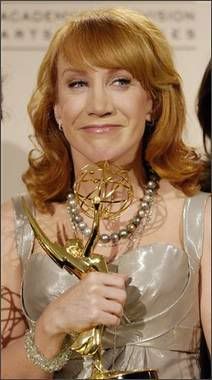
Kathy Griffin Silenced |
Kathy Griffin's Emmy Remarks to Be Censored
The AP reports:
Before Kathy Griffin won a creative arts Emmy last weekend for her reality show, 'My Life on the D-List,' she joked that an award would move her to the C-list. She was right: 'C' as in censored. The TV academy said her raucous acceptance speech will be edited when the event, which was taped, is shown Saturday on the E! channel.
The main prime-time Emmy Awards air the next night on Fox.
'Kathy Griffin's offensive remarks will not be part of the E! telecast on Saturday night,' the Academy of Television Arts & Sciences said in a statement Monday.
In her speech, Griffin said that 'a lot of people come up here and thank Jesus for this award. I want you to know that no one had less to do with this award than Jesus.'
She went on to hold up her Emmy, make an off-color remark about Christ and proclaim, 'This award is my god now!'
The comedian's remarks were condemned Monday by Catholic League President Bill Donohue, who called them a 'vulgar, in-your-face brand of hate speech.'
According to the TV academy and E!, when the four hour-plus ceremony is edited into a two-hour program, Griffin's remarks will be shown in 'an abbreviated version' in which some language may be bleeped.
The program was in production and unfinished, an E! spokeswoman said Monday.
Requests for comment were left Monday evening by phone and e-mail with Griffin's publicist. They were not immediately returned.
The Catholic League, an anti-defamation group, called on the TV academy to 'denounce Griffin's obscene and blasphemous comment' at Sunday's ceremony.
The academy said Monday it had no plans to address the issue in the prime-time broadcast.
The organization may have another delicate issue to consider, this one involving an off-color fake music video that aired last December on 'Saturday Night Live' and won a creative arts Emmy for best song.
Andy Samberg of 'SNL' said Saturday that he had yet to be asked by the TV academy to perform the tune with Timberlake on the Fox broadcast, but he was willing.
Timberlake, on a concert tour, is scheduled to be in Los Angeles next weekend.
The subject of their '(Blank) in a Box' video: wrapping a certain part of the male anatomy and presenting it to a loved one as a holiday present.
The academy has said that 'show elements are in the process of being worked out.'
Monday, June 25, 2007
| [+/-] |
U.S. Supreme Court Votes Against Banner - Shows Divide on Speech in Schools |
The New York Times reports:
The Alaska high school student who unfurled a 14-foot banner with the odd message “Bong Hits 4 Jesus” insisted that it was a banner about nothing, a prank designed to get him and his friends on television as the Olympic torch parade went through Juneau en route to the 2002 Winter Games in Salt Lake City.
The school’s principal insisted, to the contrary, that the banner advocated, or at least celebrated, illegal drug use, and that the student, Joseph Frederick, should be punished for displaying it. She suspended him for 10 days.
On Monday, by a narrow margin, the Supreme Court backed the principal in a decision that showed the court deeply split over what weight to give to free speech in public schools.
Six justices voted to overturn a federal appeals court’s ruling that left the principal, Deborah Morse, liable for damages for violating Mr. Frederick’s First Amendment rights.
Chief Justice John G. Roberts Jr. spoke, at least nominally, for five of the six. He said for the court that Ms. Morse’s reaction to the banner, which was displayed off school property but at a school-sponsored event, was a reasonable one that did not violate the Constitution.
While the banner might have been nothing but “gibberish,” the chief justice said, it was reasonable for the principal, who “had to decide to act — or not act — on the spot,” to decide both that it promoted illegal drug use and that “failing to act would send a powerful message to the students in her charge, including Frederick, about how serious the school was about the dangers of illegal drug use.”
He added, “The First Amendment does not require schools to tolerate at school events student expression that contributes to those dangers.”
Four other justices, Antonin Scalia, Anthony Kennedy, Clarence Thomas and Samuel A. Alito Jr., signed the chief justice’s opinion, although Justice Thomas took a much different approach. He said that Mr. Frederick had no First Amendment rights to violate.
“In light of the history of American public education,” Justice Thomas said, “it cannot seriously be suggested that the First Amendment ‘freedom of speech’ encompasses a student’s right to speak in public schools.” The court’s precedents had become incoherent, he said, adding, “I am afraid that our jurisprudence now says that students have a right to speak in school except when they don’t.”
The sixth justice, Stephen G. Breyer, did not sign the chief justice’s opinion, but wrote separately to say that the First Amendment issue was sufficiently cloudy that the court should have avoided deciding it. Instead, he said, the court should have ruled in the principal’s favor on the alternative ground that she was entitled to immunity from the student’s lawsuit.
Under the court’s doctrine of “qualified immunity,” government officials may not be sued for damages unless they have violated “clearly established” rights “of which a reasonable person would have known.”
There were additional shades of opinion within the chief justice’s majority. Justice Alito, joined by Justice Kennedy, wrote separately to emphasize what they said was the narrowness of the court’s holding. They said the decision should be understood as limited to speech advocating drug use, and noted that the court had not endorsed the much broader argument, put forward by the Bush administration, that school officials could censor speech that interfered with a school’s “educational mission.”
The breadth of that argument had alarmed religious conservatives, on the ground that school officials would get a license to enforce political correctness. Justice Alito, who had expressed a similar concern as an appeals court judge, said that the “educational mission” argument “strikes at the very heart of the First Amendment” by allowing school officials to “suppress speech on political and social issues based on disagreement with the viewpoint expressed.”
Writing for the four dissenters, Justice John Paul Stevens said that even limited to drugs, the majority opinion distorted the First Amendment by “inventing out of whole cloth a special First Amendment rule permitting the censorship of any student speech that mentions drugs” in a way that someone might perceive as containing a “latent pro-drug message.”
Justice Stevens said that “carving out pro-drug speech for uniquely harsh treatment finds no support in our case law and is inimical to the values protected by the First Amendment.”
Noting that alcohol also posed a danger to teenagers, Justice Stevens wondered whether “the court would support punishing Frederick for flying a ‘Wine Sips 4 Jesus’ banner,” which he said might be seen as pro-religion as well as pro-alcohol.
The dissenters, who also included Justices David H. Souter, Ruth Bader Ginsburg and Breyer, agreed with the majority that the principal should not be held personally liable for monetary damages. The case was Morse v. Frederick, No. 06-278.

Thursday, June 14, 2007
| [+/-] |
Fear vs. Free Speech at Work |
In his new book, Vanderbilt B-school professor Bruce Barry explores the sometimes threatened status of free speech in the workplace
From BusinessWeek:
Do you feel as if your boss controls what you say and do even after hours? If so, you're not alone. After noticing more and more examples of people getting fired or being shunned for their political affiliation, activism, or speech, Bruce Barry, a professor of management and sociology at the Owen Graduate School of Management at Vanderbilt University, set out to research free speech in the workplace. What he discovered, he says, is that employers have much more power over our personal lives than ever before.
The culmination of his research is the recently published Speechless: The Erosion of Free Expression in the American Workplace (Berrett-Koehler Publishers, June, 2007). In it, Barry demonstrates the problem through examples—including a woman in Alabama who lost her job for having a John Kerry bumper sticker on her car—and offers viable solutions. But if you're looking for conspiracy theories, don't look to Barry's work. He admits that there's no rampant movement by managers to censor everyone or fire every person who keeps a blog. But he is concerned when free speech is stifled.
"What I'm concerned about is that when someone does get fired for his blog, and it becomes widely known, it puts a chill on everybody else," says Barry. "It sends a clear message: Watch what you say. Your employer is paying attention to your speech, even in some cases when it doesn't have very much at all to do with your job."
Barry recently discussed the erosion of free speech with BusinessWeek reporter Francesca Di Meglio. Here are edited excerpts of their conversation:
What surprised you most about the research you did?
A lot of the research I did was legal research trying to answer the questions, "Is there free speech in the American workplace? For whom? To what extent?" The knee-jerk answer is, "Not really, because constitutional rights in this country don't really apply on private property or in the private sector." One of the surprises was to actually find out there are some rights to free expression in the workplace, even in the private sector.
[The issue] is complicated. It depends, in part, on where you live because some of this is governed by employment law, which varies widely from state to state. It depends, in part, on what kind of speech we're talking about because there are some laws that cover certain kinds of activity, like political activity, but not others. Those laws also vary from state to state. The other alarming thing I found was that, even with all those complications and exceptions, employers have nearly total control over the expressive activities of employees in this country both on and off the job.
You write that the erosion of free speech has gotten worse in the last 30 years. Why do you think that's happening as we're modernizing and, one would hope, becoming more transparent and tolerant?
You can look at it from both sides—the perspective of the employer and employee. From the standpoint of employees, work has changed over the last 30 years. There's less job security, more global trade, more people relying on multiple employment opportunities to form a professional career.
All of this makes for less job security and more concern about getting in trouble with one's employer. I think people self-censor more because of the changing nature of employment. Something else that has gone on in the last 20 or 30 years is increased attention by employers to their image and stewardship of their brand and reputation. This makes them increasingly cautious about employee expression that might depart from the preferred corporate point of view or somehow reflect negatively on the brand, image, or firm (see BusinessWeek.com, 6/15/04, "Free Speech and the Factory Floor").
I spend a good part of the book talking about technology—e-mail, blogs, the Web, all of this. Employee speech is the same we've always had—kvetching about the boss or one's co-workers. What is new is that technology gives people opportunities to engage in that age-old speech in new ways that reach a lot more people and can be found by employers. The problem is that the same tools that give employees new ways to express themselves also give employers new tools to police that speech.
Do you think fear is driving employers? If so, what are they afraid of?
I don't think there's some sort of active conspiracy to shut down speech. A combination of law, conventional wisdom, and habitual management practice creates this climate. We know that the law gives employers in the U.S. a great deal of latitude, especially in the private sector, to do what they will with employees—fire them for good reasons, bad reasons, no reasons—in the absence of an employment contract. There is an impulse on the part of managers to shut down speech that even remotely might threaten corporate interests. I grant that it's their legal right under our system. But I think it's ill advised and bad for employees and society.
Work is where people live out major parts of their lives. It's where they construct their civic selves. It's where they make ties with other people. It's where they sometimes express opinions—political, civic, otherwise. If you shut down people's lives as citizens during the workday, or create a climate where even after work they have to worry that their employer might object to their activism, you create situations where people choose not to actively engage as citizens. This really harms the health of a democracy, and that's a bad thing.
How bad is the problem really? Is there hope?
I'm not going to argue that it's the paramount problem facing workers in a country where people are worried about employment security, stagnant wages, health-care issues and costs, and retirement. It's easy to say that this is not the biggie. On the other hand, if people don't feel free to talk about the issues that are the biggies, then it's all interrelated.
One thing that is also changing in the world—maybe it's always been the case—is the intersection between work and public policy. People's opinions on these things matter. If people feel as though they are risking their jobs by being active in some of these issues, then I think that is a very serious problem. It's not hard to convince people that there's declining civic participation in this country. Workplaces are part of the problem, rather than the solution, to civil engagement.
I spend a lot of time in the book saying, "What we can do about this?" I offer some remedies in two categories. One is legal. We could make big changes to constitutional law that change how the Bill of Rights and free speech apply on private property. That's not going to happen, but we could do it. I want to make some suggestions—smaller, more practical ones—about employment law. It varies from state to state. States that don't do it so well could pass laws that mimic the states that do it better. The better practices could spread. That would grant workers more protection, and that's not outlandish by any means. I think we even see some of that happening.
The other big suggestion I make has to do with employers. We hear about cases because they make the news or land in court. But nobody calls a lawyer or reporter until some manager makes an unfortunate decision. The real point of leverage is with these managers and employers and how they see the role of employee expression. What I urge in the book is a change in mindset.
Employers should not be so quick to assume that expressive activity is a threat to the business. They should understand that they don't just live in a nine-to-five world where people can do all of their speech and free expression on nights and weekends on their own time. Work and life are interconnected. Employers are just as much stewards of civil society as any other big institution. If employers would see themselves more as participants in that civil society—rather than as an institution apart from it—maybe they would be a little more tolerant and less impulsive at shutting down speech.
What message would you send to business students?
Someone once said, "We live in a society, not just purely an economy." Business schools have this unfortunate tendency, my own included, to go too far in conditioning students to think that market principles of economic behavior are the overarching, ruling principles of life that should guide all decision making.
I would urge business students to think more broadly than that, to understand that they don't cease to be citizens of a deliberative democracy when they enter the corporate workplace door. Society benefits when employers understand that the people who come to work for them may be selling their labor but not necessarily their civic selves or consciences, and they shouldn't be asked to do so.
Monday, April 16, 2007
| [+/-] |
Can Bush Prevent Non-Disruptive Dissenters From Taxpayer-funded Events Without Violating Their Rights? |
The AP reports:
White House officials can exclude dissenters from taxpayer-funded appearances by President Bush without violating the protesters' rights, according to lawyers for volunteers who helped eject three people from a hall where Bush was to speak.
Attorneys for Michael Casper and Jay Bob Klinkerman said the government has the same rights as a private corporation when its officials speak.
"The president may constitutionally make viewpoint-based exclusionary determinations in conveying his own message," the attorneys said in a filing last week. "So in following the instructions of the White House and carrying out its viewpoint-based exclusions, Casper and Klinkerman did not violate any of plaintiffs' constitutional rights."
Plaintiffs Leslie Weise and Alex Young were among the three told to leave just before Bush was to talk about his plans for Social Security at the March 21, 2005, event in Denver.
Weise and Young argue they were ejected for their political views. They had arrived in a car bearing a "No blood for oil" bumper sticker. They were also wearing T-shirts saying "Stop the lies" under their clothes but did not show them.
They have said they had no plans to disrupt the event, but Young hoped to ask Bush a question if given the opportunity.
The defense filing points to a ruling by another federal appeals court in a 1992 case in which an Ohio woman displaying a pro-Bill Clinton button was barred from a campaign rally for the first President Bush. The appeals court said rally organizers had a right to control their message, and the Supreme Court later refused to revive the lawsuit.
Martha Tierney, an attorney for the Colorado plaintiffs, said Monday the Ohio case does not apply to her clients' case because the event at the center of the 1992 case was funded by a private organization, the Strongsville, Ohio, Republican Party.
"A private organization is entitled to limit the kinds of speech that the public can have if it comes to attend its event," Tierney said. "But the government is under a different standard and can't limit speech just based on viewpoint at a public, taxpayer-funded event."
The 10th U.S. Circuit Court of Appeals, where the latest motion was filed, is weighing the volunteers' argument that they are protected from lawsuits by governmental immunity. A lower court rejected that argument.
Last month, Weise and Young filed a separate lawsuit against three White House officials, accusing them of creating an unconstitutional policy to limit dissent at the president's appearances.
White House officials do not comment on pending litigation, spokesman Blair Jones said Monday.
Monday, September 18, 2006
| [+/-] |
The "Bong Hits 4 Jesus" Student Speech Case: With Kenneth Starr Seeking High Court Review Of The Ninth Circuit Decision, Is Someone Blowing Smoke? |
Findlaw columnist Julie Hilden writes:
Last Monday, September 11, former Independent Counsel Kenneth Starr - now a lawyer at Kirkland & Ellis -- asked the Supreme Court to review a March 10 decision by the U.S. Court of Appeals for the Ninth Circuit, in the case of Frederick v. Morse. The decision upheld a public high school student's First Amendment right to display a banner off campus. Starr represents the school district on a pro bono basis.
In a two-part series of columns, I'll explain why I believe the Ninth Circuit was right to rule as it did. I'll also put the decision in the context of two other controversial decisions the Ninth Circuit has issued this year regarding public school students' speech.
The Facts of the Frederick Case
The Frederick case grew out of an incident in which Juneau, Alaska high school senior Joseph Frederick unfurled a banner reading "Bong Hits 4 Jesus" on a public sidewalk. He did so during a privately-sponsored rally where townspeople watched the Olympic torch pass by. Students were released from school to attend the rally. The high school's "pep band" and cheerleaders performed there, but the court found that teacher supervision of other students at the rally was "minimal or nonexistent."
Frederick and his friends made sure they unfurled their banner when TV cameras were passing by - but the school's Principal, Deborah Morse, who was also attending the rally, went up to Frederick, grabbed the banner, crumpled it up, and suspended him for ten days.
Frederick later sued, invoking the federal civil rights statute that allows plaintiffs to seek money damages for government infringements of their constitutional rights, including First Amendment rights.
In my view, the principal's conduct was appalling. She didn't just tell Frederick to put his sign away, or that it was inappropriate, nor did she warn him that he could be suspended. Rather, she actually went right up to him on a public street and destroyed his banner.
This is the kind of thing that we believe cannot happen in this country. Is it suddenly acceptable simply because the victim is eighteen? What happened to school officials' duty to try to convince students - first, by setting the right example -- to solve their differences with reason, not violence? Ironically, if Frederick had ripped up another student's poster on school grounds, he surely would have been suspended for doing so.
In short, the example this principal is setting is a very ugly one. No wonder the Ninth Circuit held - on the separate question of the principal's claim to immunity under the federal civil rights statute - that "it would be clear to a reasonable [principal] that [her] conduct was unlawful in the situation [she] confronted." (As a result, the principal herself may face liability for damages; she is a co-defendant in the case, along with the school board.)
How could this kind of behavior strike Starr, or Kirkland & Ellis, as so worthy of protecting, that it was worth taking this case on for the school district as a pro bono project?
The Legal Standards for Public School Students' Speech
There are three Supreme Court cases setting forth standards for public school students' speech -- which were considered by the Ninth Circuit - but only one is relevant here.
One of the cases, Hazelwood School Dist. v. Kuhlmeier - addressing school-sponsored speech -- doesn't apply because neither Frederick's banner (nor the rally itself) was school-sponsored in the sense that, for instance, a school-funded student newspaper is.
A second case, Bethel School Dist. No. 3 v. Fraser - which was relied on by the district court, but distinguished by the Ninth Circuit -- doesn't apply because it addresses only vulgar, lewd, obscene, and otherwise "plainly offensive" speech, and because the Ninth Circuit has interpreted that to mean, in essence, obscenity or, at least, speech involving four-letter words or similarly profane language.
Finally, there is Tinker v. Des Moines Independent Community School Dist.. Its rule is simple: Student speech -- other than speech that falls under the precedents noted above - can only be punished or otherwise regulated if it "materially disrupts classwork or involves substantial disorder or invasion of the rights of others." Moreover, to support the punishment or regulation, school districts must cite "evidence that [the punishment] is necessary to avoid material or substantial interference with schoolwork or discipline."
Applying the Legal Standard in the Frederick Case
The Juneau School District had an exceptionally weak case under Tinker.
In support of its case that Frederick's banner was disruptive, the District claimed that the banner would be read by many at the rally as "advocating or condoning illegal drug use."
Similarly, School Superintendent Peggy Cowan recently told CNN that this case is appropriate for Supreme Court review because it raises "an important question about how the First Amendment applies to pro-drug messages in an educational setting."
But even if this was, to some extent, a pro-drug message, that wasn't all it was. The district itself acknowledged that Frederick could have been not just responding to, but parodying the school's anti-drug message (and parody is strongly protected by the First Amendment). Moreover the "for Jesus" part shouldn't be left out of the analysis; juxtaposing "Bong Hits," the informal "4" for "for," and "Jesus" may also send a message that religion shouldn't be taken so seriously, and a message that Jesus was more laid-back, and would have been more sympathetic to the counterculture, than some authoritarians would admit.
I'm not, of course, claiming that this message was well-thought out. To the contrary, it reads like a spur-of-the-moment lark, a prank. But I do think that it meant something different and more complicated, than just, say, a "Smoke Pot" banner would have. (Frederick himself said the banner was intended to be meaningless and funny, and he just wanted to get it on television. However, as many First Amendment cases have shown, words often have an impact beyond their intended meaning.)
The District also claimed that if the principal had done nothing, the district would have been seen by many as giving its imprimatur to Frederick's pro-drug message. But that claim seems ridiculous: If the District was as avid about spreading its anti-drug message as it claims that it was, no one would believe that it had suddenly changed its policy by merely deciding not to rip up Frederick's poster. If anything, onlookers might believe the District tolerated Frederick's poster out of a healthy respect for the First Amendment, or that the school district simply wasn't worried about its own message being undermined by a poorly-thought-out sophomoric sign.
Why the Ninth Circuit Is Right, and Starr Is Wrong, In This Case
Because this case is such a clear First Amendment violation, and because the Ninth Circuit rightly sided with the student, there's no good reason here for Supreme Court review.
In explaining why review was sought, Eric Hagen, an attorney from Starr's office who also worked on the Supreme Court petition, told a reporter, "It makes it a little harder when teachers and principals in their daily duties might be subject to a damages lawsuit and be held personally liable." But it's only harder for teachers and principals to perform their daily duties when the lines for liability are unclear.
As noted above, there are few First Amendment violations clearer than a government employee's crumpling up someone's banner at a privately-sponsored rally on a public street. That's censorship with a capital "C." If the Supreme Court does want to make the line between permissible disciplinary action and impermissible First Amendment violation clearer, perhaps it should wait for a subtler, closer case.
Ironically, I think most schoolchildren, if taught a bit about the First Amendment, could easily identify this as an obvious violation. Their teachers and principals ought at least to be able to do the same.
Wednesday, December 7, 2005
| [+/-] |
Secret ID Law to Get Hearing |
Wired reports:
Although John Gilmore lives just five blocks from San Francisco's Department of Motor Vehicles, his driver's license is expired. On purpose.
The outspoken, techno-hippie, wealthy civil libertarian doesn't want to give his Social Security number to the DMV.
Neither will he show his driver's license at airports, or submit to routine security searches. This refusal to obey the rules led him to file suit against the Bush administration (Gilmore v. Gonzales) after being rebuffed at two different airports on July 4, 2002, when he tried to fly without showing identification. One airline offered to let Gilmore fly without showing ID, but only if he underwent more intensive security screening, which he declined.
On Thursday, Gilmore and his lawyers will get 20 minutes in front of the 9th U.S. Circuit Court of Appeals to make their argument against identification requirements and government secrecy, in a case that time and shifting public opinion has transformed from a quirky millionaire's indignant protest into a closely watched test of the limitations of executive branch power.
"The nexus of the case has always been the right to travel," Gilmore said. "Can the government prevent Americans from moving around in their own country by slapping any silly rules on them -- you have to show ID, you have to submit to searches, you have to wear a yarmulke?"
Gilmore has sunk thousands of dollars into fighting identification requirements, but he also personally committed to not traveling in the United States if he has to show identification.
So Gilmore has not taken a train, an intercity bus or a domestic flight since July 4, 2002. He still flies internationally.
Gilmore describes himself as being under "regional arrest," and said he would love to drive and fly again.
"I'm a millionaire," Gilmore said. "I can do whatever the fuck I want, right? Why should I run around without an ID? Because no one else was paying attention to that and letting our liberties slip down the drain. I figured it was worth some amount of money and some amount of personal sacrifice to keep a free society."
Gilmore has long been a prominent figure in the privacy and civil liberties communities -- he co-founded the Electronic Frontier Foundation. But many civil liberties advocates begged Gilmore not to file suit in 2002 because they were certain he would lose and set bad case law, according to Gilmore's lawyer, Jim Harrison.
Things might be different in late 2005.
"The same people that were telling John that you really should not do this while the country is inflamed are the same ones that filed friend-of-the-court briefs to the 9th Circuit," Harrison said.
Gilmore also thinks the mood of the country has changed. "It is now considered patriotic to criticize the president," Gilmore said.
While civil liberties groups now publicly back Gilmore's challenge to government secrecy, many privacy advocates still privately grumble that Gilmore's case is not the best vehicle for challenging identification requirements.
On Thursday, Gilmore will argue that the government's secret identification rules -- no federal law compels travelers to show ID -- and no-fly list infringe on his First Amendment rights, but don't make the country safer.
In addition, government lawyers long denied the existence of the rule -- which predates the Sept. 11 terrorist attacks -- even though there are signs in airports cautioning passengers that they are required to show identification.
The government recently switched tactics, acknowledging the rule exists but arguing that the identification requirement is a law-enforcement technique.
So far, the government has refused to show Gilmore the order compelling airlines to ask for identification, saying that the rule is "sensitive security information," a security designation that was greatly expanded by Congress in 2002, allowing the Transportation Security Administration wide latitude to withhold information from the public.
Gilmore argues that secrecy and the power of the "sensitive security information," or SSI, designation is to blame for the repeated privacy scandals at the TSA.
"TSA and DHS in general have set themselves up to be insulated from criticism, to have their inner workings be invisible, because they can pull this magic SSI shield over anything they do," Gilmore said. "And what you see are the natural consequences of that kind of secrecy, which is that incompetence is never detected and corrected."
Sunday, October 31, 2004
| [+/-] |
Behind Closed Doors |
Who is The Council For National Policy and What Are They Up To? And Why Don't They Want You To Know?
At Americans United, Jeremy Leaming and Rob Boston write:
When a top U.S. senator receives a major award from a national advocacy organization, it’s standard procedure for both the politician and the group to eagerly tell as many people about it as possible.
Press releases spew from fax machines and e-mails clog reporters’ in-boxes. The news media are summoned in the hope that favorable stories will appear in the newspapers, on radio and on television.
It was odd, therefore, that when U.S. Senate Majority Leader Bill Frist (R-Tenn.) accepted a “Thomas Jefferson Award” from a national group at the Plaza Hotel in New York City in August, the media weren’t notified. In fact, they weren’t welcome to attend.
“The media should not know when or where we meet or who takes part in our programs, before or after a meeting,” reads one of the cardinal rules of the organization that honored Frist.
The membership list of this group is “strictly confidential.” Guests can attend only with the unanimous approval of the organization’s executive committee. The group’s leadership is so secretive that members are told not to refer to it by name in e-mail messages. Anyone who breaks the rules can be tossed out.
What is this group, and why is it so determined to avoid the public spotlight?
That answer is the Council for National Policy (CNP). And if the name isn’t familiar to you, don’t be surprised. That’s just what the Council wants.
The CNP was founded in 1981 as an umbrella organization of right-wing leaders who would gather regularly to plot strategy, share ideas and fund causes and candidates to advance the far-right agenda. Twenty-three years later, it is still secretly pursuing those goals with amazing success.
Since its founding, the tax-exempt organization has been meeting three times a year. Members have come and gone, but all share something in common: They are powerful figures, drawn from both the Religious Right and the anti-government, anti-tax wing of the ultra-conservative movement.
It may sound like a far-left conspiracy theory, but the CNP is all too real and, its critics would argue, all too influential.
What amazes most CNP opponents is the group’s ability to avoid widespread public scrutiny. Despite nearly a quarter century of existence and involvement by wealthy and influential political figures, the CNP remains unknown to most Americans. Operating out of a non-descript office building in the Washing ton, D.C., suburb of Fairfax, Va., the organization has managed to keep an extremely low profile an amazing feat when one considers the people the CNP courts.
New York Times reporter David Kirkpatrick was finally able to pierce the CNP veil in August when he attended a gathering of the group in New York City just before the Republican convention, where the organization presented Frist with the “Jefferson Award.”
The Times described the CNP as consisting of “a few hundred of the most powerful conservatives in the country” who meet “behind closed doors at undisclosed locations…to strategize about how to turn the country to the right.”
Accepting the award, Frist acknowledged the group’s power, telling attendees, “The destiny of the nation is on the shoulders of the conservative movement.”
The CNP meeting was perhaps more important than what took place on the carefully choreographed GOP convention stage a few days later, said Barry W. Lynn, executive director of Americans United for Separation of Church and State.
“The real crux of this is that these are the genuine leaders of the Republican Party, but they certainly aren’t going to be visible on television next week,” Lynn told The Times days before the start of the GOP convention. “The CNP members are not going to be visible next week, but they are very much on the minds of George W. Bush and Karl Rove every week of the year, because these are the real powers in the party.”
The Times’ Kirkpatrick was able to obtain the CNP’s current membership list and reported that its roster includes Focus on the Family founder James C. Dobson, Paul Weyrich of the Free Congress Foundation, Wayne LaPierre of the National Rifle Association and Grover Norquist, head of Americans for Tax Reform. A CNP financial disclosure form for 2002 lists Norquist and Howard Phillips, founder of the ultra-conservative Constitution Party, as directors. The current president of the group is Donald P. Hodel, former executive director of the Christian Coalition.
Other CNP directors include names that would not mean a lot to most people, but they are key players in the right-wing universe. Becky Norton Dunlop is vice president for external relations at the Heritage Foundation. James C. Miller III is former director of Citizens for a Sound Economy. Stuart W. Epperson owns a chain of Christian radio stations. E. Peb Jackson is former president of Young Life. T. Kenneth Cribb Jr., vice president of the CNP, was a domestic policy advisor to President Ronald W. Reagan and runs the Intercollegiate Studies Institute, a group that funds right-wing newspapers on college campuses. Ken Raasch is a businessman who works in partnership with popular artist Thomas Kinkade.
Others who have been affiliated with the CNP include TV preachers Jerry Falwell and Pat Robertson, longtime anti-feminist crusader Phyllis Schlafly, Iran-Contra figure turned right-wing talk radio host Oliver North, former U.S. Sen. Jesse Helms (R-N.C.), wealthy Cali fornia savings and loan heir Howard Ahmanson, former House Majority Leader Dick Army (R-Texas), Attorney General John Ashcroft and Tommy Thompson, secretary of the U.S. Depart ment of Health and Human Services.
Republican Party glitterati and top government officials frequently appear at CNP meetings. During the gathering before this year’s GOP convention, The New York Times reported that several Bush administration representatives were scheduled for speeches. Under secretary of State John Bolton spoke about plans for Iran, Assistant Attorney General Alexander Acosta talked about human trafficking and Dan Senor, who worked for Paul Bremer in Iraq, was scheduled to talk about the war there.
The Times said the CNP meeting was focused on the Bush-Cheney re-election efforts and quoted an anonymous participant who called the gathering a “pep rally” for the president’s campaign. Passing a federal marriage amendment and using that subject as a wedge issue was also a top priority.
The newspaper noted that another CNP meeting that took place shortly after the American invasion of Iraq included visits from Vice President Dick Cheney and Defense Secretary Donald Rumsfeld. A Canadian newspaper reported that Rumsfeld provided the gathering’s keynote address and that Cheney was scheduled to speak. (See “People & Events,” June 2003 Church & State.)
In April of 2002, according to an ABC News story that ran online, Supreme Court Justice Clarence Thomas was the keynote speaker at a CNP meeting in a northern Virginia suburb of Washington, D.C., where White House counsel Alberto Gonzales and Timothy Goeglein, a White House liaison to religious communities, also spoke.
Heavy-hitters such as these show that the CNP is a force to be reckoned with, and Republican politicians ignore the group at their peril. In 1999, GOP presidential candidate George W. Bush appeared before a CNP gathering in San Antonio, and, in a closed-door meeting, assured the members of his right-wing bona fides. Bush critics demanded that the president release the text of his remarks, but he refused. Nonetheless, rumors soon surfaced that Bush promised the CNP to implement its agenda and vowed to appoint only anti-abortion judges to the federal courts.
How did this influential organization get its start? To find the answer, it’s necessary to go all the way back to 1981 and the early years of the Reagan presidency.
Excited by Reagan’s election, Tim LaHaye, Richard Viguerie, Weyrich and a number of far-right conservatives began meeting to discuss ways to maximize the power of the ultra-conservative movement and create an alternative to the more centrist Council on Foreign Relations. In mid May, about 50 of them met at the McLean, Va., home of Viguerie, owner of a conservative fund-raising company.
Viguerie had a knack for networking. Shortly before helping launch the CNP, Viguerie and Weyrich initiated the Moral Majority and tapped Falwell to run it, making the obscure Lynchburg pastor a major political figure overnight. Viguerie’s goal was to lead rural White voters in the South out of the Democratic Party and into the Republican Party by emphasizing divisive social issues such as abortion, gay rights and school prayer.
Back when the CNP was founded, it was a little less media shy. In the summer of 1981, Woody Jenkins, a former Louisiana state lawmaker who served as the group’s first executive director, told Newsweek bluntly, “One day before the end of this century, the Council will be so influential that no president, regardless of party or philosophy, will be able to ignore us or our concerns or shut us out of the highest levels of government.”
From the beginning, the CNP sought to merge two strains of far-right thought: the theocratic Religious Right with the low-tax, anti-government wing of the GOP. The theory was that the Religious Right would provide the grassroots activism and the muscle. The other faction would put up the money.
The CNP has always reflected this two-barreled approach. The group’s first president was LaHaye, then president of Family Life Seminars in El Cajon Calif. LaHaye, a fundamentalist Baptist preacher who went on in the 1990s to launch the popular “Left Behind” series of apocalyptic potboilers, was an early anti-gay crusader and frequent basher of public education and he still is today.
Alongside figures like LaHaye and leaders of the anti-abortion movement, the nascent CNP also included Joseph Coors, the wealthy beer magnate; Herbert and Nelson Bunker Hunt, two billionaire investors and energy company executives known for their advocacy of right-wing causes, and William Cies, another wealthy businessman.
Interestingly, the Hunts, Cies and LaHaye all were affiliated with the John Birch Society, the conspiracy-obsessed anti-communist group founded in 1959. LaHaye had lectured and conducted training seminars frequently for the Society during the 1960s and ’70s a time when the group was known for its campaign against the civil rights movement.
Bringing together the two strains of the far right gave the CNP enormous leverage. The group, for example, could pick a candidate for public office and ply him or her with individual donations and PAC money from its well-endowed, business wing.
The goals of the CNP, then, are similarly two-pronged. Activists like Nor quist, who once said he wanted to shrink the federal government to a size where it could be drowned in a bathtub, are drawn to the group for its exaltation of unfettered capitalism, hostility toward social-service spending and low (or no) tax ideology.
Dramatically scaling back the size of the federal government and abolishing the last remnants of the New Deal may be one goal of the CNP, but many of the foot soldiers of the Religious Right sign on for a different crusade: a desire to remake America in a Christian fundamentalist image.
Since 1981, CNP members have worked assiduously to pack government bodies with ultra-conservative lawmakers who agree that the nation needs a major shift to the right economically and socially. They rail against popular culture and progressive lawmakers, calling them the culprits of the nation’s moral decay. Laws must be passed and enforced, the group argues, that will bring organized prayer back to the public schools, outlaw abortion, prevent gays from achieving full civil rights and fund private religious schools with tax funds.
The CNP does not directly fund these activities itself. In fact, a glance at the group’s publicly available financial statements reveals a modest budget. In 2002, the CNP operated with income of just over $1.2 million. The national office has just a handful of staff members.
(In no way a grassroots organization, the CNP gets much of its money from far-right foundations. The Coors family and Richard DeVos, founder of Amway, have been among the CNP’s largest financial backers. The group received $125,000 from a Coors family philanthropic arm, the Castle Rock Foun dation, and the Richard and Helen DeVos Foundation. Richard DeVos was also one of the CNP’s early presidents and Jeffrey and Holly Coors have been members for many years.)
The CNP’s budgetary figures don’t tell the whole story, however. Financial data shows that the bulk of its money $815,227 in 2002 is spent on “educational conferences and seminars for national leaders in the fields of business, government, religion and academia to explore national policy alternatives.” An additional $69,108 was spent on “weekly newsletters…distributed to all members to keep them apprised of member activities and public policy issues.”
In other words, the CNP is merely a facilitator. While the group has an affiliated arm CNP Action that does some lobbying, in the main it does not work directly to implement the schemes its members devise during the three yearly meetings. The well-heeled leaders and their affiliated organizations are expected to come up with their own funds to pay for the plots hatched during the meetings.
Despite the group’s obsessive desire for secrecy, some information has leaked out over the years, mainly due to the persistent efforts of a few writers and researchers.
In 1988, writer Russ Bellant noted in his book The Coors Connection, which details the beer dynasty’s funding of right-wing causes and groups, that many CNP members have been associated with the outer reaches of the conservative movement. Bellant found that among the far right, there is a certain cachet to being a CNP member. Members pay thousands of dollars yearly to keep their CNP membership. Bellant noted that at the time, individuals paid $2,000 per year for membership and those seeking a spot on the CNP’s board of directors shelled out $5,000 each.
Research undertaken by a now-defunct watchdog group, the Institute for First Amend ment Studies (IFAS), shed some more light on the group’s activities. For many years running, IFAS founder Skip Porteous was able to obtain CNP membership lists, which he posted online.
Bellant noted that Tom Ellis, a top political operative of the ultra-conservative Jesse Helms, followed LaHaye as the CNP president in 1982. Ellis had a checkered past, having served as a director of a foundation called the Pioneer Fund, which has a long history of subsidizing efforts to prove blacks are genetically inferior to whites.
Bellant’s book, as well as work by the IFAS, reveals other CNP members who have flirted with extremist and hateful propaganda.
In addition to obsessing over communist threats and buttressing white supremacist ideology, the CNP has included many members bent on replacing American democracy with theocracy.
LaHaye, like the whole of the nation’s Religious Right leaders, nurtures a strong contempt for the First Amendment principle of church-state separation, because it seriously complicates their goal of installing fundamentalist Christianity as the nation’s officially recognized religion. LaHaye has worked within the CNP and other groups to replace American law with “biblical law.” (See “Left Behind,” February 2002 Church & State.)
Former Christian Coalition head Ralph Reed has also been involved with the CNP and addressed the group during the August GOP meeting in New York. Asked about his relationship with the CNP by CNN’s Wolf Blitzer Aug. 29, Reed fell back on the common ploy of asserting that the group is just a ramped-up social club.
“I think it’s like-minded individuals who believe in conservative public policy views. And they get together a few times a year,” said Reed (whose CNP topic was “The 2004 Elections: Who Will Win in November?”).
Reed, now a top official of the Bush-Cheney campaign, said he is no longer a CNP member, asserting that he quit because “I was just busy doing other things.”
The CNP goes way beyond LaHaye and Reed in its effort to embrace the Religious Right. For many years, the late leader of the Christian Recon struc tionist movement, Rousas J. Rushdoony, was a member. Reconstructionists espouse a radical theology that calls for trashing the U.S. Constitution and replacing it with the harsh legal code of the Old Testament. They advocate the death penalty for adulterers, blasphemers, incorrigible teen agers, gay people, “witches” and those who worship “false gods.”
Another CNP-Reconstruc tionist tie comes through Howard Phillips, the Con stitution Party leader. Phillips, a longtime CNP member, is a disciple of Rushdoony and uses rhetoric that strikes a distinctly Reconstructionist tone. In a 2003 Constitution Party gathering in Clackamas, Oregon, Phillips told party members and guests, “We’ve got to be ready when God chooses to let us restore our once-great Republic.” A report by the Southern Poverty Law Center said that Phillips proclaimed that his party was “raising up an army” to “take back this nation!”
The CNP has provided more prominent Religious Right figures, such as Dob son, with a forum to promote church-state merger and shove the Republican Party toward the right. In 1998, Dobson ap peared before a CNP gathering where he admitted he voted for Constitution Party nominee Phillips in the 1996 presidential election instead of Republican candidate Bob Dole. Dobson threatened to bolt the Republican Party and take “as many people with me as possible” if the GOP did not stop taking Christian conservatives for granted. (Dobson’s speech, like all addresses before CNP functions, was not intended for media coverage. A transcript was published by the IFAS, which was able to gain access to the meeting. The transcript remains avail able on the Internet at www.buildingequality.us/ifas /cnp/dobson.html.)
Dobson railed against the Repub lican-controlled Congress for apparently giving short shrift to the “pro-moral community” and easily acquiescing to a “post-modern notion, that there is no moral law to the universe.” That notion, Dobson said, has spread throughout the nation like a cancer.
For Dobson, the moral law of the universe is clear and should be evident to all lawmakers. The universe “has a boss,” he said. “And He has very clear ideas of what is right and wrong.”
Dobson blasted the Republican-led Congress for increasing funding to Planned Parenthood and the National Endowment of the Arts and for espousing a “safe sex ideology” that he said includes advocacy of the use of condoms to help prevent sexually transmitted diseases.
All of this, Dobson said, directly contravenes God’s law.
“It’s a lack of conviction that there is a boss to the universe and that there are moral standards that we are held to and we need officials that will stand up and respect them,” Dobson said.
Dobson concluded his lecture by begging CNP members “shamelessly, to use your influence on the party at this critical stage of our history. You have a lot of influence on the party. A lot of you are politicians. I beg you to talk to them about what’s at stake here because they’ve laid the foundation for a revolt and I don’t think they even know it because they’re so out of touch with the people that I’m talking about.”
Dobson seemed fully aware that he was speaking to an ultra-partisan group. Indeed, the ABCNews.com report noted that some CNP members have bragged about helping “Christian conservatives” take over Republican state party operations in several Southern and Mid western states.
The CNP’s current executive director, a former California lawmaker named Steve Baldwin, has tried to downplay the organization’s influence on powerful state and national lawmakers. He has remained cagey about the CNP’s goals, insisting it is merely a group that counters liberal policy arguments.
In many ways, Baldwin himself exemplifies the CNP’s operate-in-secret strategy. As a political strategist in Cali fornia in the early 1990s, Baldwin was one of the key architects of the “stealth strategy” that led to Religious Right activists being elected to school boards and other local offices.
“Stealth candidates” were trained to emphasize pocketbook issues such as taxes and spending. But once elected, they would pursue a Religious Right agenda, such as demanding creationism in public schools. A spate of the candidates won election in Southern Cali fornia in the early 1990s, but most were later removed by the voters when the true agenda became apparent.
Baldwin tried to use the stealth strategy during his own campaign for the California Assembly in 1992. He lost that race but fared better in 1994, winning election to a seat in the 77th Assembly District. While in office, he helped lead efforts by Religious Right conservatives to take over the state GOP and, briefly, the entire Assembly.
Baldwin had to leave the Assembly in 2000 after serving six years due to California’s term-limits law. According to one California media outlet, his hard-right views had by then alienated most other members of the Assembly.
But Baldwin refused to let up. In the spring of 2002, while working at the CNP, he penned a controversial article for the law review at TV preacher Pat Robertson’s Regent University. The piece, “Child Molestation and the Homosexual Movement,” linked pedo philia to homosexuality.
The article went on to become a staple in the Religious Right’s anti-gay canon, despite the fact that its claims were challenged by legitimate researchers.
“It is difficult to convey the dark side of the homosexual culture without appearing harsh,” wrote Baldwin. “However, it is time to acknowledge that homosexual behavior threatens the foundation of Western civilization the nuclear family.”
What might the future hold for Baldwin and the CNP? Already Jenkins’ vision of a day when powerful politicians would pay heed to the group has come to pass. With social issues such as same-sex marriage increasingly dominating the Religious Right’s agenda, the organization is not likely to want for things to do.
Americans United, which has monitored the activities of the CNP for years, says the groups holds radical views and is especially dangerous because of its success in connecting Religious Right activism with the secular right’s deep financial pockets.
AU’s Lynn said he hopes the media begins to pay more attention to the CNP and expose its goals.
“If the CNP gets its way,” Lynn said, “the First Amendment, along with the rest of the U.S. Constitution, will be replaced with fundamentalist dogma. In order to ensure religious liberty for future generations of Americans, the CNP’s agenda must be derailed.”
