The NY Times reports:
Four Western oil companies are in the final stages of negotiations this month on contracts that will return them to Iraq, 36 years after losing their oil concession to nationalization as Saddam Hussein rose to power.
Exxon Mobil, Shell, Total and BP — the original partners in the Iraq Petroleum Company — along with Chevron and a number of smaller oil companies, are in talks with Iraq’s Oil Ministry for no-bid contracts to service Iraq’s largest fields, according to ministry officials, oil company officials and an American diplomat.
The deals, expected to be announced on June 30, will lay the foundation for the first commercial work for the major companies in Iraq since the American invasion, and open a new and potentially lucrative country for their operations.
The no-bid contracts are unusual for the industry, and the offers prevailed over others by more than 40 companies, including companies in Russia, China and India. The contracts, which would run for one to two years and are relatively small by industry standards, would nonetheless give the companies an advantage in bidding on future contracts in a country that many experts consider to be the best hope for a large-scale increase in oil production.
There was suspicion among many in the Arab world and among parts of the American public that the United States had gone to war in Iraq precisely to secure the oil wealth these contracts seek to extract. The Bush administration has said that the war was necessary to combat terrorism. It is not clear what role the United States played in awarding the contracts; there are still American advisers to Iraq’s Oil Ministry.
Sensitive to the appearance that they were profiting from the war and already under pressure because of record high oil prices, senior officials of two of the companies, speaking only on the condition that they not be identified, said they were helping Iraq rebuild its decrepit oil industry.
For an industry being frozen out of new ventures in the world’s dominant oil-producing countries, from Russia to Venezuela, Iraq offers a rare and prized opportunity.
While enriched by $140 per barrel oil, the oil majors are also struggling to replace their reserves as ever more of the world’s oil patch becomes off limits. Governments in countries like Bolivia and Venezuela are nationalizing their oil industries or seeking a larger share of the record profits for their national budgets. Russia and Kazakhstan have forced the major companies to renegotiate contracts.
The Iraqi government’s stated goal in inviting back the major companies is to increase oil production by half a million barrels per day by attracting modern technology and expertise to oil fields now desperately short of both. The revenue would be used for reconstruction, although the Iraqi government has had trouble spending the oil revenues it now has, in part because of bureaucratic inefficiency.
For the American government, increasing output in Iraq, as elsewhere, serves the foreign policy goal of increasing oil production globally to alleviate the exceptionally tight supply that is a cause of soaring prices.
The Iraqi Oil Ministry, through a spokesman, said the no-bid contracts were a stop-gap measure to bring modern skills into the fields while the oil law was pending in Parliament.
It said the companies had been chosen because they had been advising the ministry without charge for two years before being awarded the contracts, and because these companies had the needed technology.
A Shell spokeswoman hinted at the kind of work the companies might be engaged in. “We can confirm that we have submitted a conceptual proposal to the Iraqi authorities to minimize current and future gas flaring in the south through gas gathering and utilization,” said the spokeswoman, Marnie Funk. “The contents of the proposal are confidential.”
While small, the deals hold great promise for the companies.
“The bigger prize everybody is waiting for is development of the giant new fields,” Leila Benali, an authority on Middle East oil at Cambridge Energy Research Associates, said in a telephone interview from the firm’s Paris office. The current contracts, she said, are a “foothold” in Iraq for companies striving for these longer-term deals.
Any Western oil official who comes to Iraq would require heavy security, exposing the companies to all the same logistical nightmares that have hampered previous attempts, often undertaken at huge cost, to rebuild Iraq’s oil infrastructure.
And work in the deserts and swamps that contain much of Iraq’s oil reserves would be virtually impossible unless carried out solely by Iraqi subcontractors, who would likely be threatened by insurgents for cooperating with Western companies.
Yet at today’s oil prices, there is no shortage of companies coveting a contract in Iraq. It is not only one of the few countries where oil reserves are up for grabs, but also one of the few that is viewed within the industry as having considerable potential to rapidly increase production.
David Fyfe, a Middle East analyst at the International Energy Agency, a Paris-based group that monitors oil production for the developed countries, said he believed that Iraq’s output could increase to about 3 million barrels a day from its current 2.5 million, though it would probably take longer than the six months the Oil Ministry estimated.
Mr. Fyfe’s organization estimated that repair work on existing fields could bring Iraq’s output up to roughly four million barrels per day within several years. After new fields are tapped, Iraq is expected to reach a plateau of about six million barrels per day, Mr. Fyfe said, which could suppress current world oil prices.
The contracts, the two oil company officials said, are a continuation of work the companies had been conducting here to assist the Oil Ministry under two-year-old memorandums of understanding. The companies provided free advice and training to the Iraqis. This relationship with the ministry, said company officials and an American diplomat, was a reason the contracts were not opened to competitive bidding.
A total of 46 companies, including the leading oil companies of China, India and Russia, had memorandums of understanding with the Oil Ministry, yet were not awarded contracts.
The no-bid deals are structured as service contracts. The companies will be paid for their work, rather than offered a license to the oil deposits. As such, they do not require the passage of an oil law setting out terms for competitive bidding. The legislation has been stalled by disputes among Shiite, Sunni and Kurdish parties over revenue sharing and other conditions.
The first oil contracts for the majors in Iraq are exceptional for the oil industry.
They include a provision that could allow the companies to reap large profits at today’s prices: the ministry and companies are negotiating payment in oil rather than cash.
“These are not actually service contracts,” Ms. Benali said. “They were designed to circumvent the legislative stalemate” and bring Western companies with experience managing large projects into Iraq before the passage of the oil law.
A clause in the draft contracts would allow the companies to match bids from competing companies to retain the work once it is opened to bidding, according to the Iraq country manager for a major oil company who did not consent to be cited publicly discussing the terms.
Assem Jihad, the Oil Ministry spokesman, said the ministry chose companies it was comfortable working with under the charitable memorandum of understanding agreements, and for their technical prowess. “Because of that, they got the priority,” he said.
In all cases but one, the same company that had provided free advice to the ministry for work on a specific field was offered the technical support contract for that field, one of the companies’ officials said.
The exception is the West Qurna field in southern Iraq, outside Basra. There, the Russian company Lukoil, which claims a Hussein-era contract for the field, had been providing free training to Iraqi engineers, but a consortium of Chevron and Total, a French company, was offered the contract. A spokesman for Lukoil declined to comment.
Charles Ries, the chief economic official in the American Embassy in Baghdad, described the no-bid contracts as a bridging mechanism to bring modern technology into the fields before the oil law was passed, and as an extension of the earlier work without charge.
To be sure, these are not the first foreign oil contracts in Iraq, and all have proved contentious.
The Kurdistan regional government, which in many respects functions as an independent entity in northern Iraq, has concluded a number of deals. Hunt Oil Company of Dallas, for example, signed a production-sharing agreement with the regional government last fall, though its legality is questioned by the central Iraqi government. The technical support agreements, however, are the first commercial work by the major oil companies in Iraq.
The impact, experts say, could be remarkable increases in Iraqi oil output.
While the current contracts are unrelated to the companies’ previous work in Iraq, in a twist of corporate history for some of the world’s largest companies, all four oil majors that had lost their concessions in Iraq are now back.
But a spokesman for Exxon said the company’s approach to Iraq was no different from its work elsewhere.
“Consistent with our longstanding, global business strategy, ExxonMobil would pursue business opportunities as they arise in Iraq, just as we would in other countries in which we are permitted to operate,” the spokesman, Len D’Eramo, said in an e-mailed statement.
But the company is clearly aware of the history. In an interview with Newsweek last fall, the former chief executive of Exxon, Lee Raymond, praised Iraq’s potential as an oil-producing country and added that Exxon was in a position to know. “There is an enormous amount of oil in Iraq,” Mr. Raymond said. “We were part of the consortium, the four companies that were there when Saddam Hussein threw us out, and we basically had the whole country.”
Thursday, June 19, 2008
| [+/-] |
Deals With Iraq Are Set To Bring Oil Giants Back |
Monday, February 11, 2008
| [+/-] |
The Chicken Doves |
Elected to end the war, Democrats have surrendered to Bush on Iraq and betrayed the peace movement for their own political ends
At the Rolling Stone, Matt Taibbi writes:
Quietly, while Hillary Clinton and Barack Obama have been inspiring Democrats everywhere with their rolling bitchfest, congressional superduo Harry Reid and Nancy Pelosi have completed one of the most awesome political collapses since Neville Chamberlain. At long last, the Democratic leaders of Congress have publicly surrendered on the Iraq War, just one year after being swept into power with a firm mandate to end it.
Solidifying his reputation as one of the biggest pussies in U.S. political history, Reid explained his decision to refocus his party's energies on topics other than ending the war by saying he just couldn't fit Iraq into his busy schedule. "We have the presidential election," Reid said recently. "Our time is really squeezed."
There was much public shedding of tears among the Democratic leadership, as Reid, Pelosi and other congressional heavyweights expressed deep sadness that their valiant charge up the hill of change had been thwarted by circumstances beyond their control — that, as much as they would love to continue trying to end the catastrophic Iraq deal, they would now have to wait until, oh, 2009 to try again. "We'll have a new president," said Pelosi. "And I do think at that time we'll take a fresh look at it."
Pelosi seemed especially broken up about having to surrender on Iraq, sounding like an NFL coach in a postgame presser, trying with a straight face to explain why he punted on first-and-goal. "We just didn't have any plays we liked down there," said the coach of the 0-15 Dems. "Sometimes you just have to play the field-position game...."
In reality, though, Pelosi and the Democrats were actually engaged in some serious point-shaving. Working behind the scenes, the Democrats have systematically taken over the anti-war movement, packing the nation's leading group with party consultants more interested in attacking the GOP than ending the war. "Our focus is on the Republicans," one Democratic apparatchik in charge of the anti-war coalition declared. "How can we juice up attacks on them?"
The story of how the Democrats finally betrayed the voters who handed them both houses of Congress a year ago is a depressing preview of what's to come if they win the White House. And if we don't pay attention to this sorry tale now, while there's still time to change our minds about whom to nominate, we might be stuck with this same bunch of spineless creeps for four more years. With no one but ourselves to blame.
The controversy over the Democratic "strategy" to end the war basically comes down to whom you believe. According to the Reid-Pelosi version of history, the Democrats tried hard to force President Bush's hand by repeatedly attempting to tie funding for the war to a scheduled withdrawal. Last spring they tried to get him to eat a timeline and failed to get the votes to override a presidential veto. Then they retreated and gave Bush his money, with the aim of trying again after the summer to convince a sufficient number of Republicans to cross the aisle in support of a timeline.
But in September, Gen. David Petraeus reported that Bush's "surge" in Iraq was working, giving Republicans who might otherwise have flipped sufficient cover to continue supporting the war. The Democrats had no choice, the legend goes, but to wait until 2009, in the hopes that things would be different under a Democratic president.
Democrats insist that the reason they can't cut off the money for the war, despite their majority in both houses, is purely political. "George Bush would be on TV every five minutes saying that the Democrats betrayed the troops," says Sen. Bernie Sanders of Vermont. Then he glumly adds another reason. "Also, it just wasn't going to happen."
Why it "just wasn't going to happen" is the controversy. In and around the halls of Congress, the notion that the Democrats made a sincere effort to end the war meets with, at best, derisive laughter. Though few congressional aides would think of saying so on the record, in private many dismiss their party's lame anti-war effort as an absurd dog-and-pony show, a calculated attempt to score political points without ever being serious about bringing the troops home.
"Yeah, the amount of expletives that flew in our office alone was unbelievable," says an aide to one staunchly anti-war House member. "It was all about the public show. Reid and Pelosi would say they were taking this tough stand against Bush, but if you actually looked at what they were sending to a vote, it was like Swiss cheese. Full of holes."
In the House, some seventy Democrats joined the Out of Iraq caucus and repeatedly butted heads with Reid and Pelosi, arguing passionately for tougher measures to end the war. The fight left some caucus members bitter about the party's failure. Rep. Barbara Lee of California was one of the first to submit an amendment to cut off funding unless it was tied to an immediate withdrawal. "I couldn't even get it through the Rules Committee in the spring," Lee says.
Rep. Lynn Woolsey, a fellow caucus member, says Democrats should have refused from the beginning to approve any funding that wasn't tied to a withdrawal. "If we'd been bold the minute we got control of the House — and that's why we got the majority, because the people of this country wanted us out of Iraq — if we'd been bold, even if we lost the votes, we would have gained our voice."
An honest attempt to end the war, say Democrats like Woolsey and Lee, would have involved forcing Bush to execute his veto and allowing the Republicans to filibuster all they wanted. Force a showdown, in other words, and use any means necessary to get the bloodshed ended.
"Can you imagine Tom DeLay and Denny Hastert taking no for an answer the way Reid and Pelosi did on Iraq?" asks the House aide in the expletive-filled office. "They'd find a way to get the votes. They'd get it done somehow."
But any suggestion that the Democrats had an obligation to fight this good fight infuriates the bund of hedging careerists in charge of the party. In fact, nothing sums up the current Democratic leadership better than its vitriolic criticisms of those recalcitrant party members who insist on interpreting their 2006 mandate as a command to actually end the war. Rep. David Obey, chair of the House Appropriations Committee and a key Pelosi-Reid ally, lambasted anti-war Democrats who "didn't want to get specks on those white robes of theirs." Obey even berated a soldier's mother who begged him to cut off funds for the war, accusing her and her friends of "smoking something illegal."
Rather than use the vast power they had to end the war, Democrats devoted their energy to making sure that "anti-war activism" became synonymous with "electing Democrats." Capitalizing on America's desire to end the war, they hijacked the anti-war movement itself, filling the ranks of peace groups with loyal party hacks. Anti-war organizations essentially became a political tool for the Democrats — one operated from inside the Beltway and devoted primarily to targeting Republicans.
This supposedly grass-roots "anti-war coalition" met regularly on K Street, the very capital of top-down Beltway politics. At the forefront of the groups are Thomas Matzzie and Brad Woodhouse of Americans Against the Escalation in Iraq, the leader of the anti-war lobby. Along with other K Street crusaders, the two have received iconic treatment from The Washington Post and The New York Times, both of which depicted the anti-war warriors as young idealist-progressives in shirtsleeves, riding a mirthful spirit into political combat — changing the world is fun!
But what exactly are these young idealists campaigning for? At its most recent meeting, the group eerily echoed the Reid-Pelosi "squeezed for time" mantra: Retreat from any attempt to end the war and focus on electing Democrats. "There was a lot of agreement that we can draw distinctions between anti-war Democrats and pro-war Republicans," a spokeswoman for Americans Against the Escalation in Iraq announced.
What the Post and the Times failed to note is that much of the anti-war group's leadership hails from a consulting firm called Hildebrand Tewes — whose partners, Steve Hildebrand and Paul Tewes, served as staffers for the Democratic Senatorial Campaign Committee (DSCC). In addition, these anti-war leaders continue to consult for many of the same U.S. senators whom they need to pressure in order to end the war. This is the kind of conflict of interest that would normally be an embarrassment in the activist community.
Worst of all is the case of Woodhouse, who came to Hildebrand Tewes after years of working as the chief mouthpiece for the DSCC, where he campaigned actively to re-elect Democratic senators who supported the Iraq War in the first place. Anyone bothering to look — and clearly the Post and the Times did not before penning their ardent bios of Woodhouse — would have found the youthful idealist bragging to newspapers before the Iraq invasion about the pro-war credentials of North Carolina candidate Erskine Bowles. "No one has been stronger in this race in supporting President Bush in the War on Terror and his efforts to effect a regime change in Iraq," boasted the future "anti-war" activist Woodhouse.
With guys like this in charge of the anti-war movement, much of what has passed for peace activism in the past year was little more than a thinly veiled scheme to use popular discontent over the war to unseat vulnerable Republicans up for re-election in 2008. David Sirota, a former congressional staffer whose new book, The Uprising, excoriates the Democrats for their failure to end the war, expresses disgust at the strategy of targeting only Republicans. "The whole idea is based on this insane fiction that there is no such thing as a pro-war Democrat," he says. "Their strategy allows Democrats to take credit for being against the war without doing anything to stop it. It's crazy."
Justin Raimondo, the uncompromising editorial director of Antiwar.com, regrets contributing twenty dollars to Americans Against the Escalation in Iraq. "Not only did they use it to target Republicans," he says, "they went after the ones who were on the fence about Iraq." The most notorious case involved Lincoln Chafee, a moderate from Rhode Island who lost his Senate seat in 2006. Since then, Chafee has taken shots at Democrats like Reid, Hillary Clinton and Chuck Schumer, all of whom campaigned against him despite having voted for the war themselves.
"Look, I understand partisan politics," says Chafee, who now concedes that voters were correct to punish him for his war vote. "I just find it amusing that those who helped get us into this mess now say we need to change the Senate — because we're in a mess."
The really tragic thing about the Democratic surrender on Iraq is that it's now all but guaranteed that the war will be off the table during the presidential campaign. Once again — it happened in 2002, 2004 and 2006 — the Democrats have essentially decided to rely on the voters to give them credit for being anti-war, despite the fact that, for all the noise they've made to the contrary, in the end they've done nothing but vote for war and cough up every dime they've been asked to give, every step of the way.
Even beyond the war, the Democrats have repeatedly gone limp-dick every time the Bush administration so much as raises its voice. Most recently, twelve Democrats crossed the aisle to grant immunity to phone companies who participated in Bush's notorious wiretapping program. Before that, Democrats caved in and confirmed Mike Mukasey as attorney general after he kept his middle finger extended and refused to condemn waterboarding as torture. Democrats fattened by Wall Street also got cold feet about upsetting the country's gazillionaires, refusing to close a tax loophole that rewarded hedge-fund managers with a tax rate less than half that paid by ordinary citizens.
But the war is where they showed their real mettle. Before the 2006 elections, Democrats told us we could expect more specifics on their war plans after Election Day. Nearly two years have passed since then, and now they are once again telling us to wait until after an election to see real action to stop the war. In the meantime, of course, we're to remember that they're the good guys, the Republicans are the real enemy, and, well, go Hillary! Semper fi! Yay, team!
How much of this bullshit are we going to take? How long are we supposed to give the Reids and Pelosis and Hillarys of the world credit for wanting, deep down in their moldy hearts, to do the right thing?
Look, fuck your hearts, OK? Just get it done. Because if you don't, sooner or later this con is going to run dry. It may not be in '08, but it'll be soon. Even Americans can't be fooled forever.
| [+/-] |
How The Spooks Took Over The News |
In his controversial new book, Nick Davies argues that shadowy intelligence agencies are pumping out black propaganda to manipulate public opinion – and that the media simply swallow it wholesale
From The Independent:
On the morning of 9 February 2004, The New York Times carried an exclusive and alarming story. The paper's Baghdad correspondent, Dexter Filkins, reported that US officials had obtained a 17-page letter, believed to have been written by the notorious terrorist Abu Musab al Zarqawi to the "inner circle" of al-Qa'ida's leadership, urging them to accept that the best way to beat US forces in Iraq was effectively to start a civil war.
The letter argued that al-Qa'ida, which is a Sunni network, should attack the Shia population of Iraq: "It is the only way to prolong the duration of the fight between the infidels and us. If we succeed in dragging them into a sectarian war, this will awaken the sleepy Sunnis."
Later that day, at a regular US press briefing in Baghdad, US General Mark Kimmitt dealt with a string of questions about The New York Times report: "We believe the report and the document is credible, and we take the report seriously... It is clearly a plan on the part of outsiders to come in to this country and spark civil war, create sectarian violence, try to expose fissures in this society." The story went on to news agency wires and, within 24 hours, it was running around the world.
There is very good reason to believe that that letter was a fake – and a significant one because there is equally good reason to believe that it was one product among many from a new machinery of propaganda which has been created by the United States and its allies since the terrorist attacks of September 2001.
For the first time in human history, there is a concerted strategy to manipulate global perception. And the mass media are operating as its compliant assistants, failing both to resist it and to expose it.
The sheer ease with which this machinery has been able to do its work reflects a creeping structural weakness which now afflicts the production of our news. I've spent the last two years researching a book about falsehood, distortion and propaganda in the global media.
The "Zarqawi letter" which made it on to the front page of The New York Times in February 2004 was one of a sequence of highly suspect documents which were said to have been written either by or to Zarqawi and which were fed into news media.
This material is being generated, in part, by intelligence agencies who continue to work without effective oversight; and also by a new and essentially benign structure of "strategic communications" which was originally designed by doves in the Pentagon and Nato who wanted to use subtle and non-violent tactics to deal with Islamist terrorism but whose efforts are poorly regulated and badly supervised with the result that some of its practitioners are breaking loose and engaging in the black arts of propaganda.
Like the new propaganda machine as a whole, the Zarqawi story was born in the high tension after the attacks of September 2001. At that time, he was a painful thorn in the side of the Jordanian authorities, an Islamist radical who was determined to overthrow the royal family. But he was nothing to do with al-Q'aida. Indeed, he had specifically rejected attempts by Bin Laden to recruit him, because he was not interested in targeting the West.
Nevertheless, when US intelligence battered on the doors of allied governments in search of information about al-Q'aida, the Jordanian authorities – anxious to please the Americans and perhaps keen to make life more difficult for their native enemy – threw up his name along with other suspects. Soon he started to show up as a minor figure in US news stories – stories which were factually weak, often contradictory and already using the Jordanians as a tool of political convenience.
Then, on 7 October 2002, for the first time, somebody referred to him on the record. In a nationally televised speech in Cincinnati, President George Bush spoke of "high-level contacts" between al-Q'aida and Iraq and said: "Some al-Q'aida leaders who fled Afghanistan, went to Iraq. These include one very senior al-Q'aida leader who received medical treatment in Baghdad this year, and who has been associated with planning for chemical and biological attacks."
This coincided with a crucial vote in Congress in which the president was seeking authority to use military force against Iraq. Bush never named the man he was referring to but, as the Los Angeles Times among many others soon reported: "In a speech [on] Monday, Bush referred to a senior member of al-Q'aida who received medical treatment in Iraq. US officials said yesterday that was Abu al Musab Zarqawi, a Jordanian, who lost a leg during the US war in Afghanistan."
Even now, Zarqawi was a footnote, not a headline, but the flow of stories about him finally broke through and flooded the global media on 5 February 2003, when the Secretary of State, Colin Powell, addressed the UN Security Council, arguing that Iraq must be invaded: first, to stop its development of weapons of mass destruction; and second, to break its ties with al-Q'aida.
Powell claimed that "Iraq today harbours a deadly terrorist network headed by Abu Musab al Zarqawi"; that Zarqawi's base in Iraq was a camp for "poison and explosive training"; that he was "an associate and collaborator of Osama bin Laden and his al-Q'aida lieutenants"; that he "fought in the Afghan war more than a decade ago"; that "Zarqawi and his network have plotted terrorist actions against countries, including France, Britain, Spain, Italy, Germany and Russia".
Courtesy of post-war Senate intelligence inquiries; evidence disclosed in several European trials; and the courageous work of a handful of journalists who broke away from the pack, we now know that every single one of those statements was entirely false. But that didn't matter: it was a big story. News organisations sucked it in and regurgitated it for their trusting consumers.
So, who exactly is producing fiction for the media? Who wrote the Zarqawi letters? Who created the fantasy story about Osama bin Laden using a network of subterranean bases in Afghanistan, complete with offices, dormitories, arms depots, electricity and ventilation systems? Who fed the media with tales of the Taliban leader, Mullah Omar, suffering brain seizures and sitting in stationery cars turning the wheel and making a noise like an engine? Who came up with the idea that Iranian ayatollahs have been encouraging sex with animals and girls of only nine?
Some of this comes from freelance political agitators. It was an Iranian opposition group, for example, which was behind the story that President Mahmoud Ahmadinejad was jailing people for texting each other jokes about him. And notoriously it was Iraqi exiles who supplied the global media with a dirty stream of disinformation about Saddam Hussein.
But clearly a great deal of this carries the fingerprints of officialdom. The Pentagon has now designated "information operations" as its fifth "core competency" alongside land, sea, air and special forces. Since October 2006, every brigade, division and corps in the US military has had its own "psyop" element producing output for local media. This military activity is linked to the State Department's campaign of "public diplomacy" which includes funding radio stations and news websites. In Britain, the Directorate of Targeting and Information Operations in the Ministry of Defence works with specialists from 15 UK psyops, based at the Defence Intelligence and Security School at Chicksands in Bedfordshire.
In the case of British intelligence, you can see this combination of reckless propaganda and failure of oversight at work in the case of Operation Mass Appeal. This was exposed by the former UN arms inspector Scott Ritter, who describes in his book, Iraq Confidential, how, in London in June 1998, he was introduced to two "black propaganda specialists" from MI6 who wanted him to give them material which they could spread through "editors and writers who work with us from time to time".
In interviews for Flat Earth News, Ritter described how, between December 1997 and June 1998, he had three meetings with MI6 officers who wanted him to give them raw intelligence reports on Iraqi arms procurement. The significance of these reports was that they were all unconfirmed and so none was being used in assessing Iraqi activity. Yet MI6 was happy to use them to plant stories in the media. Beyond that, there is worrying evidence that, when Lord Butler asked MI6 about this during his inquiry into intelligence around the invasion of Iraq, MI6 lied to him.
Ultimately, the US has run into trouble with its propaganda in Iraq, particularly with its use of the Zarqawi story. In May 2006, when yet another of his alleged letters was handed out to reporters in the Combined Press Information Centre in Baghdad, finally it was widely regarded as suspect and ignored by just about every single media outlet.
Arguably, even worse than this loss of credibility, according to British defence sources, the US campaign on Zarqawi eventually succeeded in creating its own reality. By elevating him from his position as one fighter among a mass of conflicting groups, the US campaign to "villainise Zarqawi" glamorised him with its enemy audience, making it easier for him to raise funds, to attract "unsponsored" foreign fighters, to make alliances with Sunni Iraqis and to score huge impact with his own media manoeuvres. Finally, in December 2004, Osama bin Laden gave in to this constructed reality, buried his differences with the Jordanian and declared him the leader of al-Q'aida's resistance to the American occupation.
| [+/-] |
Army Buried Study Faulting Iraq Planning |
The NY Times reports:
The Army is accustomed to protecting classified information. But when it comes to the planning for the Iraq war, even an unclassified assessment can acquire the status of a state secret.
That is what happened to a detailed study of the planning for postwar Iraq prepared for the Army by the RAND Corporation, a federally financed center that conducts research for the military.
After 18 months of research, RAND submitted a report in the summer of 2005 called “Rebuilding Iraq.” RAND researchers provided an unclassified version of the report along with a secret one, hoping that its publication would contribute to the public debate on how to prepare for future conflicts.
But the study’s wide-ranging critique of the White House, the Defense Department and other government agencies was a concern for Army generals, and the Army has sought to keep the report under lock and key.
A review of the lengthy report — a draft of which was obtained by The New York Times — shows that it identified problems with nearly every organization that had a role in planning the war. That assessment parallels the verdicts of numerous former officials and independent analysts.
The study chided President Bush — and by implication Secretary of State Condoleezza Rice, who served as national security adviser when the war was planned — as having failed to resolve differences among rival agencies. “Throughout the planning process, tensions between the Defense Department and the State Department were never mediated by the president or his staff,” it said.
The Defense Department led by Donald H. Rumsfeld was given the lead in overseeing the postwar period in Iraq despite its “lack of capacity for civilian reconstruction planning and execution.”
The State Department led by Colin L. Powell produced a voluminous study on the future of Iraq that identified important issues but was of “uneven quality” and “did not constitute an actionable plan.”
Gen. Tommy R. Franks, whose Central Command oversaw the military operation in Iraq, had a “fundamental misunderstanding” of what the military needed to do to secure postwar Iraq, the study said.
The regulations that govern the Army’s relations with the Arroyo Center, the division of RAND that does research for the Army, stipulate that Army officials are to review reports in a timely fashion to ensure that classified information is not released. But the rules also note that the officials are not to “censor” analysis or prevent the dissemination of material critical of the Army.
The report on rebuilding Iraq was part of a seven-volume series by RAND on the lessons learned from the war. Asked why the report has not been published, Timothy Muchmore, a civilian Army official, said it had ventured too far from issues that directly involve the Army.
“After carefully reviewing the findings and recommendations of the thorough RAND assessment, the Army determined that the analysts had in some cases taken a broader perspective on the early planning and operational phases of Operation Iraqi Freedom than desired or chartered by the Army,” Mr. Muchmore said in a statement. “Some of the RAND findings and recommendations were determined to be outside the purview of the Army and therefore of limited value in informing Army policies, programs and priorities.”
Warren Robak, a RAND spokesman, declined to talk about the contents of the study but said the organization favored publication as a matter of general policy.
“RAND always endeavors to publish as much of our research as possible, in either unclassified form or in classified form for those with the proper security clearances,” Mr. Robak said in a statement. "The multivolume series on lessons learned from Operation Iraqi Freedom is no exception. We also, however, have a longstanding practice of not discussing work that has not yet been published."
When RAND researchers began their work, nobody expected it to become a bone of contention with the Army. The idea was to review the lessons learned from the war, as RAND had done with previous conflicts.
The research was formally sponsored by Lt. Gen. James Lovelace, who was then the chief operations officer for the Army and now oversees Army forces in the Middle East, and Lt. Gen. David Melcher, who had responsibility for the Army’s development and works now on budget issues.
A team of RAND researchers led by Nora Bensahel interviewed more than 50 civilian and military officials. As it became clear that decisions made by civilian officials had contributed to the Army’s difficulties in Iraq, researchers delved into those policies as well.
The report was submitted at a time when the Bush administration was trying to rebut building criticism of the war in Iraq by stressing the progress Mr. Bush said was being made. The approach culminated in his announcement in November 2005 of his “National Strategy for Victory in Iraq.”
One serious problem the study described was the Bush administration’s assumption that the reconstruction requirements would be minimal. There was also little incentive to challenge that assumption, the report said.
“Building public support for any pre-emptive or preventative war is inherently challenging, since by definition, action is being taken before the threat has fully manifested itself,” it said. “Any serious discussion of the costs and challenges of reconstruction might undermine efforts to build that support.”
Another problem described was a general lack of coordination. “There was never an attempt to develop a single national plan that integrated humanitarian assistance, reconstruction, governance, infrastructure development and postwar security,” the study said.
One result was that “the U.S. government did not provide strategic policy guidance for postwar Iraq until shortly before major combat operations commenced.” The study said that problem was compounded by General Franks, saying he took a narrow view of the military’s responsibilities after Saddam Hussein was ousted and assumed that American civilian agencies would do much to rebuild the country.
General Franks’s command, the study asserted, also assumed that Iraq’s police and civil bureaucracy would stay on the job and had no fallback option in case that expectation proved wrong. When Baghdad fell, the study said, American forces there “were largely mechanized or armored forces, well suited to waging major battles but not to restoring civil order. That task would have been better carried out, ideally, by military police or, acceptably, by light infantry trained in urban combat.”
A “shortfall” in American troops was exacerbated when General Franks and Mr. Rumsfeld decided to stop the deployment of the Army’s First Cavalry Division when other American forces entered Baghdad, the study said, a move that reflected their assessment that the war had been won. Problems persisted during the occupation. In the months that followed, the report said, there were “significant tensions, most commonly between the civilian and military arms of the occupation.”
The poor planning had “the inadvertent effort of strengthening the insurgency,” as Iraqis experienced a lack of security and essential services and focused on “negative effects of the U.S. security presence.” The American military’s inability to seal Iraq’s borders, a task the 2005 report warned was still not a priority, enabled foreign support for the insurgents to flow into Iraq.
In its recommendations, the study advocated an “inverted planning process” in which military planners would begin by deciding what resources were needed to maintain security after an adversary was defeated on the battlefield instead of treating the postwar phase as virtually an afterthought. More broadly, it suggested that there was a need to change the military’s mind-set, which has long treated preparations to fight a major war as the top priority. The Army has recently moved to address this by drafting a new operations manual which casts the mission of stabilizing war-torn nations as equal in importance to winning a conventional war.
As the RAND study went through drafts, a chapter was written to emphasize the implications for the Army. An unclassified version was produced with numerous references to newspaper articles and books, an approach that was intended to facilitate publication.
Senior Army officials were not happy with the results, and questioned whether all of the information in the study was truly unclassified and its use of newspaper reports. RAND researchers sent a rebuttal. That failed to persuade the Army to allow publication of the unclassified report, and the classified version was not widely disseminated throughout the Pentagon.
Neither General Lovelace nor General Melcher agreed to be interviewed for this article, but General Lovelace provided a statement through a spokesman at his headquarters in Kuwait.
“The RAND study simply did not deliver a product that could have assisted the Army in paving a clear way ahead; it lacked the perspective needed for future planning by the U.S. Army,” he said.
A Pentagon official who is familiar with the episode offered a different interpretation: Army officials were concerned that the report would strain relations with a powerful defense secretary and become caught up in the political debate over the war. “The Army leaders who were involved did not want to take the chance of increasing the friction with Secretary Rumsfeld,” said the official, who asked not to be identified because he did not want to alienate senior military officials.
The Army has asked that the entire RAND series be resubmitted and has said it will decide on its status thereafter.
Wednesday, February 6, 2008
| [+/-] |
War Costs Next Year Estimated at $170 Billion or More |
The New York Times reports:
The military operations in Iraq and Afghanistan could cost $170 billion in the next fiscal year over and above the $515.4 billion regular Pentagon budget that President Bush has proposed, Defense Secretary Robert M. Gates said on Wednesday.
Mr. Gates gave that estimate in testimony before the Senate Armed Services Committee after cautioning the panel that any estimate would be dicey, given the unpredictability of war.
“Well, a straight-line projection, Mr. Chairman, of our current expenditures would probably put the full-year cost in a strictly arithmetic approach at about $170 billion,” Mr. Gates said in response to questions from Senator Carl Levin, the Michigan Democrat who is the head of the committee.
So, Mr. Levin pressed, “That would be a total then of $685 billion” in Pentagon spending for the fiscal year that begins Oct. 1. “Does that sound right?”
“Yes, sir,” Mr. Gates replied. “But as I indicated, I have no confidence in that figure.”
Mr. Levin has been a persistent critic of the war in Iraq, and he has complained that the Bush administration has been less than straightforward about the financial costs of the Iraq and Afghanistan campaigns by seeking supplemental funding outside the regular Pentagon budget. Congress has gone along with the supplemental requests, with members of both parties pledging to give American troops whatever they need.
“While the monetary cost is not the most important part of the debate over Iraq or Afghanistan, it does need to be part of that debate, and the citizens of our nation have a right to know what those costs are projected to be,” Senator Levin said.
Mr. Gates said he was concerned that some countries who have pledged troops to Afghanistan were not fully meeting their commitments, and that he would bring up the subject with his counterparts from other NATO countries.
“I think we have to be realistic about the political realities that face some of the governments in Europe,” Mr. Gates said. “Many of them are coalition governments, some of them are minority governments, and they are doing what they think is at the far end of what is politically acceptable.”
The secretary added: “There are allies that are doing their part and are doing well. The Canadians, the British, the Australians, the Dutch, the Danes, are really out there on the line and fighting.”
While Mr. Gates was before the committee, Secretary of State Condoleezza Rice was making the same point during a visit to London.
Mr. Gates got a relatively friendly welcome, perhaps in part because he has tried to adopt a style less confrontational than that of his predecessor, Donald H. Rumsfeld. Adm. Michael G. Mullen was also welcomed warmly by committee members in his first appearance before the panel as chairman of the Joint Chiefs of Staff,
Senator Levin complained, as he has before, about what he sees as the failure of the post-Saddam Hussein government in Iraq. “For years, the Iraqi leaders have failed to seize the opportunity our brave troops gave them,” he said. “It is long past time that the Iraqi leaders hear a clear, simple message: we can’t save them from themselves; it’s in their hands, not ours, to create a nation by making the political compromises needed to end the conflict.”
Senator John W. Warner of Virginia, the committee’s ranking Republican and one of his party’s most influential voices on military matters, did not disagree with Senator Levin on Iraq. “I think by any fair standard, that level of progress to date is falling below the expectations that we had hoped,” he said. “Senator Levin quite appropriately observed that the elected officials in Iraq are simply not exercising the full responsibility of the range of sovereignty, and that puts our forces in a certain degree of continuing peril and risk.”
Mr. Gates said in response to questions that he will soon visit Iraq again and confer with Gen. David H. Petraeus, the top American commander, on whether and when to reduce American troop strength to the “pre-surge” level of about 130,000.
Also on Wednesday, Gen. Dan K. McNeill, the commander of NATO forces in Afghanistan, agreed that the international military mission there was “under-resourced,” in particular when compared with deployments to Iraq.
“Afghanistan, land mass-wise, is half again as big as Iraq, for example, if you want to get some relative bearing there,” General McNeill said during a Pentagon news briefing.
In Afghanistan, the population is “estimated to be perhaps as much as 3 million more than Iraq, yet we have, in trying to operate in a counterinsurgency environment, only a fraction of the force that the coalition has in Iraq,” General McNeill added. “So there’s no question it’s an under-resourced force.”
General McNeill said that if the official American military counterinsurgency doctrine were applied to Afghanistan, then well over 400,000 allied and Afghan security troops would be required. He acknowledged the impossibility of fielding a force of that size.
“The trick, then, is to manage the risk that’s inherent in having an under-resourced international force and reaching the level of capacity at which the Afghan national security forces ought to be,” he said, stressing especially the importance of training the local police.
The NATO-led security assistance mission has about 40,000 troops in Afghanistan, of which 14,000 are American. Separately, the United States has 12,000 other troops there conducting counterterrorism and support missions. Mr. Gates in recent days signed a deployment order for an additional 3,200 marines for temporary duty in Afghanistan.
The general also disputed public assessments that the Afghan insurgency was growing, and he cited the number of low- to high-level insurgent leaders who were killed or captured. “That number is significant,” General McNeill said. “Many of those were jihadists who cut their teeth fighting the Soviets. They were good at their skills. They’re no longer on the battlefield. That’ll be very helpful.”
Commenting on a recent public debate about skills of various NATO nations at waging counter-insurgency missions, General McNeill said that “it is probably an incontrovertible truth that if you pull a huge alliance together, that the going-in position of different nationalities of that alliance, or at least their military forces, is somewhat different.”
He acknowledged differences in training, as well as varying political pressures from individual home capitals that affect the capabilities of those forces in Afghanistan.
Looking to the future, General McNeill predicted an exceedingly large opium harvest, and warned that significant portions of narcotics profits would go to Taliban and other insurgent activity.
Sunday, January 27, 2008
| [+/-] |
Why Congress Didn't Bring The Troops Home |
The Democratic majority squandered chances to work with Republicans unhappy with Bush and tried to bully their rivals.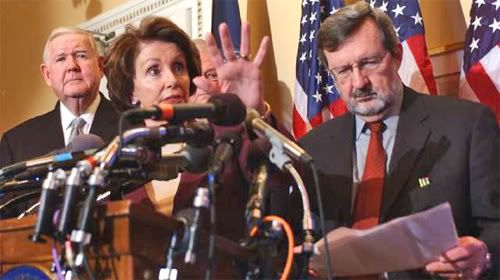
(Dennis Cook / Associated Press)
The Los Angeles Times reports:
To a crescendo of clicking cameras, House Speaker Nancy Pelosi stepped before a row of shimmering U.S. flags last March to make an announcement Americans had been waiting four months to hear.
November's elections had swept Democrats into power on a wave of frustration with the Iraq war. Now, flanked by three committee chairmen in her ceremonial Capitol office, the San Francisco congresswoman prepared to unveil the party's plan to bring the troops home.
"The American people called for a new direction," the speaker said, trying to give voice to the historic moment. "That's what this bill does."
There was just one problem. Pelosi had no answer for a simple question: Would the plan get any GOP support?
"I'm the last person to ask about Republican votes," she said curtly.
The speaker's dismissive comment drew little attention that morning. But it was telling. Today, the legislative drive against the war -- the most intense on Capitol Hill since the Vietnam era -- is all but over. As Wisconsin Sen. Russ Feingold, a leading antiwar Democrat, bluntly put it: "We have made no progress."
What happened?
The answer lies partly in the slim Democratic majority and a determined Republican president.
But it was the new Democratic majority's inability to work across the aisle that ultimately ensured failure.
Like the Republicans they had replaced, senior Democrats chose confrontation over cooperation.
They squandered opportunities to work with Republicans unhappy with the president.
And, under pressure from their antiwar base, they tried to bully their rivals.
"Even now, I fail to understand how we think we can stop the war unless we bring in Republicans," said Hawaii Rep. Neil Abercrombie, one of the liberal Democrats who challenged his party's strategy.
Unintended outcome
Democrats -- and even many Republicans -- had expected a far different result.
When GOP senators sat down for a tense luncheon in the Capitol's wood-paneled Mansfield Room last January, their party was in turmoil.
President Bush's decision to send additional troops to Iraq, combined with the party's election losses, infuriated many lawmakers. As Vice President Dick Cheney sat silently, a heated debate erupted.
Virginia Sen. John W. Warner, a white-haired veteran of two wars, rose to express deep concern that the U.S. military was caught in a civil war in Iraq. On the other side, Arizona's John McCain and South Carolina's Lindsey Graham passionately warned that retreat would spell disaster.
"It was a very difficult time," recalled Graham, who struggled that afternoon to prevent a full-scale revolt. "Republicans wanted to drop Iraq like a hot potato."
Senate Democrats were trying to capitalize on the dissent with a resolution that would simply express opposition to the troop buildup.
Senate Majority Leader Harry Reid, a conservative Democrat from Nevada who had worked often with Republicans, turned to Warner.
His decision to effectively cede control of the war debate to a lawmaker from the president's party was the calculation of a veteran tactician. Democrats had taken control of the Senate by the narrowest of margins, 51-49. (The chamber's two independents typically side with the Democrats.) If they wanted to force the president to do anything, they would need as many as a dozen Republicans to overcome a filibuster.
But Reid, a former boxer, was also a fierce partisan who had excelled as a leader by keeping Democrats together. That impulse would be decisive.
As Warner walked the hallways of the Senate trying to find GOP votes and proposed weakening the resolution, the staunchest antiwar members of Reid's caucus grew increasingly restive.
Within days, Feingold said he would oppose the resolution. So too did Connecticut's Christopher J. Dodd, another liberal Democrat. Reid, who was skeptical that Warner could deliver enough Republicans, cut off debate. GOP senators killed the measure on a procedural vote.
After just four weeks, the drive to build consensus was effectively over.
"It changed the political complexion of the debate and the environment," said Maine Sen. Olympia J. Snowe, a moderate Republican who had worked on the resolution.
The quick demise of the anti-surge resolution prompted Democrats to focus inward. The party, which had done little to develop a consensus antiwar strategy, was in turmoil.
Grass-roots groups that had helped elect Democrats were clamoring for legislation to restrict war funding and compel a swift withdrawal. So, too, was the nearly 80-strong House Out of Iraq caucus, one of whose leaders, Rep. Maxine Waters (D-Los Angeles), would get in a shouting match with Pelosi at a packed Democratic caucus meeting.
Other Democrats were reluctant to try to end the war by limiting money. "We didn't want to send a message that we weren't going to fund the troops," said Michigan Sen. Carl Levin, the Senate Armed Services Committee chairman.
Pelosi turned to House Appropriations Chairman David R. Obey to write a bill that would bring Democrats together.
Obey, an old-school liberal from rural northern Wisconsin, was a fierce critic of the war. But the 38-year veteran was also someone who could cut deals with Republicans. Obey scorned doctrinaire antiwar Democrats who "didn't want to get any specks on those white robes of theirs." In one confrontation with a soldier's mother who asked Obey to stop paying for the war, the lawmaker exploded in a rant against "idiot liberals."
Republican leaders -- still struggling to keep their caucus from splintering -- worried that Obey would reach out to GOP moderates. "If they had put their hands out . . . there were probably 50 or 60 of my members who could have been there," House Minority Leader John A. Boehner of Ohio said recently. "It could have been a very different outcome."
That was not the task Pelosi handed Obey.
The new speaker, who like Reid had united her party against hard-nosed GOP majorities, had never chaired a committee or drafted major legislation that required bipartisan compromise. She had a frosty relationship with Republican lawmakers. Now, she made it clear to Obey that she wanted a withdrawal timeline.
Drafts upon drafts
Obey and his staff hunkered down in his office for weeks, poring over scores of Democratic proposals. With Obey dictating language over his senior aide's shoulder, they produced draft after draft. Most of them went into a shredder.
Then, over the first weekend in March, they reached for a little-noticed bill filed just days earlier by Rep. Howard Berman (D-Valley Village) that linked pullout dates to the performance of the Iraqi government.
The war-funding bill that Pelosi announced at the March news conference would require the administration to begin withdrawing troops no later than March 2008, and to complete the pullout by August.
Democrats would triumphantly pass the most sweeping antiwar legislation since the Vietnam War. But it had attracted just two Republican votes in the Senate and two in the House, not nearly enough to override a presidential veto.
The Democratic response was to threaten to bury their Republican foes at the polls.
New York Sen. Charles E. Schumer, the combative head of the Democratic Senatorial Campaign Committee, gleefully touted plummeting GOP poll numbers. "They're going to have to break because they're going to have to look . . . extinction in the eye."
Democratic leaders now openly ridiculed compromise proposals from Republicans.
When Indiana Sen. Richard G. Lugar, a soft-spoken Republican and former Foreign Relations chairman, in late June made an earnest call for withdrawing troops, he got a visit from Bush's national security advisor within 48 hours. Democratic leaders ignored him and shut down debate on his proposal to require the Bush administration to submit a withdrawal plan.
Senior Democrats insisted the measure was too weak and would give Republicans political cover.
On the other side of the Capitol, Democrats were attacking their own. Hawaii's Abercrombie, a former Vietnam War protester, was shouted down at a meeting with fellow antiwar Democrats to discuss a similar bill he drafted.
"This was taken as a sign that suddenly I wasn't on the road to Damascus anymore. I had fallen from the true path," Abercrombie said. Pelosi, under pressure from the Out of Iraq caucus, prevented his bill from ever coming up for a vote.
A whiff of revenge
Many Democrats wrongly believed Republicans would break over the August recess when a well-funded antiwar campaign would target many in their districts. This heavy-handed approach had been a hallmark of the way Republicans had run Capitol Hill. Now, GOP lawmakers recoiled at the withdrawal timeline and the smash-mouth tactics.
No Democratic withdrawal measure ever won more than four GOP votes in the House or Senate.
By September, when Army Gen. David H. Petraeus gave Congress an upbeat report about diminishing violence, the Democratic legislative campaign against the war was effectively dead.
Today, Pelosi professes surprise that so few GOP lawmakers joined the Democratic antiwar effort. "I didn't foresee that," she said.
But neither she nor Reid express any regrets.
"We tried everything except yoga," Reid said recently, sitting by a fire in his office on the other side of the Capitol. "Republicans weren't looking for middle ground. . . . We felt we were on track with what the American people wanted."
But, the Congress that began 2007 with a relatively high 35% approval rating now rates just 22%, according to Gallup surveys.
"One of the many messages sent by voters in 2006 was that they were unhappy with the war in Iraq," said Maine Sen. Susan Collins, a moderate Republican. "Another message that was sent and not heard was that they were tired of partisan gridlock."
noam.levey@latimes.com
Friday, January 25, 2008
| [+/-] |
Bush Plan For Iraq Would Be A First |
No OK from Congress seen; Constitutional issues raised
The Boston Globe reports:
President Bush's plan to forge a long-term agreement with the Iraqi government that could commit the US military to defending Iraq's security would be the first time such a sweeping mutual defense compact has been enacted without congressional approval, according to legal specialists.
After World War II, for example - when the United States gave security commitments to Japan, South Korea, the Philippines, Australia, New Zealand, and NATO members - Presidents Truman and Eisenhower designated the agreements as treaties requiring Senate ratification. In 1985, when President Ronald Reagan guaranteed that the US military would defend the Marshall Islands and Micronesia if they were attacked, the compacts were put to a vote by both chambers of Congress.
By contrast, Bush and Iraqi Prime Minister Nouri Al-Maliki have already agreed that a coming compact will include the United States providing "security assurances and commitments" to Iraq to deter any foreign invasion or internal terrorism by "outlaw groups." But a top White House official has also said that Bush does not intend to submit the deal to Congress.
"We don't anticipate now that these negotiations will lead to the status of a formal treaty which would then bring us to formal negotiations or formal inputs from the Congress," General Douglas Lute, Bush's deputy national security adviser for Iraq and Afghanistan, said in November when the White House announced the plan.
Lute's disclosure initially attracted little scrutiny. Most of the attention has instead focused on whether the pact could make it more difficult for the United States to withdraw from Iraq after Bush leaves office. Although the next president could scrap the agreement, reneging on the compact would create diplomatic problems by showing that the nation does not live up to its obligations, specialists say.
But there is now also growing alarm about the constitutional issues raised by Bush's plan. Legal specialists and lawmakers of both parties are raising questions about whether it would be unconstitutional for Bush to complete such a sweeping deal on behalf of the United States without the consent of the legislative branch.
"There is literally no question that this is unprecedented," said Oona Hathaway, a Yale Law School professor who has written a forthcoming law journal article about the proposed Iraq agreement. "The country has never entered into this kind of commitment without Congress being involved, period."
At a House hearing on the pact on Wednesday, Representative Dana Rohrabacher, Republican of California and a former Reagan administration official, accused the Bush administration of "arrogance" for not consulting with Congress about the pact. If it includes any guarantees to Iraq, he said, Congress must sign off.
"We are here to fulfill the constitutional role established by the founding fathers," Rohrabacher said, adding, "It is not all in the hands of the president and his appointees. We play a major role."
Bush and Maliki have said they intend to complete the agreement by July 31. The two countries need to reach some kind of an agreement this year in order to create a legal framework for the continued presence of US troops in Iraq after Dec. 31, when a United Nations Security Counsel mandate is due to expire.
But the "long-term relationship of cooperation and friendship" outlined in November goes far beyond an ordinary status-of-forces agreement. It would include promises of debt forgiveness, economic and technical aid, facilitating "especially American investments" in Iraq - and the security commitments, according to Bush and Maliki's joint declaration last November.
Facing mounting criticism over its assertion that Bush can reach such an agreement on his own, the administration has sent mixed signals about whether it intends to follow through on the plan. The New York Times today reported that administration officials told a reporter that the final pact may not have security guarantees after all, but the article did not identify its sources.
Officially, the administration has not changed the plans it announced in November. Asked to respond to the critics who say that such a pact must be approved by Congress, White House National Security Council spokesman Gordon Johndroe and Secretary of Defense Robert Gates each said that it was premature to talk about the pact because its final text has not yet been negotiated.
"I haven't been involved in any discussions of what kind of form the agreement would take or anything else," Gates said at press conference yesterday. "I do know there's a strong commitment inside the administration to consult very closely with the Congress on this."
But Representative Bill Delahunt, Democrat of Massachusetts, who chaired the hearing on Wednesday, asked four top administration officials - Lute, Undersecretary of Defense for Policy Eric Edelman, and the State Department's top legal and Iraq advisers, John Bellinger and David Satterfield - to appear and explain the administration's intentions. All four declined.
However, Lute may have offered a clue to the administration's legal arguments during the November press conference when he noted that "We have about a hundred agreements similar to the one envisioned for the US and Iraq already in place, and the vast majority of those are below the level of a treaty." Johndroe, the White House spokesman, also mentioned the existence of such agreements in a Globe interview this week.
Legal specialists, however, say that the numerous pacts that were completed without congressional consent are not similar to the agreement Bush and Maliki outlined in November.
Other such "status-of-forces agreements" are far more limited contracts with countries that host US military bases, covering comparatively minor issues such as leasing arrangements and which country will prosecute any US soldiers accused of committing a crime.
By contrast, Senate Foreign Relations Committee Chairman Joe Biden told Bush in a letter released yesterday, "As a matter of constitutional law, and based on over 200 years of practice," Bush could not commit the US military to protecting Iraq's security without congressional consent.
"A commitment that the United States will act to assist Iraq, potentially through the use of our armed forces in the event of an attack on Iraq, could effectively commit the nation to engage in hostilities," Biden wrote. "Such a commitment cannot be made by the executive branch alone under our Constitution."
Biden said yesterday he had received no reply to the letter, which he sent late last month.
Adding to the pressure, Democratic presidential candidate Hillary Clinton has also repeatedly raised the topic in recent days. The New York senator has filed legislation that would block the expenditure of funds to implement any agreement with Iraq that was not submitted to Congress for approval. Her rival, Senator Barack Obama of Illinois, became a cosponsor to the bill on Tuesday.
"We've got to rein in President Bush," Clinton said Monday in a South Carolina debate. "We need legislation in a hurry."
Wednesday, January 23, 2008
| [+/-] |
Defining The U.S. Presence In Iraq |
Democrats Attack Bush's Iraq Security Proposal
The Washington Post reports:
The leading Democratic presidential candidates and their allies on Capitol Hill have launched fierce attacks in recent days on a White House plan to forge a new, long-term security agreement with the Iraqi government, complaining that the administration is trying to lock in a lasting U.S. military presence in Iraq before the next president takes office.
Among the top critics is Sen. Hillary Rodham Clinton (D-N.Y.). She has used the past two Democratic presidential debates to blast President Bush for his effort, as she put it Monday in South Carolina, "to try to bind the United States government and his successor to his failed policy."
Her concerns have been echoed by Sen. Barack Obama (Ill.) and other Democratic lawmakers who are focusing their fire on the administration's plans for a long-term commitment to Iraq, after gaining little traction for their efforts to force a faster withdrawal of U.S. combat troops there.
"How do you make an commitment to a country where there is no way of measuring whether that country is likely to have a functioning government?" Sen. Joseph R. Biden Jr. (Del.), chairman of the Foreign Relations Committee, asked in an interview yesterday.
Biden recently wrote a letter to Bush expressing concern that the agreement could "mire us in an Iraqi civil war indefinitely." Biden and other lawmakers held out the possibility that they will try to block the administration's plans to reach a bilateral accord with Iraq, or at least seek to compel the White House to submit any such agreement for congressional approval.
Administration officials said the next president will have full authority to withdraw troops if that is desired. They said Democrats are reading too much into the plan, which they describe as an effort to give the next commander in chief the tools to deal with the situation in Iraq.
Efforts to secure an agreement began with little fanfare late last year. The White House announced then that it was opening negotiations with the Iraqis on a new bilateral agreement that would cover how the two countries will relate politically, economically, culturally and militarily in the years ahead.
The agreement would include "security assurances and commitments" to Iraq to deter foreign aggression, according to a declaration of principles that Bush and Prime Minister Nouri al-Maliki signed in November. Officials said they hope to conclude the pact by mid-year, in time to replace the expiring United Nations mandate that authorizes the operations of coalition troops in Iraq.
As described by administration officials, the accord would amount to a standard "status of forces agreement" with a friendly country. It would cover such issues as the power U.S. forces would have to arrest and detain Iraqis, or the rules covering engagement with the enemy.
Historically, such agreements have not been submitted to Congress for approval, though administration officials concede that if they were to agree to certain security "guarantees" for the Iraqis, they would have to bring the matter before the Senate. Lawmakers are insisting that the proposed agreement is already broad enough to require congressional review.
"While the exact structure of the forthcoming agreement is yet to be negotiated, the U.S. has concluded similar agreements with more than 120 countries around the world, including many countries in the region," said White House spokesman Gordon Johndroe. He also addressed a key concern raised by Clinton and other Democrats: "The Iraqi government has indicated that they do not want permanent U.S. bases in Iraq, and we are not seeking them."
The accord has stirred liberal activists, with the advocacy group MoveOn.org recently garnering more than 250,000 signatures on a petition demanding congressional involvement in any agreement.
Democrats' suspicions have been further fanned in recent weeks by comments from Bush and from senior Iraqi officials suggesting that a significant U.S. troop presence in Iraq could endure for years. During his recent trip to the Middle East, Bush spoke of how "long-term success will require active U.S. engagement that outlasts my presidency."
The number of U.S. troops in Iraq is set to decrease from 160,000 to 130,000 by summer.
Rep. Bill Delahunt (D-Mass.) convened a hearing yesterday to explore the proposed agreement. He dismissed the contention that the proposal is routine, saying that administration officials declined to explain themselves before his Foreign Affairs subcommittee.
"We don't trust this administration," he said, suggesting that at first glance, the scope of the proposed agreement goes well beyond that of a standard status-of-forces agreement.
Despite such sentiments, Bush and his advisers express the private conviction that any presidential successor will find it hard to disengage from Iraq, no matter what is said on the campaign trail. One senior official, not authorized to speak publicly, said Clinton or any another would-be president will eventually welcome the agreement that the Bush administration intends to negotiate with the Iraqis.
"Is the next president going to say, 'I don't want to fight al-Qaeda in Iraq'? Maybe," this official said. "But I think they are going to want to, and we will give them the proper authorities."
Tuesday, January 22, 2008
| [+/-] |
The War Card: Orchestrated Deception on the Path to War |
False Pretenses - Following 9/11, President Bush and seven top officials of his administration waged a carefully orchestrated campaign of misinformation about the threat posed by Saddam Hussein's Iraq
The Center for Public Integrity reports:
President George W. Bush and seven of his administration's top officials, including Vice President Dick Cheney, National Security Adviser Condoleezza Rice, and Defense Secretary Donald Rumsfeld, made at least 935 false statements in the two years following September 11, 2001, about the national security threat posed by Saddam Hussein's Iraq. Nearly five years after the U.S. invasion of Iraq, an exhaustive examination of the record shows that the statements were part of an orchestrated campaign that effectively galvanized public opinion and, in the process, led the nation to war under decidedly false pretenses.
On at least 532 separate occasions (in speeches, briefings, interviews, testimony, and the like), Bush and these three key officials, along with Secretary of State Colin Powell, Deputy Defense Secretary Paul Wolfowitz, and White House press secretaries Ari Fleischer and Scott McClellan, stated unequivocally that Iraq had weapons of mass destruction (or was trying to produce or obtain them), links to Al Qaeda, or both. This concerted effort was the underpinning of the Bush administration's case for war.
It is now beyond dispute that Iraq did not possess any weapons of mass destruction or have meaningful ties to Al Qaeda. This was the conclusion of numerous bipartisan government investigations, including those by the Senate Select Committee on Intelligence (2004 and 2006), the 9/11 Commission, and the multinational Iraq Survey Group, whose "Duelfer Report" established that Saddam Hussein had terminated Iraq's nuclear program in 1991 and made little effort to restart it.
In short, the Bush administration led the nation to war on the basis of erroneous information that it methodically propagated and that culminated in military action against Iraq on March 19, 2003. Not surprisingly, the officials with the most opportunities to make speeches, grant media interviews, and otherwise frame the public debate also made the most false statements, according to this first-ever analysis of the entire body of prewar rhetoric.
President Bush, for example, made 232 false statements about weapons of mass destruction in Iraq and another 28 false statements about Iraq's links to Al Qaeda. Secretary of State Powell had the second-highest total in the two-year period, with 244 false statements about weapons of mass destruction in Iraq and 10 about Iraq's links to Al Qaeda. Rumsfeld and Fleischer each made 109 false statements, followed by Wolfowitz (with 85), Rice (with 56), Cheney (with 48), and McClellan (with 14).
The massive database at the heart of this project juxtaposes what President Bush and these seven top officials were saying for public consumption against what was known, or should have been known, on a day-to-day basis. This fully searchable database includes the public statements, drawn from both primary sources (such as official transcripts) and secondary sources (chiefly major news organizations) over the two years beginning on September 11, 2001. It also interlaces relevant information from more than 25 government reports, books, articles, speeches, and interviews.
Consider, for example, these false public statements made in the run-up to war:
On August 26, 2002, in an address to the national convention of the Veteran of Foreign Wars, Cheney flatly declared: "Simply stated, there is no doubt that Saddam Hussein now has weapons of mass destruction. There is no doubt he is amassing them to use against our friends, against our allies, and against us." In fact, former CIA Director George Tenet later recalled, Cheney's assertions went well beyond his agency's assessments at the time. Another CIA official, referring to the same speech, told journalist Ron Suskind, "Our reaction was, 'Where is he getting this stuff from?' "
In the closing days of September 2002, with a congressional vote fast approaching on authorizing the use of military force in Iraq, Bush told the nation in his weekly radio address: "The Iraqi regime possesses biological and chemical weapons, is rebuilding the facilities to make more and, according to the British government, could launch a biological or chemical attack in as little as 45 minutes after the order is given. . . . This regime is seeking a nuclear bomb, and with fissile material could build one within a year." A few days later, similar findings were also included in a much-hurried National Intelligence Estimate on Iraq's weapons of mass destruction — an analysis that hadn't been done in years, as the intelligence community had deemed it unnecessary and the White House hadn't requested it.
In July 2002, Rumsfeld had a one-word answer for reporters who asked whether Iraq had relationships with Al Qaeda terrorists: "Sure." In fact, an assessment issued that same month by the Defense Intelligence Agency (and confirmed weeks later by CIA Director Tenet) found an absence of "compelling evidence demonstrating direct cooperation between the government of Iraq and Al Qaeda." What's more, an earlier DIA assessment said that "the nature of the regime's relationship with Al Qaeda is unclear."
On May 29, 2003, in an interview with Polish TV, President Bush declared: "We found the weapons of mass destruction. We found biological laboratories." But as journalist Bob Woodward reported in State of Denial, days earlier a team of civilian experts dispatched to examine the two mobile labs found in Iraq had concluded in a field report that the labs were not for biological weapons. The team's final report, completed the following month, concluded that the labs had probably been used to manufacture hydrogen for weather balloons.
On January 28, 2003, in his annual State of the Union address, Bush asserted: "The British government has learned that Saddam Hussein recently sought significant quantities of uranium from Africa. Our intelligence sources tell us that he has attempted to purchase high-strength aluminum tubes suitable for nuclear weapons production." Two weeks earlier, an analyst with the State Department's Bureau of Intelligence and Research sent an email to colleagues in the intelligence community laying out why he believed the uranium-purchase agreement "probably is a hoax."
On February 5, 2003, in an address to the United Nations Security Council, Powell said: "What we're giving you are facts and conclusions based on solid intelligence. I will cite some examples, and these are from human sources." As it turned out, however, two of the main human sources to which Powell referred had provided false information. One was an Iraqi con artist, code-named "Curveball," whom American intelligence officials were dubious about and in fact had never even spoken to. The other was an Al Qaeda detainee, Ibn al-Sheikh al-Libi, who had reportedly been sent to Eqypt by the CIA and tortured and who later recanted the information he had provided. Libi told the CIA in January 2004 that he had "decided he would fabricate any information interrogators wanted in order to gain better treatment and avoid being handed over to [a foreign government]."
The false statements dramatically increased in August 2002, with congressional consideration of a war resolution, then escalated through the mid-term elections and spiked even higher from January 2003 to the eve of the invasion.
It was during those critical weeks in early 2003 that the president delivered his State of the Union address and Powell delivered his memorable U.N. presentation. For all 935 false statements, including when and where they occurred, go to the search page for this project; the methodology used for this analysis is explained here.
In addition to their patently false pronouncements, Bush and these seven top officials also made hundreds of other statements in the two years after 9/11 in which they implied that Iraq had weapons of mass destruction or links to Al Qaeda. Other administration higher-ups, joined by Pentagon officials and Republican leaders in Congress, also routinely sounded false war alarms in the Washington echo chamber.
The cumulative effect of these false statements — amplified by thousands of news stories and broadcasts — was massive, with the media coverage creating an almost impenetrable din for several critical months in the run-up to war. Some journalists — indeed, even some entire news organizations — have since acknowledged that their coverage during those prewar months was far too deferential and uncritical. These mea culpas notwithstanding, much of the wall-to-wall media coverage provided additional, "independent" validation of the Bush administration's false statements about Iraq.
The "ground truth" of the Iraq war itself eventually forced the president to backpedal, albeit grudgingly. In a 2004 appearance on NBC's Meet the Press, for example, Bush acknowledged that no weapons of mass destruction had been found in Iraq. And on December 18, 2005, with his approval ratings on the decline, Bush told the nation in a Sunday-night address from the Oval Office: "It is true that Saddam Hussein had a history of pursuing and using weapons of mass destruction. It is true that he systematically concealed those programs, and blocked the work of U.N. weapons inspectors. It is true that many nations believed that Saddam had weapons of mass destruction. But much of the intelligence turned out to be wrong. As your president, I am responsible for the decision to go into Iraq. Yet it was right to remove Saddam Hussein from power."
Bush stopped short, however, of admitting error or poor judgment; instead, his administration repeatedly attributed the stark disparity between its prewar public statements and the actual "ground truth" regarding the threat posed by Iraq to poor intelligence from a Who's Who of domestic agencies.
On the other hand, a growing number of critics, including a parade of former government officials, have publicly — and in some cases vociferously — accused the president and his inner circle of ignoring or distorting the available intelligence. In the end, these critics say, it was the calculated drumbeat of false information and public pronouncements that ultimately misled the American people and this nation's allies on their way to war.
Bush and the top officials of his administration have so far largely avoided the harsh, sustained glare of formal scrutiny about their personal responsibility for the litany of repeated, false statements in the run-up to the war in Iraq. There has been no congressional investigation, for example, into what exactly was going on inside the Bush White House in that period. Congressional oversight has focused almost entirely on the quality of the U.S. government's pre-war intelligence — not the judgment, public statements, or public accountability of its highest officials. And, of course, only four of the officials — Powell, Rice, Rumsfeld, and Wolfowitz — have testified before Congress about Iraq.
Short of such review, this project provides a heretofore unavailable framework for examining how the U.S. war in Iraq came to pass. Clearly, it calls into question the repeated assertions of Bush administration officials that they were the unwitting victims of bad intelligence.
Above all, the 935 false statements painstakingly presented here finally help to answer two all-too-familiar questions as they apply to Bush and his top advisers: What did they know, and when did they know it?
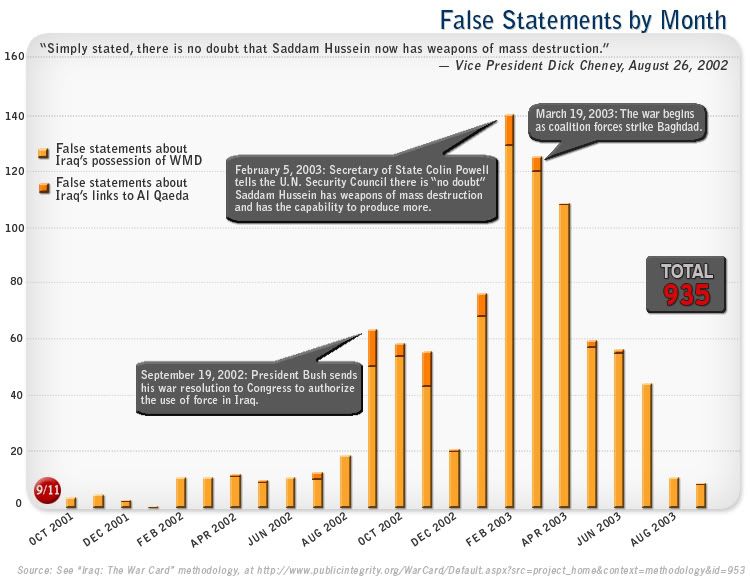
Thursday, January 17, 2008
| [+/-] |
Gates Calls For Extended U.S. Presence in Iraq |
McClatchey reports:
Against the backdrop of the improved security situation in Iraq, Secretary of Defense Robert Gates announced Thursday a shift in U.S. strategy that will require an extended U.S. presence in Iraq, although with fewer troops.
Gates and top uniformed officers sketched out a plan that runs counter to pledges by Democratic presidential contenders to bring about a rapid drawdown of the U.S. military presence in Iraq. One candidate, former Sen. John Edwards of North Carolina, called for the withdrawal of nearly all U.S. combat troops from Iraq by the end of 2009.
Gates and the uniformed military leadership said a smaller U.S. presence will be needed for the foreseeable future to provide support for Iraqi forces. They didn't go as far as Sen. John McCain, R-Ariz., however, who says that U.S. troops may be stationed in Iraq for decades or even a century.
"We'll have some people here, if the government of Iraq wants it, for some period of time. That could be five to 10 years. But it will not be at the levels we're at now. I don't believe that that will be necessary," said Lt. Gen. Raymond Odierno, the No. 2 commander in Iraq, during a teleconference from Baghdad.
He said the support could include U.S. air power for five to 10 years, close air support for ground operations, helicopters and "an appropriate number of ground forces that go along with that." Odierno gave no figure for the ground forces, saying "that will be dictated by the situation on the ground."
Gates told reporters that the U.S. mission ultimately will be a "strategic overwatch" in which U.S. forces won't be engaged on a daily basis and Iraqis will take the lead. Under that strategy, Gates said, American forces "are providing support, we are going after al Qaida, we are helping them ...protect their borders, and we are doing training and equipping missions." Gates said the transition already has begun.
He couldn't say how long the U.S. military would remain in Iraq or whether the troop strength would fall below 100,000 by the end of President Bush's term, as Gates has previously proposed.
None of the military leaders spelled out how the strategy would change if the lull in violence ends or if the Iraqi forces cannot maintain security. In either scenario, U.S. forces would have to secure neighborhoods and root out armed factions.
So far, the first of five combat brigades has departed, with four others set to leave by July. By early summer, U.S. troop strength is to fall to 15 combat brigades, or roughly 130,000 troops, approximately the level before the troop surge began last February.
Odierno said Thursday that the U.S. will continue to pay roughly 175,000 "concerned local citizens" to patrol their neighborhoods $375 a month until at least the end of the year. And he said Iraqi forces likely can't control all of Iraq's 18 provinces until the end of the 2008 at the earliest.
On Capitol Hill on Thursday, Lt. Gen. James Dubik, the commander of the Multi-National Security Transition Command in Iraq, told the House Armed Services Committee that Iraqi security forces could reach 580,000 by the end of the year. But he predicted that the Iraqi troops couldn't protect their country without assistance for another decade.
Not everyone welcomed the suggestion of a long-term presence in Iraq. During Dubik's testimony, Rep. Roscoe G. Bartlett, R-Md., asked, "Does that mean we are going to be there forever?"
Dubik said no, but he couldn't say when U.S. troops could leave Iraq for good.
Thursday, December 20, 2007
| [+/-] |
Do U.S. Prisons in Iraq Breed Insurgents? |
The Christian Science Monitor reports:
American officials have detained thousands of insurgents in the months since the surge of forces began this spring, in an effort that most agree has improved security in Iraq. But now the commander of the American detention facilities in Iraq is wondering aloud if holding all those detainees is breeding a "micro-insurgency" and asking whether it's time to begin releasing thousands of people.
The two main detention facilities operated by the US military in Iraq, at Camp Bucca near Basra and Camp Cropper in Baghdad, have swollen to hold nearly 30,000 detainees. That's not the 40,000 individuals Army Gen. David Petraeus allotted for when American forces began to implement the Baghdad security plan this spring. But it may be too many, says Marine Maj. Gen. Doug Stone, who oversees detainees for the US-led force.
Holding thousands of "moderate detainees," marked by green jumpsuits at Camp Bucca, runs counter to the notion of winning over a population in a classic counterinsurgency, he says. General Stone believes many of these Iraqi insurgents were never motivated by anything more than money and most only desire to live peacefully. Many can be safely released back to society, back to their families and in their neighborhoods without straining security or their communities, he says.
Stone believes that there should be debate about how many detainees US forces continue to hold and how many should now be freed.
"I am of the strong viewpoint that there is [now] enough confidence in the process that I'm a champion for releasing those for whom the process has worked and who are essentially a reduced security threat to the coalition," says Stone in a phone interview from Camp Bucca.
Indeed, the nature of the war may be shifting. The Pentagon's quarterly assessment of security and stability in Iraq, released on Tuesday, shows that violence is down across the country. Roadside bombings, for example, have dropped by 68 percent since June.
Stone, a Marine reservist who has headed a number of software development firms, is known for his passion and deliberate approach to understanding the nature of insurgencies. He is calling attention to the issue because he thinks it's time to rethink holding so many detainees at this phase of the war. As the commander of detention operations, he can provide input on the release of detainees through a new board process, but the commanders in the field who send individuals to him have the ultimate input on whether someone should be held or let go. But some commanders are resistant to letting detainees go.
Stone, who doesn't participate in field operations, recognizes that his perspective is from "inside the wire."
Commanders whose troops detain insurgents and other criminals for activities against their own men may have another way of looking at it.
"I'm not on the ground looking at their situation, and they're not in the detention facility seeing these people," says Stone.
He made an impassioned plea recently when Marine Commandant Gen. James Conway paid a visit to Bucca in November. General Conway came away impressed with the programs Stone has implemented there and is concerned that the growing number of detainees doesn't make sense anymore.
"If you roll up 150 guys in a village and you don't have probable cause, you've just created 150 little terrorists," says Conway, who says the US must review the process.
"I think there has to be more of a reason to hold a detainee or, send them away," says Conway.
In many ways, Iraq's increased security could be attributed to higher numbers of detainees. But much of the success stems from the changing attitudes of Iraqi citizens toward their own security and, to a lesser extent, their views of the American presence.
"You're always worried about 'Do you have the right guys?'" says Brig. Gen. Joe Anderson, chief of staff for the Multi-National Corps Iraq. The American military has been releasing as many as 80 detainees per week, and is looking to release more, says General Anderson, who notes that releasing detainees and getting them back to where they belong is "a major logistical task."
"You don't just open the gates and let them go," he says. "It is a deliberate methodical operation."
General Petraeus is deeply concerned about fighting the insurgency in Iraq, both on the ground and inside the walls of detainee facilities, says a senior military official in Baghdad. In the meantime, holding Iraqis is all about "legitimacy," says the official.
"We're not out arresting Iraqis [at random], we're out detaining individuals for whom we have reasonable grounds [to believe] that they are an imperative for security in Iraq," says the official, who asked not to be named due to the sensitivity of the issue. "Everything we do is within the law."
After the Abu Ghraib prison scandal, the US military transferred many detainees to Bucca and set about creating a model prison system.
Since arriving in April, Stone is credited for spearheading an innovative detainee program in which education, respect, and vocational and religious programs are a primary focus.
Stone brought imams from Baghdad to teach detainees, many of whom are illiterate, about the teachings of the Koran with the aim to foster a more moderate outlook among the population.
For the first time, detainees participate in boards that allow them to better understand why they are being held under lock and key, Stone says, to getting them to learn how their conduct affects their situation.
Stone says that on his watch, more than 3,000 detainees have been released using his methods. So far, he's seen a very slight recidivism rate and only a few former detainees were recaptured and brought back to the detention facility.
There are still hard-core insurgents and terrorists living inside the yards. In contrast to the green-clad detainees determined to be more moderate, those individuals are given red jumpsuits to wear and are largely segregated from the rest of the detainee population. Amber-colored jumpsuits indicate the wearer is "changing" to a more moderate stance.
But Bucca has had its problems, giving rise to Stone's concern that if not done right, a microinsurgency could be growing within the American-run facility, an irony that has emerged as the facility grows.
Before Stone took command, there was a riot in March, followed by another in May, that may have involved as many as 10,000 detainees. There are also a series of tunnels that have been dug in and outside the facility that have been used, in some cases, to target guards, Stone says.
