The New York Times reports:
An internal Justice Department inquiry has concluded that Bush administration lawyers committed serious lapses of judgment in writing secret memorandums authorizing brutal interrogations but that they should not be prosecuted, according to government officials briefed on its findings.
The report by the Office of Professional Responsibility, an internal ethics unit within the Justice Department, is also likely to ask state bar associations to consider possible disciplinary action, which could include reprimands or even disbarment, for some of the lawyers involved in writing the legal opinions, the officials said.
The conclusions of the 220-page draft report are not final and have not yet been approved by Attorney General Eric H. Holder Jr. The officials said that it is possible that the final report might be subject to further revision but that they did not expect major alterations in its main findings or recommendations.
The findings, growing out of an inquiry that started in 2004, would represent a stinging rebuke of the lawyers and their legal arguments.
But they would stop short of the criminal referral sought by some human rights advocates, who have suggested that the lawyers could be prosecuted as part of a criminal conspiracy to violate the anti-torture statute. President Obama has said the Justice Department would have to decide whether the lawyers who authorized the interrogation methods should face charges, while pledging that interrogators would not be investigated or prosecuted for using techniques that the lawyers said were legal.
The draft report is described as very detailed, tracing e-mail messages between the Justice Department lawyers and officials at the White House and the Central Intelligence Agency. Among the questions it is expected to consider is whether the memos were an independent judgment of the limits of the federal anti-torture statute or were deliberately skewed to justify the use of techniques proposed by the C.I.A.
At issue is the question of whether the lawyers acted ethically and competently in writing a series of Justice Department legal opinions from 2002 to 2007.
The opinions permitted the Central Intelligence Agency to use a number of methods that human rights groups and legal experts have condemned as torture, including waterboarding, wall-slamming and shackling for hours in a standing position. The opinions allowed many of these practices to be used repeatedly and in combination.
The main targets of criticism are John Yoo, Jay S. Bybee and Steven G. Bradbury, who, as senior officials of the department’s Office of Legal Counsel, were principal authors of the opinions.
It was unclear whether all three would be the subject of bar association referrals. One person who saw the report said it did not recommend bar action against Mr. Bradbury.
Mr. Bradbury, and lawyers for Mr. Yoo, now a law professor at Berkeley, and for Mr. Bybee, now a federal appeals court judge in Nevada, all declined to comment Tuesday, saying Justice Department rules require confidentiality for ethics reviews.
The work of other lawyers in the counsel’s office was also questioned in the report, the officials said, but none are believed to be the subject of disciplinary recommendations. The report reaches no conclusions about the role of lawyers at the White House or the C.I.A. because the jurisdiction of the ethics unit does not extend beyond the Justice Department.
The draft report on the interrogation opinions was completed in December and provoked controversy inside the Bush administration Justice Department. But criticism of the legal work in the memos has intensified since last month when the Obama administration disclosed one previously secret opinion from 2002, drafted mainly by Mr. Yoo and signed by Mr. Bybee, and three from 2005, signed by Mr. Bradbury, which for the first time described the coercive interrogation methods in detail.
Michael B. Mukasey, attorney general when the draft report was first completed, was said by colleagues to have been critical of its quality and upset over its scathing conclusions. He wrote a 10-page rebuttal to its findings, and, in his farewell speech to employees, warned against second-guessing the legal work of the department’s lawyers.
Several legal scholars have remarked that in approving waterboarding, the near-drowning method Mr. Obama and his aides have described as torture, the Justice Department lawyers did not cite cases in which the United States government previously prosecuted American law enforcement officials and Japanese World War II interrogators for using the procedure.
In a letter on Monday, the Justice Department advised two Democratic senators on the Judiciary committee, Richard J. Durbin of Illinois and Sheldon Whitehouse of Rhode Island, that the former department lawyers who wrote the opinions had until May 4 to submit written appeals to the findings.
The letter, written by Ronald Weich, an assistant attorney general, also said the report had been given to the C.I.A. for review and declassification, and some officials said they expected a version to be made public, probably late this month.
Mr. Durbin and Mr. Whitehouse, who have criticized the Bush administration’s interrogation policies, have repeatedly demanded the release of the report. Mr. Whitehouse is scheduled to hold a hearing on May 13, to examine issues related to the report.
The professional responsibility office first began examining the actions of the lawyers nearly five years ago. Recently, Mr. Holder named Mary Patrice Brown, a senior federal prosecutor in Washington to head the office, moving its longtime chief, H. Marshall Jarrett, to another job within the Justice Department.
Tuesday, May 5, 2009
| [+/-] |
Torture Memos: Inquiry Suggests No Prosecutions |
Saturday, July 14, 2007
| [+/-] |
DoJ: "Oversight Board Failed To Report Intelligence Violations" |
For 5 1/2 years, not one violation was passed along to the Attorney General.
The Houston Chronicle reports:
An independent oversight board created to identify intelligence abuses after the CIA scandals of the 1970s did not send any reports to the attorney general of legal violations during the first 5 1/2 years of the Bush administration's counterterrorism effort, the Justice Department has told Congress.
Although the FBI told the board of a few hundred legal or rules violations by its own agents after the Sept. 11, 2001, attacks, the board did not identify which of them were indeed legal violations. This spring, it forwarded reports of violations in 2006, officials said.
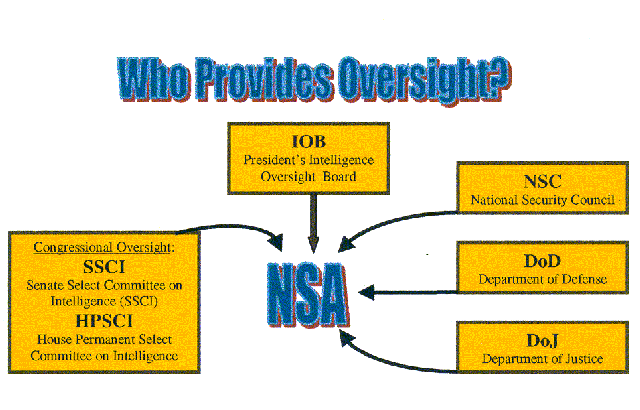
The President's Intelligence Oversight Board — the principal civilian watchdog of the intelligence community — is obligated under a 26-year-old executive order to tell the attorney general and the president about any intelligence activities it believes "may be unlawful." The board was vacant for the first two years of the Bush administration.
The FBI sent copies of its violation reports directly to Attorney General Alberto R. Gonzales. But the board's mandate was to provide independent oversight, so the absence of such communications has prompted critics to question whether the board was doing its job.
"It's now apparent that the IOB was not actively employed in the early part of the administration. And it was a crucial period when its counsel would seem to have been needed the most," said Anthony Harrington, who served as the board's chairman for most of the Clinton administration.
"The White House counsel's office and the attorney general should have known and been concerned if they did not detect an active and effective IOB," Harrington said. Senate Judiciary Committee chairman Patrick J. Leahy, D-Vt., added: "It is deeply disturbing that this administration seems to spend so much of its energy and resources trying to find ways to ignore any check and balance on its authority and avoid accountability to Congress and the American public."
White House spokeswoman Dana Perino said Friday that "the president expects every single person working in counterterrorism and intelligence strictly to follow the law — and if there are instances where that has not occurred, either intentionally or non-intentionally, he expects it promptly to be corrected." She said the White House was relying on the presidentially appointed director of national intelligence to monitor problems.
Through five previous administrations, members of the board — all civilians not employed by the government — have been privy to some of America's most secret intelligence operations and have served as a private watchdog against unpublicized abuses. The subjects of their investigations and the resulting reports are nearly all classified.
The Bush administration first appointed board members in 2003. Since then, the CIA and the National Security Agency have been caught up in controversy over interrogation tactics at secret prisons, the transfer of prisoners to countries that use torture, and domestic wiretapping not reviewed by federal courts.
Until recently, the board had not told the attorney general about any wrongdoing. "The Attorney General has no record of receiving reports from the IOB regarding intelligence activities alleged to be potentially unlawful or contrary to Executive Order or Presidential directive," the Justice Department told the House Judiciary Committee in a May 9 letter.
White House officials said the board began forwarding reports of problems shortly thereafter. White House officials declined to discuss the board's interactions with President Bush, and said its members could not be interviewed for this report.
President Gerald R. Ford created the board in the mid-1970s after the Church Committee identified numerous abuses by U.S. intelligence agencies. President Ronald Reagan made the board permanent with an executive order in 1981 and gave it the mission to identify legal violations.
Harrington said that under President Clinton, the board sent reports of legal violations by intelligence agencies promptly to the attorney general. Officials said it concluded that the administration showed poor judgment in supporting Iranian arms shipments to Bosnia, and it complained about the CIA's policy of employing known torturers or killers as informants in Latin America.
Perino said that during the first two years of the Bush administration, a career intelligence officer at the White House collected and reviewed reports in which the FBI and other intelligence agencies self-disclosed violations of civil liberties and privacy safeguards.
The board's three or four members — it has alternated over the years — are usually drawn from the larger President's Foreign Intelligence Advisory Board, which advises the commander in chief on U.S. intelligence policy and performance. The oversight board has been a mix of intelligence experts, such as George H.W. Bush's choice of former Air Force Gen. Lew Allen, and civilians from other walks of life, such as Bill Clinton's choice of Philadelphia investment banker Harold Pote.
The board now in place is led by former Bush economic adviser Stephen Friedman. It includes Don Evans, friend of the president and a former commerce secretary, former Adm. David Jeremiah and lawyer Arthur B. Culvahouse.
Perino said the board's "original unique mission and primary oversight role has been supplemented" in recent years by new layers of government. The administration now relies on the director of national intelligence — a job created in 2005 — to watch for abuses, along with presidentially appointed inspector generals. As a result, Bush is considering changes to Reagan's executive order, she said.
Clinton-era deputy national security adviser James B. Steinberg said, however, that "you have to have a civilian proxy who on one hand can be trusted with these secrets and can still call the operator on the carpet when they go astray. If you neuter these internal mechanisms, then you are basically saying there is no one watching the henhouse."
On Friday, the FBI and the Justice Department announced several reforms meant to strengthen internal oversight, including the creation of a legal "compliance office" inside the bureau and a review office inside the department that will regularly examine all violations.
Separately, Gonzales wrote the top Republican on the Senate Judiciary Committee, Sen. Arlen Specter of Pennsylvania, to defend his 2005 testimony that there had been no verified civil liberties abuses during the first three years of the efforts against terrorism. The Post reported last week that the FBI had sent Gonzales a half-dozen reports of violations of civil liberties and privacy safeguards before his testimony.
Gonzales wrote Friday that he did not consider the conduct in those reports to be abuses because the violations involved mistakes, not deliberate misconduct. "My testimony was completely truthful, and I stand by that testimony," he wrote.
Leahy scoffed at Gonzales' explanation. "The American people deserve an attorney general who will fully and accurately inform the Senate and the public about violations of civil liberties. Instead, they have one who misleads Congress and then hides behind dictionary definitions," he said.
Friday, March 9, 2007
| [+/-] |
Justice Department: FBI Acted Illegally On Data |
Audit finds agency misused Patriot Act to obtain information on citizens
MSNBC reports:
The FBI improperly and, in some cases, illegally used the USA Patriot Act to secretly obtain personal information about people in the United States, a Justice Department audit concluded Friday.
And for three years the FBI has underreported to Congress how often it forced businesses to turn over the customer data, the audit found.
FBI agents sometimes demanded the data without proper authorization, according to the 126-page audit by Justice Department Inspector General Glenn Fine. At other times, the audit found, the FBI improperly obtained telephone records in non-emergency circumstances.
FBI Director Robert Mueller said he was to blame for not putting more safeguards into place.
“I am to be held accountable,” Mueller said. He told reporters he would correct the problems and did not plan to resign.
“The inspector general went and did the audit that I should have put in place many years ago,” Mueller said.
The audit blames agent error and shoddy record-keeping for the bulk of the problems and did not find any indication of criminal misconduct.
Still, "we believe the improper or illegal uses we found involve serious misuses of national security letter authorities," the audit concludes.
Attorney General Alberto Gonzales, who oversees the FBI, said the problems outlined in the report involved no intentional wrongdoing. In remarks prepared for delivery to privacy officials late Friday, Gonzales said that “there is no excuse for the mistakes that have been made, and we are going to make things right as quickly as possible.”
At issue are the security letters, a power outlined in the Patriot Act that the Bush administration pushed through Congress after the Sept. 11, 2001, terror attacks. The letters, or administrative subpoenas, are used in suspected terrorism and espionage cases. They allow the FBI to require telephone companies, Internet service providers, banks, credit bureaus and other businesses to produce highly personal records about their customers or subscribers — without a judge's approval.
About three-fourths of the national security letters were issued for counterterror cases, and the other fourth for spy investigations.
Chief acknowledges deficiencies
In an earlier statement, Mueller called Fine's audit "a fair and objective review of the FBI's use of a proven and useful investigative tool."
The finding "of deficiencies in our processes is unacceptable," Mueller said.
"We strive to exercise our authorities consistent with the privacy protections and civil liberties that we are sworn to uphold," Mueller said. "Anything less will not be tolerated. While we've already taken some steps to address these shortcomings, I am ordering additional corrective measures to be taken immediately."
Fine's annual review is required by Congress, over the objections of the Bush administration.
The audit released Friday found that the number of national security letters issued by the FBI skyrocketed in the years after the Patriot Act became law.
In 2000, for example, the FBI issued an estimated 8,500 letters. By 2003, however, that number jumped to 39,000. It rose again the next year, to about 56,000 letters in 2004, and dropped to approximately 47,000 in 2005.
Over the entire three-year period, the FBI reported issuing 143,074 national security letters requesting customer data from businesses, the audit found. But that did not include an additional 8,850 requests that were never recorded in the FBI’s database, the audit found.
Also, Fine’s audit noted, a 2006 report to Congress showing that the FBI delivered only 9,254 national security letters during the previous year — on 3,501 U.S. citizens and legal residents — was only required to report certain types of requests for information. That report did not outline the full scope of the national security letter requests in 2005, nor was it required to, Fine’s office said.
Additionally, the audit found, the FBI identified 26 possible violations in its use of the national security letters, including failing to get proper authorization, making improper requests under the law and unauthorized collection of telephone or Internet e-mail records.
Of the violations, 22 were caused by FBI errors, while the other four were the result of mistakes made by the firms that received the letters.
Unauthorized signatures
The FBI also used so-called "exigent letters," signed by officials at FBI headquarters who were not authorized to sign national security letters, to obtain information. In at least 700 cases, these exigent letters were sent to three telephone companies to get toll billing records and subscriber information.
"In many cases, there was no pending investigation associated with the request at the time the exigent letters were sent," the audit concluded.
In a letter to Fine, Gonzales asked the inspector general to issue a follow-up audit in July on whether the FBI had followed recommendations to fix the problems.
“To say that I am concerned about what has been revealed in this report would be an enormous understatement,” Gonzales said in remarks prepared for delivery to the privacy officials. “Failure to adequately protect information privacy is a failure to do our jobs.”
Senators outraged over the conclusions signaled they would provide tougher oversight of the FBI — and perhaps limit its power.
"I am very concerned that the FBI has so badly misused national security letters," said Sen. Arlen Specter, R-Pa., top Republican on the Senate Judiciary Committee, which oversees the FBI.
Sen. Russ Feingold, D-Wis., another member of the judiciary panel, said the report "proves that 'trust us' doesn't cut it."
The American Civil Liberties Union said the audit proves Congress must amend the Patriot Act to require judicial approval anytime the FBI wants access to sensitive personal information. “The attorney general and the FBI are part of the problem, and they cannot be trusted to be part of the solution,” said Anthony D. Romero, the ACLU’s executive director.
Justice spokeswoman Tasia Scolinos said Gonzales "commends the work of the inspector general in uncovering serious problems in the FBI's use of NSLs."
