
According to NJ.com:
A Democratic superdelegate from New Jersey said this week he is worried that unifying the party behind Barack Obama may be difficult because the Clinton camp "has engaged in some very divisive tactics and rhetoric it should not have."
U.S. Rep. Rob Andrews, who supported Hillary Clinton throughout the primary season, disclosed he received a phone call shortly before the April 22 Pennsylvania primary from a top member of Clinton's organization and that the caller explicitly discussed a strategy of winning over Jewish voters by exploiting tensions between Jews and African-Americans.
"There have been signals coming out of the Clinton campaign that have racial overtones that indeed disturb me," Andrews said at his campaign headquarters in Cherry Hill Tuesday night after he lost his bid for the Democratic U.S. Senate nomination.
"Frankly, I had a private conversation with a high-ranking person in the campaign ... that used a racial line of argument that I found very disconcerting. It was extremely disconcerting given the rank of this person. It was very disturbing."
Andrews said the phone call came after he angered the Clinton camp by making some positive comments about Obama. He would not disclose the caller's name because of the private nature of the conversation.
The Obama camp declined to comment. Clinton's campaign issued an angry response to Andrews, who once was charged with lobbying other members of Congress to support her.
"Comments like these, coming so soon after Congressman Andrews' crushing defeat, are sad and divisive," said Clinton's chief national spokesman, Phil Singer.
Andrews stood by his statements and said: "I would hope that all Democrats can put this divisiveness behind them. I'm glad the Clinton campaign is finally about to change its tone." He said he made his comments only after his primary loss to Sen. Frank Lautenberg because "I didn't want people to think I was trying to win over Obama supporters in the primary."
Some Obama supporters, as well as neutral Democrats such as Rep. James E. Clyburn of South Carolina, had complained during the campaign that Clinton surrogates injected racial overtones into the contest.
Former president Bill Clinton was criticized for downplaying Obama's win in South Carolina by comparing it to the ultimately unsuccessful 1988 campaign of the Rev. Jesse Jackson. Former vice presidential candidate Geraldine Ferraro gave up an honorary post in the Clinton campaign after saying in an interview that Obama would not have made it so far if he were white.
Andrews has joined other New Jersey Clinton delegates this week in saying he looks forward to uniting the delegation behind the presumptive nominee.
New Jersey's Feb. 5 primary allotted a majority of its 107 pledged delegates to Clinton, and 12 of the state's 20 superdelegates endorsed her, but state party leaders say they are not worried about getting on the same page for the campaign against the Republicans' presumptive nominee, Sen. John McCain of Arizona.
During an interview on MSNBC Thursday morning, Gov. Jon Corzine, who was the leader of New Jersey's Clinton supporters, pivoted toward Obama, saying he "absolutely" will fight for the senator from Illinois.
"It's time for Democrats to unite around Barack Obama and move forward," said Corzine, who last year was the first sitting governor to come out for Clinton. "We're all going to get behind Barack and go full throttle."
McCain, who has been able to attract followers outside of traditional Republican strongholds, is pursuing middle-of-the road Democrats much the way Ronald Reagan did a generation ago and is looking to be competitive in moderate states like New Jersey.
He is returning to the state for a town hall-style meeting next Friday at Burlington County College and will be opening a Garden State headquarters.
"It's very clear that John McCain is putting New Jersey in play," said state Sen. Bill Baroni (R-Mercer), who is chairing the Republican's effort in the state. "Everything that we can do to show the political world that John McCain is competing in New Jersey we are doing."
Friday, June 6, 2008
| [+/-] |
Racist Strategy From Clinton Camp |
Monday, June 2, 2008
| [+/-] |
The Dirty Trickster |
In the New Yorker, Jeffrey Toobin writes:
A sign inside the front door of Miami Velvet, a night club of sorts in a warehouse-style building a few minutes from the airport, states, “If sexual activity offends you in any way, do not enter the premises.” At first glance, though, the scene inside looks like a nineteen-eighties disco, with a bar, Madonna at high volume, flashing lights, a stripper’s pole, and a dancer’s cage. But a flat-screen television on the wall plays porn videos, and many clubgoers disappear into locker rooms and emerge wearing towels. From there, some of them go into a lounge, a Jacuzzi room, or one of about half a dozen private rooms to have sex—with their dates or with new acquaintances. Miami Velvet is the leading “swingers’ club” in Miami, and Roger Stone took me there to explain the role he may have played in the fall of Eliot Spitzer, the former governor of New York.
For nearly forty years, Stone has hovered around Republican and national politics, both near the center and at the periphery. At times, mostly during the Reagan years, he was a political consultant and lobbyist who, in conventional terms, was highly successful, working for such politicians as Bob Dole and Tom Kean. Even then, though, Stone regularly crossed the line between respectability and ignominy, and he has become better known for leading a colorful personal life than for landing big-time clients. Still, it is no coincidence that Stone materialized in the midst of the Spitzer scandal—and that he had memorable cameos in the last two Presidential elections. While the Republican Party usually claims Ronald Reagan as its inspiration, Stone represents the less discussed but still vigorous legacy of Richard Nixon, whose politics reflected a curious admixture of anti-Communism, social moderation, and tactical thuggery. Stone believes that Nixonian hardball, more than sunny Reaganism, is John McCain’s only hope for the Presidency.
Over the years, Stone’s relationships with colleagues and clients have been so combustible that his value as a messenger has been compromised. Stone worked for Donald Trump as an occasional lobbyist and as an adviser when Trump considered running for President in 2000. “Roger is a stone-cold loser,” Trump told me. “He always tries taking credit for things he never did.” Like Nixon, Stone is also a great hater—of, among others, the Clintons, Karl Rove, and Spitzer. So what happened at Miami Velvet one night last September, he said, amounted to a gift.
“She was sitting right over there,” Stone told me, pointing to a seat at the bar, as we sipped vodka from plastic cups. (Miami Velvet is B.Y.O.B., to avoid the trouble of securing a liquor license, so Stone had brought along a bottle of the brand p.i.n.k.) “We were just having a casual conversation, and I told her I was a dentist,” Stone said. “She told me she was a call girl, but she wasn’t working that night.” Miami Velvet prohibits prostitution on the premises, a point that is emphasized in the four-page single-spaced legal waiver that everyone must sign to be admitted. (Another house rule, which is reinforced by signs on the wall, is “No means no.”) “She told me she had a very high-end clientele—she kept using the word ‘high-end’—athletes, international businessmen, politicians,” Stone said.
“‘Like who?’ I asked her,” Stone went on. “She named a couple of sports guys, some car dealers I’d heard of because of their commercials, and then she said, ‘I almost had a date with Eliot Spitzer, the governor of New Jersey.’ ” Stone laughed. “She didn’t know much about politics. So I asked her, ‘Did this guy have a beard?’ ” (Jon Corzine, the governor of New Jersey, has a beard.) No, the woman said, he was a skinny bald guy—a description that fit Spitzer. According to Stone, the woman told him that Spitzer had reached her through her escort service, which listed her as a brunette, but she had dyed her hair blond. So the agency referred the governor to a dark-haired colleague, the woman said, who met up with Spitzer in Miami.
“I asked her what her friend said about Spitzer,” Stone told me. “She said he was nice enough, but the only odd thing was that he kept his socks on. They were the kind that went to the middle of the calf, and one of them kept falling down.”
Stone said that he decided, after hearing the story, to keep the conversation with the woman to himself for the moment. But there was never any doubt that he would eventually deploy it. As Stone puts it in one of the many rules he lives by, “He who speaks first, loses.”
Stone spends most of his time in Miami these days, but he’s still greeted warmly by the staff at the “21” Club, the venerable former speakeasy on West Fifty-second Street. “I love it here,” Stone said, as we settled into a corner table. “It’s like time stopped in about 1975 in here—my kind of place.” What appeals to Stone is not just the red-meat-and-red-wine gastronomy but also the jackets-required formality. Stone has had his suits tailor-made since the nineteen-seventies, partly because he has a bodybuilder’s physique, which makes it difficult to buy clothes off the rack, but also because he is fastidious about what he wears. He owns more than a hundred suits. For many years, he bleached his hair to an almost fluorescent yellow, but he now keeps it a more banal brown. For dinner, he wore a chalk-striped double-breasted suit, a starched white shirt with a spread collar, and a silver-colored tie, and, outside the restaurant, a homburg. His outfit comported with two of the rules in his book, “Stone’s Rules for War, Politics, Food, Fashion, and Living,” which he hopes to publish soon: “Never wear a double-breasted suit and a button-down collar” and “White dress shirts after six.”
Stone ordered a Stolichnaya Martini. “The key to a good Martini is you have to marinate the olives in vermouth first,” he said. “Nixon gave me the recipe. He said he got it from Winston Churchill.”
Stone did not grow up in such rarefied company. He was born in 1952, half Italian and half Hungarian, and was raised in Lewisboro, New York. His mother wrote for the local newspaper, and his father dug wells. Before he was a teen-ager, a neighbor gave him a copy of Barry Goldwater’s book “The Conscience of a Conservative,” and Stone was hooked. In 1965, when he was thirteen, Stone was taking the train into New York to work weekends on behalf of the ill-fated mayoral campaign of William F. Buckley, Jr. “The key thing about Lewisboro is that it is just across the border from New Canaan,” Stone said, referring to the wealthy Connecticut suburb. “So early on I saw myself as living in kind of a bridge between two cultures, the white working class and the white upper class.” In Stone’s political world view, both groups are, or ought to be, united in opposition to the meddling hand of government.
Stone moved to Washington to attend George Washington University, but he became so engrossed in Republican politics that he never graduated. He was just nineteen when he played a bit part in the Watergate scandals. He adopted the pseudonym Jason Rainier and made contributions in the name of the Young Socialist Alliance to the campaign of Pete McCloskey, who was challenging Nixon for the Republican nomination in 1972. Stone then sent a receipt to the Manchester Union Leader, to “prove” that Nixon’s adversary was a left-wing stooge. Stone hired another Republican operative, who was given the pseudonym Sedan Chair II, to infiltrate the McGovern campaign. Stone’s Watergate high jinks were revealed during congressional hearings in 1973, and the news cost Stone his job on the staff of Senator Robert Dole. Stone then moved into the world of political consulting, to which he was temperamentally better suited than government service. He co-founded the National Conservative Political Action Committee, which spent money in support of candidates, including Chuck Grassley, of Iowa, and Dan Quayle, in Indiana, who were instrumental in the G.O.P. takeover of the Senate.
Stone revels in his Watergate pedigree, noting almost apologetically that he was never accused of breaking any law. “The Democrats were weak, we were strong,” he told me. (Stone’s rules: “Attack, attack, attack—never defend” and “Admit nothing, deny everything, launch counterattack.”) In Nixon’s later years, Stone organized a series of dinners at the former President’s home in New Jersey, where groups of journalists would listen to the great man’s monologues about world events. “Of course a lot of the journalists hated Nixon, but they were always blown away by how smart he was,” Stone said.
It was Stone’s preoccupation with toughness that led to his enduring affection for Nixon. “The reason I’m a Nixonite is because of his indestructibility and resilience,” Stone said. “He never quit. His whole career was all built around his personal resentment of élitism. It was the poor-me syndrome. John F. Kennedy’s father bought him his House seat, his Senate seat, and the Presidency. No one bought Nixon anything. Nixon resented that. He was very class-conscious. He identified with the people who ate TV dinners, watched Lawrence Welk, and loved their country.” (Rule: “When I hear the word ‘culture,’ I reach for my revolver.”)
Although Stone shares many of Nixon’s resentments, his own tastes have always tended to more Rabelaisian pleasures than “champagne music” and Salisbury steak. Not long ago, Stone went to the Ink Monkey tattoo shop in Venice Beach and had a portrait of Nixon’s face applied to his back, right below the neck. “Women love it,” Stone said.
Nixon recognized the effectiveness of anti-élitism—a staple of American campaigns even today—as a core message. “Everybody talks about the Reagan Democrats who helped put the Republican Party over the top, but they were really the Nixon Democrats. The exodus of working-class people from the Democratic Party was started by Nixon. The realignment was delayed by Watergate, but it was really Nixon who figured out how to win,” Stone said. “We had a non-élitist message. We were the party of the workingman! We wanted lower taxes for everyone, across the board. They were the party of the Hollywood élite.” Stone went on, “The point that the Democrats missed was that the people who weren’t rich wanted to be rich. And Jimmy Carter was viewed as an appeaser.” (Rule: “The Democrats are the party of slavery; the Republicans are the party of freedom.”)
Hank Sheinkopf, the veteran Democratic political consultant, who has known Stone for many years, values his political insights. “He was able to use the Democratic teachings on voter turnout and class warfare and turn it against us,” Sheinkopf told me. “He knew what populism was in reverse. He thought like a Democrat and dressed like a plutocrat. He once said to me, ‘Are you black? Are you Hispanic? Are you gay?’ When I said no, he said, ‘Then why the fuck are you a Democrat? You should be with us.’ ”
Stone detests Hillary Clinton’s politics but admires her pugnacity. He wrote recently on his Web site, an erratically updated collection of observations called Stonezone.com, “I must admit she has demonstrated true grit and Nixonian-like tenacity in the face of adversity.” Stone particularly admires Clinton’s attempt to hang the “élitist” tag on Barack Obama. “It’s a good idea,” he said.
In 1976, Stone was named national youth director for Reagan’s first, failed run for the Republican nomination. Four years later, after serving on various young-Republican task forces, Stone asked the leaders of Reagan’s next campaign for the toughest assignment they had. They made Stone, who was in his late twenties, political director of New York, New Jersey, and Connecticut. The region hardly looked like Reagan country, but Stone found a new mentor to help him. “I was invited to a party by a socialite named Sheila Mosler, and Roy Cohn was there,” Stone said, as the captain delivered an order of “21” ’s steak tartare. “Roy was a Democrat, but he was an anti-Communist and a master of public relations, and he wanted to help me with Reagan. He told me to come see him at his town house.
“When I got there, Roy was in his bathrobe, eating three strips of bacon burned to a crisp and both halves of a devilled egg,” Stone went on. “He started telling me how he was going to help me set up the Reagan campaign—everything from union endorsements to office space. He told me to ride down to the courthouse with him. He had a young lawyer with him, and it was clear that Roy knew nothing about the case he was going to argue. But he knew it didn’t matter. He used to say, ‘Don’t tell me the law. Tell me the judge.’ Roy knew how the world worked.” Following Cohn’s lead, Stone played hardball for Reagan, challenging George H. W. Bush’s New York primary delegates on a variety of technical grounds, getting many of them disqualified. A couple of years later, Cohn threw Stone a thirtieth-birthday party in a private room at “21.”
Like Stone, Cohn combined conservative politics with an outré personal life. “Roy was not gay,” Stone told me. “He was a man who liked having sex with men. Gays were weak, effeminate. He always seemed to have these young blond boys around. It just wasn’t discussed. He was interested in power and access. He told me his absolute goal was to die completely broke and owing millions to the I.R.S. He succeeded in that.” Cohn was a role model for Stone. “I’m a total Republican, but I’ve never claimed to be a Christian-right conservative. They’re a large but dwindling part of the Party. We need to get suburban moderates back. Fiscal conservatives and social moderates have been drummed out of the Party. Fiscal conservatives are the glue that holds the Party together. Social issues, unfortunately, do nothing but put voters out of reach for us.” (Rule: “Folks want to get government out of the boardroom and the bedroom.”)
Stone did not enter the government after Reagan won the election. Instead, he started a political-consulting and lobbying firm with several co-workers from the campaign. The name of the operation went through several iterations, but it was perhaps best known as Black, Manafort, Stone & Atwater, the latter being Lee Atwater, who had worked briefly in the Reagan White House’s political office. The partners made their money by charging blue-chip corporate clients such as Ronald Perelman’s MacAndrews & Forbes and Rupert Murdoch’s News Corp. large fees to lobby their former campaign colleagues, many of whom had moved into senior posts in the new Administration. There were also less savory clients—Zaire’s Mobuto Sese Seko, Angola’s UNITA rebels, Philippine President Ferdinand Marcos. Stone and his wife at the time, Ann, became famous for their lavish life style, which included a chauffeur-driven Mercedes and tailor-made clothes. They threw raucous parties for no reason or for almost no reason, like Calvin Coolidge’s birthday.
To some people, the idea that Reagan’s former campaign operatives would become lobbyists was shocking. In 1985, in what reads like a charming period piece from a vanished era, Jacob Weisberg wrote a profile of Stone in The New Republic, which bore the headline “State-of-the-Art Sleazeball.” Weisberg said that Stone and his colleagues “have abandoned helping Reagan make conservative ideals reality in order to sell their connections to the highest bidders—whether in service of those ideals or not.” Now such connections are so common as to scarcely merit comment. For example, Charles Black ran BKSH & Associates, the successor firm to that original venture, until he took a leave to manage John McCain’s campaign for President. And the firm is now a subsidiary of the public-relations conglomerate Burson-Marsteller, whose chief executive is Mark Penn, an adviser to Hillary Clinton’s campaign. “So what that means is that Mark Penn is Charlie Black’s boss,” Stone told me. “And they said I was sleazy.” (Black has since resigned from BKSH.)
Stone never much cared for corporate lobbying—or for being part of any large organization—so he stuck to campaign work more than his partners did. (Rule: “No one ever built a statue to a committee.”) In 1981, Stone ran his first major campaign on his own, Tom Kean’s race for governor of New Jersey against the Democrat Jim Florio. Kean won in a recount.
During the Reagan years in Washington, Stone began cultivating in earnest the image of a lovable rogue. Then, as now, some colleagues and clients found Stone’s affectations tiresome, at best. Ed Rollins, who served as President Reagan’s first political director, said, “Roger was a fringe player around town. He always had this reputation of being a guy who exaggerated things, who pretended he did things. Roger was never on Nixon’s staff, was never on the White House staff. I don’t think you’ll find anyone in the business who trusts him. Roger was always a little rat.”
According to Douglas Schoen, a co-founder of the Penn, Schoen & Berland polling firm, with whom Stone has worked on political campaigns over the years, and who regards Stone as a friend, “He’s not so much a Republican as an actor who likes to assume poses. The show is not a by-product of his life—it is his life.” Hank Sheinkopf remains on good terms with Stone, but recognizes his ability to alienate both allies and adversaries. “He wreaks havoc in his wake,” he told me. “When he’s on, he’s the best, but he is really more about his life than his work. I went tie-shopping with him once, down at the old Barneys, on Seventh Avenue, and it was one of the most memorable experiences of my life. It was a time in his life when he was obsessed with Alan Flusser suits and great ties. He bought about ten of the most beautiful and expensive ties I’d ever seen. But he’s moved on. Now he’s into watch fobs and hats.”
In 1988, Stone worked as a senior consultant to George H. W. Bush’s successful campaign against Michael Dukakis, which was managed by Lee Atwater. The experience prompts a rare disclaimer from Stone, who is usually eager to claim credit for hardball tactics. “We had an ad running about the furloughs in Massachusetts, with a revolving door, and it was really polling well—a great ad—and none of the prisoners were identifiable,” Stone told me. “But then Atwater came in with this version that had Willie Horton’s picture—and he said they were going to have an independent group put it on the air.” (Horton was a convicted murderer who committed a rape after fleeing while on furlough from prison in Massachusetts while Dukakis was governor.) “I told Atwater that it was a mistake, that we were winning the issue without having to resort to this racist crap. I told Atwater, ‘You are going to get linked to this, and it is gonna follow you and George Bush for the rest of your life.’ It did.” (Atwater died of a brain tumor in 1991. Other campaign officials told me that they were not in a position to know what Stone said to Atwater about the Horton ad.) For all his bravado, Stone told me that he shied away from racially inflammatory campaign work. He says frequently, “You know, Nixon was the one who desegregated the schools—not that he ever got any credit for it.”
After Bush, Sr.,’s victory, Stone returned to his firm, mixing corporate clients and occasional political consulting. He worked on three campaigns for Arlen Specter, the Pennsylvania Republican. He developed a specialty in ballot initiatives, especially about gaming. (Stone doesn’t gamble. “The odds are stacked,” he told me. “It’s a loser’s game.”) Stone came to prefer working on these kinds of race. “I do a lot of referendums,” he said. “They can’t talk back. They don’t have wives. They don’t have friends who tell you how to run the campaign. They are supported by special interests, so there’s a lot of money in them.” (Rule: “There is only one party—the Green Party.”) In the nineties, Stone divorced Ann and married Nydia Bertran, whose father had been a diplomat in pre-Castro Cuba. His wife, whom he invariably refers to as “Mrs. Stone,” had family ties in south Florida, and the couple began spending time in Miami.
Stone served as a senior consultant to Bob Dole’s 1996 campaign for President, but that assignment ended in a characteristic conflagration. The National Enquirer, in a story headlined “Top Dole Aide Caught in Group-Sex Ring,” reported that the Stones had apparently run personal ads in a magazine called Local Swing Fever and on a Web site that had been set up with Nydia’s credit card. “Hot, insatiable lady and her handsome body builder husband, experienced swingers, seek similar couples or exceptional muscular . . . single men,” the ad on the Web site stated. The ads sought athletes and military men, while discouraging overweight candidates, and included photographs of the Stones. At the time, Stone claimed that he had been set up by a “very sick individual,” but he was forced to resign from Dole’s campaign. Stone acknowledged to me that the ads were authentic. “When that whole thing hit the fan in 1996, the reason I gave a blanket denial was that my grandparents were still alive,” he said. “I’m not guilty of hypocrisy. I’m a libertarian and a libertine.”
When I arrived in Miami, Stone suggested that we meet for lunch at Versailles, a Cuban restaurant on Calle Ocho, in the heart of the city’s émigré community. Stone strolled in wearing a perfectly pressed white linen shirt and a panama hat. In his customary defiance of medical convention, Stone makes sure that his skin is bronzed by the sun twelve months a year. (Rule: “White shirt + tan face = confidence.”) He ordered a triple espresso, one of four or so he drinks every day.
When I asked why he moved to Miami, Stone quoted a Somerset Maugham line: “It’s a sunny place for shady people. I fit right in.” After leaving Black, Manafort, in the mid-nineties, Stone had operated on his own, hopping from project to project. He ran one of the quixotic independent bids for New York governor of the billionaire Tom Golisano; helped defeat a pro-environment voter initiative in Florida, in 1996; and ran a political campaign in Ukraine. (“I’m the father of the yard sign in Ukraine,” Stone told me. “They say, ‘Comrade is genius.’ ”) He realized that he could establish his base anywhere he wanted. “I could see the smoke billowing from the Pentagon on 9/11, and after that I decided to get the hell out of Washington,” Stone said at lunch. “That’s when I cut my last ties there.”
Stone’s move to Miami seems almost inevitable. The weather facilitates year-round tanning. And the byzantine politics of the city, with anti-Communism at its core, suits Stone’s temperament. “You are at the nexus of Cuban internecine politics, with family rivalries that have carried over from Cuba,” Stone said. “This is the nexus for Colombian politics, also a hotbed for Puerto Rican politics. It’s all going on right here.”
Stone’s knowledge of the peculiar world of Miami led to what may be his most enduring political legacy—his role in the resolution of the 2000 Presidential election. The Enquirer’s disclosures about Stone’s personal life had made him radioactive in terms of a public role in the Presidential race, but when the contest came down to a recount in Florida his talent for hand-to-hand political combat was too useful for senior Republicans to ignore. According to Stone, James A. Baker III, the former Secretary of State, who was leading the Bush forces, told his aide Margaret Tutwiler to recruit Stone. (Baker and Tutwiler say that they don’t remember this, but that it is possible.) “They asked me to go to Palm Beach County, which was where the first big fight was, but I thought I could do more good here in Miami-Dade,” Stone said.
Stone decided to concentrate at first on “the atmospherics,” as he put it, which in Miami means radio. Several Spanish-language stations in the city devoted themselves entirely to talk about politics; no print or television outlets could match their influence. The most powerful of these was Radio Mambi, a fifty-thousand-watt station, whose principal owner and on-air voice was Armando Perez-Roura, a Cuban exile who was known as the Cuban-American community’s Rush Limbaugh. Radio Mambi was Stone’s first stop.
“Latin media is unique in the sense that when you buy advertising you also are buying programming,” Stone told me. “If you buy, you get to supply the guests. So I started buying time, and bringing Mrs. Stone, whose command of the Spanish language is better than mine, around to be the guest. The idea we were putting out there was that this was a left-wing power grab by Gore, the same way Fidel Castro did it in Cuba. We were very explicitly drawing that analogy.” Stone was fortunate, too (as was Bush), because the recount came soon after the Elián González affair, in which the Clinton-Gore Administration enraged many Miami Cubans by agreeing to return Elián, who was six years old, to his father in Cuba. A local political consultant sold Stone a contact list of activists who had been working on the González case. “We used the list to turn out crowds whenever we wanted,” Stone said. “We were telephoning the shit out of all the appropriate demographics.”
After our lunch, Stone summoned his chauffeur-driven Jaguar—he owned four Jaguars at the time—to take us downtown, so that he could walk me through the events that concluded the Miami recount. On November 21, 2000, the Florida Supreme Court gave Gore an important victory by ruling that the deadline for recounts would be extended to November 26th. At that point, the top priority for the Gore forces was to get the recounts up and running, especially in Miami-Dade County, which is the most populous in the state. On the Republican side, according to Stone, “The whole idea behind what they were doing was that there had already been one recount of the votes, so we didn’t want another. The idea was to shut it down, stop the recount here in Miami.” By November 22nd, the recount process had begun, in a conference room on the eighteenth floor of the Stephen P. Clark Government Center, a vast concrete office building on a forlorn plaza in downtown Miami.
The scene in front of the Clark center that morning was volatile—which was, of course, exactly how Stone wanted it. Several thousand mostly pro-Bush protesters had gathered on the sun-baked plaza to insist that the recount be shut down. Early that morning, Perez-Roura, of Radio Mambi, had sent Evilio Cepero, a local activist who sometimes worked for him as a reporter, to broadcast from the scene. Cepero urged Perez-Roura’s listeners to join the protest, addressed the growing crowd with a megaphone, and interviewed supporters, like the local members of Congress Lincoln Diaz-Balart and Ileana Ros-Lehtinen. Many held signs that said “SORE/LOSERMAN.” Others chanted, “Remember Elián!”
“We set up a Winnebago trailer, right over here,” Stone said when we got out of the Jaguar and walked about a block away from the Clark center, on First Street. “I set up my command center there. I had walkie-talkies and cell phones, and I was in touch with our people in the building. Our whole idea was to shut the recount down. That was why we were there. We had the frequency to the Democrats’ walkie-talkies and were listening to their communications, but they were so disorganized that we didn’t learn much that was useful.”
A substantial contingent of young Republican Capitol Hill aides, along with such congressmen as John Sweeney, of New York, who had travelled to Miami, joined in the protest. Thanks to this delegation, the events at the Clark center have come to be known as the “Brooks Brothers riot,” but Stone disputes that characterization. “There was a Brooks Brothers contingent, but the crowd in front of the courthouse was largely Spanish,” he said. “Most of the people there were people that we drew to the scene.”
At one point on November 22nd, Stone said, he heard from an ally in the building that Gore supporters were trying to remove some ballots from the counting room. “One of my pimply-faced contacts said, ‘Two commissioners have taken two or three hundred ballots to the elevator,’ ” Stone said. “I said, ‘O.K., follow them. Half you guys go on the elevator and half go in the stairs.’ Everyone got sucked up in this. They were trying to keep the doors from being closed. Meanwhile, they were trying to take the rest of the ballots into a back room with no windows. I told our guys to stop them—don’t let them close the door! They are trying to keep the door from being closed. There was a lot of screaming and yelling.” (In fact, the Gore official in the elevator, Joe Geller, was carrying a single sample ballot.) The dual scenes of chaos—both inside and outside the building—prompted the recount officials to stop their work. The recount in Miami was never re-started, depriving Gore of his best chance to catch up in the over-all state tally.
As is customary with Stone, there is some controversy about his precise role. “I was the guy in charge of the trailer, and I coördinated the Brooks Brothers riot,” Brad Blakeman, a lobbyist and political consultant who worked for Bush in Miami, told me. “Roger did not have a role that I know of. His wife may have been on the radio, but I never saw or heard from him.” Scoffing at Blakeman’s account, Stone asserts that he was in the trailer; he said that he had never heard of Blakeman. (Rule: “Lay low, play dumb, keep moving.”)
Four years later, Stone played a similar role in Bush’s reëlection campaign. In September, 2004, CBS News aired what it said were newly discovered documents in a report suggesting that George W. Bush had dodged military service in Vietnam. The authenticity of the documents was quickly challenged, and the focus in the news media shifted to whether CBS had been bamboozled into using forgeries, not whether the charges were true. In a CNN interview, Terry McAuliffe, then the head of the Democratic National Committee, seized on a New York Post item citing a “hot rumor” that Stone—“an old dirty trickster from the Nixon days,” in McAuliffe’s words—had forged the documents, presumably to embarrass CBS and help Bush. It was a measure of Stone’s reputation at that point that a top Democrat had attempted, on such slim evidence, to link him to a campaign transgression.
“It’s so rare that I’m accused of something that I’m not guilty of that I felt I had to respond,” Stone told me. Rather than simply deny his involvement, Stone went on cable news to deepen the controversy and lob his own accusation—equally baseless—that the Democrats were somehow involved with the documents. (A Stone rule, borrowed from Gore Vidal: “Never pass up the opportunity to have sex or be on television.”) In an interview with CNN, Stone said, “The real question here is, what is the complicity of the Kerry campaign, or what did Max Cleland know and when did he know it?” (Cleland, a former senator from Georgia, was an aide to John Kerry.) Recalling the episode, Stone said that his problem with the potentially forged documents was practical, not moral. “It was nuts to think I had anything to do with those documents,” he said. “Those papers were potentially devastating to George Bush. You couldn’t put them out there assuming that they would be discredited. You couldn’t have assumed that this would redound to Bush’s benefit. I believe in bank shots, but that one was too big a risk.” Still, Stone was happy to put his seamy reputation to work for the Republican cause. “I definitely saw the opening to be a good party man,” Stone said. (Rule: “Nothing is on the level.”)
When we first met in Miami, Stone brought along an old friend, Michael Caputo, who has assisted him in various projects over the years. Caputo grew up in upstate New York, where his family runs an insurance business that had a dispute with Eliot Spitzer when he was attorney general. As a form of revenge, Caputo had started two Web sites—spitzerfile.com and newyorkfacts.net—that collected negative press stories about the new governor. With help from a friend who had run computer projects for the Pentagon, Caputo and Stone located the e-mail addresses of many journalists and other prominent people in New York and sent them news of Spitzer’s woes. “The left has done a better job of dominating the new space,” Stone said. “We’re weak on the Web. The whole thing was a labor of love.”
It was, in short, Stone’s idea of entertainment. “I thought Spitzer was punk, and I wanted to fuck with him any way I could,” he said. (Rule: “Hate is a stronger motivator than love.”) By the middle of 2007, his Spitzer bashing had become a business, because Stone was hired in June as a consultant to the New York State Senate Republicans.
On August 6th, someone whose voice sounded a great deal like Stone’s left a message on the office answering machine of Bernard Spitzer, the governor’s eighty-three-year-old father. The caller referred to a possible investigation of loans made by the elder Spitzer to his son’s campaigns. “If you resist this subpoena, you will be arrested and brought to Albany,” said the caller, who went on, “And there is not a goddam thing your phony, psycho, piece-of-shit son can do about it.” Private detectives hired by Bernard Spitzer traced the call to Stone’s wife’s telephone, but Stone, however implausibly, denied leaving the message. At first, he claimed that on the night of the call he had been attending the Broadway show “Frost/Nixon,” but there was no performance that evening. Stone also suggested that his landlord, a Spitzer supporter, had set him up, or that a standup comedian and impressionist had imitated his voice. As a result of the controversy, Stone had to relinquish his position with the State Senate Republicans.
“They caught Roger red-handed lying,” Donald Trump said. “What he did was ridiculous and stupid. I lost respect for Eliot Spitzer when he didn’t sue Roger Stone for doing that to his father, who is a wonderful man.”
The brouhaha over the phone call did little to faze Stone. Some weeks later, he was approached by a pair of F.B.I. agents who may have been in the early stages of an investigation of Spitzer. (Stone says that he doesn’t know why the F.B.I. sought him out.) Stone declined to speak with them, but on November 19, 2007, Stone’s attorney wrote to the agents and recounted the story that the woman had told him at Miami Velvet, including the part about the socks. (“Perhaps you can use this detail to corroborate Mr. Stone’s information,” the letter states.) Four months later, Spitzer resigned, after it was revealed that he was a client of the Emperors Club V.I.P., a prostitution ring.
In Stone’s mind, this turn of events suggests that he may have played a key role in forcing Spitzer out of office. (He takes satisfaction in noting that a recent New York Post report about another prostitute allegedly patronized by Spitzer corroborated the claim that he preferred to wear his socks during sex.) But, as is usually the case with Stone, there is ample reason for skepticism. The F.B.I. declined to comment, but it appears that the bureau was investigating Spitzer because of suspicious money transfers, including some that ultimately went to the Emperors Club; Stone’s significance, if any, in that case is hard to assess. Moreover, Roger Portella, the manager of Miami Velvet, told me that his records showed that until our visit earlier this year Stone had not been in the club since 2005. When I asked Stone about this, he said that on the occasion of his conversation with the off-duty prostitute he had come with another Miami Velvet member, and thus did not give his name. “Whether it started with Stone, or he contributed to an ongoing investigation, we have no idea,” a member of the Spitzer camp told me. “There is a lot of crazy stuff around the edges of this case. Stone is one part.”
In any event, in the months leading up to Spitzer’s surprise resignation, Stone did offer his friends cryptic hints of what might be coming. “Roger guaranteed me that Spitzer wouldn’t last,” Douglas Schoen said. “When the call to the father happened, and he was fired, he said, ‘I will last longer than Spitzer will.’ I had no idea what he was talking about at the time—no one thought there was a chance that Eliot was going to lose his job. But of course Roger was right.”
At times, Stone’s real party seems to be the vaudevillian rather than the G.O.P. Earlier this year, Stone created an independent political group, known as a 527, to criticize Hillary Clinton, and he dubbed the organization Citizens United Not Timid. The group had no real operations and existed mostly so that Stone could refer to its acronym. I suggested that this was juvenile. “I thought it up in a bar,” Stone said. “I was having fun!” (Rule: “Get your carbs from booze—not potatoes, rice, pasta, or bread.”) His Jaguar was, at that moment, passing the federal courthouse in Miami, where he had just been sued for trademark infringement by an actual political organization that used the name Citizens United. “It was unbelievable,” Stone told me. “We spent a whole half a day in court on this stupid thing. And at the end of the day I announced that I had a new name: Citizens Uniformly Not Timid.”
Ultimately, the process—the battle—interests Stone more than the result. Four years ago, he says, he gave advice (free) to Al Sharpton during his run for President, seeing in the Reverend a temperamental, if not a political, kindred spirit. And though Stone remains a Republican, he engages in the sport of seemingly hating many members of his own party, whom he regards, he says, as élitists. After his work for Golisano, Stone nursed a grudge against George Pataki, Spitzer’s Republican predecessor, and Stone seems to be gearing up for an anti-Jeb Bush campaign, should the former Florida governor decide to run for President in 2012. “Jeb is waiting in the wings? Over my dead body,” Stone said. “The Bushes have brought us to ruin twice—first 1992 and now. I’ll see you in New Hampshire to stop it. I’ll wait for him.”
For the moment, though, Stone must be content to watch the current Presidential race from the sidelines. His only prior dealing with John McCain was bumpy. “I was doing some lobbying for Trump’s airline in the eighties, and he was competing for landing slots at LaGuardia against America West Airlines, so I went to see McCain about it in his office at the Capitol,” Stone told me. “I made an offhand comment that it wasn’t surprising that he was backing America West, because they were based in Phoenix. He stood up and said, ‘What the fuck are you talking about? Get the fuck out of my office!’ But I didn’t take it personally. I supported him in 2000, and I support him now.”
McCain’s route to victory, Stone believes, is a Nixonian slash-and-burn campaign against Barack Obama, the likely Democratic nominee. “Obama and his wife are élitists and they’re weak,” Stone told me. “They don’t share middle-class values. Middle-class Americans are proud of their country, and they are not. He thinks he’s going to sit down with Iran and Hamas. How do you know he’s not going to shake hands with a suicide bomber? You can’t sit down with people who don’t want to sit down. All he’s going to do is raise taxes, which is going to give the government more money but it’s not going to create any jobs.” Stone added, “McCain himself should not run a slash-and-burn campaign, but a slash-and-burn campaign will have to be run by others.” (Rule: “Use a cutout.”)
When Stone talks about politics, formulating arguments that candidates can use, he tends to ramp his voice up to a snarl, the way that the message on Bernard Spitzer’s answering machine sounded. It’s like an actor running lines. But, when he switches back to an analytical mode, Stone immediately turns cheerful, full of love for the game. “Remember,” Stone said. “Politics is not about uniting people. It’s about dividing people. And getting your fifty-one per cent.” (Stone’s rule: “The only thing worse in politics than being wrong is being boring.”)
Thursday, May 8, 2008
| [+/-] |
Obama Plans To Declare Victory May 20 |
In Politico.com:
Not long after the polls close in the May 20 Kentucky and Oregon primaries, Barack Obama plans to declare victory in his bid for the Democratic presidential nomination.
And, until at least May 31 and perhaps longer, Hillary Clinton’s campaign plans to dispute it.
It’s a train wreck waiting to happen, with one candidate claiming to be the nominee while the other vigorously denies it, all predicated on an argument over what exactly constitutes the finish line of the primary race.
The Obama campaign agrees with the Democratic National Committee, which pegs a winning majority at 2,025 pledged delegates and superdelegates—a figure that excludes the penalized Florida and Michigan delegations. The Clinton campaign, on the other hand, insists the winner will need 2,209 to cinch the nomination—a tally that includes Florida and Michigan.
“We don’t accept 2,025. It is not the real number because that does not include Florida and Michigan,” said Howard Wolfson, one of Clinton’s two chief strategists. “It’s a phony number.”
Wolfson said they intend to contest the DNC’s 2,025 number “every day,” as well as any declaration of victory made by Obama based upon that number, because it does not include Florida and Michigan.
In January, Clinton won both states by wide margins when Obama did not actively contest them. The two states were stripped of their delegates for holding early primaries not sanctioned by the Democratic National Committee.
Obama will not reach the 2,025 magic number on May 20. Rather, on that date he is all but certain to hit a different threshold—1,627 pledged delegates, which would constitute a winning majority among the 3,253 total pledged delegates if Florida and Michigan are not included.
“On May 20 we’re going to declare victory,” said an Obama senior advisor who asked that his name be withheld to speak candidly, adding that after those contests they will be “the ones with the most pledged delegates and the most popular votes.”
While the nature of that declaration of victory is “still developing,” in the advisor’s words, the Obama campaign contends that the winner of a majority of pledged delegates should be the party nominee.
“Senator Obama, our campaign and our supporters believe pledged delegates is the most legitimate metric for determining how this race has unfolded,” wrote Obama campaign manager David Plouffe Wednesday in a memo to superdelegates. “It is simply the ratification of the DNC rules - your rules - which we built this campaign and our strategy around.”
But the Clinton campaign’s insistence on counting Florida and Michigan would alter not only the overall delegate math, but the pledged delegate math as well. Because if the two states are included in the count, the total number of pledged delegates would rise from 3,253 to 3,566—which means the magic number for a majority rises to 1,784, not 1,627 as the Obama campaign asserts.
By hewing to that interpretation, the Clinton campaign would thus be able to raise doubts about a May 20 declaration of victory by Obama.
Since the earliest possible resolution of the Florida/Michigan dispute is May 31, when the DNC Rules and Bylaws Committee will meet in Washington to address petitions from Michigan and Florida DNC members, the 11-day period between the May 20 primaries and the RBC meeting could produce a chaotic stretch where Obama claims to be the party nominee while Clinton argues otherwise.
Already, the two campaigns are gearing up for the battle.
“With the Clinton path to the nomination getting even narrower, we expect new and wildly creative scenarios to emerge in the coming days,” wrote Plouffe in his memo. “While those scenarios may be entertaining, they are not legitimate and will not be considered legitimate by this campaign or its millions of supporters, volunteers, and donors.”
“You can declare mission accomplished but that doesn’t mean that the mission has actually been accomplished,” Wolfson said.
Sunday, May 4, 2008
| [+/-] |
Polls: Obama Falters With Working-Class Whites |
The AP reports:
Barack Obama's problem winning votes from working-class whites is showing no sign of going away, and their impression of him is getting worse.
Those are ominous signals as he hopes for strong performances in the coming week in Indiana and North Carolina primaries that would derail the candidacy of Hillary Rodham Clinton, his rival for the Democratic presidential nomination. Those contests come as his candidacy has been rocked by renewed attention to his volatile former pastor, the Rev. Jeremiah Wright, and by his defeat in last month's Pennsylvania primary.
In an Associated Press-Yahoo News poll in April, 53 percent of whites who have not completed college viewed Obama unfavorably, up a dozen percentage points from November. During that period, the numbers viewing Clinton and Republican candidate John McCain negatively have stayed about even.
Huge preference for Clinton
The April poll — conducted before the Pennsylvania contest — also showed an overwhelming preference for Clinton over Obama among working-class whites. They favored her over him by 39 percentage points, compared to a 10-point Obama lead among white college graduates. Obama also did worse than Clinton among those less-educated voters when matched up against Republican candidate John McCain.
"It's the stuff about his preacher ... and the thing he said about Pennsylvania towns, how they turn to religion," Keith Wolfe, 41, a supermarket food stocker from Parkville, Md., said in a follow-up interview. "I don't think he'd be a really good leader."
Just before the Pennsylvania primary, Obama said many small-town residents are bitter about their lives and turn for solace to religion and guns.
Recent voting patterns underscore Obama's continued poor performance with these voters, who are often pivotal in general election swing states like Florida, Ohio and Pennsylvania.
In Democratic primaries held on or before Super Tuesday, Feb. 5, whites who have not finished college favored the New York senator by a cumulative 59 percent to 32 percent, according to exit polls of voters conducted for The Associated Press and the television networks.
In primaries since Feb. 5, that group has favored Clinton by 64 percent to 34 percent. That includes Ohio and Pennsylvania, in which working-class whites have favored Clinton by 44 and 41 percentage points respectively.
The AP-Yahoo poll shows less educated whites present a problem to Obama in part because of who they are. Besides being poorer, they tend to be older than white college graduates — and Clinton has done strongly with older white voters.
'Lacks content'
Yet political professionals and analysts say more is at play. They blame Obama's problems with blue-collar whites on their greater reluctance to embrace his bid to become the first black president, and his failure to address their concerns about job losses and the battered economy specifically enough.
Terry Madonna, a political science professor at Franklin & Marshall College in Lancaster, Pa., said Obama lost among working-class whites in the state because his message of how this generation's time has come did not address their economic needs.
"While it's incredibly motivating and passionate and compelling, it lacks content," Madonna said. "Hillary would come in and relate to them, talk about the specifics of her policy."
Pennsylvania also illustrated the problems racial attitudes among less educated whites are causing Obama.
In exit polls, one in five of the state's white voters who haven't completed college said race was an important factor in choosing a candidate, about double the number of white college graduates who said so. Eight in 10 of them voted for Clinton over Obama, and only about half said they would vote for Obama over McCain in November.
"The scab is peeled back off," Democratic pollster John Anzalone, not working for either presidential candidate, said of the latest attention focused on Wright and Obama's denunciations of him. In video clips of past sermons, Wright has damned the United States for its history of racism and accused the government of spreading the HIV virus to harm blacks.
Obama pollster Cornell Belcher said that while working-class whites have favored Clinton, the fact that huge numbers of them and other voters have participated in Democratic contests boded well for the November election.
"I don't think there's going to be erosion in the fall of a core group of Democratic voters," Belcher said.
While less educated whites tend to vote less frequently than better educated voters, they are important because of their sheer number.
Exit polls show they have comprised three in 10 voters in Democratic contests so far, a group that cannot be ignored in a contest that has seen Obama maintain a slim lead. They made up 43 percent of all voters in the 2004 presidential contest, when they heavily favored President Bush over Democrat John Kerry.
Underlining his need to connect with these voters, Obama has geared some television ads in Indiana toward economic issues. In recent days he has turned to small events, rather than his trademark huge rallies, concentrating on the economy, including lunching with a blue-collar Indiana family while discussing their problems.
He has let cameras record him playing basketball in hopes of connecting with the passionate fans of the sport who populate Indiana and North Carolina.
The findings from the AP-Yahoo News poll are from interviews with 863 Democrats on a panel of adults questioned in November and April. It has a margin of sampling error of plus or minus 3.3 percentage points.
The poll was conducted over the Internet by Knowledge Networks, which initially contacted people using traditional telephone polling methods and followed with online interviews. People chosen for the study who had no Internet access were given it free.
The exit poll is based on in-person interviews with more than 36,000 voters in 28 states that have held primaries this year in which both candidates actively competed. The margin of sampling error is plus or minus 1 percentage point, larger for some subgroups.
Saturday, April 19, 2008
| [+/-] |
Break-In At Obama's Campaign Offices in Pennsylvania |
At The Chicago Tribune, Josh Drobnyk reports:
Barack Obama's Allentown office was burglarized this week, and multiple laptops and cell phones were stolen, an Obama campaign aide said today. A police spokesman confirmed the incident, but couldn't provide details today because reports are kept in the department's records depository, which is closed weekends.
An Obama aide, speaking on condition of anonymity, said "a couple" field laptops were taken out of the office at 1233 Linden St. The computers have demographic information that the campaign uses to target voters. "A couple" cell phones were also taken, the aide said.
Police spokesman Capt. James Stephens confirmed the break-in, but could not confirm details of what was taken because the records office is closed on weekends. When and how the break-in occurred also remained unclear. Stephens would only say that it happened "a couple days ago." The Obama campaign declined to comment officially on the incident.
Both campaigns have had their share of incidents at field offices during the race. Obama field offices in California and Iowa have also been broken into. And late last year, a man took campaign workers hostage at a Hillary Clinton field office in Rochester, N.H.
Sunday, February 24, 2008
| [+/-] |
The Prosecution of Governor Siegelman |
CBS News reports:
Is Don Siegelman in prison because he’s a criminal or because he belonged to the wrong political party in Alabama? Siegelman is the former governor of Alabama, and he was the most successful Democrat in that Republican state. But while he was governor, the U.S. Justice Department launched multiple investigations that went on year after year until, finally, a jury convicted Siegelman of bribery.
Now, many Democrats and Republicans have become suspicious of the Justice Department’s motivations. As correspondent Scott Pelley reports, 52 former state attorneys-general have asked Congress to investigate whether the prosecution of Siegelman was pursued not because of a crime but because of politics.
Ten years ago life was good for Don Siegelman. After he became governor, many believed he was headed to a career in national politics. In 1999, Siegelman’s pet project was raising money to improve education, so he started a campaign to ask voters to approve a state lottery. He challenged Republicans to come up with a better idea.
“You tell us how you’re going to pay for college scholarships. You tell us how you’re going to put state of the art computers inside every school in this state,” he said.
But now the applause has long faded. Today, Siegelman is at a federal prison camp in Louisiana. He’s doing seven years. The main charge against him was that he took a bribe, giving a position on a state board to businessman Richard Scrushy, who had made a big donation to that lottery campaign. There was a star witness, Nick Bailey, a Siegelman aide who had a vivid story to tell.
“Mr. Bailey had indicated that there had been a meeting with Governor Siegelman and Mr. Scrushy, a private meeting in the Governor's office, just the two of them,” says Doug Jones, who was one of Siegelman’s lawyers. “And then, as soon as Mr. Scrushy left, the governor walked out with a $250,000 check that he said Scrushy have given him for the lottery foundation.”
“Had the check in his hand right then and there? “ Pelley asks.
“Had the check in his hand right then,” Jones says.
“That Scrushy had just handed to him, according to Bailey's testimony?” Pelley asks.
“That's right, showed it to Mr. Bailey. And Nick asked him, ‘Well, what does he want for it?’ And Governor Siegelman allegedly said, ‘A seat on the CON Board.’ Nick asked him, ‘Can we do that?’ And he said, ‘I think so,’” Jones says.
The CON board regulates hospital construction, and Scrushy ran a healthcare company. Both Siegelman and Scrushy were convicted in federal court.
But, as 60 Minutes found out, the imprisonment of Don Siegelman is not nearly as simple as that.
“I haven't seen a case with this many red flags on it that pointed towards a real injustice being done,” says Grant Woods, the former Republican attorney general of Arizona.
Woods is one of the 52 former state attorneys-general, of both parties, who’ve asked Congress to investigate the Siegelman case.
“I personally believe that what happened here is that they targeted Don Siegelman because they could not beat him fair and square. This was a Republican state and he was the one Democrat they could never get rid of,” Woods says.
Now a Republican lawyer from Alabama, Jill Simpson, has come forward to claim that the Siegelman prosecution was part of a five-year secret campaign to ruin the governor. Simpson told 60 Minutes she did what’s called “opposition research” for the Republican party. She says during a meeting in 2001, Karl Rove, President Bush’s senior political advisor, asked her to try to catch Siegelman cheating on his wife.
"Karl Rove asked you to take pictures of Siegelman?" Pelley asks.
"Yes," Simpson replies.
"In a compromising, sexual position with one of his aides," Pelley clarifies.
"Yes, if I could," Simpson says.
She says she spied on Siegelman for months but saw nothing. Even though she was working as a Republican campaign operative, Simpson says she wanted to talk to 60 Minutes because Siegelman’s prison sentence bothers her conscience.
Simpson says she wasn’t surprised that Rove made this request. Asked why not, she tells Pelley, “I had had other requests for intelligence before.”
“From Karl Rove?” Pelley asks.
“Yes,” Simpson says.
Rove was a strategist in Alabama. Simpson says she worked with him on several campaigns.
60 Minutes contacted Rove. Through his lawyer, he denied Simpson’s allegations. One of Rove’s close Alabama associates was Republican consultant Bill Canary. Simpson says she was on a conference call in 2002 when Canary told her she didn’t have to do more intelligence work because, as Canary allegedly said, “My girls” can take care of Siegelman. Simpson says she asked “Who are your girls?”
“And he says, ‘Oh, my wife, Leura. You know, she's the Middle District United States Attorney.’ And he said, ‘And then Alice Martin. She is the Northern District Attorney, and I've helped with her campaign,’” Simpson says.
“Federal prosecutors?” Pelley asks.
“Yes, Sir,” she says.
Bill Canary denies the conversation ever happened. He told 60 Minutes he never tried to influence any government official in the case. His wife Leura Canary and Alice Martin are top federal prosecutors in the state. Both were appointed by President Bush, and their offices investigated Siegelman. Details of some of those investigations leaked to the press. And Siegelman lost his 2002 re-election campaign narrowly to Republican Bob Riley.
Two years later, as Siegelman geared up to run again, the Justice Department took one of its Siegelman investigations to trial-an indictment involving an alleged Medicaid scam.
“He’s indicted. He goes to trial. That's a pretty big deal to have your former governor on trial. Everybody's there. The government gives their opening argument. The judge says, ‘I want to see you in chambers because this case, there's no case here,’" Grant Woods says.
Woods says the judge threw the case out, without a witness testifying. “The case is so lame that he throws it out,” he says.
Vindicated, Siegelman focused on winning the 2006 election. And that’s when Jill Simpson says she heard the Justice Department was going to try again. She says she heard it from a former classmate and work associate Rob Riley, the son of the new Republican governor.
“Rob said that they had gotten wind that Don was going to run again,” she says.
“And Rob Riley said what about that?” Pelley asks.
“They just couldn't have that happen,” Simpson says.
Asked how they were going to prevent that from happening, she says, “Well, they had to re-indict him, is what Rob said.”
Simpson told this same story, under oath, to Congressional investigators in a closed session. Rob Riley told 60 Minutes he never talked to Jill Simpson about this.
Four months after Simpson says they spoke, Siegelman was indicted on new charges. Doug Jones, Siegelman’s lawyer, says one of the prosecutors told him that Justice Department headquarters in Washington had ordered a top to bottom review of the case. Today, the Alabama prosecutors deny that it was Washington - but whoever ordered it, there was a big boost to the investigation.
“They started over. People started getting subpoenas that had never gotten subpoenas before, for testimony, for records. The governor's brother, his bank records started getting subpoenaed. The net was cast much wider than had ever been cast before,” Jones says.
“You know, on the other hand, what's wrong with the Department of Justice vigorously investigating a case if they think there is an indictment to be made on public corruption charges?” Pelley asks.
“Well, you still have to investigate crimes, not people. It undermines the entire system of justice because at that point anybody can be a target. Any prosecutor can look across the table and say, ‘You know what? I just don't like you,’” Jones says.
The prosecution was handled by the office of U.S. Attorney Leura Canary, whose husband Bill Canary had run the campaign of Siegelman’s opponent, Gov. Riley.
“Why would you do it that way?” Woods asks. “Why wouldn't you say, ‘You know what? We're going to bring in someone from another jurisdiction to do it. There's a lot of United States attorneys around the country. We'll have somebody come in and do this case.’ That's not what happened in Alabama. Every time they had the chance to go the extra mile to be independent and objective, they didn't do it.”
Leura Canary handled the case for eight months. When defense attorneys objected, she turned it over to her assistants and says that she had nothing further to do with it.
In this new investigation, prosecutors zeroed in on that vivid story told by Siegelman’s aide, Nick Bailey, who said he saw the governor with a check in his hand after meeting Richard Scrushy. Trouble was, Bailey was wrong about the check, and Siegelman’s lawyer says prosecutors knew it.
“They got a copy of the check. And the check was cut days after that meeting. There was no way possible for Siegelman to have walked out of that meeting with a check in his hand,” Jones explains.
“That would seem like a problem with the prosecution's case,” Pelley remarks.
“It was a huge problem especially when you've got a guy who's credibility was going to be the lynch pin of that case. It was a huge problem,” Jones says.
And there was another problem with the prosecutor’s star witness: Nick Bailey was a crook. Unknown to Siegelman, Bailey had been extorting money from Alabama businessmen. Facing ten years in prison, Bailey agreed to cooperate with prosecutors to get a lighter sentence.
60 Minutes went to talk to Bailey. The Justice Department wouldn’t let our cameras into the prison, but we met with him for hours.
Bailey told 60 Minutes that before the Siegelman trial, he spoke to prosecutors more than 70 times, and he admitted that during those conversations he had trouble remembering details. He told 60 Minutes the prosecutors were so frustrated, they made him write his proposed testimony over and over to get his story straight.
If Bailey’s telling the truth, his notes, by law, should have been turned over to the defense. But Siegelman’s lawyers tell 60 Minutes they never saw any such notes and never had a chance to show the jury just how much Bailey’s story had changed.
No one at the Justice Department would be interviewed for this story, but they did send a statement which read, in part, "This case was brought by career prosecutors … based upon the law and the evidence alone. After considering that evidence … a jury of Mr. Siegelman's peers found him guilty beyond a reasonable doubt.”
But Grant Woods, the former attorney general of Arizona, says the case should never have gone to trial. “The prosecutor's gotta look at it and say, ‘Hey, is this the sort of thing that we're really talking about when we're talking about bribery?’ Because what the public needs to know here is there is no allegation that Don Siegelman ever put one penny in his pocket,” he says.
Richard Scrushy did make donations totaling $500,000 to that education lottery campaign, and after serving on the hospital board under three previous governors, Scrushy was re-appointed by Siegelman.
But Woods says that’s politics, not bribery. “You do a bribery when someone has a real personal benefit. Not, ‘Hey, I would like for you to help out on this project which I think is good for my state.’ If you're going to start indicting people and putting them in prison for that, then you might as well just build nine or ten new federal prisons because that happens everyday in every statehouse, in every city council, and in the Congress of the United States,” he says.
“What you seem to be saying here is that this is analogous to giving a great deal of money to a presidential campaign. And as a result, you become ambassador to Paris,” Pelley remarks.
“Exactly. That's exactly right,” Woods says.
Siegelman was campaigning in the 2006 Democratic primary as he went to trial. “We’re going to turn this bus into what we call the night shift, because after the trial every day we’re gonna be hittin the trail every day,” he said.
But he lost in the primary. After two months, the jury deadlocked twice, then, voted to convict on its third deliberation. Many legal minds were shocked when federal judge Mark Fuller, at sentencing, sent Siegelman directly to prison without allowing the usual 45 days before reporting.
“He had him manacled around his legs like we do with crazed killers. And whisked off to prison just like that. Now what does that tell you? That tells you that this was personal. You would not do that to a former governor,” Woods says.
“Would you do that to any white collar criminal?” Pelley asks.
“No, I haven't seen it done,” Woods says.
“Help me understand something. You're blaming the Republican administration for this prosecution. You're saying it was a political prosecution. You are a Republican. How do I reconcile that?” Pelley asks.
“We're Americans first. And you got to call it as you see it. And you got to stand up for what's right in this country,” Woods says.
Karl Rove and others at the White House were subpoenaed to testify before Congress but they refused to appear. And the Justice Department has refused to turn over hundreds of documents in the case.
Tuesday, February 5, 2008
| [+/-] |
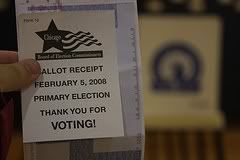
Election Officials Probe Use of 'Magic' Invisible Ink Pens in 49th Ward |
The Chicago-Tribune reports:
Chicago election officials Tuesday afternoon were trying to unravel the mystery of the incredible invisible ink.
It's no Agatha Christie novel but a real case for election investigators sent to the 49th Ward's 42nd precinct Tuesday morning, after 20 ballots were cast with "magic" invisible ink pens.
Election officials just smirked, shook their heads in disbelief and called it the most bizarre election snafu in recent memory.
Apparently, said city election board spokesman James Allen, the poll workers told incredulous voters—including one spouse of an election judge—that the stylus used for touch-screen voting was actually an inkless pen to fill out paper ballots.
"You spend months trying to prepare for every contingency," Allen said. "Trying to anticipate every possible way people might be confused . . . then this? Incredible."
Even the ballot scanning machine knew better, he said, rejecting all 20 ballots as blank.
"Each time, the judges overrode the scanner and recorded the vote," he said.
By 3 p.m., only five of the 20 voters had been contacted to return to recast their votes.
"I'm incredibly angry, and I feel so dumb," said Amy Carlton, 38, of Rogers Park. "And I am not a dumb person."
Carlton said all the judges at the polling place insisted that they had been trained in the use of the "magic" pens.
"I've voted before," Carlton said. "I was thinking, 'This is crazy,' but when someone in authority insists, what are you supposed to do?"
Election officials were encouraging any affected voters to call 312-269-7870. They said those voters can recast their votes if they return to the polling place.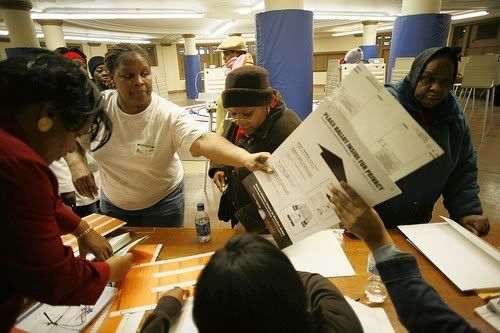
Friday, January 11, 2008
| [+/-] |
Obama Campaign Memo |
A summary of the Obama campaign's charge that Hillary Clinton's campaign is using race as an issue in the election surfaces in the form of a memo
Subject: MUST READ: Key S.C. figure takes issue with Clintons
SHUCK AND JIVE
Clinton Supporter Andrew Cuomo, Referring To Obama, Said “You Can’t Shuck And Jive At A Press Conference. All Those Moves You Can Make With The Press Don’t Work When You’re In Someone’s Living Room.” Clinton-supporting New York Attorney General Andrew Cuomo said the thing that’s great about New Hampshire is that you have to go out and meet people rather than “shuck and jive” through press conferences there. Cuomo said of New Hampshire on an Albany radio station: “It’s not a TV-crazed race. Frankly, you can’t buyyour way into it. You can’t shuck and jive at a press conference. All those moves you can make with the press don’t work when you’re in someone’s living room.” [Newsday, 1/11/08]
MARTIN LUTHER KING / LYNDON JOHNSON COMPARISON
Clinton, Criticizing Obama For Promising “False Hope” Said That While MLKJr. Spoke On Behalf Of Civil Rights, President Lyndon Johnson Was The One Who Got Legislation Passed: “It Took A President To Get It Done.” Clinton rejoined the running argument over hope and “false hope” in an interview in Dover this afternoon, reminding Fox’s Major Garrett that while Martin Luther
King Jr. spoke on behalf of civil rights, President Lyndon Johnson was the one who got the legislation passed. Hillary was asked about Obama’s rejoinder that there’s something vaguely un-American about dismissing hopes as false, and that it doesn’t jibe with the careers of figures like John F. Kennedy and King. “Dr. King’s dream began to be realized when President Johnson passed the Civil Rights Act,” Clinton said. “It took a president to get it done.” [Politico, 1/7/08; Video]
Clinton Introducer Said JFK Gave Hope, But Was Assassinated. Clinton introducer: “If you look back, some people have been comparing one of the other candidates to JFK and he was a wonderful leader, he gave us a lot of hope but he was assassinated and Lyndon Baines Johnson actually did all his work and got the republicans to pass all those measures.” [HRC, Dover, NH,
1/7/08] AUDIO ATTACHED
NELSON MANDELA
Bill Clinton Implied Hillary Clinton Is Stronger Than Nelson Mandela. “I have been blessed in my life to know some of the greatest figures of the last hundred years. […] I go to Nelson Mandela’s birthday party every year and we’re still very close. […] But if you said to me, ‘You’ve got one last job for your country but it’s hazardous and you may not get out with life and limb intact and you have to do it alone except I’ll let you take one other person, and I had to pick one person whom I knew who would never blink, who would never turn back, who would make great decisions […] I would pick Hillary.’” [ABC News, 1/7/08; Audio]
DRUG USE
Clinton’s NH Campaign Chair Raised The Youthful Drug Use Of Obama And Said It Would “Open The Door To Further Queries On The Matter.” Clinton’s Campaign Issued A Statement Distancing Themselves From Shaheen’s Comments And Shaheen Issued A Statement Saying That He “Deeply Regret[s] The Comments.” The Democratic presidential race took on a decidedly nasty and personal turn, with the New Hampshire co-chair for Clinton, raising the youthful drug use of Obama. Shaheen said Obama’s having been so open — as opposed to then-Gov. George W. Bush, who refused to detail his past drug use during his 2000 presidential campaign — will “open the door to further queries on the matter. It’ll be, ‘When was the last time? Did you ever give drugs to anyone? Did you sell them to anyone?’” Shaheen said. “There are so many openings for Republican dirty tricks. It’s hard to overcome.” By the end of the day, Clinton campaign spokesman Phil Singer had issued a statement asserting that “these comments were not authorized or condoned by the campaign in any way.” And Shaheen himself issued a statement: “I deeply regret the comments I made today and they were not authorized by the campaign in any way.” [ABC News, 12/12/07]
Mark Penn, In Trying To Defend His Campaign Over Bill Shaheen’s Obama Drug Use Comments, Used The Word “Cocaine,” Drawing A Rebuke From Edwards Adviser Joe Trippi. Mark Penn, defending the Clinton campaign in light of Bill Shaheen’s comments about Obama’s drug use, repeatedly referenced Obama’s cocaine use. Edwards adviser Joe Trippi accused Penn of dropping the word “cocaine” deliberately. Mark Penn said “Well, I think we have made clear that the — the issue related to cocaine use is not something that the campaign was in any way raising. And I think that has been made clear. I think this kindergarten thing was a joke after Senator.” Joe Trippi responded and said “I think he just did it again. He just did it again. …
This guy’s been filibustering on this. He just said cocaine again.”
[Politico, 12/13/07; Video]
FAIRY TALE
Donna Brazile Lashed Into Bill Clinton For Comparing Obama To A “Fairy Tale” And Said “It’s An Insult… As An African-American” And That His Tone And Words Are “Very Depressing.” Donna Brazile lit into Bill Clinton over his insulting comments of Obama, where he called him a “fairy tale” and said “I could understand his frustration at this moment. But, look, he shouldn’t take out all his pain on Barack Obama. It’s time that they regroup. Figure out what Hillary needs to do to get her campaign back on track. It sounds like sour grapes coming from the former commander in chief. Someone that many Democrats hold in high esteem. For him to go after Obama, using a fairy tale, calling him as he did last week. It’s an insult. And I will tell you,
as an African-American, I find his tone and his words to be very depressing. .. I think his tone, I think calling Barack Obama a kid, he is a UnitedStates senator.” [Politico, 1/8/08]
Amaya Smith
South Carolina Press Secretary
Obama for America
Wednesday, December 19, 2007
| [+/-] |
Book Links Jamming to GOP 'High Ups' |
Operative imprisoned in case tells his story.
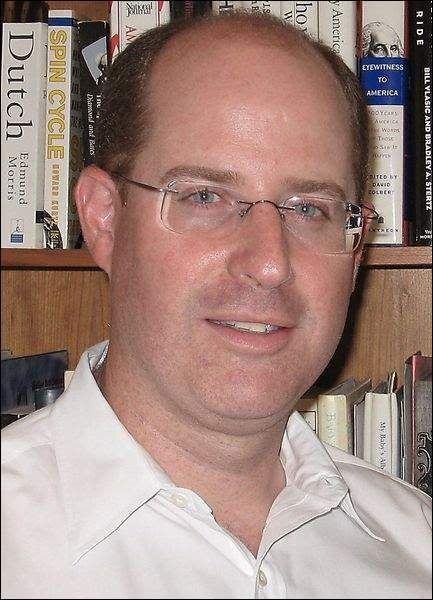 Republican consultant Allen Raymond
The Concord Monitor reports:
The conspiracy to jam New Hampshire Democratic Party phone lines on Election Day 2002 must have gone to the top of the Republican Party, one of the operatives imprisoned in the scheme writes in a forthcoming book.
Republican consultant Allen Raymond writes that he became involved only because he'd been called by James Tobin, then the New England political director for the Republican National Committee.
"The Bush White House had complete control of the RNC, and there was no way someone like Tobin was going to try what he was proposing without first getting it vetted by his high-ups," Raymond wrote in How To Rig an Election, a book set for publication next month. "That's if Tobin, rather than one of his bosses, had even thought of the ploy himself - which seemed unlikely."
Raymond, who once had the same RNC job as Tobin for the mid-Atlantic region, said that before Tobin's call, his telemarketing outfit, GOP Marketplace, had been shut out of RNC jobs. Allen figured he'd lost favor because he publicly aired his disdain for Bush and feuded with a Bush vendor. "I figured this was the Dare - the Bushies' way of making me prove my stripes to get back into the club," he wrote.
In an interview, Raymond said the book had two aims: To entertain - he said he aimed for a cross between Ball Four and Wise Guys (the book Goodfellas was based on) - and to follow the adage "sunlight's the best disinfectant."
"Anybody who reads this book and is mad at me has no sense of humor," he said.
The Monitor obtained an advance copy yesterday. The book is set for release Jan. 8, the day of New Hampshire's presidential primary.
Former gossip columnist Ian Spiegelman, who used to write the New York Post's Page Six, co-wrote the book, which is full of vulgar, colorful language. Raymond said he was connected with Spiegelman through his agent.
"The gossip world at the level he was working is highly charged, highly political," Raymond said. "So I knew that he'd understand what I was talking about."
President Bush is described as a "Connecticut-raised cowboy who'd been blind drunk until he was forty." Steve Forbes, whose presidential campaign Raymond worked for in 2000, "looked like he'd been put together on an operating table" and "had a stammering speech pattern that made you think he was on the verge of a seizure."
Raymond, 40, also knocks the Republican Party that employed him for nearly a decade. "Ever hear the one about the president who picked a land war in the Middle East?" he writes. "Or the one about the vice president who took a scattergun to an old man's face? And then got the old man to apologize for getting shot? That's the type I was dealing with."
Tobin, meanwhile, is painted as a moderate New Englander who'd gone to work for Bush's campaign and "reinvented himself as a full-fledged, Bible-thumping, fear-mongering acolyte for the Holy Connecticut Cowboy."
The U.S. attorneys who handled Tobin's trial also don't escape derision. Prosecutors Nick Marsh and Andrew Levchuk are described as the "pair from Keystone" who "knew exactly nothing" when they took over the case.
The phone-jamming scheme involved repeated hang-up calls made to jam six phone lines - five at the Democratic Party's get-out-the-vote operation and one for a firefighters union offering rides to the polls. Raymond writes that the plan was to tie up the lines all day, but it was aborted after 90 minutes on orders from then-state Republican Party Chairman John Dowd, who insisted it was illegal.
The calls were made on the day of the down-to-the-wire Senate race between Jeanne Shaheen and John Sununu, whose names are almost afterthoughts in the book, mentioned only after pages of discussing the scheme. Sununu won the election by 19,571 votes; the two may face a rematch next year.
Raymond, who served three months in federal prison, and two other men pleaded guilty to criminal conspiracy charges for their roles in the scheme. Chuck McGee, executive director of the New Hampshire Republican Party at the time, came up with the idea. Idaho telemarketer Shaun Hansen owned the company that made the calls.
As the phone-jamming blew up in the press and the FBI investigated, Allen wrote, the RNC opted for "the old-school cover-up" route.
Tobin pleaded not guilty, went to trial and was convicted of telephone harassment in 2005. This spring, an appeals court overturned the ruling and sent the case back to U.S. District Court in Concord for further arguments. Tobin is slated for a new trial in February, though Judge Steven McAuliffe is considering a motion to acquit him.
To Raymond, Tobin was the scheme's "linchpin," and he wrote that he "couldn't believe it" when he read in the newspaper that Tobin pleaded not guilty.
"Now, Tobin was not mentally defective; he could not have believed his own lies," Raymond wrote. To Raymond, he said, the key question is: "Who is he protecting?"
Raymond repeatedly notes that the RNC has paid millions for Tobin's legal defense. "My old pals at the Republican National Committee were spending almost $3 million on my coconspirator's legal defense because he was still a loyal member of the GOP family, while at the same time labeling me a liar, a rogue and a thief to any news outlet that would listen," he wrote.
The smaller details of being a man under indictment are also detailed in the book.
Raymond went to great pains to convince lawyers at the Department of Justice that he wasn't what they were expecting - "a slimy D.C. scoundrel in a Gucci suit, French cuffs, tassel shoes and a fat watch." When he was under investigation, he owned three watches worth a total of $6,000 - so he went to CVS and bought a Timex. He also pulled out the first suit he'd owned, "a power tie from 1990" and loafers with a whole.
"When I put the whole ensemble together, (my wife) Elizabeth just clucked her tongue and gave me the thumbs-up," he wrote. "And then I jumped into my Audi and went to my meeting."
In addition to phone jamming, Raymond elaborates on other political dirty tricks, such as using racial tensions to target phone calls in a New Jersey congressional race that sounded as if they were coming in support of his opponent. He deployed the "angry black man" voice on Eastern European Democrats and used actors with "thick Spanish accents" to tape calls aimed at union households.
These days, Raymond said, he's promoting his book, coaching little league and working at a few business ventures on the side. He lives in the Washington, D.C., area with his wife and two elementary-school-age sons.
He's done with working in politics. As a felon, he said, he's not allowed to vote. But if he could, he'd call himself undeclared, no longer a Republican.
"I love politics, but I'm done. I'll never make a living in politics again," Raymond said in the interview. "After what I went through, one, who would hire me? And two, why would I ever want to work for anybody who would hire me?"
| [+/-] |
Is Hillary or Barack More Vulnerable? |
At ConsortiumNews.com, Robert Parry reports:
Even as Hillary Clinton’s operatives were dropping hints that Republicans would exploit Barack Obama’s youthful drug use, some Clinton insiders privately worried about her own vulnerability because the Bush administration possesses detailed knowledge of her movements – and her husband’s – over the past seven years.
Because of Sen. Clinton’s unique status as the first former First Lady to run for President – and because her husband was succeeded by a Republican – she is the first candidate to have both her and her spouse be subject to regular, long-term surveillance by an Executive Branch agency controlled by the opposing political party.
Since they left the White House in 2001, Bill and Hillary Clinton have been under the protection of the Secret Service, formerly a branch of the Treasury Department and now part of the Homeland Security Department. Records are maintained showing where they go and whom they meet.
Homeland Security is under the control of Michael Chertoff, a longtime Clinton nemesis dating back to his work as a Republican lawyer on the Senate’s Whitewater investigation in the 1990s. In 2003, Sen. Clinton cast the sole dissenting vote against Chertoff’s nomination as a federal judge in protest against his abrasive conduct during the Whitewater inquiry.
Though Secret Service records are supposed to be closely held secrets, a source close to the Clintons told me that it is believed that senior Republicans have received regular briefings about movements of the Clintons that might prove embarrassing if released during the general election campaign.
Given this possibility, Clinton operatives were walking a tightrope when they began raising questions about what bare-knuckled Republican operatives might do with Sen. Obama’s public acknowledgement that he experimented with drugs, including cocaine, as a young man.
As part of the Clinton campaign’s broader effort to raise doubts about Obama’s electability, Clinton’s New Hampshire co-chairman Bill Shaheen told the Washington Post that “one of the things [the Republicans are] certainly going to jump on is his drug use. …
“It’ll be, ‘When was the last time? Did you ever give drugs to anyone? Did you sell them to anyone?’ … There are so many openings for Republican dirty tricks. It’s hard to overcome.”
Though an uproar over the remarks soon forced Shaheen’s resignation, Clinton’s chief strategist Mark Penn managed to slip the word “cocaine” into a denial that the Clinton campaign was playing its own dirty trick.
"The issue related to cocaine use is not something the campaign is in any way raising," Penn said on MSNBC’s "Hardball."
The Clinton campaign’s gamesmanship prompted more protests from the Obama camp and a satire by New York Times columnist Maureen Dowd who recounted a mock Iowa debate in which Hillary Clinton inserted drug references at every possible opportunity. [NYT, Dec. 16, 2007]
Clinton/Bush Ties
But there is a history to the Clinton and Bush families possessing damaging secrets about the other, a kind of balance of terror in which the Bushes usually have the upper hand and the Clintons have chosen mostly to make concessions and seek favors from the more powerful family.
On Dec. 17 in South Carolina, Bill Clinton demonstrated that tendency, saying Hillary Clinton’s first act as President would be to send Bill Clinton and George H.W. Bush on an around-the-world mission to repair America’s image.
“The first thing she intends to do is to send me and former President Bush and a number of other people around the world to tell them that America is open for business and cooperation again,” said Bill Clinton, who is proud that he has accompanied the senior Bush on many international humanitarian missions.
Clinton’s comment could be viewed as both a slap at George W. Bush and a kiss-up to his father. But the elder Bush responded icily through a spokesman, saying he supports his son’s foreign policy and “never discussed an ‘around-the-world mission’ with either former President Bill Clinton or Sen. Clinton.”
It was not the first time that the senior Bush, the patriarch of America’s most prominent political family, had put down the upstart Clinton.
In 1992 when Clinton – as Arkansas governor – sought the White House, then-President Bush encouraged his subordinates to find a “silver bullet” that would kill off Clinton’s presidential hopes.
The senior Bush later acknowledged to FBI investigators that he was “nagging” his aides to push for more information about Bill Clinton’s student travels to the Soviet Union and Czechoslovakia and about right-wing rumors that Clinton had sought to renounce his U.S. citizenship.
“Hypothetically speaking, President Bush advised that he would not have directed anyone to investigate the possibility that Clinton had renounced his citizenship because he would have relied on others to make this decision,” according to an FBI report on its interview with the elder Bush. “He [Bush] would have said something like, ‘Let’s get it out’ or ‘Hope the truth gets out.’” [For details, see Robert Parry’s Secrecy & Privilege.]
With such high-level urging, White House chief of staff James Baker instructed his aide, Janet Mullins, to ask Steven Berry, assistant secretary of state for legislative affairs, about progress on right-wing press requests for information about Clinton’s student travel.
Eventually, the White House interest was communicated to State Department official Elizabeth Tamposi, a Bush political appointee who saw it as a green light to move ahead with the legally questionable search.
On the night of Sept. 30, 1992, Tamposi dispatched three aides to the federal records center in Suitland, Maryland, where they searched Clinton’s passport file as well as his mother’s, presumably because they thought it might contain some references to Clinton.
In a later press interview, Tamposi asserted that she ordered the search after Berry had pressured her to “dig up dirt on Clinton” for the Bush White House.
Press Leak
Though finding no letter renouncing citizenship, the State Department officials still made use of Clinton’s passport application, which had staple holes and a slight tear in the corner.
The tear was easily explained by the routine practice of stapling a photo or money order to the application, but Tamposi seized on the ripped page to justify a new suspicion, that a Clinton ally at the State Department had removed the renunciation letter.
Tamposi shaped that speculation into a criminal referral which was forwarded to the Justice Department. Thin as the case was, George H.W. Bush’s reelection campaign had its official action so the renunciation rumor could be turned into a public issue.
Within hours of the criminal referral, someone from the Bush camp leaked word about the confidential FBI investigation to reporters at Newsweek magazine.
The Newsweek story about the tampering investigation hit the newsstands on Oct. 4, 1992. The article suggested that a Clinton backer might have removed incriminating material from Clinton’s passport file, precisely the spin that the Bush people wanted.
Immediately, President George H.W. Bush took the offensive, using the press frenzy over the tampering story to attack Clinton’s patriotism on a variety of fronts, including his student trip to Moscow in 1970. With his patriotism challenged, Clinton saw his once-formidable lead shrink.
Clinton’s campaign ultimately was saved by quick-thinking Democrats on Capitol Hill who exposed the passport leak as a political dirty trick. That forced the elder Bush into a quasi-apology for the scandal, which became known as “Passport-gate.”
After Clinton won the election, however, the criminality of the dirty trick was swept under the rug by Republican special prosecutor Joseph DiGenova, who was appointed to investigate by a federal judicial panel run by right-wing appellate judge David Sentelle.
(Showing what a small world political Washington can be, DiGenova is married to Republican lawyer Victoria Toensing, a key figure in the public attacks on former U.S. Ambassador Joseph Wilson and his wife, CIA officer Valerie Plame, over Wilson’s criticism of the WMD intelligence that George W. Bush used to justify invading Iraq.)
Unearthing Dirt
As President, Clinton not only turned the other cheek in regard to “Passport-gate” but made sure that federal investigators averted their eyes from other scandals implicating former President Bush. Clinton presumably thought that his magnanimity could gain some reciprocity from Republicans when it came to his own scandals.
As Clinton was taking office in 1993, three important investigations were underway, all of which Clinton could have helped by ordering key documents declassified or giving other backing to the investigators.
Special prosecutor Lawrence Walsh was still battling the cover-up that had surrounded the Iran-Contra scandal of the 1980s; Democratic congressmen were digging into the “Iraqgate” scandal, the covert supplying of dangerous weapons to Iraq’s Saddam Hussein in the 1980s; and a House task force was suddenly inundated with evidence pointing to Republican guilt in the “October Surprise” case, alleged interference by the Reagan-Bush campaign in 1980 to undermine President Jimmy Carter’s efforts to free 52 American hostages then held in Iran.
Combined, those three investigations could have rewritten the history of the 1980s, exposing serious wrongdoing by Republicans who had held the White House for a dozen years. The full story also would likely have terminated the presidential ambitions of the powerful Bush family, since George H.W. Bush was implicated in all three scandals.
However, Clinton and the leaders of the Democratic majorities in Congress didn’t care enough about the truth to fight for it. Instead, they saw the truth as a bargaining chip that could be cheaply traded away.
Clinton agreed to let George H.W. Bush retreat gracefully into retirement despite Bush’s brazen attempt to destroy Walsh’s criminal investigation by issuing six pardons to Iran-Contra defendants on Christmas Eve 1992.
In his 2004 memoir, My Life, Clinton wrote that he “disagreed with the pardons and could have made more of them but didn’t.” Clinton cited several reasons for giving his predecessor a pass.
“I wanted the country to be more united, not more divided, even if that split would be to my political advantage,” Clinton wrote. “Finally, President Bush had given decades of service to our country, and I thought we should allow him to retire in peace, leaving the matter between him and his conscience.”
By his choice of words, Clinton revealed how he saw information – not something that belonged to the American people and that had intrinsic value to the democratic process – but as a potential weapon that could be put to “political advantage.”
Joining the Cover-ups
On the Iran-Contra pardons, Clinton saw himself as generously passing up a club that he could have wielded to bludgeon an adversary. He chose instead to join in a cover-up in the name of national unity.
Similarly, the Democratic congressional leadership ignored the flood of incriminating evidence pouring into the “October Surprise” task force in December 1992.
Chief counsel Lawrence Barcella told me later that he urged task force chairman Lee Hamilton to extend the investigation several months to examine this new evidence of Republican guilt, but Hamilton ordered Barcella simply to wrap up the probe with a finding that the Reagan-Bush campaign had done nothing wrong.
Some of the new incriminating evidence – including an unprecedented report from the Russian government about its knowledge of illicit Republican contacts with Iran – was simply hidden away in boxes that I discovered two years later and dubbed “The October Surprise X-Files.”
The “Iraqgate” investigation met a similar fate under Clinton’s Justice Department, which chose to ignore or dismiss evidence of covert shipments of dangerous war materiel to Saddam Hussein during the 1980s.
When former Reagan national security official Howard Teicher came forward with an affidavit describing secret U.S.-backed arms shipments to Iraq, Clinton’s Justice Department went on the offensive – against Teicher, bullying him into silence.
Even as Republicans pounded Clinton over his Whitewater real estate deal and other alleged misdeeds, his administration continued to see no evil when it came to criminal acts implicating Ronald Reagan or George H.W. Bush.
True to form, the Clinton administration did nothing when Reagan’s 1984 campaign chief Ed Rollins wrote in his 1996 memoir Bare Knuckles and Back Rooms that a top Filipino politician had admitted delivering an illegal $10 million cash payment to Reagan from Philippine dictator Ferdinand Marcos.
"I was the guy who gave the ten million from Marcos to your campaign," the Filipino told Rollins in 1991, according to the memoir. "I was the guy who made the arrangements and delivered the cash personally. ...It was a personal gift from Marcos to Reagan."
However, Rollins has refused since to divulge the name of either the Filipino politician or the Republican lobbyist who allegedly handled the pay-off. The stunning anecdote did attract some press coverage in 1996 but the story died because the Clinton administration made no effort to follow it up.
(Rollins is now chairman of Republican Mike Huckabee’s presidential campaign.) [For details on Marcos-Reagan case, see Consortiumnews.com’s “Huckabee’s Chairman Hid Payoff Secret.”]
Off the Radar
During Clinton’s presidency, I approached then-deputy White House chief of staff John Podesta and other senior officials to ask whether they had any plans to pursue important investigations that had been left undone in 1993. I was told those issues simply weren’t “on the radar scopes.”
However, if Clinton thought that his collaboration in keeping the Reagan-Bush secrets from the American people would earn him some bipartisan help from the Republicans, he was mistaken.
Clinton saw his prized domestic agenda, including Hillary Clinton’s health care reform, defeated; his party lose control of Congress in 1994; the House vote to impeach him in 1998 for lying about an extramarital sexual relationship; and George H.W. Bush’s oldest son steal the 2000 election from Clinton’s Vice President, Al Gore.
Now, as Campaign 2008 begins to unfold, a similar dynamic is in place.
George W. Bush has engaged in a variety of acts that appear to be illegal, extra-legal or unconstitutional, while the Clintons are again signaling that they have no intention of holding the Bush family accountable.
If Bill Clinton is right – that his wife’s first act as President would be to ask him and George H.W. Bush to go on an around-the-world goodwill mission – Hillary Clinton is making it clear that she has no intention of holding George W. Bush accountable for any wrongdoing.
There is no way that George H.W. Bush would help the Clintons on the diplomatic front if they were taking action against his eldest son.
So, the stage seems set for another Bush-Clinton revolving door where the Bushes get a free pass as they leave in exchange for the Clintons hoping against hope that the powerful family will show them a little respect and maybe a touch of mercy.
Or, as the Clinton friend suggested to me last week, maybe their real hope is that the Bushes won’t reveal what they’ve learned from the Secret Service records detailing where the Clintons have gone and with whom.
While “Passport-gate” is now only a little-remembered chapter of Campaign 1992, it does show how easily a sitting President can get subordinates to stretch – or even break – the law to unearth information that can serve a political purpose.
In George W. Bush’s case, the temptation will be strong to use whatever means he has at his disposal to ensure that his successor continues his “war on terror” policies and doesn’t authorize serious investigations into controversies such as torture and illegal wiretapping.
The Clintons also have to be nervous because the Republicans have the advantage of an ideologically committed news media, from popular talk-radio hosts and Internet bloggers to Rev. Sun Myung Moon’s Washington Times and Rupert Murdoch’s Fox News.
If Sen. Clinton wins the Democratic nomination, any information, especially some tidbit that suggests sexual improprieties, could be leaked to any number of right-wing media outlets and quickly jump into the mainstream press.
A scandal would prove especially devastating if backed by real information, like what might be available in Secret Service records.
One reason that civil libertarians have been alarmed about Bush’s assertion of nearly unlimited executive authority over such tactics as wiretapping, data-mining and domestic spy satellites is that it has coincided with a Republican goal for near-permanent political control of the U.S. government.
While the Clinton campaign is surely right that the Republicans will exploit whatever they can to discredit Sen. Obama, it appears to be equally true that they will use whatever they have to gain an advantage with the Clintons, too.
