CBS News reports:
Is Don Siegelman in prison because he’s a criminal or because he belonged to the wrong political party in Alabama? Siegelman is the former governor of Alabama, and he was the most successful Democrat in that Republican state. But while he was governor, the U.S. Justice Department launched multiple investigations that went on year after year until, finally, a jury convicted Siegelman of bribery.
Now, many Democrats and Republicans have become suspicious of the Justice Department’s motivations. As correspondent Scott Pelley reports, 52 former state attorneys-general have asked Congress to investigate whether the prosecution of Siegelman was pursued not because of a crime but because of politics.
Ten years ago life was good for Don Siegelman. After he became governor, many believed he was headed to a career in national politics. In 1999, Siegelman’s pet project was raising money to improve education, so he started a campaign to ask voters to approve a state lottery. He challenged Republicans to come up with a better idea.
“You tell us how you’re going to pay for college scholarships. You tell us how you’re going to put state of the art computers inside every school in this state,” he said.
But now the applause has long faded. Today, Siegelman is at a federal prison camp in Louisiana. He’s doing seven years. The main charge against him was that he took a bribe, giving a position on a state board to businessman Richard Scrushy, who had made a big donation to that lottery campaign. There was a star witness, Nick Bailey, a Siegelman aide who had a vivid story to tell.
“Mr. Bailey had indicated that there had been a meeting with Governor Siegelman and Mr. Scrushy, a private meeting in the Governor's office, just the two of them,” says Doug Jones, who was one of Siegelman’s lawyers. “And then, as soon as Mr. Scrushy left, the governor walked out with a $250,000 check that he said Scrushy have given him for the lottery foundation.”
“Had the check in his hand right then and there? “ Pelley asks.
“Had the check in his hand right then,” Jones says.
“That Scrushy had just handed to him, according to Bailey's testimony?” Pelley asks.
“That's right, showed it to Mr. Bailey. And Nick asked him, ‘Well, what does he want for it?’ And Governor Siegelman allegedly said, ‘A seat on the CON Board.’ Nick asked him, ‘Can we do that?’ And he said, ‘I think so,’” Jones says.
The CON board regulates hospital construction, and Scrushy ran a healthcare company. Both Siegelman and Scrushy were convicted in federal court.
But, as 60 Minutes found out, the imprisonment of Don Siegelman is not nearly as simple as that.
“I haven't seen a case with this many red flags on it that pointed towards a real injustice being done,” says Grant Woods, the former Republican attorney general of Arizona.
Woods is one of the 52 former state attorneys-general, of both parties, who’ve asked Congress to investigate the Siegelman case.
“I personally believe that what happened here is that they targeted Don Siegelman because they could not beat him fair and square. This was a Republican state and he was the one Democrat they could never get rid of,” Woods says.
Now a Republican lawyer from Alabama, Jill Simpson, has come forward to claim that the Siegelman prosecution was part of a five-year secret campaign to ruin the governor. Simpson told 60 Minutes she did what’s called “opposition research” for the Republican party. She says during a meeting in 2001, Karl Rove, President Bush’s senior political advisor, asked her to try to catch Siegelman cheating on his wife.
"Karl Rove asked you to take pictures of Siegelman?" Pelley asks.
"Yes," Simpson replies.
"In a compromising, sexual position with one of his aides," Pelley clarifies.
"Yes, if I could," Simpson says.
She says she spied on Siegelman for months but saw nothing. Even though she was working as a Republican campaign operative, Simpson says she wanted to talk to 60 Minutes because Siegelman’s prison sentence bothers her conscience.
Simpson says she wasn’t surprised that Rove made this request. Asked why not, she tells Pelley, “I had had other requests for intelligence before.”
“From Karl Rove?” Pelley asks.
“Yes,” Simpson says.
Rove was a strategist in Alabama. Simpson says she worked with him on several campaigns.
60 Minutes contacted Rove. Through his lawyer, he denied Simpson’s allegations. One of Rove’s close Alabama associates was Republican consultant Bill Canary. Simpson says she was on a conference call in 2002 when Canary told her she didn’t have to do more intelligence work because, as Canary allegedly said, “My girls” can take care of Siegelman. Simpson says she asked “Who are your girls?”
“And he says, ‘Oh, my wife, Leura. You know, she's the Middle District United States Attorney.’ And he said, ‘And then Alice Martin. She is the Northern District Attorney, and I've helped with her campaign,’” Simpson says.
“Federal prosecutors?” Pelley asks.
“Yes, Sir,” she says.
Bill Canary denies the conversation ever happened. He told 60 Minutes he never tried to influence any government official in the case. His wife Leura Canary and Alice Martin are top federal prosecutors in the state. Both were appointed by President Bush, and their offices investigated Siegelman. Details of some of those investigations leaked to the press. And Siegelman lost his 2002 re-election campaign narrowly to Republican Bob Riley.
Two years later, as Siegelman geared up to run again, the Justice Department took one of its Siegelman investigations to trial-an indictment involving an alleged Medicaid scam.
“He’s indicted. He goes to trial. That's a pretty big deal to have your former governor on trial. Everybody's there. The government gives their opening argument. The judge says, ‘I want to see you in chambers because this case, there's no case here,’" Grant Woods says.
Woods says the judge threw the case out, without a witness testifying. “The case is so lame that he throws it out,” he says.
Vindicated, Siegelman focused on winning the 2006 election. And that’s when Jill Simpson says she heard the Justice Department was going to try again. She says she heard it from a former classmate and work associate Rob Riley, the son of the new Republican governor.
“Rob said that they had gotten wind that Don was going to run again,” she says.
“And Rob Riley said what about that?” Pelley asks.
“They just couldn't have that happen,” Simpson says.
Asked how they were going to prevent that from happening, she says, “Well, they had to re-indict him, is what Rob said.”
Simpson told this same story, under oath, to Congressional investigators in a closed session. Rob Riley told 60 Minutes he never talked to Jill Simpson about this.
Four months after Simpson says they spoke, Siegelman was indicted on new charges. Doug Jones, Siegelman’s lawyer, says one of the prosecutors told him that Justice Department headquarters in Washington had ordered a top to bottom review of the case. Today, the Alabama prosecutors deny that it was Washington - but whoever ordered it, there was a big boost to the investigation.
“They started over. People started getting subpoenas that had never gotten subpoenas before, for testimony, for records. The governor's brother, his bank records started getting subpoenaed. The net was cast much wider than had ever been cast before,” Jones says.
“You know, on the other hand, what's wrong with the Department of Justice vigorously investigating a case if they think there is an indictment to be made on public corruption charges?” Pelley asks.
“Well, you still have to investigate crimes, not people. It undermines the entire system of justice because at that point anybody can be a target. Any prosecutor can look across the table and say, ‘You know what? I just don't like you,’” Jones says.
The prosecution was handled by the office of U.S. Attorney Leura Canary, whose husband Bill Canary had run the campaign of Siegelman’s opponent, Gov. Riley.
“Why would you do it that way?” Woods asks. “Why wouldn't you say, ‘You know what? We're going to bring in someone from another jurisdiction to do it. There's a lot of United States attorneys around the country. We'll have somebody come in and do this case.’ That's not what happened in Alabama. Every time they had the chance to go the extra mile to be independent and objective, they didn't do it.”
Leura Canary handled the case for eight months. When defense attorneys objected, she turned it over to her assistants and says that she had nothing further to do with it.
In this new investigation, prosecutors zeroed in on that vivid story told by Siegelman’s aide, Nick Bailey, who said he saw the governor with a check in his hand after meeting Richard Scrushy. Trouble was, Bailey was wrong about the check, and Siegelman’s lawyer says prosecutors knew it.
“They got a copy of the check. And the check was cut days after that meeting. There was no way possible for Siegelman to have walked out of that meeting with a check in his hand,” Jones explains.
“That would seem like a problem with the prosecution's case,” Pelley remarks.
“It was a huge problem especially when you've got a guy who's credibility was going to be the lynch pin of that case. It was a huge problem,” Jones says.
And there was another problem with the prosecutor’s star witness: Nick Bailey was a crook. Unknown to Siegelman, Bailey had been extorting money from Alabama businessmen. Facing ten years in prison, Bailey agreed to cooperate with prosecutors to get a lighter sentence.
60 Minutes went to talk to Bailey. The Justice Department wouldn’t let our cameras into the prison, but we met with him for hours.
Bailey told 60 Minutes that before the Siegelman trial, he spoke to prosecutors more than 70 times, and he admitted that during those conversations he had trouble remembering details. He told 60 Minutes the prosecutors were so frustrated, they made him write his proposed testimony over and over to get his story straight.
If Bailey’s telling the truth, his notes, by law, should have been turned over to the defense. But Siegelman’s lawyers tell 60 Minutes they never saw any such notes and never had a chance to show the jury just how much Bailey’s story had changed.
No one at the Justice Department would be interviewed for this story, but they did send a statement which read, in part, "This case was brought by career prosecutors … based upon the law and the evidence alone. After considering that evidence … a jury of Mr. Siegelman's peers found him guilty beyond a reasonable doubt.”
But Grant Woods, the former attorney general of Arizona, says the case should never have gone to trial. “The prosecutor's gotta look at it and say, ‘Hey, is this the sort of thing that we're really talking about when we're talking about bribery?’ Because what the public needs to know here is there is no allegation that Don Siegelman ever put one penny in his pocket,” he says.
Richard Scrushy did make donations totaling $500,000 to that education lottery campaign, and after serving on the hospital board under three previous governors, Scrushy was re-appointed by Siegelman.
But Woods says that’s politics, not bribery. “You do a bribery when someone has a real personal benefit. Not, ‘Hey, I would like for you to help out on this project which I think is good for my state.’ If you're going to start indicting people and putting them in prison for that, then you might as well just build nine or ten new federal prisons because that happens everyday in every statehouse, in every city council, and in the Congress of the United States,” he says.
“What you seem to be saying here is that this is analogous to giving a great deal of money to a presidential campaign. And as a result, you become ambassador to Paris,” Pelley remarks.
“Exactly. That's exactly right,” Woods says.
Siegelman was campaigning in the 2006 Democratic primary as he went to trial. “We’re going to turn this bus into what we call the night shift, because after the trial every day we’re gonna be hittin the trail every day,” he said.
But he lost in the primary. After two months, the jury deadlocked twice, then, voted to convict on its third deliberation. Many legal minds were shocked when federal judge Mark Fuller, at sentencing, sent Siegelman directly to prison without allowing the usual 45 days before reporting.
“He had him manacled around his legs like we do with crazed killers. And whisked off to prison just like that. Now what does that tell you? That tells you that this was personal. You would not do that to a former governor,” Woods says.
“Would you do that to any white collar criminal?” Pelley asks.
“No, I haven't seen it done,” Woods says.
“Help me understand something. You're blaming the Republican administration for this prosecution. You're saying it was a political prosecution. You are a Republican. How do I reconcile that?” Pelley asks.
“We're Americans first. And you got to call it as you see it. And you got to stand up for what's right in this country,” Woods says.
Karl Rove and others at the White House were subpoenaed to testify before Congress but they refused to appear. And the Justice Department has refused to turn over hundreds of documents in the case.
Sunday, February 24, 2008
| [+/-] |
The Prosecution of Governor Siegelman |
Wednesday, January 23, 2008
| [+/-] |
Drought Could Shut Down Nuclear Power Plants |
Southeast water shortage a factor in huge cooling requirements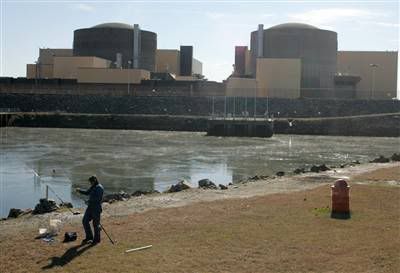
MSNBC reports:
Nuclear reactors across the Southeast could be forced to throttle back or temporarily shut down later this year because drought is drying up the rivers and lakes that supply power plants with the awesome amounts of cooling water they need to operate.
Utility officials say such shutdowns probably wouldn’t result in blackouts. But they could lead to shockingly higher electric bills for millions of Southerners, because the region’s utilities could be forced to buy expensive replacement power from other energy companies.
Already, there has been one brief, drought-related shutdown, at a reactor in Alabama over the summer.
“Water is the nuclear industry’s Achilles’ heel,” said Jim Warren, executive director of N.C. Waste Awareness and Reduction Network, an environmental group critical of nuclear power. “You need a lot of water to operate nuclear plants.” He added: “This is becoming a crisis.”
An Associated Press analysis of the nation’s 104 nuclear reactors found that 24 are in areas experiencing the most severe levels of drought. All but two are built on the shores of lakes and rivers and rely on submerged intake pipes to draw billions of gallons of water for use in cooling and condensing steam after it has turned the plants’ turbines.
Because of the yearlong dry spell gripping the region, the water levels on those lakes and rivers are getting close to the minimums set by the Nuclear Regulatory Commission. Over the next several months, the water could drop below the intake pipes altogether. Or the shallow water could become too hot under the sun to use as coolant.
“If water levels get to a certain point, we’ll have to power it down or go off line,” said Robert Yanity, a spokesman for South Carolina Electric & Gas Co., which operates the Summer nuclear plant outside Columbia, S.C.
Limits on intake pipes
Extending or lowering the intake pipes is not as simple at it sounds and wouldn’t necessarily solve the problem. The pipes are usually made of concrete, can be up to 18 feet in diameter and can extend up to a mile. Modifications to the pipes and pump systems, and their required backups, can cost millions and take several months. If the changes are extensive, they require an NRC review that itself can take months or longer.
Even if a quick extension were possible, the pipes can only go so low. It they are put too close to the bottom of a drought-shrunken lake or river, they can suck up sediment, fish and other debris that could clog the system.
An estimated 3 million customers of the four commercial utilities with reactors in the drought zone get their power from nuclear energy. Also, the quasi-governmental Tennessee Valley Authority, which sells electricity to 8.7 million people in seven states through a network of distributors, generates 30 percent of its power at nuclear plants.
While rain and some snow fell recently, water levels across the region are still well below normal. Most of the severely affected area would need more than a foot of rain in the next three months — an unusually large amount — to ease the drought and relieve pressure on the nuclear plants. And the long-term forecast calls for more dry weather.
Lakes nearing their minimums
At Progress Energy Inc., which operates four reactors in the drought zone, officials warned in November that the drought could force it to shut down its Harris reactor near Raleigh, according to documents obtained by the AP. The water in Harris Lake stands at 218.5 feet — just 3½ feet above the limit set in the plant’s license.
Lake Norman near Charlotte is down to 93.7 feet — less than a foot above the minimum set in the license for Duke Energy Corp.’s McGuire nuclear plant. The lake was at 98.2 feet just a year ago.
“We don’t know what’s going to happen in the future. We know we haven’t gotten enough rain, so we can’t rule anything out,” said Duke spokeswoman Rita Sipe. “But based on what we know now, we don’t believe we’ll have to shut down the plants.”
During Europe’s brutal 2006 heat wave, French, Spanish and German utilities were forced to shut down some of their nuclear plants and reduce power at others because of low water levels — some for as much as a week.
If a prolonged shutdown like that were to happen in the Southeast, utilities in the region might have to buy electricity on the wholesale market, and the high costs could be passed on to customers.
“Currently, nuclear power costs between $5 to $7 to produce a megawatt hour,” said Daniele Seitz, an energy analyst with New York-based Dahlman Rose & Co. “It would cost 10 times that amount that if you had to buy replacement power — especially during the summer.”
At a nuclear plant, water is also used to cool the reactor core and to create the steam that drives the electricity-generating turbines. But those are comparatively small amounts of water, circulating in what are known as closed systems — that is, the water is constantly reused. Water for those two purposes is not threatened by the drought.
Instead, the drought could choke off the billions of gallons of water that pass through the region’s reactors every day to cool used steam. Water sucked from lakes and rivers passes through pipes, which act as a condenser, turning the steam back into water. The outside water never comes into direct contact with the steam or any nuclear material.
At some plants — those with tall, Three Mile Island-style cooling towers — a lot of the water travels up the tower and is lost to evaporation. At other plants, almost all of the water is returned to the lake or river, though significantly hotter because of the heat absorbed from the steam.
Progress spokeswoman Julie Hahn said the Harris reactor, for example, sucks up 33 million gallons a day, with 17 million gallons lost to evaporation via its big cooling towers. Duke’s McGuire plant draws in more than 1 billion gallons a day, but most of it is pumped back to its source.
Nuclear plants are subject to restrictions on the temperature of the discharged coolant, because hot water can kill fish or plants or otherwise disrupt the environment. Those restrictions, coupled with the drought, led to the one-day shutdown Aug. 16 of a TVA reactor at Browns Ferry in Alabama.
The water was low on the Tennessee River and had become warmer than usual under the hot sun. By the time it had been pumped through the Browns Ferry plant, it had become hotter still — too hot to release back into the river, according to the TVA. So the utility shut down a reactor.
David Lochbaum, nuclear project safety director for the Union of Concerned Scientists, warned that nuclear plants are not designed to take the wear and tear of repeatedly stopping and restarting.
“Nuclear plants are best when they flatline — when they stay up and running or shut down for long periods to refuel,” Lochbaum said. “It wears out piping, valves, motors.”
Both the industry and NRC spokesman Scott Burnell said plants can shut down and restart without problems.
Thursday, October 4, 2007
| [+/-] |
Selective Justice in Alabama? |
TIME reports:
On May 8, 2002, Clayton Lamar (Lanny) Young Jr., a lobbyist and landfill developer described by acquaintances as a hard-drinking "good ole boy," was in an expansive mood. In the downtown offices of the U.S. Attorney in Montgomery, Ala., Young settled into his chair, personal lawyer at his side, and proceeded to tell a group of seasoned prosecutors and investigators that he had paid tens of thousands of dollars in apparently illegal campaign contributions to some of the biggest names in Alabama Republican politics. According to Young, among the recipients of his largesse were the state's former attorney general Jeff Sessions, now a U.S. Senator, and William Pryor Jr., Sessions' successor as attorney general and now a federal judge. Young, whose detailed statements are described in documents obtained by TIME, became a key witness in a major case in Alabama that brought down a high-profile politician and landed him in federal prison with an 88-month sentence. As it happened, however, that official was the top Democrat named by Young in a series of interviews, and none of the Republicans whose campaigns he fingered were investigated in the case, let alone prosecuted.
The case of Don Siegelman, the Democratic former Governor of Alabama who was convicted last year on corruption charges, has become a flash point in the debate over the politicization of the Bush Administration's Justice Department. Forty-four former state attorneys general — Republicans and Democrats — have cited "irregularities" in the investigation and prosecution, saying they "call into question the basic fairness that is the linchpin of our system of justice." The Department of Justice and the U.S. Attorney's office strongly deny that politics played any part in Siegelman's prosecution. They say the former Governor, who recently began serving the first months of his more than seven-year sentence, got exactly what he deserved. But Justice officials have refused to turn over documentation on the case requested by the House Judiciary Committee, which scheduled a hearing on Siegelman's prosecution for Oct. 11.
Now TIME has obtained sensitive portions of the requested materials, including FBI and state investigative records that lay out some of Young's testimony. The information provided by the landfill developer was central to roughly half the 32 counts that Siegelman faced for allegedly accepting campaign contributions, money and gifts in exchange for official favors. (Siegelman was acquitted on 25 of those counts and convicted on seven. Young pleaded guilty to bribery-related charges and, in recognition of his cooperation with the government, received a short two-year sentence and fine.) But what Young had to say about Sessions, Pryor and other high-profile Alabama Republicans was even more remarkable for the simple fact that much of it had never before come to light.
The Young transcripts will probably add fuel to charges that the Bush Administration pursued selective justice in Alabama. Leura Canary, the U.S. Attorney whose office drove Siegelman's prosecution, is married to Bill Canary, Alabama's most prominent political operative and a longtime friend of Karl Rove's. In May an Alabama lawyer and Republican activist named Dana Jill Simpson gave a notarized statement that she heard Canary say Rove "had spoken with the Department of Justice" about "pursuing" Siegelman, with help from two of Alabama's U.S. Attorneys. Bill Canary called her charge "outrageous," and other alleged participants in the phone conversation issued similar denials. (The White House declined to comment, citing Siegelman's pending appeal.) But last month Simpson testified behind closed doors before the House Judiciary Committee. Sources tell TIME that, under penalty of perjury, she repeated her allegations about Canary and Rove.
Alabama is as red a state as the clay in its earth. After the years of rule by Southern Democrats, Republicans have now taken up residence in the Governor's mansion, as well as most statewide offices and congressional seats. In the 1990s Rove helped orchestrate a G.O.P. near sweep of the Alabama Supreme Court.
In this new Republican landscape, Siegelman emerged as one of the few Democratic stars, winning the Governor's race in 1998. He lost the seat in a close and contested race in 2002, but polls in 2003 showed that he had a good chance of recapturing the governorship. Then came the first indictment from the U.S. Attorney in Birmingham, charging Siegelman with using his position to rig a state bidding process. A judge dismissed the case in 2004 for lack of evidence. Just as Siegelman was preparing to run for Governor again, a second round of charges was brought in 2005 by the U.S. Attorney's office in Montgomery. His trial in 2006 overlapped with Alabama's Democratic primary, in which Siegelman had initially been a heavy favorite.
The investigation into Siegelman began as an inquiry into a contract held by Young to build a state warehouse in Alabama. Young was a well-liked figure in Montgomery who, by his own account, was in the habit of handing out cash, checks, rides on his private airplane and other goodies to members of both political parties. In return, he apparently hoped to receive favorable treatment for his garbage dumps and other lucrative state-related business.
Young testified that he had furnished Siegelman with an all-terrain vehicle and a motorcycle, lavishing money on the Governor and his aides. But he was an equal-opportunity influence monger. Early in the investigation, in November 2001, Young announced that five years earlier, he "personally provided Sessions with cash campaign contributions," according to an FBI memo of the interview. Prosecutors didn't follow up that surprising statement with questions, but Young volunteered more. The memo adds that "on one occasion he [Young] provided Session [sic] with $5,000 to $7,000 using two intermediaries," one of whom held a senior position with Sessions' campaign. On another occasion, the FBI records show, Young talked about providing "$10,000 to $15,000 to Session [sic]. Young had his secretaries and friends write checks to the Sessions campaign and Young reimbursed the secretaries and friends for their contributions."
If true, Young's statements describe political money laundering that would be a clear violation of federal law. In 1996, when Young said he had made the contributions, it was illegal to give a candidate more than $1,000 for a primary or general campaign. None of the individuals Young named as his intermediaries in making the donations are listed in Federal Election Commission records as contributors to Sessions' 1996 U.S. Senate race. "We have on record a $1,000 contribution from Mr. Young during the 1996 election cycle and no record of any other contribution from him," says a spokesman for Sessions.
Young also openly offered details about what he said were donations totaling between $12,000 and $15,000 to Pryor's campaign for state attorney general. Once again, Young had used the friends-and-colleagues maneuver. According to the FBI record, "Young advised that during Pryor's 1998 campaign, he contributed money through other individuals." Young named four people who "all wrote checks to Pryor's campaign and were reimbursed by Young for their contributions." At one point in the conversation, Young seemed particularly eager to tell all. "This was not just for the Governor's [Siegelman's] campaign," he told investigators. "It was also for the attorney general's campaign ... I gave you the example of five checks totaling $25,000. If I was there, I would write them out or just sign them, and they would fill in who it was to or whatever." According to Young, a top official on Pryor's campaign "would call and say, 'I need money for this, this or this,'" and Young would take care of the request. ("I do not have a recollection of the amounts that you describe as having been contributed by Lanny Young or his associates to my campaign," Pryor wrote in an e-mail to TIME.)
But it wasn't always as impersonal as handing over a stack of bills or checks. Among the illegal actions alleged in Siegelman's indictment was his acceptance from Young of thousands of dollars' worth of free T shirts and hundreds of specially embossed coffee mugs to give away as Christmas presents. The freebies were popular, said Young. "I had got them coffee cups and stuff before and shirts, and I had the same thing for Bill [Pryor]." Young estimated the value of the mugs at $13,000 to $15,000, and he even offered to share the extras with his inquisitors: "I've still got a case of his [Pryor's coffee cups] ... if y'all want to come get them." ("I don't think we want to touch them right now," an investigator replied.)
This evidence was heard by lawyers from U.S. Attorney Canary's office, representatives of Alabama's Republican attorney general and an attorney from the Justice Department's public-integrity unit in Washington. But in an unusual exercise of prosecutorial discretion, nearly all the payments and donations went uninvestigated. And when Siegelman's defense team, which had obtained Young's statements amid tens of thousands of documents provided in discovery, raised his accusations briefly in court, a judge quickly ruled them irrelevant.
Legal experts say prosecutors enjoy wide latitude in deciding whom to charge in criminal cases. But according to Laurie Levenson, a former assistant U.S. Attorney and a prominent expert in legal ethics at Loyola Law School in Los Angeles, there are limits. "Certainly prosecutors would face a professional obligation to check out or verify the allegations in this case," she says. "Not doing so would represent a potential abuse of prosecutorial discretion." The key, she adds, is whether prosecutors chose not to pursue evidence of criminal activity by Republicans because of political bias or a conflict of interest. Sometimes prosecutors have a more benign motive; they may simply verify that allegations are untrue or be unclear on how to categorize the offense or the relevant statute of limitations. Certainly in Young's statements about Sessions and Pryor, he did not allege a quid pro quo for his money laundering of their campaigns. And whatever the involvement of their campaigns, Sessions and Pryor both assert they were completely unaware of his confessed chicanery. But the U.S. Attorney's office chose to prosecute Siegelman in no small measure on the basis of Young's word and chose not to investigate Sessions and Pryor — or their campaigns — on the basis of that same word.
Several people involved in the Siegelman case who spoke to TIME say prosecutors were so focused on going after Siegelman that they showed almost no interest in tracking down what Young said about apparently illegal contributions to Sessions, Pryor, other well-known figures in the Alabama G.O.P. and even a few of the state's Democrats. "It just didn't seem like that was ever going to happen," said an individual present during key parts of the investigation. "Sessions and Pryor were on the home team."
That description is not just a metaphor: several of the lawyers involved in the Siegelman investigation were from Pryor's office and had worked for Sessions as well when he held the post. In such circumstances, say experts on legal ethics, it is nearly always incumbent on investigators to inform a third party and recuse themselves from further questioning to avoid a conflict of interest. In this instance, it appears the investigators chose not to recuse themselves but to simply ignore the allegations. (Steve Feaga, an assistant U.S. Attorney in Canary's office, says, "I'm confident that we investigated every viable federal crime and prosecuted them.")
The fact that most of Young's claimed contributions apparently went unrecorded raises the possibility that he never made them, that he was merely boasting. But it would also mean that he had lied to federal agents, which is a felony, and Young was never charged with that crime. If he had lied, that would also have diminished Young's credibility as a key government witness against Siegelman. One of Young's lawyers tells TIME, "There was never the slightest suggestion by prosecutors that the information my client provided about contributions to Sessions and Pryor was in any way untrue." The judge in the Siegelman case also seemed to find Young credible: he stated at sentencing that he had increased the sentencing guidelines for the Governor on the basis of a prosecution memo that alleged "systematic and pervasive corruption" and cited a "criminal relationship with Lanny Young."
The controversy surrounding the case in Alabama is not that Siegelman went to prison and his Republican colleagues didn't. Without an investigation or even questions being asked, it's impossible to know whether any of them committed illegal acts. The issue is that some of the same allegations that led to Siegelman's indictment never merited so much as a follow-up when raised in connection with Republicans.
U.S. Attorney Canary has vigorously rejected the suggestion of any political influence on the case. She has pointed out that the investigation of Siegelman originated not with her but with her Democratic predecessor as U.S. Attorney and in the office of Alabama's then attorney general, Bill Pryor. Moreover, she notes that she was in charge of the case for only eight months, long before indictments were handed down, and then publicly recused herself to avoid even the appearance of a conflict of interest.
Yet Canary was in charge when Young spoke about his payments to the Sessions and Pryor campaigns and to other Alabama Republicans. At the same time, her husband's consulting firm, Capitol Group LLC, was being paid close to $40,000 to advise Pryor. A source who held a senior post in Canary's office during the long-running investigation into Siegelman says it's almost inconceivable that Canary would not have been informed of Young's charges against prominent Republican officeholders and candidates. Canary denied that to TIME. The fact that those charges were never looked at will only heighten suspicions that the Siegelman prosecution was a case of selective justice and that in the Bush Administration, enforcing the law has been a partisan pursuit.
