For AHN, Jacob Cherian writes:
A U.S. soldier describing his experience in war torn Iraq has walked away with the $10,000 2007 Lulu Blooker Prize. This comes amid the U.S. government's campaign to restrict soldiers' blogs that have not won prior approval from the government.
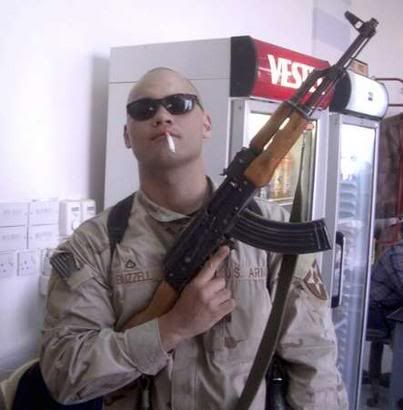
The award for books based on blogs went to "My War: Killing Time In Iraq," by Colby Buzzell.
"My War may be the last frank and open military blog blook," said Paul Jones, chair of the Blooker judges, reports BBC news.
"Endlessly surprising... delightfully profane," Arianna Huffington, a Blooker judge this year, commented on the winning selection.
She added it was "an unfiltered, often ferocious expression of his boots-on-the-ground view of the Iraq war."
Buzzell said he had blogged from an army cyber café during his posting in Iraq.
The U.S. army had requested the blog be shut down, but by the time Buzzell had won the interest of several publishers.
"My War tells what it's like to be a grunt fighting in the Sunni Triangle with more power and authority than the best 'embedded reporter' could manage," Blooker judge Nick Cohen, told BBC.
"It's something of a triumph for blogs over traditional media," added Cohen.
"The success of books like My War reflects the growing recognition of 'trickle-up writing', or writing that starts online," Bob Young, chief executive of the Blooker's sponsor, Lulu.com, told BBC.
Monday, May 14, 2007
| [+/-] |
Soldier's Blog of Post-War Iraq Wins Lulu Booker Prize |
| [+/-] |
Iraq To Bar Press From Blast Scenes |
Iraq's interior ministry has decided to bar news photographers and camera operators from the scenes of bomb attacks, operations director Brigadier General Abdel Karim Khalaf said on Sunday (local time).
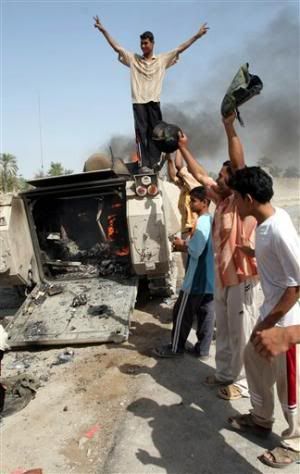 Iraqis jubilate next to a burning Danish military vehicle near Basra, Iraq's second-largest city, 550 kilometers (340 miles) southeast of Baghdad, Iraq, Monday, May 14, 2007. A Danish soldier was killed and five others were injured by a roadside bomb Monday in southern Iraq, the army said. An Iraqi interpreter was also injured in the explosion, which occurred as the Danish unit was on a routine patrol in several vehicles near Basra, said Maj. Kim Gruenberger of the Danish Army Operational Command. The injured soldiers were in stable condition, he said. (AP Photo / Nabil al-Jurani)
ABC News reports:
His announcement was the latest in a series of attempts to curtail press coverage of the ongoing conflict, which has already attracted criticism from international human rights bodies.
"There are many reasons for this prohibition," he said.
"We do not want evidence to be disturbed before the arrival of detectives, the ministry must respect human rights and does not want to expose victims and does not want to give terrorists information that they achieved their goals.
"This decision does not imply a curtailment of press freedom, it is a measure followed all over the world."
International and local media coverage of Iraq's deadly sectarian conflict generates dozens of images and reports of carnage every day, as insurgent bomb attacks continue.
Sunday, May 13, 2007
| [+/-] |
DoD Blocking YouTube, Others |
To save bandwidth, officials say several sites to be off-limits at work.
Stars and Stripes report:
Starting Monday, the Defense Department will block access to MySpace, YouTube and a host of other sites on official department computers worldwide, in an effort to boost its network efficiency.
Troops and families living on U.S. bases will still be able to view the sites through private Internet networks, but the move leaves servicemembers in Iraq and Afghanistan who use the popular picture- and video-sharing sites with little or no access to them.
Defense officials said the move is solely a reaction to the heavy drain the streaming video and audio can put on the defense computer network.
“We’re not passing any judgment on these sites, we’re just saying you shouldn’t be accessing them at work,” said Julie Ziegenhorn, spokeswoman for U.S. Strategic Command. “This is a bandwidth and network management issue. We’ve got to have the networks open to do our mission. They have to be reliable, timely and secure.”
In a message to troops from U.S. Forces Korea commander Gen. B.B. Bell on Friday, he acknowledged many of the sites being blocked are used by troops to keep in touch with family and friends.
“This recreational traffic impacts our official DOD network and bandwidth availability, while posting a significant operational security challenge,” he wrote.
Ironically, the Defense Department this year had just begun expanding its own use of YouTube to reach a younger, broader audience and show clips of U.S. troops in action.
Multi-National Force — Iraq, U.S. Army Civil Affairs Command in Afghanistan, and the U.S. Army Corps of Engineers in the Gulf Region have all launched new channels on the Web site to highlight recent successes overseas.
Ziegenhorn said that wasn’t taken into consideration when the Joint Task Force Global Network Operations began reviewing and flagging sites that posed problems to the network.
“This is all about what is a drain on the system,” she said.
A review of the banned sites has been under way since February, she said. And the task force is still considering other problematic addresses to add to the list.
“This will be an ever-evolving discussion, because we need to constantly make sure those networks are available and secure,” she said.
The official policy blocking the sites will be released Monday, the same day they go into effect. But Ziegenhorn said most network administrators are already aware of the change.
The individual services have already blocked some sites for the same bandwidth issues. In addition, Defense Department policy prohibits troops or civilian workers from using government computers from accessing inappropriate sites because of inappropriate content, such as pornography.
