McClatchy reports:
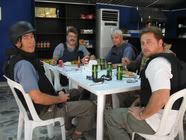
The dress code at the Blue Star restaurant inside Baghdad's Green Zone now calls for vest and hat.
Flak vest and Kevlar helmet, to be precise. And it's a good thing.
At least four mortar rounds hit inside the Green Zone about 1:30 p.m. Saturday, killing two Iraqi civilians, according to a U.S. soldier who could not speak for attribution because he's not authorized to talk to reporters.
Meanwhile, a State Department official, after initially denying that State had ordered its 1,000 Baghdad personnel to wear protective gear, said that a copy of the order obtained by McClatchy Newspapers was an undiscussable security breach.
Saturday's attack followed a barrage of up to 35 mortars and rockets that slammed into the Green Zone - considered the safest place in Baghdad - on Wednesday.
The embassy issued its memo later that day.
"As a result of the recent increase of indirect fire attacks on the International Zone, outdoor movement is restricted to a minimum," it states. "Remain within a hardened structure to the maximum extent possible and strictly avoid congregating outdoors. Personal protective equipment (PPE) is mandatory until further notice.
"Public places that are not in a hardened structure - such as the Blue Star Restaurant - should be frequented only in conjunction with the use of your PPE."
An embassy spokesman on Saturday initially denied that State now requires workers to wear body armor in the Green Zone.
He got upset when shown the memo.
"You're asking me to comment on an internal document?" he said, refusing to give his name. "How did you get it? We don't talk to what our security posture is."
Saturday's attack, which, like most of the rest, came from the east, the stronghold of Shiite Mahdi Army militia members loyal to anti-American cleric Muqtada al-Sadr, closed the Blue Star for lunch. But it reopened at 6 p.m. for dinner.
The place features white plastic tables and chairs, a magnum bottle of Johnny Walker Red scotch on the bar, plastic fish squirming in a faux aquarium and bootleg DVDs in a rack. All beneath a blue-and-white striped canvas tent.
Research Triangle Institute, of Durham, N.C., runs the compound where the Blue Star's located. The institute is helping local governments ramp up utilities and other projects in Iraq's provinces.
Five contract workers from the Research Triangle Institute filtered in. All wore flak vests and helmets. Mark Grubb, the first to arrive, ordered a 16.9-ounce Carlsberg beer. A choice of spaghetti, kebabs and burgerish meat lay ahead.
"A (mortar) round landed here in the compound," Grubb said. The blast severed a water line and the Internet cable. It also hit where the compound's security chief resides. "You could see it on the closed-circuit camera," Grubb said.
There were no injuries.
While some 100 British embassy workers and about 55 United Nations personnel living in the Green Zone sleep in hardened housing, State Department personnel sleep unprotected.
Asked how State could require workers to walk around outdoors in body armor while making them sleep in unprotected quarters, the embassy official said: "I wouldn't characterize it as being a mixed message."
U.S. embassy workers, speaking on condition of anonymity, have told McClatchy that they're angry and scared.
They'll get hardened sleeping quarters when construction of the new American embassy compound is complete. That's expected to be this fall.
Saturday, July 14, 2007
| [+/-] |
State Dept. Orders Flak Jackets In Baghdad's Green Zone |
Thursday, July 12, 2007
| [+/-] |
In Baghdad, Even Babies Quickly Learn To Duck Snipers |
McClatchy reports:
Nawal Na'eem Karim was surprised this week to hear her toddler tell her, "Talaq inana! Talaq inana!" — "Bullets here! Bullets here!"
He was warning her to step cautiously past the windows. Their house is in a kill zone. At 18 months, her baby already had learned counterinsurgency survival. He still wears a diaper.
Karim's family is among hundreds in Baghdad's Shiite Muslim-dominated Amil neighborhood who are under siege in their homes; in this case from two local snipers, one apparently stationed in a minaret of a nearby Sunni Muslim mosque.
Her experience shows that the U.S. troop buildup has yet to penetrate everywhere in Baghdad, as President Bush pressed Thursday for more time for the increase to show results.
"Leaving now will be dangerous for Iraq, the region and the United States," he said.
The U.S. military spokesman here on Wednesday and President Bush on Thursday described the war mainly as a battle against al Qaida. Brig. Gen. Kevin Bergner cited "hundreds" of insurgents from the group al Qaida in Iraq who'd been captured or killed since June, when American-led forces launched offensives in provinces north and east of the capital.
But Karim and her neighbors wish U.S. or Iraqi forces would concentrate on the local snipers. Because of that failing, from her perspective, the American troops can't leave soon enough. There's vigorous debate on this point, however, and some of her neighbors say U.S. troops are the only force that's still preserving order.
American military officials said they'd had reports of a sniper just outside Amil but were unable to confirm whether the shots came from a mosque. They recommended that residents call a Baghdad hot line. The number wasn't in service when McClatchy reporters called several times Thursday.
The shooter took up shop a few months ago, presumably in a minaret of the Abu Bakar mosque, a couple of blocks from Karim's house. The mosque is in the al Janabat area, the only parcel in Amil — due west and just south of the fortified Green Zone — that Shiites don't control.
This sniper works the morning and evening shifts, although lately he's been taking the mornings off. It's unclear how many he's killed or wounded. Residents can set their watches to the shooting.
"In the morning he starts at 6:30, when students and people go to work, until 7:30," said Ahmed Talib Hassan, 22, a medical student. The sniper typically resumes from 7 p.m. until sundown, he said, "when people start coming back home."
For the past few days, the morning routine from the Sunni enclave has started with mortar attacks, Hassan said, "as kind of a reminder" for the sniper to start firing.
Last week, another sniper took up a position to the west of the first shooter. This one targeted Karim's home, where the former schoolteacher lives with her husband, who makes a living working on generators, and their three sons. The older boys are 6 and 4.
On July 4, sniper bullets hit the backyard fence and the outside wall of her bedroom and came through a window, smashing a mirror in the kitchen.
Karim, 34, who wears her dark hair flowing down her back, sometimes pokes her head through doorways before scampering from room to room. She's afraid to wash dishes in the kitchen sink. She tells her children not to play in the backyard garden, not to play out front, not to play by the windows.
She's frustrated, and looks forward to the day that U.S. troops will leave Iraq. "It will be a happy day when it comes," she said.
"You invaded Iraq in 20 days but the Amil neighborhood is still suffering for more than two years," she added.
"Why couldn't they control a small area that a sniper has taken over, when they have all the technology to get rid of him within seconds?"
There's another side to the debate.
"There will be a real disaster if the American troops leave," said Zainab, 27, of Baghdad, who asked that her full name not be used to protect her safety. "It will open the way for the militias and insurgents to have open civil war. We live in a civil war now, but a hidden one because of U.S. troops. If they leave now, the civil war would be public. Innocent Iraqis would be the only losers."
Umran al Mosawi, 56, of Baghdad, disagreed. "Stability will come with (the U.S. troop) departure because they are the ones who protect all the criminals in Iraq," he said. A troop withdrawal would allow the Iraqi government to get tough and "have real strict decisions" against insurgents from neighboring countries.
Haidar al Azzawi, 37, of Baghdad, said Americans "have committed many mistakes and are part of the problem." However, "their departure now would be the biggest mistake."
