The New York Post reports:
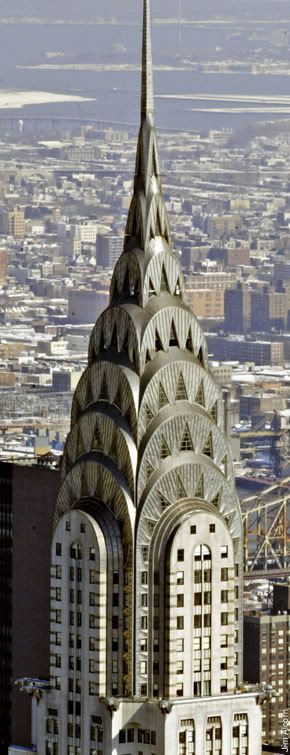
The latest Big Apple trophy being coveted by oil-rich sovereign wealth funds is the landmark Chrysler Building.
Sources say the super-rich Abu Dhabi Investment Council is negotiating an $800 million deal for a 75 percent stake in the Art Deco treasure that has defined the Midtown skyline since 1930.
The Chrysler assets would be purchased from TMW - the German arm of an Atlanta-based investment fund that's been eager to cash out of its Chrysler stake.
The deal follows last month's sale of the GM Building and three other Macklowe/Equity Portfolio properties for $3.95 billion to a group of investors including the wealth funds of Kuwait and Qatar and Boston Properties.
As part of the Chrysler deal, sources said the Abu Dhabi Investment Council would also get part of the skyscraper's signature Trylons retail prize next door.
Tishman Speyer Properties owns the remaining 25 percent stake in the Chrysler Building and operates the landmark at 405 Lexington Ave., along with the Trylons and the newer next door neighbor at 666 Third Ave.
The Trylons space also involves retail portion, which includes the Capital Grille steakhouse and a Citibank branch.
The buildings sit on land owned by Cooper Union, which leased it in a long-term arrangement to others and uses the payments to support tuition for its students.
Recently Tishman Speyer obtained a 150-year extension of the ground lease.
Sources say the deal would leave Tishman Speyer in charge of the building, with the Abu Dhabi fund essentially acting as a silent partner.
Abu Dhabi has also partnered with Tishman Speyer in other deals around the world, sources said. Since TMW and Tishman Speyer sold 666 Fifth Ave. to Kushner Companies for $1.8 billion last year, the Atlanta group began informing the real estate community that it was ready to cash out in the landmark Chrysler Center, as well.
None of the principals involved in the deal had any comment.
Boston Properties closed on its purchase of the GM Building on Monday with investment partners Kuwait and Qatar, and will complete the purchase of three other former Macklowe properties over the next few months.
Developer Harry Macklowe was forced to sell the assets after taking a personal loan on the GM Building and other family assets to raise nearly $7 billion to buy a city package of former Equity Office buildings.
The credit markets tanked right after completing that deal in July and Macklowe was unable to refinance the short-term debt causing him to sell the four buildings to Boston Properties and return the Equity portfolio to lender Deutsche Bank.
Wednesday, June 11, 2008
| [+/-] |
|
Tuesday, February 19, 2008
| [+/-] |
For Perhaps $490 a Month, a Home on the Hudson River |
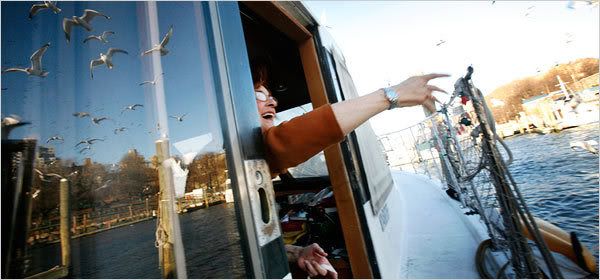 Leslie Day feeding sea gulls from her 43-foot cruiser at the 79th Street Boat Basin. Dr. Day, a naturalist and author who teaches at an elementary school, has lived at the boat basin for 32 years.
From the New York Times:
Leslie Day flirted, dated, married, raised a family and found her life’s work in Manhattan — or rather, just off its shore.
Born on the Upper West Side, she moved to a 34-foot houseboat at the 79th Street Boat Basin when she was 30, single and a masseuse. She found her future husband, a biologist, on the 43-foot houseboat next door. After they were wed, they traded up to a 57-foot houseboat, and they raised a son. Now, as empty-nesters, the couple live on a 43-foot cruiser.
Dr. Day, 62, who is now an elementary school teacher, recently wrote “Field Guide to the Natural World of New York City.” When Mayor Michael R. Bloomberg honored her book last fall in a ceremony at Gracie Mansion, he reached the part of his script that noted where she lived and ad-libbed a reaction she had heard many times. “Do you really?” he said. “That’s amazing. Thirty-two years and it never sunk or anything like that?”
Since 1937, when Franklin Delano Roosevelt was president, the 79th Street Boat Basin has been an object of fascination off the island of Manhattan, part fishing village, part Monte Carlo and all floating opera all of the time.
The boat basin floats on five main docks on the banks of the Hudson River. For decades, there have been as many as 100 pleasure craft, some pristine, others slovenly — schooners, houseboats, yachts and trawlers — tethered just off the Riverside Park promenade, three blocks from Broadway and Zabar’s.
Critics have called the residents squatters on public property, in a high-end trailer park; even the city government, which owns the docks, has not always been comfortable with the arrangement.
But the boaters call themselves a community with rights like any other. Residents have ranged from millionaires to those between jobs. All seem to embrace self-expression. One man liked wearing a Superman sweatshirt as he bounced on a trampoline on the dock.
“Over the years,” said Ed Bacon, 67, a yacht broker and the resident of longest standing at more than 37 years, “we’ve had starving artists, Wall Street financiers, rock promoters, computer programmers, United Nations employees and,” pausing to laugh, “Dick DeBartolo.” He is a senior writer at Mad magazine, who maintains a boat as an office.
Mr. Bacon, a former I.B.M. executive, would not have it any other way. Living among people like himself, he said, would be like “reading from only one page of a book.”
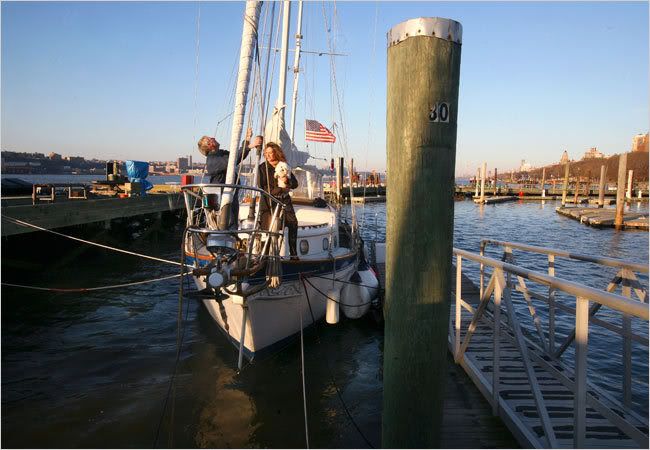 Ed Bacon, the resident of longest standing at the 79th Street Boat Basin, and Regina Jordan with their pet, Ollie, at home on their ketch. Mr. Bacon is a former I.B.M. executive; Ms. Jordan is a chef. “At first, in the 1970s, the boat basin was a divorcés’ heaven,” Mr. Bacon said. “All of these guys were divorced and all they would wind up with is the boat. It became a real party place.”
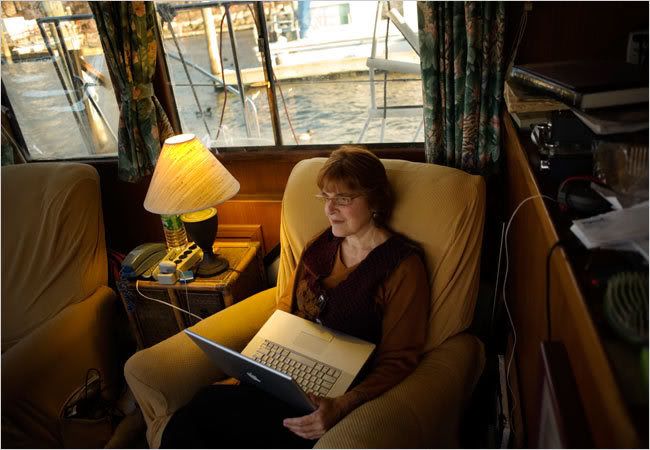 The naturalist Leslie Day on her cruiser. Mayor Michael R. Bloomberg wondered if she had ever lived on a boat that sank. [photos by Gabriele Stabile]
Celebrities have visited, too. Aristotle Onassis once anchored his yacht there. Malcolm Forbes, Frank Sinatra and Mario Puzo, whose boat was named Godfather, used the basin.
But the living, despite appearances, is not always easy. When a ferry rumbles past, throwing up a huge wake, the residences buck and weave like horses. Low tide, meaningless on land, sends the docks downward by five feet or more.
In the cold months, pets fall into chilly water. People slip on icy piers. In an especially frigid winter, a miniature Antarctica can freeze around the basin. In 2005, ice floes caused more than $400,000 damage to the river pilings and other dock infrastructure, according to the city’s Department of Parks and Recreation.
Miraculously, there have been no major fires. But bloated corpses have bumped up boat side, spoiling someone’s morning coffee. Once, a distraught man in a tuxedo leapt into the river, but residents saved him.
What the boat basin has not had for a while is newcomers, though that is beginning to change.
Keith Kerman, the chief of operations for the Parks Department, said the agency stopped issuing permits for year-round dockage in 1994 in an effort to gradually reduce the population of full-timers, who once occupied nearly all of the 116 permanent slips. The city wanted more public access, and more revenue: Short-term rentals bring in more money. Now, the number of full-timers has fallen to 43.
After years of clashes with the remaining residents, the two sides reached a compromise: The department would issue a small number of new annual permits, infusing new blood into the community.
A permit to dock a boat is one of the last real estate bargains in Manhattan, costing a fraction of even a tiny Upper West Side apartment rental. It costs $108 a foot for the summer season; $88 a foot for the other six months. Thus, a typical 30-foot boat would cost $5,880 in annual dock fees, or $490 a month.
Planned by Robert Moses when he was the city parks commissioner, the boat basin was built in 1937 to offer summer dockage to the public.
By the 1960s, however, boaters began to live there year-round and the number of so-called transient boaters, those who stayed for days or weeks, fell.
By the 1970s, there were problems. Outside managers stopped maintaining the docks, and residents filed lawsuits.
In 1989 the city resumed management of the basin.
One of the fiercest critics of the boat basin has been the Riverside Park Fund, a private group that raises money for the park. In 1991, Peter M. Wright, then its chairman, said, “The people in the boat basin are squatters on public land.”
Now, James T. Dowell, the fund’s president, said, “The conditions are immeasurably improved.” He added, “The fund has been pleased that the balance has shifted toward seasonal and day people, so it’s a much more public amenity.”
There is a full-time dockmaster. The Parks Department provides, free of charge, a boat pump-out system that connects directly to the boats of full-timers and visitors. (Dumping raw sewage into the river is illegal.) Paper and other garbage can be discarded in a nearby container. A fresh-water line system is also free, but electricity, telephone, television and Internet access are paid for by boaters.
Mr. Bacon, who began living at the boat basin during the Lindsay administration, and his second wife, Regina Jordan, live with a 2-year-old toy poodle, Ollie, on a two-mast cutter-rig ketch that is 54 feet long. It is Mr. Bacon’s third and largest boat.
Mr. Bacon remembers his first winter, in 1970, as especially tough. It was hard to get electricity to boats, he recalls, and there were frequent power failures. To get fresh water, boaters ran garden hoses underwater and to their boats. Mr. Bacon remembers hauling six or seven buckets of water from the dock faucet just to take a shower.
“You learned to cooperate very quickly,” he recalled. Camaraderie and cocktails were strong.
“At first, in the 1970s, the boat basin was a divorcés’ heaven,” he said. “All of these guys were divorced and all they would wind up with is the boat. It became a real party place.”
With the increase in part-timers, revenues from dock fees have risen sixfold, to $241,000 last year from $40,000 in 2001. (There is a waiting list of 450 names for part-time slots, from May to October.)
Last month, an audit by the city comptroller found “fiscal irregularities” that raised “serious concerns about the possibility of fraud.” The comptroller, William C. Thompson Jr., recommended a much tighter system of monitoring operations, including the collection, recording and reporting of gross receipts.
The parks commissioner, Adrian Benepe, said that the department had already strengthened fiscal controls and that there was no evidence of misappropriation of funds.
Last year, when the Parks Department began issuing new annual permits, the first two boaters began moving in.
Sim Cass, 51, a baker and a former sailor in the British merchant navy, is one of them.
He said that he fell in love with the boat basin at first sight, in 1983. “You can see the horizon and the sun and the arc of the moon,” he said, “and yet you are decidedly in Manhattan.”
Mr. Cass, who now lives in an apartment in the East Village, first applied for a year-round permit seven years ago and was finally issued one last October. He plans to move in this summer and live on his 37-foot trawler, which is already docked there.
“I’d love to live there now,” he said, noting that he is waiting for his daughter to leave for college. “Wintertime is spectacular!”
Like other new full-timers, Mr. Cass must ensure his boat is seaworthy. By May of next year, the 19 full-time boats that the Parks Department considers unseaworthy must be fully operational, in case of an emergency evacuation.
Gene Greenspun, now 89, lived on his boat for 32 years until 2002, when an early-morning wake from a passing boat smashed his craft against the pier. He escaped but his boat sank.
A widower who now lives in an East Side apartment, Mr. Greenspun said the other day that he was miserable, as he put it, “on land.”
But Mr. Greenspun, a developer of a manufacturing process for children’s dolls, could not move back. “It was like a child dying,” he said. “You don’t hang around the place where the child died.”
For Mr. Greenspun and others who have left, Mr. Bacon, the yacht broker, is planning a reunion June 12 at the boat basin. So far, he has contacted more than 100 alumni, out of several hundred.
“We’ll have a lot to talk about,” Mr. Bacon said.
Monday, July 30, 2007
| [+/-] |
Our Changing Culture |
The New York Daily News reports:
Parking cheats have shoved 500 pounds of foreign coins into meters this year - slugs city officials are now trying to hawk.
"We have pretty much every denomination from every continent," said Anthony Alfano, deputy chief of meter collections, rattling off nations from Greece to Ghana. "The most common [are] the Greek drachmas."
Department of Transportation officials have been collecting bids on the coins and plan to accept the best offer tomorrow.
"We are not expecting a windfall, but it's a way of recouping revenue for the city," Alfano said.
In years past, buyers have paid approximately $2 to $4 a pound - far short of the estimated $8,500 the city lost in revenue because of the foreign impostors, officials said.
The highest bidder must agree to buy all 500 pounds - 8-1/2 bags of coins that are being stored in a secret location for safety reasons.
DOT takes in about $90 million in coins from parking meters annually. It started selling the foreign coins about a decade ago after deciding it was impractical to exchange them to U.S. currency.
"In the scheme of things the money and volume of coins is pretty insignificant," Alfano said.
It's becoming harder to dupe the new high-tech meters with foreign coins, and the annual sale could become obsolete in the next few years. When the coins were sold in 2001, there were 1,402 pounds of foreign slugs - 33 bags. Last year, only 728 pounds were sold.
"The electronic meters are more discriminating," Alfano said.
Last year's batch went to Jim Corliss, a 60-year-old Braintree, Mass., collector who bids under his company name, Sir Speedy Printing. The three-time winner put in a bid again this year.
"Every once in a while I find something of value," he said. One time, he stumbled on a 1835 British shilling. "It sounds exciting, but it was worth $5," he said.
He confessed to collecting "zillions" of coins since he started the hobby as a 12-year-old paperboy sorting through tips. "I have a big house," he said.
Monday, July 9, 2007
| [+/-] |
New York Plans Surveillance Veil For Downtown |
The NYTimes reports:
By the end of this year, police officials say, more than 100 cameras will have begun monitoring cars moving through Lower Manhattan, the beginning phase of a London-style surveillance system that would be the first in the United States.
The Lower Manhattan Security Initiative, as the plan is called, will resemble London’s so-called Ring of Steel, an extensive web of cameras and roadblocks designed to detect, track and deter terrorists. British officials said images captured by the cameras helped track suspects after the London subway bombings in 2005 and the car bomb plots last month.
If the program is fully financed, it will include not only license plate readers but also 3,000 public and private security cameras below Canal Street, as well as a center staffed by the police and private security officers, and movable roadblocks.
“This area is very critical to the economic lifeblood of this nation,” New York City’s police commissioner, Raymond W. Kelly, said in an interview last week. “We want to make it less vulnerable.”
But critics question the plan’s efficacy and cost, as well as the implications of having such heavy surveillance over such a broad swath of the city.
For a while, it appeared that New York could not even afford such a system. Last summer, Mr. Kelly said that the program was in peril after the city’s share of Homeland Security urban grant money was cut by nearly 40 percent.
But Mr. Kelly said last week that the department had since obtained $25 million toward the estimated $90 million cost of the plan. Fifteen million dollars came from Homeland Security grants, he said, while another $10 million came from the city, more than enough to install 116 license plate readers in fixed and mobile locations, including cars and helicopters, in the coming months.
The readers have been ordered, and Mr. Kelly said he hoped the rest of the money would come from additional federal grants.
The license plate readers would check the plates’ numbers and send out alerts if suspect vehicles were detected. The city is already seeking state approval to charge drivers a fee to enter Manhattan below 86th Street, which would require the use of license plate readers. If the plan is approved, the police will most likely collect information from those readers too, Mr. Kelly said.
But the downtown security plan involves much more than keeping track of license plates. Three thousand surveillance cameras would be installed below Canal Street by the end of 2008, about two-thirds of them owned by downtown companies. Some of those are already in place. Pivoting gates would be installed at critical intersections; they would swing out to block traffic or a suspect car at the push of a button.
Unlike the 250 or so cameras the police have already placed in high-crime areas throughout the city, which capture moving images that have to be downloaded, the security initiative cameras would transmit live information instantly.
The operation will cost an estimated $8 million to run the first year, Mr. Kelly said. Its headquarters will be in Lower Manhattan, he said, though the police were still negotiating where exactly it will be. The police and corporate security agents will work together in the center, said Paul J. Browne, the chief spokesman for the police. The plan does not need City Council approval, he said.
The Police Department is still considering whether to use face-recognition technology, an inexact science that matches images against those in an electronic database, or biohazard detectors in its Lower Manhattan network, Mr. Browne said.
The entire operation is forecast to be in place and running by 2010, in time for the projected completion of several new buildings in the financial district, including the new Goldman Sachs world headquarters.
Civil liberties advocates said they were worried about misuse of technology that tracks the movement of thousands of cars and people,
Would this mean that every Wall Street broker, every tourist munching a hot dog near the United States Court House and every sightseer at ground zero would constantly be under surveillance?
“This program marks a whole new level of police monitoring of New Yorkers and is being done without any public input, outside oversight, or privacy protections for the hundreds of thousands of people who will end up in N.Y.P.D. computers," Christopher Dunn, a lawyer with the New York Civil Liberties Union, wrote in an e-mail message.
He said he worried about what would happen to the images once they were archived, how they would be used by the police and who else would have access to them.
Already, according to a report last year by the civil liberties group, there are nearly 4,200 public and private surveillance cameras below 14th Street, a fivefold increase since 1998, with virtually no oversight over what becomes of the recordings.
Mr. Browne said that the Police Department would have control over how the material is used. He said that the cameras would be recording in “areas where there’s no expectation of privacy” and that law-abiding citizens had nothing to fear.
“It would be used to intercept a threat coming our way, but not to collect data indiscriminately on individuals,” he said.
Mr. Browne said software tracking the cameras’ images would be designed to pick up suspicious behavior. If, for example, a bag is left unattended for a certain length of time, or a suspicious car is detected repeatedly circling the same block, the system will send out an alert, he said.
Still, there are questions about whether such surveillance devices indeed serve their purpose.
There is little evidence to suggest that security cameras deter crime or terrorists, said James J. Carafano, a senior fellow for homeland security at the Heritage Foundation, a conservative research group in Washington.
For all its comprehensiveness, London’s Ring of Steel, which was built in the early 1990s to deter Irish Republican Army attacks, did not prevent the July 7, 2005, subway bombings or the attempted car bombings in London last month. But the British authorities said the cameras did prove useful in retracing the paths of the suspects’ cars last month, leading to several arrests.
While having 3,000 cameras whirring at the same time means loads of information will be captured, it also means there will be a lot of useless data to sift through.
“The more hay you have, the harder it is to find the needle,” said Mr. Carafano.
Monday, June 25, 2007
| [+/-] |
Whitman On Hotseat Over 9/11 Aftermath |
The AP reports:
Ex-EPA chief Christie Whitman was bombarded by boos and a host of accusations Monday at a hearing into her assurances that it had been safe to breathe the air around the fallen World Trade Center.
The confrontation between the former head of the Environmental Protection Agency and her critics grew heated at times. Some members of the audience shouted in anger, only to be gaveled down by Rep. Jerrold Nadler, D-N.Y., who chaired the hearing.
For three hours Whitman faced charges from Nadler and others that the Environmental Protection Agency's public statements after the Sept. 11, 2001, attacks gave people a false sense of safety.
Whitman maintained the government warned those working on the toxic debris pile to use respirators, while elsewhere in lower Manhattan the air was safe to the general public.
"There are indeed people to blame. They are the terrorists who attacked the United States, not the men and women at all levels of government who worked heroically to protect and defend this country," Whitman said.
Since the attacks, independent government reviews have faulted the EPA's handling of the immediate aftermath and the agency's long-term cleanup program for nearby buildings.
A study of more than 20,000 people by Mount Sinai Medical Center in New York concluded that, since the attacks, 70 percent of ground zero workers have suffered some sort of respiratory illness. A separate study released last month found that rescue workers and firefighters contracted sarcoidosis, a serious lung-scarring disease, at a rate more than five times as high as in the years before the attacks.
Nadler, a Democrat whose district includes the World Trade Center site, called the hearing after years of criticizing federal officials for what he says was a negligent and incomplete cleanup.
He said the Bush administration "has continued to make false, misleading and inaccurate statements and refused to take remedial actions, even in the face of overwhelming evidence."
Whitman called such allegations "misinformation, innuendo and downright falsehoods."
Her responses were mostly calm and deliberate. But under questioning from Rep. Keith Ellison, D-Minn., Whitman angrily raised her voice, saying she based her statements on "what I was hearing from professionals," not the whims of politicians.
Whitman pointed out that her son was in the World Trade Center complex that day, "and I almost lost him," at which point Ellison said he would not "stand here and allow you to try to obfuscate."
"I'm not obfuscating," Whitman shot back. "I have been called a liar even in this room today."
She has long insisted that her statements that the "air is safe" were aimed at those living and working near ground zero, not those who actually toiled on the toxic pile that included asbestos.
"Was it wrong to try get the city back on its feet as quickly as possible in the safest way possible? Absolutely not," she said, drawing catcalls from the crowd.
Dozens of activists and Sept. 11 rescue workers came to the hearing, and some in the audience hissed when Whitman said she felt former Mayor Rudy Giuliani's administration "did absolutely everything in its power to do what was right" in handling the health concerns.
Rep. Trent Franks, R-Ariz., the ranking Republican on the House Judiciary subcommittee, said he worried that assigning blame to Whitman could mean, in future crises, that "officials might default to silence."
Thursday, June 21, 2007
| [+/-] |
GAO Report: "U.S. Misled NYC Residents On Dust From Ground Zero" |
The NYTimes reports:
Federal environmental officials misled Lower Manhattan residents about the extent of contamination in their condominiums and apartments after the collapse of the World Trade Center, according to a preliminary report released on Wednesday by the Government Accountability Office.
According to the report, made public during a Senate subcommittee hearing, the Environmental Protection Agency did not accurately report the results of a residential cleanup program in 2002 and 2003. More than 4,000 apartments in Lower Manhattan were professionally decontaminated in that program, and the agency reported that only a “very small” number of air samples taken in those residences showed unsafe levels of asbestos.
But the agency failed to explain that 80 percent of the air samples were taken after the apartments had already been cleaned.
“That was misleading,” said John B. Stephenson, director of the natural resources and environment division of the Government Accountability Office, an investigative arm of Congress. He spoke after testifying at a hearing of the Subcommittee on Superfund and Environmental Health of the Senate Committee on Environment and Public Works, which is reviewing the government’s response to environmental and health issues at ground zero.
The report concluded that the misleading information had left residents with an erroneous impression about risk. As a result, only 295 residents and apartment building owners asked to take part in a new residential cleanup program before enrollment ended in March. That number represented just a small portion of the 20,000 apartments eligible to participate.
“Residents are understandably reluctant to participate in what they consider to be a waste of time,” said Senator Hillary Rodham Clinton, who led the subcommittee hearing. Senator Clinton, who has been sharply critical of the federal response to 9/11-related health issues, said the data in the report offered “a very different picture from what the White House would like us to believe.”
Susan P. Bodine, assistant administrator of the environmental agency’s Office of Solid Waste and Emergency Response, declined to comment on the report. “I would have to go back and check the numbers,” she said in an interview.
Wednesday’s hearing was the first to look into the administration’s environmental response to the trade center disaster since Democrats took control of Congress. Christie Whitman, the agency’s administrator in 2001, is expected to testify at a committee hearing in the House on Monday about her handling of the disaster and the way she communicated the level of risk to the public.
Also at Wednesday’s hearing, Senator Clinton announced that a Senate appropriations subcommittee had included $55 million in the 2008 budget proposal for screening and treatment of people exposed to ground zero dust.
The money would, for the first time, cover residents of Lower Manhattan. The measure would also require the Department of Health and Human Services to develop a long-term screening and treatment plan.
