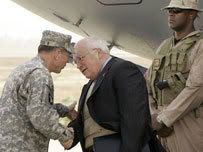
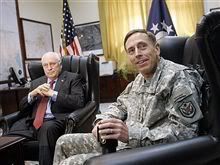
The commander of US forces in Iraq, General David Petraeus, yesterday sharpened America's confrontation with Iran, claiming that a leader of its Revolutionary Guard corps was in direct charge of policy in Baghdad.
The Guardian reports:
The charge that Tehran's ambassador to Baghdad, Hassan Kazemi-Qomi, was a member of the Quds force, a unit of Iran's Revolutionary Guard, takes US accusations of Iranian meddling in Iraq's violence to a new level. It strengthens suggestions that Washington is ratcheting up the rhetoric against Tehran in preparation for military strikes against Revolutionary Guard facilities in Iran.
"The ambassador is a Quds force member," Gen Petraeus told reporters at the weekend. "Now he has diplomatic immunity and therefore he is obviously not subject [to scrutiny]."
Hours after Gen Petraeus spoke to CNN and Reuters at a US military base near the Iranian border, the US military said it had arrested three members of an Iranian-backed militia believed to be responsible for the kidnapping of five Britons.
The Britons - a computer expert and four bodyguards - were taken from the finance ministry in Baghdad last May by gunmen dressed in police commander uniforms without a shot being fired.
The general, who told Congress last month that Iran was playing an increasingly dangerous role in Iraq by providing arms to Shia militia, provided no evidence that Mr Kazemi-Qomi was a member of the Revolutionary Guard. The Iranian ambassador has held two sessions with the top US diplomat in Baghdad, Ryan Crocker, to discuss the violence in Iraq.
Responding to the accusations at a news conference, the Iranian foreign ministry spokesman, Mohammad Ali Hosseini, said: "His remarks are not new and what he said was in line with the previous accusations against Iran."
Tehran denies US accusations that it plays a role in Iraq's violence, as well as western allegations that its nuclear programme is aimed at developing atomic weapons.
In August, officials revealed that the Bush administration was considering designating the entire Revolutionary Guard corps a terrorist organisation. However, reports last month said the state department had decided instead to single out the Quds force as a terrorist entity, which would enable the Bush administration to impose financial measures against the elite unit.
Gen Petraeus said at the weekend that he had few doubts about the role of the Quds force in the violence in Iraq, accusing the unit of supplying material for roadside bombs which have killed US troops as well as provincial governors. "There should be no question about the malign, lethal involvement and activities of the Quds force in this country," he said.
Also yesterday an Iraqi government inquiry found that guards working for the private security contractor Blackwater had opened fire without provocation on Iraqi civilians. A spokesman for the prime minister, Nuri al-Maliki, said 17 people had been killed in the incident, and that the convoy under Blackwater's protection "wasn't even hit by a stone" when the guards opened fire.
Monday, October 8, 2007
| [+/-] |
U.S. Blames Tehran For Escalating Iraq Violence |
Thursday, September 20, 2007
| [+/-] |
The Democrats Could've Handled the MoveOn Vote Strategically |
At Huffington Post, R.J. Eskow writes:
The resolution condemning MoveOn.org for its Petraeus ad was a no-win proposition for the Democrats - so why did they allow it to come to a vote without calling Admiral Fallon to the stand? Democratic Senators were left with the choice of either attacking MoveOn or opening themselves up to cheap shots come election time.
It didn't have to be that way.
Instead, Senate Democrats could've taken this position: We can't judge the fairness or accuracy of the MoveOn ad until we hear from Gen. Petraeus' boss. The ad says Petraeus is a political general who shades the facts, and he deserves a fair hearing. So let's put his boss under oath and ask him these questions:
1. Did Gen. Petraeus level with the American people, in your opinion?
2. Do you find him to be truthful and honest, or politically motivated?
3. Did you tell the General that you think he's an "ass-kissing little chickenshit"? If so, why?
4. Do you believe that the so-called "Surge" is working?
5. Are improvements in Anbar Province related to the Surge?
6. In your opinion, do Gen. Petraeus' opinions on Iraq reflect those of the Joint Chiefs and most experienced military leaders?
7. Do you consider criticism of Gen. Petraeus "the same as criticizing our troops"?
This GOP maneuver provided the ideal opening for Dems to do what they should have done before. Petraeus is a mid-level general. Why did the Senate minority and the Administration get to pick him, rather than a higher-ranking officer, to present his skewed version of the facts?
Admiral Fallon's opinions on these questions are well known, and his answers would almost certainly have rendered the MoveOn resolution politically dead. The GOP would have objected to his testimony, of course, but the Dems could have answered: How can you ask us to vote without first hearing the facts?
Both Sen. Clinton and Sen. Obama tried, in their separate ways, to make the best of the situation. Sen. Clinton defending MoveOn from scapegoating, while Sen. Obama essentially said what many people were thinking: Don't you people have more important things to do?
Both responses have some merit, but they and other Democrats were forced to play a bad hand. Why are they letting the minority decide who testifies and what comes to a vote?
This situation could have, and should have, been handled strategically. It would have served the Democrats politically - but more importantly, it would have given the American people a chance to hear the unvarnished truth.
| [+/-] |
Senate Approves Resolution Denouncing MoveOn.org Ad |
The NY Times reports:
The Senate approved a resolution on Thursday denouncing the liberal antiwar group MoveOn.org over an advertisement that questioned the credibility of Gen. David H. Petraeus, the American commander in Iraq.
MoveOn.org, with 3.2 million members, has become a powerful force in Democratic politics and the advertisement it paid for, which appeared in The New York Times, has come under sharp attack from Congressional Republicans and others as unpatriotic and impugning the integrity of General Petraeus.
Senator Hillary Rodham Clinton of New York and Senator Christopher J. Dodd of Connecticut, both Democratic candidates for president, voted against the resolution, which passed 72 to 25.
But curiously absent from the vote was Senator Barack Obama of Illinois, also a Democratic candidate for president, who had canceled a campaign appearance in South Carolina so he could be in Washington for votes.
Mr. Obama issued a statement calling the resolution, put forward by Senator John Cornyn, Republican of Texas, “a stunt.” Mr. Obama said, “By not casting a vote, I registered my protest against these empty politics.”
Mr. Obama had voted minutes earlier in favor of an extremely similar resolution proposed by Senator Barbara Boxer, Democrat of California.
Ms. Boxer’s proposal, which failed, called for the Senate to “strongly condemn all attacks on the honor, integrity and patriotism” of anyone in the United States armed forces. It did not mention the MoveOn.org ad. Mr. Dodd and Mrs. Clinton also voted in favor of Ms. Boxer’s proposal.
Senator Joseph R. Biden Jr. of Delaware, who is also seeking the Democratic nomination, was in Iowa and did not vote.
At a White House news conference, President Bush called the advertisement disgusting and said it was an attack not only on General Petraeus but also on the entire American military.
“And I was disappointed that not more leaders in the Democrat Party spoke out strongly against that kind of ad,” Mr. Bush said. “And that leads me to come to this conclusion: that most Democrats are afraid of irritating a left-wing group like MoveOn.org — or more afraid of irritating them than they are of irritating the United States military.”
Representative Thomas M. Davis III, Republican of Virginia, has urged the House to hold hearings on the MoveOn.org ad and to investigate whether The Times gave the group an improper discount. A New York Times Company spokeswoman has said that the group paid a standard “standby” rate.
MoveOn.org lashed out at Mr. Bush’s comments and pledged to double its spending on ads criticizing Republican lawmakers for blocking efforts by Democrats to change the war strategy. Eli Pariser, executive director of MoveOn.org Political Action, said, “What’s disgusting is that the president has more interest in political attacks than developing an exit strategy to get our troops out of Iraq and end this awful war.”
Monday, September 10, 2007
| [+/-] |
What Crocker and Petraeus Didn't Say |
McClatchey reports:
The Bush administration's top two officials in Iraq answered questions from Congress for more than six hours on Monday, but their testimony may have been as important for what they didn't say as for what they did.
A chart displayed by Army Gen. David Petraeus that purported to show the decline in sectarian violence in Baghdad between December and August made no effort to show that the ethnic character of many of the neighborhoods had changed in that same period from majority Sunni Muslim or mixed to majority Shiite Muslim.
Neither Petraeus nor U.S. Ambassador Ryan Crocker talked about the fact that since the troop surge began the pace by which Iraqis were abandoning their homes in search of safety had increased. They didn't mention that 86 percent of Iraqis who've fled their homes said they'd been targeted because of their sect, according to the International Organization for Migration.
While Petraeus stressed that civilian casualties were down over the last five weeks, he drew no connection between that statement and a chart he displayed that showed that the number of attacks rose during at least one of those weeks.
Petraeus also didn't highlight the fact that his charts showed that "ethno-sectarian" deaths in August, down from July, were still higher than in June, and he didn't explain why the greatest drop in such deaths, which peaked in December, occurred between January and February, before the surge began.
And while both officials said that the Iraqi security forces were improving, neither talked about how those forces had been infiltrated by militias, though Petraeus acknowledged that during 2006 some Iraqi security forces had participated in the ethnic violence.
Both officials said they believed that Iraq was on the path to potential success. Petraeus said that "the military objectives of the surge are, in large measure, being met." Crocker was similarly optimistic: "In my judgment, the cumulative trajectory of political, economic and diplomatic developments in Iraq is upwards, although the slope of that line is not steep."
They both pleaded for more time, even as Petraeus said that the U.S. should begin pulling troops out, with the goal of being back to the pre-surge level of 130,000 troops by next July. Further reductions would be considered next spring, as conditions allow, he said.
Both men celebrated their plan's success in encouraging residents in once-restive Anbar province to work with U.S. troops against al Qaida in Iraq.
Petraeus conceded that that success didn't extend to Ninevah province, where progress "has been much more up and down." But he didn't say that many believe that al Qaida numbers increased there only after the surge began. Ninevah is where some of the largest bombings of the year occurred, including the attack on the Yazidis, which killed more than 300.
He also offered a tepid endorsement of the Iraqi security forces, at times saying that they were increasingly capable of defending Iraq, while conceding that they needed to show more progress.
"Iraqi security forces have also continued to grow and shoulder more of the load, albeit slowly and amid continuing concerns about the sectarian tendencies of some elements in their ranks," Petraeus said. "In general, however, Iraqi elements have been standing and fighting and sustaining tough losses, and they have taken the lead in operations in many areas."
He said 445,000 people were on the security forces' payroll, but didn't discuss that many officials believe that thousands of those don't actually exist, but are phantoms whose salaries actually go into ministry officials' pockets.
Both Iraqis and U.S. officials concede that militias have infiltrated the security forces and that political leaders continue to interfere with their operations to serve their sects' interests.
Petraeus presented a series of maps to show how sectarian violence had dropped in Baghdad from December 2006 to August 2007. But all of the maps showed the same color-coding for Sunni, Shiite and mixed neighborhoods, even though the ethnicity of many neighborhoods have shifted dramatically over the previous year. U.S. military officials say that Baghdad was once 65 percent Sunni and is now 75 percent Shiite.
Questions from the 107 members of Congress who sat in on the hearing rarely produced more detail.
Still, the two men, considered by many to be among the most capable U.S. public servants to have served in Iraq, didn't attempt to hide their reservations. Both said they couldn't guarantee success.
Crocker, a fluent Arabic speaker and a lifelong student of the area, questioned the U.S. criteria for measuring success and said that the Iraqi government might never meet most of the 18 benchmarks laid out by Congress in a May law. Petraeus, who wrote the Army's counterinsurgency manual, acknowledged that violence remained at unacceptable levels.
Independent observers said the numbers that Crocker and Petraeus provided showed the violence has dropped to about where it was in May 2006, a few months after a February 2006 bombing of a revered Shiite shrine in the mostly Sunni city of Samarra, which the military uses to mark the rise in sectarian violence.
"At best, what you've got is the status quo from May or June of 2006," said Kirk Johnson, who served for 13 months as the chief statistician for Crocker and who said he supports the current strategy in Iraq.
Rand Beers, a former White House counterterrorism aide who resigned to protest the invasion of Iraq, noted there was another troop surge, in Baghdad, in summer 2006.
"We've had two surges, and in a way, things are back to the level before the first surge," Beers said in a conference call with reporters.
Retired Army Lt. Gen. Robert Gard said that it was understandable that Petraeus emphasized the positive.
"He's a human being and he's a military human being that wants to accomplish the mission," Gard said.
Friday, July 27, 2007
| [+/-] |
Iraq's PM Maliki's Relations With Petraeus, "Poor" |
From the Marine Corps Times:
A key aide says Prime Minister Nouri al-Maliki’s relations with U.S. commander Gen. David Petraeus are so poor the Iraqi leader may ask Washington the withdraw the well-regarded U.S. military leader from duty here.
The Iraqi foreign minister calls the relationship “difficult.”
Petraeus says his ties with al-Maliki are “very good” but acknowledges expressing “the full range of emotions” on “a couple of occasions.”
U.S. Ambassador Ryan Crocker, who meets together with al-Maliki and Petraeus at least weekly, concedes “sometimes there are sporty exchanges.”
Al-Maliki has spoken sharply — not of Petraeus or Crocker personally — but about their tactic of welcoming Sunni militants into the fight against al-Qaida forces in Anbar and Diyalah provinces.
But the reality of how the three men get along likely lies somewhere between the worst and best reports about their relationship — perhaps one of the most important in the world and unquestionably central to the future of Iraq, the larger Middle East and scores, if not hundreds, of political, diplomatic and military careers in the United States.
A tangle of issues confront the three men, and none of them present clear or easy solutions:
— Al-Maliki, a Shiite who spent years in exile under Saddam Hussein, hotly objects to U.S. tactic of recruiting men with ties to the Sunni insurgency into the ongoing fight against al-Qaida. He has complained loudly but with little effect except a U.S. pledge to let al-Maliki’s security apparatus vet the recruits before they join the force. He also has spoken bitterly, aides say, about delivery delays of promised U.S. weapons and equipment for his forces.
— Petraeus is confronted with an Iraqi military and police force, nominally under al-Maliki’s control, that has in many cases acted on sectarian — namely Shiite — not national Iraqi interests. He has faced a significant challenge in persuading al-Maliki to shed his ties to radical Shiite cleric Muqtada al-Sadr, who runs the Mahdi Army militia.
— Crocker’s problems with the Iraqi leader are the appearance of foot-dragging or ineffectiveness on the political front — the need to shepherd critical benchmark legislation through parliament. U.S. opponents of the war will undoubtedly demand from Crocker, when he reports to congress in September, an explanation of why U.S. troops are fighting and dying to give al-Maliki political breathing space that the Iraqi leader will not or cannot capitalize on.
First word of strained relations began leaking out with consistency earlier this month.
Sami al-Askari, an key aide to al-Maliki and a member of the prime minister’s Dawa Party, said the policy of including one-time Sunni insurgents in the security forces shows Petraeus has a “real bias and it bothers the Shiites. It is possible that we may demand his removal.”
Foreign Minister Hoshyar Zebari said in an interview with Newsweek, that the Petraeus-al-Maliki relationship was “difficult.”
“The prime minister cannot just pick up the phone and have Iraqi army units do what he says. Maliki needs more leverage.”
A lawmaker from the al-Sadr bloc, who refused use of his name fearing the party would expel him over his continued close ties to al-Maliki, said the prime minister has complained to U.S. President George W. Bush about the policy of arming Sunnis.
“He told Bush that if Petraeus continues doing that he would arm Shiite Militias. Bush told al-Maliki to calm down,” according to the lawmaker who said he was told of the exchange by al-Maliki.
The lawmaker said al-Maliki once told Petraeus: “I can’t deal with you any more. I will ask for someone else to replace you.”
In an angry outburst earlier this month, al-Maliki said American forces should leave and turn over security to Iraqi troops. He quickly backpedaled, but the damage was done.
“There is no leader in the world that is under more pressure than Nouri al-Maliki, without question. Sometimes he reflects that frustration. I don’t blame him. I probably would too,” Crocker said.
The ambassador, one of the State Department’s most seasoned Middle East diplomats, appeared to be genuinely fond of al-Maliki and profoundly understanding of the Iraqi leader’s troubles.
“We are dealing with existential issues. There are no second tier problems ... so there is a lot of pressure. And we all feel very deeply about we’re trying to get done. So yeah, sometimes there are sporty exchanges,” he said.
“And believe me I’ve had my share of them. That in no way means, in my view, strained relations. I have great admiration for Prime Minister Maliki, and I know General Petraeus does as well. And I like to think it is reciprocal. Wrestling with the things we’re all wrestling with here, it would almost be strange if you didn’t get a little passionate from time to time.”
Petraeus, a wily, rising star at the Pentagon who is known for holding his cards close to his chest, called his relations with al-Maliki “very good...and that’s the truth,” but acknowledged, “we have not pulled punches with each other.”
Here’s why, he said:
“We have made an enormous investment here — 3,600-plus soldiers, sailors, airmen and Marines have given their lives. And where we see something that could unhinge the progress that our soldiers and their soldiers are fighting to make ... or jeopardize some of the very hard-fought gains that we have made, I’m going to speak up. And I have on occasion. And on a couple of occasions have demonstrated the full range of emotions.”
All sides spoke with the critical September reports by Crocker and Petraeus to Congress clearly at the front of their minds — the need to make it clear to an increasingly hostile U.S. legislative branch that progress is being made and it would be wrong to start pulling out troops and cutting support now.
It will be a tough sell, but not for lack of getting their views before the public in advance of walking into Congressional committee rooms about seven weeks from now.
Wednesday, May 9, 2007
| [+/-] |
Cheney Meets With Iraqi Leaders |
U.S. Vice President Dick Cheney has met Iraqi leaders during an unannounced visit to Baghdad, as violence continued to claim more victims in Iraq:
Cheney held talks with General David Petraeus, commander of U.S. troops in Iraq, before meeting with Iraqi Prime Minister Nuri al-Maliki, top government ministers, and President Jalal Talabani.
"We have got a wide range of issues here in Iraq, as well as the region, focusing, of course, on things like the Baghdad security plan, ongoing operations against the terrorists, as well as the political and economic issues that are before the Iraq government," Cheney told journalists before his meetings today.
After his meetings with Iraqi officials, Cheney spoke about the Iraqi parliament's plan to take a two-month break.
"I did make it clear that we believe it is very important to move on the issues before us in a timely fashion and that any undue delay would be difficult to explain and that we hope that they would approach these issues with all deliberate [speed]," he said.
Iraq's parliament speaker, Mahmud al-Mashhadani, condemned what he said was interference in parliamentary affairs by the Iraqi government and "the government of those who have been the cause of this mess" in Iraq.
Cheney's visit marks the first leg of his Middle East tour, which will include stopovers in the United Arab Emirates, Saudi Arabia, Egypt, and Jordan. The tour is aimed at convincing Iraq's mostly Sunni neighbors to back the 4-month-old U.S.-led crackdown on insurgents in Iraq.
Meanwhile, a car bomb has killed 19 people and wounded more than 50 in the northern Iraqi city of Irbil.
The U.S. military has also said that a U.S. attack helicopter killed five bystanders, including two children, when it fired on insurgents north of Baghdad on May 8. However, the military has denied reports that the helicopter had fired on a primary school.
The military also said three of its soldiers have been killed in Iraq over the last 24 hours.
U.S. War-Funding Debate Continues
The White House said today that U.S. President George W. Bush would veto a bill drafted by Democratic leaders in the U.S. House of Representatives that would fund the Iraq war only for three months.
The Democrats' proposal would pay for the war through July. It would then give Congress the option of cutting off money if conditions do not improve.
Bush has requested more than $90 billion to fund the war through September. Last week, Bush vetoed a bill tying war funding to a timeline to start withdrawing U.S. troops from Iraq in October.