John King intervews Valerie Jarrett, Lindsey Graham, Dianne Feinstein and Joe Lieberman
Transcript of State of the Union with John King:
JOHN KING, HOST: I'm John King, and this is our STATE OF THE UNION report for this Sunday, April 26th. Today, a special look at President Obama's first 100 days in the White House, including unique behind- the-scenes accounts and images.
One of the president's closest aides and friends, senior adviser Valerie Jarrett, joins us for an exclusive look at both the policy and the personal challenges.
The release of top secret memos on CIA interrogations is fueling one of the most sensitive debates of Barack Obama's presidency. Three key senators, Lindsey Graham, Dianne Feinstein, and Joe Lieberman, on whether making the documents public undermines national security and what happens next.
Plus, strides and missteps. Two of the best political strategists assess the first 100 days, appearing together only on STATE OF THE UNION, James Carville and Mary Matalin on the first chapter of a historic presidency.
That's all ahead in this hour of STATE OF THE UNION.
A live picture there of the White House on day 97, day 97 of the Obama presidency. I asked the president about our first guest, and he'll tell you he doesn't like to make any major decisions without consulting her. A woman who has earned several nicknames like "first friend" and "the other side of Obama's brain." So who better to talk about it as we approach that important benchmark, the 100 days of the Obama presidency, than Valerie Jarrett. Valerie Jarrett, thanks for joining us on STATE OF THE UNION.
JARRETT: Thank you, John. And good morning and congratulations on your 100th day as well.
KING: Thank you. Yours is a bit more important than ours, but thank you very much. I want to start -- I want to get to some of your personal reflections on history. But I want to start with the news dominating the headlines this morning. This is The San Diego Union- Tribune. "Swine flu outbreak gets more worrisome."
The San Antonio Express-News, "In Texas flu fears shut down a high school." The administration has been aware of this since late last week, had a number of meetings and will have a briefing later today. What do we expect from the White House? Will it include, say, travel restrictions on going to Mexico? JARRETT: Well, I don't want to prejudge what the officials are going to say later today. But let's just put it this way, the president is taking this very seriously. He has assembled his teams from the Centers for Disease Control and Homeland Security. He has been briefed regularly. And he has asked them to speak to the American people and give the appropriate counsel later today.
So I'll let the experts speak to that.
KING: An interesting circumstance in that he and a number of senior officials had just been to Mexico. I understand he has been tested and he's in the clear?
JARRETT: He's fine. He is just fine. Thank you for asking, though.
KING: Let's move on to this momentous decision he has made in the past week, which was to release the CIA documents, the internal legal documents about the CIA interrogations. And I want to get your sense. You have watched him make hard decisions.
And I'm told by senior officials that this one weighs right up there with the decision to send more troops into Afghanistan as the toughest he has had to make in his first 100 days in office, in part, because only 44 men have been president of the United States, and in making this decision, he did something no president before him has done, put out former top secret memos on the previous administration so soon after taking office. Why?
JARRETT: Well, look, first of all, we are a nation of laws and the law requires us to release the documents unless there's some national security interest that would make it more important to keep them secret.
But the fact of the matter is there is nothing in the documents that the American people hadn't already seen all over the news. The techniques that were being used by the prior administration were well- known. When the president came in office, he said, we're not going to use those techniques anymore. That's not who we are as a country. In fact, Denny Blair, his intelligence adviser, has said in fact using those techniques makes us less safe. So the president said, let's release them and then let's move forward.
KING: In the context of let's move forward, there is a question about should there be a truth commission, should there be investigations, should there be prosecutions? And there is a big policy debate, but there's also a political debate that some say has been intensified by what they see as mixed messages from the White House.
If you turn over your right shoulder, I want to you take through some of the timeline. When the president released the memos on April 16th, he said, this is a time for reflection, not retribution. Three days later, his chief of staff, Rahm Emanuel, echoed the president, saying, the president believes those who devised the policy should not be prosecuted. But then on April 23rd, just a few days after the chief of staff was out, the president seemed to give a different message. Let's listen.
(BEGIN VIDEO CLIP)
PRESIDENT BARACK OBAMA: With respect to those who formulated those legal decisions, I would say that that is going to be more of a decision for the attorney general within the parameters of various laws, and I don't want to prejudge that.
(END VIDEO CLIP)
KING: Why did the president change his mind? He seems open now to possible prosecution.
JARRETT: No. Let me be clear where the president stands on this. What he has said is that anyone who followed the advice of the Justice Department and did any kind of acts that were within the confines of that advice, he doesn't think we should prosecute.
The rest of it, he leaves up to the U.S. Attorney General. That is who is supposed to make decisions about prosecution. So I think the president has been very clear and what he said is, we need to be a nation of laws, we need to be consistent, and he leaves it to the attorney general to figure out who should be prosecuted for what.
KING: Who should be prosecuted for what. If it's not those who acted on the advice they were given, who were told it was legal, what are we talking about here? Are we talking about the attorney general in the previous administration, the CIA director, Secretary Rumsfeld?
JARRETT: You and I aren't talking about anything. We are going to leave that all up to the attorney general. As you know, the Senate Intelligence Committee is having hearings as well. That is the appropriate place I think for any further investigation. And then the rest we leave to the attorney general. KING: You have a fascinating job because you have the trust of the president and you have become his conduit to many of the CEOs around America right now. He is dealing with the auto bailout. He is dealing with the financial institutions and the banks. He is in negotiations now over credit card reforms.
And you are the person who is often in touch with these CEOs, getting their advice and telling the administration things, seeking their input. One of the questions on the table is these stress test for all of the banks.
JARRETT: Yes.
KING: And without naming names, are there banks out there that are in deep trouble, and, if so, will the president and the White House, as in the case of General Motors, say, you know what, you're in trouble, you're not doing this as fast or as aggressively we thought you should do, if you want more money from us, the CEO has to go? JARRETT: Let's not leap forward. Let's look at where we are. The stress test results are just now being shared with the banks. We're going to have an announcement, I believe it's May 4th, coming from the Treasury Department and the Federal Reserve.
They've been going through an in-depth analysis of those top largest 19 banks over the course of the last several months. Let's see where we are and let's not prejudge the outcome. I think what the president's direction has been very clearly is we want to help the economy.
In order to have a healthy economy, we need to have strong banks. They need to be well-capitalized. They need to be able to lend dollars and help support our economy. And so at the end of the stress test, we want to make sure that those are -- that the banks are in a position to do that.
And so whether management changes occur, whether banks are asked to raise more capital, all of that is going to come forth in the coming week.
KING: You helped the president in the campaign. You were one of his a big fundraisers, one of his top advisers. One of the messages he gave to the American people in the campaign is, elect me and I will change the way that crazy town of Washington works, I'm not afraid to deal with Republicans, I will be bipartisan, will change the partisan, nasty tone in Washington.
I want you to listen something he said just after the election.
(BEGIN VIDEO CLIP)
OBAMA: I know we will succeed, once again, if we put aside partisanship and politics and work together. That's exactly what I intend to do as president of the United States.
(END VIDEO CLIP) KING: And, yet, in the first 100 days, only three Republican votes on the stimulus plan, no Republican votes on the Obama budget, and now the White House has pressured Democrats in Congress to use their power in the rules so, that if necessary, you can pass health care reform with 51 votes, a majority, not 60 votes.
Has the president decided that because of the mood in this town and because of the unwillingness of this town and both sides to perhaps change, that it is more important to get things done, like health care reform, like climate change, like education policy, than to make friends with the Republicans right off the bat?
JARRETT: Look, what the president has said throughout, he said in the campaign, he said it in his address the night of his election, and the way he has behaved since he took office is one of reaching out to both sides.
He includes everybody in the dialogue. He has reached out more aggressively, I think, to the Republican Party than I've ever imagined a president could possibly do. So I think the burden is on him to reach out his hand and that is what he has done. And that is what he is going to continue to do throughout this administration.
He has not changed tactics whatsoever. That is who he is as a person.
KING: Let's close -- sorry, go ahead.
JARRETT: But let me -- on the issue of health care, health care is extraordinarily important. I think there is bipartisan support for pushing health care forward. It's good for our country. It's good for our economy. And the president is determined to get it done this year.
KING: Let's close with a bit of history. I want to ask you to get up and walk over here with me as we walk over to the wall. This is a diagram of the West Wing of the White House. And you see the Oval Office here, the president's study, some of the cabinet rooms and the Roosevelt rooms, some of these offices, this is the second floor here, I believe this is Valerie Jarrett's office up here, they are highlighted for a reason.
I was a reporter at the White House for almost nine years. I walked those halls every day and never did you see this, an African- American first lady, an African-American senior adviser, an African- American deputy chief of staff, an African-American woman as the domestic policy adviser, as the deputy legal counsel, as the White House social secretary.
Barack Obama has made history. What is it like to work in a White House like this, African-American women in such positions of power?
JARRETT: Well, it's terrific. You are seeing very strong, I hope smart, intelligent African-American women. But I think have to round it out and look at the whole diversity of team. And I think what has been so extraordinary about President Obama is he appreciates diversity and he thinks it will make him think harder.
We push him to make sure that he has had a wide range of ideas as he makes decisions. And so as you fill out the rest of the team, it's extraordinary as well. But these are some pretty terrific women.
KING: And I want you to look over here at this picture. This has never been released before. We're going to have Pete Souza in here at the end of the program today to talk about looking at history through the lens of his camera.
This is a picture of the president and the first lady dancing. I believe that is the East Room of the White House right there. Take us inside and what is it like from a personal standpoint to see your two close friends in this position now? Can you believe it yet?
JARRETT: I still pinch myself every day. It's a terrific picture. It was the night of the Governors Ball, our first state dinner. And I think the president left right before they broke out into a conga line. And I think all of the folks who were there said they never had a conga line in the White House before. So it makes me happy. I'm so just extraordinarily proud of both of them. And I know that they wake up every day and they think about the American people.
And there so many people out there who are suffering and they need our help here in government. And it's his job to make sure that he delivers on the promises he made to the American people.
KING: Valerie Jarrett, here to mark the 100 days. A lot of challenges will be dealt in the second 100 days. We'll have you right back here to assess them at the end of that.
JARRETT: Look forward to it. I look forward to it.
KING: Thank you so much.
JARRETT: Thank you for having me.
KING: Thank you so much.
KING: Now we just heard Team Obama's position on the release of the so-called torture memos. What happens next? We ask three key senators about calls for investigations and prosecutions just ahead.
(BEGIN VIDEO CLIP)
OBAMA: If can you think about what Washington, D.C. was like 50 years ago or 60 years ago. And the notion that I now will be standing there and sworn in as the 44th president, I think, is something that hopefully our children take for granted, but our grandparents, I think, are still stunned by it and it's a remarkable moment.
(END VIDEO CLIP)
(COMMERCIAL BREAK)
(BEGIN VIDEO CLIP)
KING: Do you believe the president of the United States has made Americans less safe?
FORMER VICE PRESIDENT DICK CHENEY: I do. And now he is making some choices that, in my mind, will, in fact, raise the risk to the American people of another attack.
(END VIDEO CLIP)
KING: Vice President Dick Cheney there on this program just about a month ago. President Obama's election mandate was to fix a struggling U.S. economy but as he starts his 97th day in office today national security challenges are front and center. A debate whether releasing Bush administration terror policies was a blunder and over whether some of the Bush officials should be prosecuted and fresh violence in both Iraq and Pakistan will test the new administration's military and diplomatic strategies. Joining us to talk about this and assess the president's first 100 days, Democratic Senator Dianne Feinstein of California, the chairwoman of the Select Committee on Intelligence, Senator Joe Lieberman of Connecticut, the independent, former Democrat and from South Carolina, Republican Senator Lindsey Graham.
Chairwoman, I want to start with you. On the vice president's point, you heard the vice president say there he thinks the new administration is making the American people less safe. He also says that there are other memos not released into the public that prove his point that these controversial interrogation tactics used in limited circumstances actually produced intelligence that saved U.S. lives, including preventing an attack in your home State of California, the City of Los Angeles. Is he right?
FEINSTEIN: Well, I've received those memos. I asked him for them and he sent them to me. They are classified memos so I won't go into them. That's the reason why I believe the Intelligence Committee is the oversight agency for 16 intelligence agencies, including the CIA. It is our responsibility to do oversight. We have access to the classified information. And we have set upon a course, a bipartisan course with a program scope, approved by the committee, to review the conditions of detention and the techniques of interrogation of each of the high value detainees. We estimate that will take six to eight months. My hope is that the public debate quells, that we have an opportunity to do our work. The committee will consider it and then we will release, most likely, findings and recommendations.
KING: Findings and recommendations. I want to get to the other senators but to the vice president's point he believes the documents would show that the tactics worked, saved lives.
FEINSTEIN: It's very hard to tell on the face, because you have to go into who learned what at the time. Now I can go into one, at least one specific case, and it's very uncertain. So we need to find these things out and we need to do it in a way that's calm and deliberative and professional, because I think all of this, on the front burner, before the public, does harm our intelligence gathering, it does harm America's position in the world. And President Obama has worked so hard now to open a new page, to go to so many countries, to say that America is now on a different course. Let us do our work and let us do it the way it should be done.
KING: Senator Graham, you and Senator Lieberman opposed relieving these documents even though you were critics of the interrogation tactics, you thought it would undermine the mission of the united states and the CIA and now that some are out does the former vice president have a point? If some are out, should all be out?
GRAHAM: Well, here is my concern, is that, one, I think it was a mistake to release the techniques that we're talking about and inform our enemy as to what may come their way. I like what Senator Feinstein said, to go through it. And there's no doubt in my mind you may have gotten some useful information out of these techniques but the other side of the story is very real. The more than America embraces these techniques like waterboarding that comes from the Inquisition, the harder to get allies to go with us into the Mid East to fight the insurgents. You inflame the opposition. Our energy uses these images against us.
To say these techniques have brought about no good or no information is wrong, but also to say that it's been a net positive is wrong. There's a way to get good information in an aggressive manner to protect this nation without having to go into the Inquisition era. I believe you can do both. KING: And what about going forward, Senator Lieberman? The president, in relieving these memos, you didn't like that he did, but the president's message let's look forward, not look back but then the president said I'll leave this up to my attorney general who should be prosecuted. Let's listen to Mr. Holder.
(BEGIN VIDEO CLIP)
ATTORNEY GENERAL ERIC HOLDER: I will not permit the criminalization of policy differences. However, it is my responsibility, as the attorney general, to enforce the law. It is my duty to enforce the law. If I see evidence of wrongdoing, I will pursue it to the full extent of the law.
(END VIDEO CLIP)
KING: Are you comfortable with that? Do you think this should be pursued and if you rule out the interrogators saying they were told, they were following orders and acting on legal advice what they were doing was right, what are we talking about here? Are we talking about the CIA director, are we talking about the attorney general in the previous administration, Secretary Rumsfeld, somebody in the White House?
LIEBERMAN: Yeah, no, it is not clear who we are talking about. And I think it is a mistake. I go back to what the president said at the beginning, it is time to look forward. These are top secret documents. These were lawyers, you could disagree with them but in my opinion they were trying to do what they thought would protect our country.
And here is the most important point. This whole debate is moot. President Obama has prohibited these tactics from being used in interrogation, so what do we gain -- well, what do we gain, first, by releasing the memos, but, secondly, what do we gain from indicting lawyers for their opinions, if that is a possibility here, or holding a so-called Truth Commission that the reality is, it will poison the water here in Washington. It will achieve nothing.
LIEBERMAN: It will make it harder for the president to do some of the big things he wants to do for the country -- not just get the economy going, but get some Republican support for health care reform, energy independence and education reform.
So let the Intelligence Committee do its work. That should be the end of it. KING: And one of the questions in the political debate, as you well know, there are people out there saying, wait a minute. You have all these politicians -- and largely Democrats, now -- saying, you know, investigate; truth commission; investigate; we had no idea.
A timeline released by your committee, Senator Feinstein, says -- and this is backed up the former chairman of the House Intelligence Committee -- and then-CIA Director Porter Goss -- Pete Hoekstra -- you know, select members of Congress were briefed -- were briefed, way back at the beginning, including now-Speaker Nancy Pelosi.
And the timeline by your committee says that they were briefed on the use of waterboarding on three detainees, Abu Zubaydah, Abdul Rahim al-Nashiri, and Khalid Shaikh Mohammed.
The now-Speaker Pelosi says, no way; she was told there were legal -- there were -- legal opinions were written but not that the tactics had been used. Is she telling the truth?
FEINSTEIN: Well, I can't comment on that. I wasn't there. Just four people were briefed. The full committee, including myself, were briefed in September of '06. Now, that's four years later or so. So there is a big gap.
I am really strongly opposed to just certain members being briefed on something this seriously. It seems to me the whole committee should be briefed at a given time. We've been very good at retaining security, and I think it's a real disadvantage to the system just to have a few people briefed.
Because it really is a notification; there is no real discussion. When you deal with the whole committee, everybody fires back questions; there's a discussion; there's a dialogue. And I think a point of view emerges.
KING: Well, if -- to Senator Feinstein's point, Senator Graham, if the committee, the Intelligence Committee is going to look into this, and you all think that's the more responsible, measured way to do it, should the committee also look into whether Porter Goss or Nancy Pelosi is telling the truth about what came up at those briefings?
GRAHAM: Well, I'll leave that up to the committee. But the point is, if a member of Congress was read into this program, does it matter?
Yes, I think it matters. It's clear to me that the people who were devising these interrogation techniques were not trying to commit a crime against an individual person. They were trying to create tools for our intelligence community to get information to prevent what we all thought was going to be an imminent attack.
The Geneva Convention did not apply, until 2005, to the war on terror. So I can't conceive of a statute that you could prosecute anyone under because their endeavor was not to commit a crime but to look at the law and come up with aggressive interrogation techniques to get information from an enemy that we all thought was coming after us again.
So, however, if you think what they did was a crime, and you read someone into it, they're part of the crime.
So I think it's ridiculous to say the lawyers were trying to break the law. They were trying to interpret the law to protect the nation. And any member of Congress that was read into the program, I don't think they have any culpability either, because what we were trying to do is defend the nation, not conspire to hurt somebody individually, but techniques to protect us all.
KING: I want to move on to other big challenges facing the country right now.
But, before we do that and before we take a quick break, early in the Bush administration, the criticism in Congress was they never pick up the phone; they never consult us; you know, we've got some pretty smart people up here; we can help you.
I'm told that this decision was anguished; the president came in inclined to release them, changed his mind a couple times during the debate and then came back in the end and decided to release them.
At any point in that process -- I'll start with you, Senator Lieberman -- anybody from the White House pick up the phone and say, "What do you think?"
LIEBERMAN: They did not. And I can tell you, listening to what Lindsey said about looking at these decisions that were made early in the Bush administration, remembering that it was immediately after 9/11/01 there was worry about another attack imminently -- I'm proud to be the chairman of the Senate Homeland Security Committee. Our enemies are out there planning and plotting to attack us every day.
So, as we think about what we want to release, how much information we want to make public, what kind of mud fight we want to get into about something that happened seven years ago, we better remember that and focus on our security today, not back-biting and vendettas from a time passed.
KING: Quickly to you, you're the chairwoman of the committee. You're investigating these matters, anyway. Do they pick up the phone and call you?
FEINSTEIN: No. They did not.
KING: Is that a mistake?
FEINSTEIN: Well, if they had, I probably would have said, as I said, let us do our work first. Since the first two cases have already been done, let us do the rest of it before anything is released, so that at least the Intelligence Committee can see everything in context and make some decisions.
KING: All right. Much more with our Senate guests in just a moment. We ask them to lay out the stakes in the tough choices facing the United States in three major hot spots, Iraq, Pakistan and Afghanistan. "State of the Union" will be right back.
(COMMERCIAL BREAK)
(BEGIN VIDEO CLIP)
KING: On a scale of 1 to 10, sir, how confident are you, 10 being fully confident, that you will meet that deadline, that all U.S. troops will be gone at the end of 2011?
GENERAL RAY ODIERNO (USA), COMMANDER, MULTI-NATIONAL FORCE-IRAQ: As you ask me today, I believe it's a 10 that we will be gone by 2011.
(END VIDEO CLIP)
KING: We're back with our three senators, Democrat Dianne Feinstein, Independent Joe Lieberman and Republican Lindsey Graham.
That was General Odierno on this program, Easter Sunday morning. Since then, as you're all aware, there has been an uptick, as the military would call it, in violence across Iraq, Mosul, Baqubah, including in Baghdad.
And on the front page of the New York Times today, "Iraq Resists Pleas by U.S. to Placate Hussein's Party."
Essentially, Nouri al-Maliki, the prime minister, has not, at least if you believe U.S. officials, reached out to former Baath Party members and said, it's time to move on; it's time to reconcile.
Senator Lieberman, to you first, are you worried at all about the combination of those things, more violence and the slower pace of political reconciliation will knock the U.S. timetable off track?
LIEBERMAN: Sure, I am. I'm concerned about it. And incidentally, it's part of why I'm so grateful that President Obama did not yield to the calls for a precipitous rapid withdrawal of our troops from Iraq. He's got us on a timeline. It's based on conditions on the ground. And what's happening now shows that all that we've sacrificed so much and worked so hard to gain is not quite set. So we need to be careful here.
LIEBERMAN: But I think Prime Minister Maliki has really done a pretty good job at reconciling a lot of the divisions in Iraqi politics. The Sunnis are much more involved than they used to be. I know that there's some problems with former leaders what was basically Saddam Hussein's party. We ought to encourage Prime Minister Maliki to try to bring them in as well so they all could be united at what seems to be remnants of al Qaeda in Iraq that are carrying out these brutal bombings against Shia, this an attempt by al Qaeda to try to stimulate sectarian conflict again in Iraq and neither Prime Minister Maliki or the American forces or the Iraqi forces can let that happen.
KING: And if that challenge were not great enough for the military to deal with and the president to deal with, Senator Graham, you also have this expansion of the Taliban influence inside Pakistan. And ... GRAHAM: Right.
KING: ... Admiral Mullen was just there, the is due back for a White House meeting on Monday, administration officials say they have some big decisions to make based on what Admiral Mullen tells them. There are now more U.S. troops heading into Afghanistan and the question to you is if Pakistan is in such trouble and you have the Taliban on the move inside Pakistan, is it time for the president to slow down the deployment of U.S. troops in Afghanistan? Will they be at risk on the other side of the border or will we need perhaps more troops because of the uncertainty in Pakistan?
GRAHAM: I would counsel the president to do what General Petraeus and others in the region tell him about troops. There is a provision in the supplemental that is coming up in about a month that provides economic aid to Pakistan and $400 million to help them create a counterinsurgency program. I've been talking with administration officials, Republican Party leaders, to see if we can break some of that money out and pass it as a standalone provision soon to show the Pakistani people and government that we're with you, to give them some money to accelerate their counterinsurgency program and give them some money to provide economic aid to their people, the people do not want the Taliban to run Pakistan, but the economy in Pakistan is on its knees and we've got to get the Pakistani Army focused on the insurgency, as well as the government.
The threat the Pakistan is not an invasion by India. It's insurgents, the Taliban and others destabilizing the country and I think we need to be all in in helping Pakistan As to Iraq in 2011, I hope we will have a strong contingent of Americans there training their Air Force, their Navy. It is in our long-term best interest to have an enduring relationship with the people of Iraq, militarily and otherwise.
KING: Admiral Mullen says Pakistan could be at a tipping point. You see the intelligence. Is the Taliban, Senator Feinstein, a threat to the government, the central government of Pakistan?
FEINSTEIN: Oh, in my opinion, yes. I also think that these bombings, the size of the bombings in Iraq are a real danger signal. And I think that Mr. Maliki has to step up to the plate on this. And it's going to be very interesting in the next few weeks to see how he handles this. If these bombings continue and there is an escalation of violence, I think it jeopardizes everything the united states is trying to do.
With respect to the Taliban and particularly in both Afghanistan, as well as Pakistan, I think the takeover of the Swat Valley, the movement up north is a very serious thing. The fact that, despite the fact that we provide money for the Pakistani military, they have done nothing to stop this Taliban advance, I think, causes me great concern that Pakistan may be in very deep trouble. And I would think that -- and most of us, I think, do agree that Pakistan is sort of Ground Zero for terror today and that this thing has to get sorted out and sorted out quickly or you could lose the government of Pakistan and Pakistan is a in nuclear power and that concerns me deeply. KING: A grave issue there. I want to close on a lighter note.
And that is, as we approach the 100 day note we are in a political environment where people are making assessments.
I want to take you, Senator Lieberman back to something you said when you were campaigning for John McCain at the Republican National Convention. Let's listen.
(BEGIN VIDEO CLIP)
LIEBERMAN: Senator Barack Obama is a gifted and eloquent young man who I think can do great things for our country in the years ahead, but, my friends, eloquence is no substitute for a record. Not in these tough times for America.
(END VIDEO CLIP)
KING: We've been discussing a number of tough issues and there are many more, senator, has he proven you wrong, Barack Obama, in his first 100 days.
LIEBERMAN: First, John, let me thank you for running that tape.
KING: Tape is a dangerous thing.
LIEBERMAN: I have no regrets about supporting John McCain and really what I said then, I meant. Barack Obama is extremely gifted. Coming in at a very difficult time. I was thinking particularly about Iraq and Afghanistan, the war on terror. And McCain, of course, great experience, bipartisan record. Once the election was over, I said I would do everything to support Barack Obama as president. He is our president. I have, but I'll say this. I've been impressed by what he has done. He is a young man but he is extremely gifted. He has acted with strength, I think, and purpose in Iraq and Afghanistan, rebuilt some of our relations around the world and acted very boldly here at home on the economy where we needed him to particularly with the stimulus package.
But it's early but I would say he is off to a very good start. Maybe the most important thing he's done overall is that he has restored the confidence of the American people in the American presidency and he has raised their hopes about the future of our country. That is critically important.
KING: We're out of time. I want to give Senators Graham and Feinstein one sentence each. Senator Graham, to you the question is what does the Republican Party need to do in the second 100 days?
GRAHAM: To stand up for fiscal responsibility, work with the president and to make sure that we end Iraq right, win in Afghanistan and stabilize Pakistan, be a partner where we can and loyal opposition where we need to.
KING: There is a question as to whether you want to be the next governor of California. FEINSTEIN: Well, let me answer the prior question. No. You said in a sentence so give me an opportunity.
KING: All right.
FEINSTEIN: I think the Republican Party should stop being the party of no. This is a president well elected by a large number of people. He has had a very strong first 100 days. He has traveled to countries abroad, he has turned the page, he has opened a new day, he has taken strong executive actions, he has put together programs. He has delved into the economy. And I would hope that the second 100 days would find more Republican cooperation.
KING: When do we get the answer to that other question?
FEINSTEIN: Oh, you'll see.
KING: We'll see. Great. We're out of time. Senators Feinstein and Lieberman and Graham, thanks so much for coming.
Part 1
Part 2
Part 3
Up next, Mary Matalin and James Carville have both counseled presidents in crisis. Their take on the challenges and the 100 day mark, something you will see only right here on STATE OF THE UNION. Stay with us.
(COMMERCIAL BREAK)
KING: We've added a sharp and occasionally spicy political team to our "State of the Union" report. The only place you'll see these tested strategists together on TV is right here.
And joining us now from New Orleans, our newest CNN political contributor, Republican Mary Matalin, alongside our longtime contributor Democrat James Carville.
I want to get, from both of you -- good morning from Jackson Square. It looks beautiful there, this morning -- a little breezy.
I want to get, from both of you, your 100-day headline, your assessment. But first, I want to share with you the assessment of somebody we got to know in the last campaign; that is the Alaska governor, Sarah Palin.
She says this of the first 100 days, the former vice presidential nominee, "For now, Obama's back-peddle on the bipartisanship promise just makes him look insincere. At some point, Obama will need Republicans on his side. He'd be smart to spend his second 100 days making up for the serious snubs of his first."
James Carville, does Sarah Palin have a point?
CARVILLE: Well, you know, I'd rather go with Senator Lieberman's point, who supported Senator McCain, and I completely agree with him -- without going through a recital of all the accomplishments, the signature accomplishment of this president is we have a restoration of confidence in this country. People are feeling better about the country. And that's a magnificent achievement.
And I thought that Senator Lieberman did a very good job of bringing that out. And I would prefer to go with his definition of the first 100 days than Governor Palin's.
KING: And what does Mary Matalin think, at this point?
If you look at the numbers, Mary, this president does have -- about two-thirds of the American people approve of his job. Even a higher number like him as a person and like the imagery of this presidency.
What do you think? MATALIN: Yes, he's maintained his personal popularity, but -- which is on par with his predecessors, but what he's lost, after starting out with record-setting approval ratings which included a goodly amount of Republicans, a lot of independents, he has lost that support, because what he is not is what he was perceived to be in the campaign, a centrist.
He's spent more than all of his predecessors since the beginning of this country. He's expanded government, the greatest in two generations. So he's not a centrist. He's also not post-partisan.
It's not just that he demonizes his opponents, which is old politics. He'd knee-cap his own guys. He's got Valerie Jarrett, who's the liaison -- your former guest is the liaison to MoveOn.org, who is running ads against moderate Democrats. He's not a centrist. He's not post-partisan. But he is -- elections have consequences. We lost, fair and square, and let's -- that's what this debate is about. I hope Republicans can rise to the challenge and oppose him and stop some of this expansion.
KING: Well, I want to talk about some terror policy in a minute. But since you raised that point, Mary, that you lost and you hope Republicans rise to the challenge, I want you to listen to something that your friend and your former colleague in the Bush White House, Steve Schmidt, said the other day about the decline of the Republican Party. Let's listen.
(BEGIN VIDEO CLIP)
STEVE SCHMIDT, REPUBLICAN STRATEGIST: It is near-extinct, in many ways, in the Northeast. It is extinct, in many ways, on the West Coast. And it is endangered in the Mountain West, increasingly endangered in the Southwest, particularly with Hispanic demographics. And if you look at the state of the party, it is a shrinking entity.
(END VIDEO CLIP)
KING: Mary, Steve Schmidt says the leadership vacuum has him thinking you're in the "Lord of the Flies" phase of the Republican Party.
What's the road back?
MATALIN: You know, one of the advantages of age -- I didn't think I'd ever brag about this, but I'm much older than Steve and I've been through this before. And we will come back.
The Republican Party brand is irrefutably ruined, but that's because they lost their connection to conviction conservatism, common- sense conservatism. We've been here before and we've come back, not only strong but to ascend to the majority.
And there are many -- and there's a good nucleus of smart fiscal conservatives, strong defense, back to basics, personal liberty Republicans who will restore the brand and reassociate it with conservatism as we know it: Eric Cantor, Paul Ryan. You know who they are.
So the advantage of being aged is that you've been through it a couple, two or three times.
(LAUGHTER)
KING: James, I want to ask you, on this...
MATALIN: You went down, honey. You've been down.
CARVILLE: Yes, if age confers any wisdom, then you're looking at -- our combined age would make us very wise.
(LAUGHTER)
But, look, I think Steve is a very bright guy. He came down to my class at Tulane, and of course, as you know, Speaker Gingrich did, too.
But I think there's a lot of people who are trying to get under the hood of the Republican Party because, as Ross Perot said, it really needs some fixing. And there's a lot of different voices, here, and we're going to have to see what emerges.
But while all of that is going on, it's indisputable this president's enjoying a 69 percent approval rating. He's getting things done, left and right. He's got any number of things to deal with. And I think he's off to one heck of a start here. And it's understandable because the Republicans are all -- have a cacophony (ph) because they're not doing very well right now.
It's not...
KING: Mary...
MATALIN: It's not a -- it's not a cacophony (ph).
You know, John, can I just add to that?
We keep looking -- and all the pundits like to look at his top number, which is high, but as I said earlier, comparable to his predecessors. The danger spots for this president -- I'm just looking at all the polls, and they're 100 percent consistent on this. It's an 80 percent issue that people of all stripes, across the aisle, are concerned about the rapid and expansive growth of government that this president has ushered in.
That's not an old idea; it's not a stale idea; it's not Republican obstructionism. People just do not like how fast and how far this president has gone. That's an 80 percent issue.
So he's at -- he may be at 60 percent, but concerns over the things that he's done so far -- and that doesn't even include his foreign policy problems, you know -- he's got some undercurrents of issues, here, in this first 100 days. KING: Let me -- let me close on a lighter note, and that is, to James, you are a friend of now-Secretary of State Clinton. You were trying to help her retire her campaign debt when she was Senator Clinton...
(LAUGHTER)
... running against now-President Obama. And the Clinton campaign organization, trying to reduce its debt, has put out a letter offering people who contribute three potential prizes.
One is a day with former President Clinton in New York City. One is tickets to the "American Idol" season finale. And the third is, spend a weekend in Washington, D.C. with James Carville and Paul Begala.
(LAUGHTER)
Mary, you've got the checkbook there?
(LAUGHTER)
MATALIN: Oh, well, as you can see, I'd rather be here at Jazz Fest and the Zurich Classic and the Bubba Gump Run. And good luck in Washington with your crazy, loony lefties.
(LAUGHTER)
CARVILLE: I don't know.
MATALIN: That's a prize. What's the second prize, James?
CARVILLE: I always insist, the last two words, with Secretary of State Clinton and any conversation we have -- and they have always been, "Yes, ma'am."
(LAUGHTER)
So, whatever she wants, I'm delighted to do.
KING: James Carville and Mary Matalin, we are -- we are thrilled to have you back with us, together. We will see you again on "State of the Union" in the near future. Enjoy what looks like a beautiful morning, there in New Orleans.
(CROSSTALK)
KING: Take care, guys.
KING: During President Obama's time in office, we've traveled to 17 different states to hear your concerns and opinions. A unique perspective on the first 100 days from people we've been lucky to meet all across the country, next.
(COMMERCIAL BREAK)
KING: We launched STATE OF THE UNION the weekend of the Obama inauguration, promising to chronicle the big issues here in Washington and also to come see how the debates affect you. Our first of 17 states in these 100 days was Ohio, where on a factory floor, we asked the man about to make history to assess the many challenges and the moment.
(BEGIN VIDEO CLIP)
KING: You took your family to the Lincoln Memorial.
OBAMA: Now, this is a good story. I love the Lincoln Memorial at night. We go and look at the Lincoln Second Inaugural, Sasha looks up and she says that's a long speech. Do you have to give one of those? I said, actually, that one's pretty short. Mine may even be longer. At which point, the Malia turns to me and says, first African American president. Better be good.
Today I say to you that the challenges we face are real. They are serious and they are many. They will not be met easily or in a short span of time, but know this, America, they will be met.
(END VIDEO CLIP)
KING: A hundred days, of course, is far too soon to judge whether this new president will get his way and whether his way will work. But in our travels to 17 states in those 100 days, from Vermont and New York in the Northeast to Nevada and Arizona out in the Southwest, a fascinating look through your eyes of the many challenges, the uncertainty, and right here early on in Peoria, Illinois, of the pain.
(BEGIN VIDEO CLIP)
(UNKNOWN): I don't want to be on unemployment. I have never been on unemployment before.
KING (voice-over): For John and Mary Beth Fagan (ph), a double whammy. Both worked at Caterpillar, both out of work effective Friday. Three children, two cars and a mortgage.
(UNKNOWN): If things really got that bad, I would probably volunteer to go back overseas, and that's pretty bad to say.
KING: You would volunteer to go to Iraq or Afghanistan?
(UNKNOWN): For my family, I would, yes.
(END VIDEO CLIP) KING: One swift achievement in the first 100 days was passage of a $787 billion economic stimulus. The president signed it into law less than one month into his administration.
(BEGIN VIDEO CLIP)
OBAMA: We have begun the essential work of keeping the American dream alive.
(END VIDEO CLIP)
KING: Just a few weeks later, a $75 billion administration plan to help millions of homeowners make their mortgage payments.
Another bold and controversial White House move, forcing the CEO of General Motors to step down as a condition for more government bailout money.
(BEGIN VIDEO CLIP)
OBAMA: This restructuring, as painful as it will be in the short-term, will mark not an end, but a new beginning for a great American industry, an auto industry that is once more out-competing the world.
(END VIDEO CLIP)
KING: Speaking of the auto industry, we have visited a handful of states with auto plants over the past hundred days, including Ohio, Michigan, Indiana, and down here in Springhill, Tennessee, many union autoworkers told us they believe the president is overreaching.
(BEGIN VIDEO CLIP)
(UNKNOWN): Yeah, we need help, but to say that the president tells a company's CEO that he has to leave, I just don't believe that should happen.
KING: Make no mistake, Brenda Carter says she loves President Obama, but her concerns, a proof of the risks Mr. Obama faces as he takes an aggressive role in the restructuring of GM and Chrysler. The Lansing Grand River assembly line. Modern, clean and efficient. These Cadillacs among GM's best-selling models. And yet, this plant is down from two shifts to one. New cars just aren't selling.
(UNKNOWN): It's scary times right now for a lot of people.
KING: To listen, to look around is to hear and see a way of life fading. Generous Motors was the nickname when Brad Fredline was growing up. Both grandfathers retired from GM. His father, too. (UNKNOWN): You graduated on a Friday and by Monday you were working at the factory, you knew you had a rock solid job for 30 years, you buy a little place up north and you retire. Those days are gone, I'm afraid.
(END VIDEO CLIP) (COMMERCIAL BREAK)
KING: I'm John King and this is what's coming up this next hour of our STATE OF THE UNION report for this Sunday, April 26th, 2009.
Did the United States use torture to get information from suspected terrorists? The story is being covered by virtually every media outlet, but is it being done right? Howie Kurtz will grill a panel of top Washington journalists.
A pair of new movies with journalists as the stars. No problem. Just play ourselves, right? Wrong. Ahead, the real life newspaper man who helped turn Russell Crowe and Robert Downey Jr. into convincing reporters.
And as we continue CNN's special coverage of Barack Obama's first 100 days, we'll get real-world perspective from three former White House staffers who know just how tough things can get inside the Oval Office. That's all ahead this hour on STATE OF THE UNION.
Monday, April 27, 2009
| [+/-] |
Transcript & Video of State of the Union with John King - April 26, 2009 |
Tuesday, November 6, 2007
| [+/-] |
Senate Judiciary Committee Approves Mukasey Nomination |
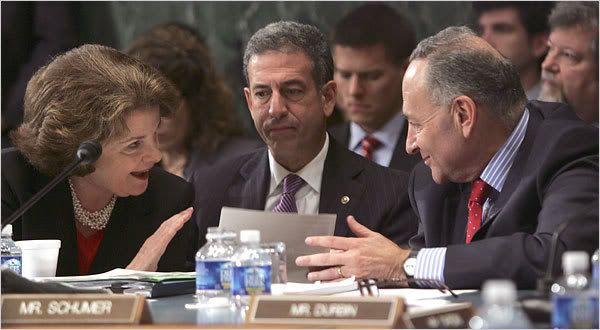 Senators Dianne Feinstein, Russ Feingold and Chuck Schumer after the vote on Tuesday.
The NY Times reports:
The Senate Judiciary Committee voted on Tuesday to approve the nomination of Michael B. Mukasey as attorney general despite opposition from most of the committee’s Democrats over Mr. Mukasey’s refusal to label a harsh interrogation technique used on terrorist suspects as torture.
Protesters opposed the Mukasey nomination and votes of two Democratic senators.
The vote, 11 to 8, with two Democrats joining all of the committee’s Republicans in supporting Mr. Mukasey, all but assured him of final confirmation by the full Senate. The Senate’s Democratic leaders are expected to schedule a vote by next week.
Mr. Mukasey, a retired federal judge from New York, ultimately owed his approval by the Judiciary Committee to the two Democrats who broke with their party to support him, Senators Dianne Feinstein of California and Charles E. Schumer, a fellow New Yorker who had initially recommended Mr. Mukasey to the White House.
The nomination of Mr. Mukasey was almost derailed by his refusal at his confirmation hearings to define as torture the interrogation technique known as waterboarding, which simulates drowning and is reported to have been used by the Central Intelligence Agency on a handful of Qaeda leaders since the Sept. 11 terror attacks.
In a letter to senators last week, Mr. Mukasey said the practice of waterboarding was “repugnant” but added that he could not judge its legality until he had been given access to classified information about interrogation techniques.
The White House welcomed the Judiciary Committee’s vote and urged that the nomination be moved quickly to the Senate floor. “Judge Mukasey has clearly demonstrated that he will be an exceptional attorney general at this critical time,” the White House spokeswoman, Dana Perino, said Tuesday.
Even some of Mr. Mukasey’s supporters said at the hearing to vote on the nomination that they were troubled by the way Mr. Mukasey handled questions about waterboarding, which the United States has fiercely condemned when carried out by other nations and had prosecuted as a war crime after World War II.
“I understand and greatly respect the view of some of my colleagues that the torture question trumps all other considerations,” Mr. Schumer said. But in explaining his vote for the nomination, Mr. Schumer said rejection of an otherwise highly praised nominee like Mr. Mukasey would allow the White House to appoint a caretaker attorney general who would not end the management turmoil and political scandals that plagued the Justice Department under Attorney General Alberto R. Gonzales.
“Judge Mukasey would be more likely than a caretaker to find on his own that waterboarding is illegal,” Mr. Schumer said.
In voting against Mr. Mukasey, the committee’s chairman, Patrick J. Leahy, and other Democrats portrayed their opposition as a defining moment for Congress in standing up to the Bush administration in upholding basic human rights and constitutional values in battling terrorism.
“America, the great and good nation that has been a beacon to the world on human rights, does not torture and should stand against torture,” Mr. Leahy said.
Senator Richard J. Durbin of Illinois, the Senate’s No. 2 Democratic leader, accused Mr. Mukasey of a “legal dodge” in refusing to repudiate “a cruel, abusive technique that has been regarded as torture in the civilized world for over 500 years.”
“When the history of this time is written, the issue of torture will define America’s values in the age of terrorism,” he continued. “Judge Mukasey’s responses to our questions on the issue of torture make it clear that he does not understand the challenge of this moment in history.”
The committee’s ranking Republican, Arlen Specter of Pennsylvania, said he had also been disturbed by Mr. Mukasey’s responses to the committee’s questions on torture, as well as on the nominee’s embrace of the Bush administration’s expansive view of the powers of the executive branch in wartime.
Mr. Specter said Mr. Mukasey’s assertion that he could not address the legality of waterboarding because he had not been briefed about it was “an excuse, and a flimsy excuse.”
But he said he decided to support the nomination after talking on Monday with Mr. Mukasey, who said he believed that if Congress outlawed waterboarding, which the Senate is now considering, the president would have no authority to overrule it. Mr. Specter said: “All factors considered, I think that the balance is decisively in favor of confirming Judge Mukasey. And I look forward to Congressional consideration of this issue of waterboarding. We’re the people who ought to decide it.”
Monday, November 5, 2007
| [+/-] |
Schumer & Feinstein Coordinate Efforts To Thwart Democrats' Base |
The Hill reports:
The coordinated statements released late Friday afternoon by two Democratic senators that they would break ranks and support President Bush’s attorney general nominee largely muted opposition from a Democratic base that has become increasingly frustrated with Congress, activist leaders said Monday.
Sens. Charles Schumer (D-N.Y.) and Dianne Feinstein (D-Calif.) effectively thwarted plans by the activist left to use the weekend to mobilize ahead of Tuesday’s Judiciary Committee vote and pressure wayward senators to reject the nominee, activists said.
“It was a surprise attack,” said Caroline Fredrickson, director of the Washington legislative office for the American Civil Liberties Union, which wants the Judiciary Committee to defeat the nomination. “There was a limited opportunity to say much about what Schumer and Feinstein had done because the timing was very cleverly calculated to avoid scrutiny.”
With the support of Schumer, Feinstein and the committee’s nine Republicans, Mukasey has garnered enough support to clear the panel and move to the Senate floor.
Before Feinstein’s announcement, sent to the media by e-mail at about 4:28 p.m., the nomination had seemed in doubt, especially after Judiciary Chairman Patrick Leahy (D-Vt.) announced his opposition to Mukasey at a 3 p.m. news conference in Burlington, Vt. Leahy became the fifth Judiciary Committee Democrat to announce his opposition over Mukasey’s refusal to state explicitly that the interrogation technique known as waterboarding constitutes torture.
Hours before Leahy’s press conference, however, Schumer in a telephone call already had laid out his thoughts to the chairman and also relayed a message that Feinstein had planned to support the nominee, according to aides.
But Schumer and Feinstein withheld announcing their decisions until late that afternoon. For Schumer, a decisive meeting came later in the day, around the same time as Leahy’s press conference. Mukasey assured him he would enforce any law Congress passes to explicitly state that certain interrogation techniques — such as waterboarding — are illegal under U.S. torture laws.
“Judge Mukasey is a lawyer’s lawyer. He will not leap to quick judgments,” Schumer said in his statement. “When we want him to do so, such as on torture, we will be disappointed. But when he resists those in the administration who want quick and facile answers . . . it is they who will be disappointed.”
The New Yorker, one of the most outspoken critics of the Bush administration, had been in an awkward position because he recommended Mukasey for the post before Democratic opposition grew. Both Schumer and Feinstein said they believed a Mukasey Justice Department would be markedly better than the tumultuous tenure of the resigned Alberto Gonzales.
Feinstein had made up her mind Thursday that she would support the nomination, but her office was still finalizing a statement when they caught wind of Schumer’s decision on Friday, one of her aides said. They decided to withhold the statement until Schumer was ready to make his announcement after both his afternoon meeting with Mukasey and the Leahy press conference. She followed up with a guest column explaining her views in Saturday’s edition of the Los Angeles Times.
“Judge Mukasey’s answers were quick and to the point, and reflected an independent mind,” Feinstein said in the column. “I truly believe he will be a strong advocate for the American people.”
By issuing coordinated statements late on a Friday afternoon, the senators employed the old Washington trick of breaking news at the end of a news cycle. Simultaneously, they undermined efforts by both the left and the right to pressure them into voting either for or against the nominee.
But they also undermined Leahy’s announcement, which would have dominated the weekend’s news. A Judiciary Committee aide, however, said there was no ill-will towards the senators for doing that.
“As you know, Sen. Leahy and Sen. Reid have not made this a caucus vote,
and as chairman, Sen. Leahy has not twisted any arms,” the aide said, referring to Senate Majority Leader Harry Reid (D-Nev.). What he does feel strongly about is knocking down, during this debate, the falsehood that waterboarding is not already torture and illegal.”
One leader of an activist group opposed to the nomination said the coordinated statements by the senators had a “chilling effect” on efforts to drum up opposition over the weekend.
“They wanted to decrease the intense focus on the two of them, and each reinforces the other by doing this together,” said Carl Tobias, a law professor at the University of Richmond. “It takes some of the heat off of each of them.”
Feinstein is familiar with being the lone Democrat to side with Republicans on the Judiciary Committee. She did so in August by joining all nine Republicans in voting for the nomination of Leslie Southwick for a lifetime seat on a New Orleans-based appeals court – over the strong objections of the other nine committee Democrats because of the nominee’s civil rights record.
Among some activist groups, the feelings are still raw with Feinstein for not joining Democrats to defeat the Southwick nomination in the committee. More broadly, the base has grown increasingly angry at Democrats for capitulating to Republicans on major issues, such as the Iraq war and Bush’s domestic spying program.
One leading Democratic activist expected Schumer to get earfuls during fundraisers for the Democratic Senatorial Campaign Committee, which he chairs. Also, one grassroots group, Democrats.com, has called for a moratorium on donations to the committee, which is trying to expand the Democratic majority in the Senate.
It’s unlikely that calls to cut off donating to the DSCC will pick up steam, activists said.
Even though Mukasey’s nomination is virtually assured, activists are still planning on airing their concerns. The Leadership Conference on Civil Rights is putting together a letter laying out its opposition and the concerns of a slew of other left-leaning groups.
Friday, November 2, 2007
| [+/-] |
Schumer and Feinstein Back Mukasey |
The NY Times reports:
The nomination of Michael B. Mukasey to be attorney general seemed all but assured late this afternoon when Senators Charles E. Schumer and Dianne Feinstein, two Democrats on the Senate Judiciary Committee, announced that they would vote in favor of the nominee.
Mr. Schumer announced his support after meeting with Mr. Mukasey this afternoon. “Judge Mukasey is not my ideal choice,” Mr. Schumer said in a statement afterward. “However, Judge Mukasey, whose integrity and independence is respected even by those who oppose him, is far better than anyone could expect from this administration.”
The statement from Mr. Schumer of New York, and late word from the office of Senator Feinstein of California that she too would endorse Mr. Mukasey, virtually assured that he would win the backing of the Judiciary Committee when it meets on Tuesday, and in all probability confirmation by the full Senate.
There are nine Republicans on the Judiciary Committee, versus 10 Democrats. So with the support of Mr. Schumer and Ms. Feinstein, the numbers are on Mr. Mukasey’s side, even though Senator Patrick J. Leahy, the Vermonter who heads the Judiciary Committee, this afternoon became the fifth Democrat on the panel to announce that he would vote against the nominee.
Mr. Schumer said his decision had been “extremely difficult,” and that a big factor was Mr. Mukasey’s opinion, conveyed to him this afternoon, that “were Congress to pass a law banning certain interrogation techniques, we would clearly be acting within our constitutional authority.”
The responses of Mr. Mukasey, a former federal judge from New York City, to committee questions about the definition of torture in interrogating suspected terrorists, and the bounds of presidential authority, have been the main obstacles to his cause.
For Mr. Leahy, those questions have not been satisfactorily answered.
“I like Michael Mukasey; I wish that I could support his nomination,” Mr. Leahy said this afternoon in Montpelier, Vt. “But I cannot.”
The senator went on to say that “no American should need a classified briefing to determine whether waterboarding is torture.”
The four other committee Democrats who have announced their opposition are Senators Edward M. Kennedy of Massachusetts, Joseph R. Biden Jr. of Delaware, Richard J. Durbin of Illinois and Sheldon Whitehouse of Rhode Island. But it seems clear now that there is not enough Democratic opposition to be fatal to the nomination.
The declarations of Senators Feinstein and Schumer would be enough to combine with the votes of the body’s 49 Republicans to win the nomination for Mr. Mukasey, barring some startling turn of events in the next several days.
Another committee Democrat, Senator Russell D. Feingold of Wisconsin, said today that he was undecided. “He may be the best nominee we can get from this administration,” Mr. Feingold said, calling Mr. Mukasey “a marked improvement” over former Attorney General Alberto R. Gonzales.
The remaining two Democrats on the panel — Herb Kohl of Wisconsin and Benjamin L. Cardin of Maryland — have yet to state their positions in advance of the committee vote.
All four Democrats running for president have said they will vote against Mr. Mukasey. In addition to Mr. Biden, Senators Hillary Rodham Clinton of New York, Barack Obama of Illinois and Christopher J. Dodd of Connecticut have said they will vote “no.”
President Bush showed his concern by campaigning again today for his embattled nominee, envisioning a “fight on the Senate floor coming next week,” and declaring that Mr. Mukasey must win for the good of the country.
“He’s a good man, he’s a fair man, he’s an independent man, and he’s plenty qualified to be the attorney general,” Mr. Bush said at the airport in Columbia, S.C. “And I strongly urge the United States Senate to confirm this man, so that I can have an attorney general to work with to protect the United States of America from further attack.”
Mr. Bush spoke just before heading to a campaign fund-raiser for Senator Lindsey Graham, a member of the Judiciary Committee, who is running for re-election.
Mr. Bush began his campaign to save the candidacy of Mr. Mukasey on Thursday, defending him in a speech and in an Oval Office interview, where he complained that Mr. Mukasey was “not being treated fairly” on Capitol Hill.
Wednesday, August 22, 2007
| [+/-] |
Transcript: Interview with Mike McConnell on the Foreign Intelligence Surveillance Act |
From the El Paso Times, the following is the transcript of a question and answer session with National Intelligence Director Mike McConnell:
Question: How much has President Bush or members of his administration formed your response to the FISA debate?
Answer: Not at all. When I came back in, remember my previous assignment was director of the NSA, so this was an area I have known a little bit about. So I came back in. I was nominated the first week of January. The administration had made a decision to put the terrorist surveillance program into the FISA court. I think that happened the 7th of Jan. So as I come in the door and I'm prepping for the hearings, this sort of all happened. So the first thing I want to know is what's this program and what's the background and I was pretty surprised at what I learned. First off, the issue was the technology had changed and we had worked ourselves into a position that we were focusing on foreign terrorist communications, and this was a terrorist foreigner in a foreign country. The issue was international communications are on a wire so all of a sudden we were in a position because of the wording in the law that we had to have a warrant to do that. So the most important thing to capture is that it's a foreigner in a foreign country, required to get a warrant. Now if it were wireless, we would not be required to get a warrant. Plus we were limited in what we were doing to terrorism only and the last time I checked we had a mission called foreign
intelligence, which should be construed to mean anything of a foreign intelligence interest, North Korea, China, Russia, Syria, weapons of mass destruction proliferation, military development and it goes on and on and on. So when I engaged with the administration, I said we've gotten ourselves into a position here where we need to clarify, so the FISA issue had been debated and legislation had been passed in the house in 2006, did not pass the Senate. Two bills were introduced in the Senate, I don't know if it was co-sponsorship or two different bills, but Sen. (Dianne Feinstein, D-Calif.) had a bill and Sen. Specter had a bill and it may have been the same bill, I don't know, but the point is a lot of debate, a lot of dialogue. So, it was submitted to the FISA court and the first ruling in the FISA court was what we needed to do we could do with an approval process that was at a summary level and that was OK, we stayed in business and we're doing our mission. Well in the FISA process, you may or may not be aware ...
Q: When you say summary level, do you mean the FISA court?
A: The FISA court. The FISA court ruled presented the program to them and they said the program is what you say it is and it's appropriate and it's legitimate, it's not an issue and was had approval. But the FISA process has a renewal. It comes up every so many days and there are 11 FISA judges. So the second judge looked at the same data and said well wait a minute I interpret the law, which is the FISA law, differently. And it came down to, if it's on a wire and it's foreign in a foreign country, you have to have a warrant and so we found ourselves in a position of actually losing ground because it was the first review was less capability, we got a stay and that took us to the 31st of May. After the 31st of May we were in extremis because now we have significantly less capability. And meantime, the community, before I came back, had been working on a National Intelligence Estimate on terrorist threat to the homeland. And the key elements of the terrorist threat to the homeland, there were four key elements, a resilient determined adversary with senior leadership willing to die for the cause, requiring a place to train and develop, think of it as safe haven, they had discovered that in the border area between Pakistan and Afghanistan. Now the Pakistani government is pushing and pressing and attempting to do something about it, but by and large they have areas of safe haven. So leadership that can adapt, safe haven, intermediate leadership, these are think of them as trainers, facilitators, operational control guys. And the fourth part is recruits. They have them, they've taken them. This area is referred to as the FATA, federally administered tribal areas, they have the recruits and now the objective is to get them into the United States for mass casualties to conduct terrorist operations to achieve mass casualties. All of those four parts have been carried out except the fourth. They have em, but they haven't been successful. One of the major tools for us to keep them out is the FISA program, a significant tool and we're going the wrong direction. So, for me it was extremis to start talking not only to the administration, but to members of the hill. So from June until the bill was passed, I think I talked to probably 260 members, senators and congressmen. We submitted the bill in April, had an open hearing 1 May, we had a closed hearing in May, I don't remember the exact date. Chairman (U.S. Rep. Silvestre Reyes, D-Texas) had two hearings and I had a chance to brief the judiciary committee in the house, the intelligence committee in the house and I just mentioned the Senate, did not brief the full judiciary committee in the Senate, but I did meet with Sen. (Patrick Leahy, D-Vt.) and Sen. (Arlen Specter, R-Pa.), and I did have an opportunity on the Senate side, they have a tradition there of every quarter they invite the director of national intelligence in to talk to them update them on topics of interest. And that happened in (June 27). Well what they wanted to hear about was Iraq and Afghanistan and for whatever reason, I'm giving them my review and they ask questions in the order in which they arrive in the room. The second question was on FISA, so it gave me an opportunity to, here I am worrying about this problem and I have 41 senators and I said several things. The current threat is increasing, I'm worried about it. Our capability is decreasing and let me explain the problem.
Q: Can't you get the warrant after the fact?
A: The issue is volume and time. Think about foreign intelligence. What it presented me with an opportunity is to make the case for something current, but what I was really also trying to put a strong emphasis on is the need to do foreign intelligence in any context. My argument was that the intelligence community should not be restricted when we are conducting foreign surveillance against a foreigner in a foreign country, just by dint of the fact that it happened to touch a wire. We haven't done that in wireless for years.
Q: So you end up with people tied up doing paperwork?
A: It takes about 200 man hours to do one telephone number. Think about it from the judges standpoint. Well, is this foreign intelligence? Well how do you know it's foreign intelligence? Well what does Abdul calling Mohammed mean, and how do I interpret that? So, it's a very complex process, so now, I've got people speaking Urdu and Farsi and, you know, whatever, Arabic, pull them off the line have them go through this process to justify what it is they know and why and so on. And now you've got to write it all up and it goes through the signature process, take it through (the Justice Department), and take it down to the FISA court. So all that process is about 200 man hours for one number. We're going backwards, we couldn't keep up. So the issue was ...
Q: How many calls? Thousands?
A: Don't want to go there. Just think, lots. Too many. Now the second part of the issue was under the president's program, the terrorist surveillance program, the private sector had assisted us. Because if you're going to get access you've got to have a partner and they were being sued. Now if you play out the suits at the value they're claimed, it would bankrupt these companies. So my position was we have to provide liability protection to these private sector entities. So that was part of the request. So we went through that and we argued it. Some wanted to limit us to terrorism. My argument was, wait a minute, why would I want to limit it to terrorism. It may be that terrorists are achieving weapons of mass destruction, the only way I would know that is if I'm doing foreign intelligence by who might be providing a weapon of mass destruction.
Q: And this is still all foreign to foreign communication?
A: All foreign to foreign. So, in the final analysis, I was after three points, no warrant for a foreigner overseas, a foreign intelligence target located overseas, liability protection for the private sector and the third point was we must be required to have a warrant for surveillance against a U.S. person. And when I say U.S. person I want to make sure you capture what that means. That does not mean citizen. That means a foreigner, who is here, we still have to have a warrant because he's here. My view is that that's the right check and balances and it's the right protection for the country and lets us still do our mission for protection of the country. And we're trying to fend off foreign threats.
Q: So are you satisfied with it the way it is now?
A: I am. The issue that we did not address, which has to be addressed is the liability protection for the private sector now is proscriptive, meaning going forward. We've got a retroactive problem. When I went through and briefed the various senators and congressmen, the issue was alright, look, we don't want to work that right now, it's too hard because we want to find out about some issues of the past. So what I recommended to the administration is, 'Let's take that off the table for now and take it up when Congress reconvenes in September.'
Q: With an eye toward the six-month review?
A: No, the retroactive liability protection has got to be addressed.
Q: And that's not in the current law?
A: It is not. Now people have said that I negotiated in bad faith, or I did not keep my word or whatever...
Q: That you had an agenda that you weren't honest about.
A: I'll give you the facts from my point of view. When I checked on board I had my discussion with the president. I'm an apolitical figure. I'm not a Republican, I'm not a Democrat. I have voted for both. My job is as a professional to try to do this job the best way I can in terms of, from the intelligence community, protect the nation. So I made my argument that we should have the ability to do surveillance the same way we've done it for the past 50 years and not be inhibited when it's a foreigner in a foreign country. The president's guidance to me early in the process, was, 'You've got the experience. I trust your judgement. You make the right call. There's no pressure from anybody here to tell you how to do it. He did that early. He revisited with me in June. He did it again in July and he said it publicly on Friday before the bill was passed. We were at the FBI, it's an annual thing, we go to the FBI and do a homeland security kind of update. So he came out at noon and said, 'I'm requesting that Congress pass this bill. It's essential. Do it before you go on recess. I'm depending on Mike McConnell's recommendations. And that was the total sum and substance of the guidance and the involvement from the White House with regard to how I should make the call. Now, as we negotiated, we started with 66 pages, were trying to get everything cleaned up at once. When I reduced it to my three points, we went from 66 pages to 11. Now, this is a very, very complex bill. I had a team of 20 lawyers working. You can change a word in a paragraph and end up with some major catastrophe down in paragraph 27, subsection 2c, to shut yourself down, you'll be out of business. So when we send up our 11 pages, we had a lot of help in making sure we got it just right so it would come back and we'd say wait a minute we can't live with this or one of the lawyers would say, 'Wait we tried that, it won't work, here's the problem.' So we kept going back and forth, so we sent up a version like Monday, we sent up a version on Wednesday, we sent up a version on Thursday. The House leadership, or the Democratic leadership on Thursday took that bill and we talked about it. And my response was there are some things I can't live with in this bill and they said alright we're going to fix them. Now, here's the issue. I never then had a chance to read it for the fix because, again, it's so complex, if you change a word or phrase, or even a paragraph reference, you can cause unintended ...
Q: You have to make sure it's all consistent?
A: Right. So I can't agree to it until it's in writing and my 20 lawyers, who have been doing this for two years, can work through it. So in the final analysis, I was put in the position of making a call on something I hadn't read. So when it came down to crunch time, we got a copy and it had some of the offending language back in it. So I said, 'I can't support it.' And it played out in the House the way it played out in the House. Meantime on the Senate side, there were two versions being looked at. The Wednesday version and the Thursday version. And one side took one version and the other side took the other version. The Thursday version, we had some help, and I didn't get a chance to review it. So now, it's Friday night, the Senate's voting. They were having their debate and I still had not had a chance to review it. So, I walked over, I was up visiting some senators trying to explain some of the background. So I walked over to the chamber and as I walked into the office just off the chamber, it's the vice president's office, somebody gave me a copy. So I looked at the version and said, 'Can't do it. The same language was back in there.'
Q: What was it?
A: Just let me leave it, not too much detail, there were things with regard to our authorities some language around minimization. So it put us in an untenable position. So then I had another version to take a look at, which was our Wednesday version, which basically was unchanged. So I said, well certainly, I'm going to support that Wednesday version. So that's what I said and the vote happened in the Senate and that was on Friday. So now it rolled to the House on Saturday. They took up the bill, they had a spirited debate, my name was invoked several times, not in a favorable light in some cases. (laughs) And they took a vote and it passed 226 to 182, I think. So it's law. The president signed it on Sunday and here we are.
Q: That's far from unanimous. There's obviously going to be more debate on this.
A: There are a couple of issues to just be sensitive to. There's a claim of reverse targeting. Now what that means is we would target somebody in a foreign country who is calling into the United States and our intent is to not go after the bad guy, but to listen to somebody in the United States. That's not legal, it's, it would be a breach of the Fourth Amendment. You can go to jail for that sort of thing. And If a foreign bad guy is calling into the United States, if there's a need to have a warrant, for the person in the United States, you just get a warrant. And so if a terrorist calls in and it's another terrorist, I think the American public would want us to do surveillance of that U.S. person in this case. So we would just get a warrant and do that. It's a manageable thing. On the U.S. persons side it's 100 or less. And then the foreign side, it's in the thousands. Now there's a sense that we're doing massive data mining. In fact, what we're doing is surgical. A telephone number is surgical. So, if you know what number, you can select it out. So that's, we've got a lot of territory to make up with people believing that we're doing things we're not doing.
Q: Even if it's perception, how do you deal with that? You have to do public relations, I assume.
A: Well, one of the things you do is you talk to reporters. And you give them the facts the best you can. Now part of this is a classified world. The fact we're doing it this way means that some Americans are going to die, because we do this mission unknown to the bad guys because they're using a process that we can exploit and the more we talk about it, the more they will go with an alternative means and when they go to an alternative means, remember what I said, a significant portion of what we do, this is not just threats against the United States, this is war in Afghanistan and Iraq.
Q. So you're saying that the reporting and the debate in Congress means that some Americans are going to die?
A. That's what I mean. Because we have made it so public. We used to do these things very differently, but for whatever reason, you know, it's a democratic process and sunshine's a good thing. We need to have the debate. The reason that the FISA law was passed in 1978 was an arrangement was worked out between the Congress and the administration, we did not want to allow this community to conduct surveillance, electronic surveillance, of Americans for foreign intelligence unless you had a warrant, so that was required. So there was no warrant required for a foreign target in a foreign land. And so we are trying to get back to what was the intention of '78. Now because of the claim, counterclaim, mistrust, suspicion, the only way you could make any progress was to have this debate in an open way.
Q. So you don't think there was an alternative way to do this?
A. There may have been an alternative way, but we are where are ...
Q. A better way, I should say.
A. All of my briefs initially were very classified. But it became apparent that we were not going to be able to carry the day if we don't talk to more people.
Q. Some might say that's the price you pay for living in a free society. Do you think that this is necessary that these Americans die?
A. We could have gotten there a different way. We conducted intelligence since World War II and we've maintained a sensitivity as far as sources and methods. It's basically a sources and methods argument. If you don't protect sources and methods then those you target will choose alternative means, different paths. As it is today al-Qaida in Iraq is targeting Americans, specifically the coalition. There are activities supported by other nations to import electronic, or explosively formed projectiles, to do these roadside attacks and what we know about that is often out of very sensitive sources and methods. So the more public it is, then they take it away from us. So that's the tradeoff.
DIVERSITY IN THE INTELLIGENCE COMMUNITY
Q: I wanted to ask you about the diversity question. This has major ramifications here, we have this center of excellence program that's recruiting high school kids, many of whom wouldn't qualify if first generation American citizens weren't allowed.
A: So you agree with me?
Q: It does sound like something that would benefit this area that would also allow you to get people from here who are bicultural and have an openness to seeing things ...
A: You're talking about Hispanics?
Q: Yes.
A: Hispanics are probably the most under-represented group if you think of America, what the ethic makeup of America, Hispanics are the most under-represented group in my community. Now, that said, and should increase that Hispanic population and programs like this will do that. That's why the outreach. But also we need, particularly with the current problem of terrorism, we need to have speakers of Urdu and Farsi and Arabic and people from those cultures that understand the issues of tribes and clans and all the things that go with understanding that part of the world. Varying religions and so on. Because it is, it's almost impossible, I've had the chance to live in the Middle East for years, I've studied it for years, it's impossible to understand it without having some feel for the culture and so on. So while I'm all for increasing the diversity along the lines we talked about, I'm also very much in favor of first generation Americans from the countries that are causing issues and problems.
Q: What is the status of that program.
A: It is not in statue. It is not in policy. It has been habit. So we've stated, as a matter of policy, that we're not going to abide by those habits.
Q: And that's already the case?
A: Yes, and are we making progress? Not fast enough, but we will make progress over time.
Q: How do you measure that?
A: Very simple, you get to measure what are you and where are you trying go and are you making progress. I wrestled with this years ago when I was NSA ....
Q: You don't want quotas, though?
A: Quotas are forbidden so we set goals. My way of thinking about it is what is your end state? Now some would say that federal governments should look like America, whatever that is. OK, that sounded like a reasonable metric, so I said, 'Alright, what does America look like?' So I got a bunch of numbers. I said, 'Alright, what do we look like?' and it didn't match, and as I just told you, the one place where there's the greatest mismatch is Hispanic. It's much closer, as matter of fact, people would be surprised how close it is across, at least my community among the other minorities. Now, that said, numbers don't necessarily equal positioning in the organization. So that's another feature we have to work on, is placement of women and minorities in leadership positions.
Q: So, you're quantifying that as well?
A: Yes.
TERRORIST ACTIVITY ON THE NATION'S SOUTHWEST BORDER
Q: There seems to be very little terrorist-related activity on the Southwest border, which is watched very closely because of the illegal immigration issue. Can you talk about why it's important to be alert here?
A: Let me go back to my NIE, those are unclassified key judgements, pull them down and look at them. You've got committed leadership. You've got a place to train. They've got trainers and they've got recruits. The key now is getting recruits in. So if the key is getting recruits in. So, if you're key is getting recruits in, how would you do that? And so, how would you do that?
Q: I'd go to the northern border where there's nobody watching.
A: And that's a path. Flying in is a path. Taking a ship in is a path. Coming up through the Mexican border is a path. Now are they doing it in great numbers, no. Because we're finding them and we're identifying them and we've got watch lists and we're keeping them at bay. There are numerous situations where people are alive today because we caught them (terrorists). And my point earlier, we catch them or we prevent them because we've got the sources and methods that lets us identify them and do something about it. And you know the more sources and methods are compromised, we have that problem.
Q: And in many cases we don't hear about them?
A: The vast majority you don't hear about. Remember, let me give you a way to think about this. If you've got an issue, you have three potential outcomes, only three. A diplomatic success, an operational success or an intelligence failure. Because all those diplomatic successes and operations successes where there's intelligence contribution, it's not an intelligence success. It's just part of the process. But if there's an intelligence failure ...
Q: Then you hear about it.
A: So, are terrorists coming across the Southwest border? Not in great numbers.
Q: There are some cases?
A: There are some. And would they use it as a path, given it was available to them? In time they will.
Q: If they're successful at it, then they'll probably repeat it.
A: Sure. There were a significant number of Iraqis who came across last year. Smuggled across illegally.
Q: Where was that?
A: Across the Southwest border.
Q: Can you give me anymore detail?
A: I probably could if I had my notebook. It's significant numbers. I'll have somebody get it for you. I don't remember what it is.
Q: The point is it went from a number to (triple) in a single year, because they figured it out. Now some we caught, some we didn't. The ones that get in, what are they going to do? They're going to write home. So, it's not rocket science, word will move around. There's a program now in South America, where you can, once you're in South American countries, you can move around in South America and Central America without a visa. So you get a forged passport in Lebanon or where ever that gets you to South America. Now, no visa, you can move around, and with you're forged passport, as a citizen of whatever, you could come across that border. So, what I'm highlighting is that something ...
Q: Is this how it happened, the cases you're talking about?
A: Yes.
Thursday, June 14, 2007
| [+/-] |
Gonzales Uses U.S. Attorney Appointment Power That Congress Banned |
Raw Story reports:
In a Senate Judiciary Committee business meeting Thursday morning, Senator Patrick Leahy (D-VT) revealed that Attorney General Alberto Gonzales once again used an interim appointment authority at the heart of the US Attorneys controversy that Congress banned in a bill sent to the President for signature on June 4.
"Senator Feinstein’s U.S. Attorney bill....repeals that portion of the Patriot Act Reauthorization that had allowed the Attorney General to circumvent advice and consent with respect to U.S. Attorneys. That bill, the Preserving United States Attorney Independence Act of 2007, has been on the President’s desk since June 4. It seems he just cannot bring himself to sign it. Instead, we were informed yesterday through the Justice Department that the Attorney General has used the power that we have voted to repeal, again," said Senator Leahy, the committee's chairman.
Tracy Schmaler, a spokeswoman for Senator Leahy, clarified the situation in an e-mail to RAW STORY.
"It just so happens the committee got notice yesterday, that on June 16, George Cardona's 210 days as Acting U.S. Attorney in the Central District of California will have run out and the Attorney General will appoint him as an interim U.S. Attorney at that time. (i.e. still using the end-run authority because Bush has slow-walked signing the bill)," she wrote.
RAW STORY could not reach the Justice Department for comment at press time.
On June 4, the Congress sent S. 214, the Preserving United States Attorney Independence Act of 2007, to President George W. Bush. The bill overturned a measure stealthily passed by the Republican-led Congress in 2006 that allowed the Attorney General to indefinitely appoint US Attorneys on an interim basis. Critics said the provision was intended to do an end-run around the standard Senate confirmation process for US Attorneys.
The bill passed the Senate by a 94-2 margin on March 20, and also cleared the House of Representatives by a 306-114 vote on May 22. The President has yet to sign or veto the bill.
Monday, May 21, 2007
| [+/-] |
Bush Calls Vote on Gonzales, "Pure Political Theater" |
Bloomberg.com reports:
President George W. Bush said Attorney General Alberto Gonzales continues to have his full support and called an attempt by Senate Democrats to hold a no-confidence vote on the embattled Justice Department chief ``pure political theater.''
``He has got my confidence, he has done nothing wrong,'' Bush said today in response to a question during a news conference at his Texas ranch. ``I stand by Al Gonzales.''
The Senate and House Judiciary committees are investigating whether the firings of eight federal prosecutors last year were the result of improper political influence. At least six Republicans have joined with Democrats in calling for Gonzales to step down because of the way the situation was handled.
Democratic Senators Charles Schumer of New York and Dianne Feinstein of California are proposing the Senate vote on a no- confidence resolution as soon as this week.
``It is this kind of political theater that has caused the American people to lose confidence in how Washington operates,'' Bush said today. He didn't directly address a question about whether he wants Gonzales to stay through the end of his term.
Schumer, responding to Bush's comments, said Gonzales should be replaced to restore the public's faith in the Justice Department.
``The president should understand that while he has confidence in Attorney General Gonzales, very few others do,'' Schumer said in a statement.
While a largely symbolic gesture, a vote of no confidence would add to the political pressure on Gonzales, 51, a longtime adviser to Bush who the president appointed as attorney general in 2005.
Senator Arlen Specter, the ranking Republican on the Judiciary Committee, said yesterday that Gonzales may resign rather than face a ``very substantial'' no-confidence vote. Specter is among the Republicans who have questioned whether Gonzales can continue to be effective in his job as the nation's chief law enforcement officer.
