The District of Columbia has moved a step closer to getting a vote in the House of Representatives. On Thursday, the Senate voted 61-to-37 to expand the size of the House by two seats, giving Washington, D.C. a single seat and giving Utah a fourth seat. Democracy Now! hosts a debate between D.C. Vote’s Eugene Dewitt Kinlow, Public Affairs Director for DC Vote Coalition, who calls the Senate’s vote as a historic victory, and Anise Jenkins, president of Stand Up! for Democracy in DC, who opposes the bill because it falls short of making Washington, D.C. the nation’s fifty-first state.
Transcript:
AMY GOODMAN: We move now to another debate, a debate that’s taking place right there in Washington, D.C. Juan?
JUAN GONZALEZ: Well, the District of Columbia has moved a step closer to getting a vote in the House of Representatives. On Thursday, the Senate voted 61-to-37 to pass the D.C. House Voting Rights Act. The bill will expand the size of the House by two seats, giving Washington, D.C. a single seat and giving Utah a fourth seat. The House is expected to soon pass the measure, and President Obama has said he will sign it into law.
The Senate approved the bill only after Republicans added an amendment to throw out Washington’s gun control laws, including its ban on semi-automatic weapons.
AMY GOODMAN: We’re joined now by two guests from Washington, D.C. Eugene Dewitt Kinlow is the public affairs director for DC Vote. On Thursday, the group hailed the Senate’s vote as a historic victory. We’re also joined by Anise Jenkins, president of Stand Up! for Democracy in DC. She opposes the bill before Congress. She says it falls far short of making Washington, D.C. the nation’s fifty-first state.
Let’s begin with Eugene Dewitt Kinlow. You are celebrating now with the Senate vote. Explain exactly what you get.
EUGENE DEWITT KINLOW: Well, you know, we’re celebrating with some mixed emotions. One, we are happy that there is a bill that has moved forward in the Senate and that actually passed a committee in the judiciary, the House, just two days in support of D.C. voting rights. We think that the residents of the District of Columbia, a city of nearly 600,000 residents, a city where people fight and die in wars, will finally have a vote and a voice in the people’s House. We are happy that a vote moves us in that direction. We are not as happy about the attachments of the amendments that was sponsored by the gun lobby to diminish our own laws in Washington.
JUAN GONZALEZ: How does removing the ban on guns have anything to do with the bill that was being voted on?
EUGENE DEWITT KINLOW: Well, you know, in the House, there’s probably a germaneness. You know, when you attach amendments, they must be germane to the major bill. That rule does not apply in the Senate. But this was directly an effort by the gun lobby and probably the NRA to relax our gun laws in Washington, D.C. You know, people want to use us as a test case, so to be able—for the gun lobby to say that, “Hey, there’s a city, Washington, D.C, people can walk around with guns, semi-automatic weapons.”
I don’t think it’s a good idea. I think that we have our own elected officials. We have a mayor and a city council that has written and has actually crafted very progressive legislation based on the will of the people. You know, for years in Washington, D.C., we’ve had a progressive gun law that says you could not have a gun. And that’s because that’s what the citizens of the District wanted. Now, for Congress to come in and say, “We will tell you what’s best for you,” when we have our own elected officials, is ludicrous.
AMY GOODMAN: Eleanor Holmes Norton, the delegate from D.C., is supportive of this legislation. Anise Jenkins, you’re not, with Stand Up! for Democracy. Why not?
ANISE JENKINS: The fact that the Senate attached the challenge to our handgun law is a perfect example. This bill for one vote, in exchange for an extra district for Utah, demonstrates what will happen if D.C. does not become a state. We will still be subject to congressional rule. Congress will still be able to overturn our laws. Our budget, our local budget, made of our local money, tax money, will have to go to Congress every year for review. If we don’t have the protection of statehood, full statehood, we will never have the equal rights that other American citizens have. That’s why we oppose the bill.
It hurts to oppose this bill. There’s been a lot of enthusiasm drummed up for this bill. There’s been a lot of money backing this bill to go through. But the bill is weak. The bill is a compromise. Statehood is the answer. Statehood is what will protect us and give us our rights.
JUAN GONZALEZ: And the reasoning for why Utah was included with an extra congressional district in addition to D.C.?
ANISE JENKINS: It was presented to the D.C. residents, who, by the way, voted for statehood in 1982, which has been the only referendum about what form of government we should have—1982 we voted for statehood. It was explained to us that Utah was being included, because Utah was the complete cultural, political opposite of D.C., and it would be easier for D.C. to get a vote if Utah got an extra congressional district, which also, by the way, gives it another electoral vote. In Stand Up! for Democracy’s opinion, this is too much of a compromise.
This was done when the Republicans controlled the Congress. This was done when Bush was president, and he said he would not even sign this bill. We need to switch tracks on this train. This train is out of control. We need to switch tracks and go to statehood. We don’t need Utah to balance us out. We don’t need Utah to cancel out our vote.
EUGENE DEWITT KINLOW: Let me just say that—and this is—
AMY GOODMAN: Eugene Dewitt Kinlow?
EUGENE DEWITT KINLOW: Let me just provide a little background. And Anise did indicate that this is a compromise. Yes, I agree. This is a compromise bill, and that’s what happens on Capitol Hill. Generally, for bills to pass, you need people who are Democratic and Republican to support the legislation. Let me be clear, this legislation that’s proposed is a bipartisan piece of legislation, which is great. We need more bipartisanship on Capitol Hill.
The bill provides for a vote in Washington, D.C., a city that is a majority Democratic city, and also provides for a vote—it doesn’t specifically say Utah, but the assumption is that it will be Utah. Utah, at the last census in 2000, narrowly missed getting another congressional seat. Now, why is this? It’s because in Utah, they have a tradition of, those who are of the Mormon faith go out into the states and do their missionary work. They were not in the states when the census was taken, and thus they were not counted. They went to court, and they lost. The compromise was to provide for a one-way, in one fell swoop—it’s not a perfect match, but it is one way of, one, enfranchising the citizens of the District of Columbia, who need this opportunity to participate in the political process fully, and one, for Utah to be made whole for their—for not having that seat at the last census.
AMY GOODMAN: You also don’t get senators here without statehood.
ANISE JENKINS: That’s absolutely true.
EUGENE DEWITT KINLOW: No, right. And the bill, clearly, in front of us is not about statehood. I think that if we talk about the statehood debate, that—there was an effort about in 1983 that failed. And it failed when there was a—you know, despite having a city that is majority Democratic and that supported President Barack Obama by about 93 percent, it failed in the House and the Senate, by two-to-one.
ANISE JENKINS: I would—
EUGENE DEWITT KINLOW: And a lot of those conditions still exist. Back in ’93, when you had a Democratic House, Senate and White House, those same conditions exist right now. And I would say if we had to put it up for statehood, that the votes do not exist for statehood.
ANISE JENKINS: I would add to the—
JUAN GONZALEZ: Anise Jenkins, I’d like to let you respond, but just to throw in a question, as well, to respond to, as well—the argument can be made that at least Congress, by voting now to grant a member of Congress, has recognized the right of political representation for D.C. and that presumably a greater Democratic majority in the future might be able then to pass, as well, the—adding two senators, as well, to the District.
ANISE JENKINS: If they vote for this bill and the bill says, specifically—there’s efforts to make amendments to this bill to say specifically, and it already implies, that this bill will not let us have senators. The Congress could see this as voting for “Case closed. You have your representative. You have your delegate. Your delegate is now a representative in the House. You will not have any senators.”
The bill even says that if we have a larger population—against the Constitution, which says if your population increases proportionately, your representatives will increase—this bill even cuts that out for D.C. So, if we go from 600,000 to a million, we still do not get two representatives. We’re still limited to two representatives and perhaps no senators. So what would the Congress be saying? We have to be very careful about what we’re putting before Congress. Is it constitutional? Is it what the residents of D.C. want? Is it what the residents of D.C. deserve?
EUGENE DEWITT KINLOW: Yes, yes, yes.
ANISE JENKINS: This bill—let me say one more thing. There has been no effort by DC Vote to go out, after they’ve raised over several million dollars, to go out into the community, hold town hall meetings, to go out and talk to the D.C. residents. This is coming from the top. We want what D.C. residents voted for.
EUGENE DEWITT KINLOW: OK, OK, let me be clear—
AMY GOODMAN: We’re going to have to leave it there—I hate to say it—but we will continue this debate. Anise Jenkins, president of Stand Up! for Democracy in DC, and Eugene Dewitt Kinlow, public affairs director for DC Vote Coalition. Just in terms of populations, to let you know the states all have under 700,000, equivalent populations to D.C., Wyoming, Vermont, North Dakota, Alaska; under a million, South Dakota, Delaware, Montana.
Friday, February 27, 2009
| [+/-] |
Senate Backs D.C. Voting Rights, But Some Local Activists Call For Statehood |
Saturday, July 26, 2008
| [+/-] |
Paul Camp, Liberals Unite On Spy Bill |
At the Wall Street Journal, Amy Schatz reports:
The fight over immunity for telecom companies in domestic-spying legislation is creating an unexpected side effect: unity among liberal bloggers and Ron Paul supporters.
Liberal activists and supporters of the Texas Republican and former presidential candidate plan to join forces Thursday and begin a "money bomb" protest of lawmakers who support telecom immunity in the Foreign Surveillance Intelligence Act. During a "money bomb," grassroots activists donate money during a short period of time -- usually a day -- to create buzz and raise money for their candidate.
The effort is timed to coincide with a planned Senate vote on the bill. Libertarians and liberal activists have blasted Democratic lawmakers, including presidential hopeful Sen. Barack Obama of Illinois, for supporting the legislation.
Both groups are upset about a provision in the bill that would provide retroactive immunity from civil actions for telecom companies alleged to have provided information to the government as part of its secret, warrantless wiretapping program. The House passed the legislation on June 20 and a Senate vote could come as soon as Thursday.
"There's entrenched power in Washington that protects itself and there are people on both sides who don't feel like they're having their rights protected," says Jane Hamsher, one of the organizers behind the effort and founder of the popular Democratic blog Firedoglake. "It's really about right and left coming together to fight the entrenched power and take their power away."
The fund-raiser represents a novel partnership between the two groups, which have separately proven themselves adept at organizing activists and readers to take action. If it goes well, organizers say it could mark the beginning of a more far-reaching partnership between the two groups, which agree on issues from ending the Iraq war to protection of civil liberties.
"For us, it's a natural alliance," says Trevor Lyman of BreaktheMatrix.com, and one of the organizers behind the famous Ron Paul "money bombs" which stunned the political establishment by raising about $14 million total for the Texas congressman's now-suspended presidential campaign.
"When it comes to civil liberties, we're absolutely aligned" with liberal activists, he says, although he notes the two groups remain far apart on other matters such as economic issues. "We stand so closely on this issue."
Mr. Paul missed the recent House vote on the domestic-spying legislation but later released a statement that he "strongly opposed every previous FISA overhaul attempt and I certainly would have voted against this one as well."
Discussions between the liberal bloggers and Mr. Paul's supporters for a joint venture only began about a week ago, but took off as anger about the telecom immunity increased in both communities. The two groups agreed to form a bipartisan political action committee, Accountability Now, and to use the Democratic fund-raising site ActBlue.com to handle the paperwork involved in legally processing political donations.
Beginning Thursday, blogs associated with both groups plan to begin plugging the joint-fundraising effort, asking their readers to pledge donations for the "money bomb" event.
Organizers say they'd like to raise "as much as possible," perhaps several million dollars, during their one-day "money bomb," which is likely to be held in August. They say they're not yet sure what they'd do with proceeds from the fund-raiser. Most likely it will be used to fund advertisements against Democratic and Republican lawmakers who supported the warrantless wiretapping legislation. It would also likely be used to fund ads supporting congressional challengers who are against the bill.
Wednesday, June 25, 2008
| [+/-] |
Obama Does Not Support Return of Fairness Doctrine |
There may be some Democrats talking about reimposing the Fairness Doctrine, but one very important one does not: presumptive presidential nominee Barack Obama.
Over at Broadcasting & Cable, John Eggerton reports:
There may be some Democrats talking about reimposing the Fairness Doctrine, but one very important one does not: presumptive presidential nominee Barack Obama.
The Illinois senator’s top aide said the issue continues to be used as a distraction from more pressing media business.
"Sen. Obama does not support reimposing the Fairness Doctrine on broadcasters," press secretary Michael Ortiz said in an e-mail to B&C late Wednesday.
"He considers this debate to be a distraction from the conversation we should be having about opening up the airwaves and modern communications to as many diverse viewpoints as possible," Ortiz added. "That is why Sen. Obama supports media-ownership caps, network neutrality, public broadcasting, as well as increasing minority ownership of broadcasting and print outlets."
The Fairness Doctrine issue flared up in recent days after reports that House Speaker Nancy Pelosi (D-Calif.) was talking about a Democratic push to reinstate it, although it was unclear at press time whether that was a new pledge or the restating of a long-held position.
Conservative paper Human Events reported that Pelosi was not planning to bring to a vote a bill to block the reimposition of the doctrine.
The paper went on to say that Pelosi “added that ‘the interest in my caucus is the reverse’ and that New York Democratic Rep. ‘Louise Slaughter has been active behind this [revival of the Fairness Doctrine] for a while now.’”
But it was unclear whether Pelosi was talking about a push, or simply restating her long-held view that the doctrine should return.
President George W. Bush pledged to veto any attempt to legislatively establish the doctrine, and Rep. Ed Markey (D-Mass.) told B&C in an interview last fall that there were no plans to try to bring the doctrine back.
One year ago, the House passed a bill, from Indiana Republican and former radio talker Mike Pence, that put a one-year moratorium on funding any Federal Communications Commission reimposition of the doctrine. Democrats, led by David Obey (D-Wis.), suggested that the amendment was a red herring, a nonissue and that it was being debated, such as it was -- no Democrats stood to oppose it -- to provide sound bites for conservative talkers and "yap yap TV," who had ginned up the issue.
In a Shakespearian mood, Obey said the amendment was "much ado about nothing" and "sound and fury, signifying nothing."
It was a permanent version of that moratorium, also pushed by Pence, that Pelosi was reportedly saying would have no chance.
But other Democrats suggested that the sticking point was the current administration, and some big names, including Sen. John Kerry (Mass.), talked about the possibility of bringing it back. Sen. John Edwards (N.C.) went so far as to say he would make the doctrine part of his media agenda.
The Fairness Doctrine required broadcasters to air both sides of controversial issues. The FCC found the doctrine unconstitutional back in 1987, and President Reagan vetoed an attempt by congressional Democrats to reinstate it.
It is a sensitive topic with Republicans, who fear that Democrats will use it to try and rein in conservative talk radio, the rise of which followed the scrapping of the doctrine.
In the wake of press reports about Pelosi's comments, Rep. John Boehner (R-Ohio), a longtime foe of the doctrine, said its return would be "nothing less than a sweeping takeover by Washington bureaucrats of broadcast media, and it is designed to squelch conservative speech on the airwaves."
Pelosi's office had not returned calls at press time on what she said, and meant, by her comments to the paper.
Tuesday, February 26, 2008
| [+/-] |
GOP Halts Effort to Retrieve White House E-Mails |
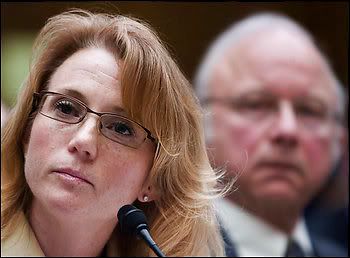 Theresa Payton, White House Office of Administration chief information officer, and Allen Weinstein, United States archivist, testify on Capitol Hill. (By Manuel Balce Ceneta -- Associated Press)
The Washington Post reports:
After promising last year to search its computers for tens of thousands of e-mails sent by White House officials, the Republican National Committee has informed a House committee that it no longer plans to retrieve the communications by restoring computer backup tapes, the panel's chairman said yesterday.
The move increases the likelihood that an untold number of RNC e-mails dealing with official White House business during the first term of the Bush administration -- including many sent or received by former presidential adviser Karl Rove -- will never be recovered, said House Democrats and public records advocates.
The RNC had previously told the House Oversight and Government Reform Committee that it was attempting to restore e-mails from 2001 to 2003, when the RNC had a policy of purging all e-mails, including those to and from White House officials, after 30 days. But Chairman Henry A. Waxman (D-Calif.) disclosed during a hearing yesterday that the RNC has now said it "has no intention of trying to restore the missing White House e-mails."
"The result is a potentially enormous gap in the historical record," Waxman said, including the buildup to the Iraq war.
Spokesman Danny Diaz said in a statement that the RNC "is fully compliant with the spirit and letter of the law." He declined further comment.
Administration officials have acknowledged that Rove and many other White House officials routinely used RNC accounts for government business, despite rules requiring that they conduct such business through official communications channels. The RNC deleted all e-mails until 2004, when it exempted White House officials from its e-mail purging policy.
About 80 White House aides used RNC accounts for official government business, committee staff members said. Rove, for example, sent or received 140,000 e-mails on RNC servers from 2002 to 2007, and more than half involved official ".gov" accounts, the panel has said.
The RNC dispute is part of a broader debate over whether the Bush administration has complied with long-standing statutory requirements to preserve official White House records -- including those reflecting potentially sensitive policy discussions -- for history and in case of future legal demands.
The committee is investigating allegations that vast stores of official Bush administration e-mails have also gone missing from the White House, which scrapped a Clinton-era archiving system and has struggled with data retention problems.
A former White House technology manager told the committee in statements released yesterday that the Bush administration's e-mail system "was primitive and the risk that data would be lost was high."
Steven McDevitt, who left the White House in 2006, said he supervised an internal study that found hundreds of days in which no electronic messages were stored for one or more White House offices from January 2003 to August 2005. The study stated a range when tallying the total number of days in which an office had no recorded e-mails, from 473 -- which had been previously reported -- to more than 1,000, McDevitt said.
McDevitt also said security was so lax that e-mail could be modified by anyone on the computer network until the middle of 2005.
Administration officials defended their efforts to fix the problems, and said they are still working to locate and identify e-mails reported as missing. "We are very energized about getting to the bottom of this," said Theresa Payton, chief information officer at the Office of Administration.
At the hearing, Payton and GOP lawmakers attacked the 2005 White House study overseen by McDevitt, calling it flawed and unreliable. McDevitt said the 250-page study involved numerous senior technology officials as well as outside contractors.
Rep. Thomas M. Davis III (Va.), the committee's ranking Republican, said in a statement that the missing e-mail allegations are "based on a discredited internal report conveniently leaked to the media." He also said that yesterday's hearing was "less about preserving records and more about resurrecting the spurious claim that the White House 'lost millions of official e-mails.'"
Davis also said, based on a briefing by Payton, that the actual number of days with missing e-mails was 202. "A substantial portion of the so-called 'missing' e-mails appear not to be missing at all, just filed in the wrong digital drawer," Davis said. No other committee member followed up on that allegation during the hearing.
| [+/-] |
Politicos Squabble Over 'Missing' White House E-Mails |
At NewsBlog, Anne Broache reports:
Democrats and Republicans were warring Tuesday over reports that the White House has "lost"--or simply failed to keep--archives of e-mails belonging to the president and his advisers.
Since last spring, the U.S. House of Representatives Committee on Oversight and Government Reform has been investigating reports that an estimated 5 million messages from 473 days between 2003 and 2005 allegedly vanished from e-mail servers housed within the president's office.
A hearing convened by the committee gave Democratic leaders a new chance to press White House officials publicly on how and when they expect to recover the files.
"We still know virtually nothing about the status of the alleged missing White House e-mails," said Committee Chairman Henry Waxman (D-Calif.).
Allen Weinstein, archivist of the United States, said the National Archives and Records Administration had similarly gotten no response from the White House to its queries about what's going on. "I'm concerned about maintaining the fullest possible presidential records," he told the committee.
Republican leaders said they were also concerned about the prospect of missing nuggets of presidential history, but they accused the Democrats of failing to acknowledge the White House's ongoing efforts to retrieve the messages. Republican Ranking Member Tom Davis (R-Va.) said the White House has said it has since reduced the number of days' worth of missing e-mails from 473 to 202 after discovering that those messages had been filed "in the wrong digital drawer" as part of a switch from the Lotus Notes to Microsoft Exchange e-mail system in 2002.
White House Chief Information Officer Theresa Payton assured the committee that her office is working actively on a multi-step restoration process. Their early results have identified an unspecified number of the previously "missing" messages, though those results still have to be validated.
When pressed by Davis, Payton also said she felt "very comfortable" that they would be able to reconstruct any remaining lost documents from "disaster recovery backup tapes," although she said that process would be time-consuming and could cost at least $15 million.
Did advisers use Republican National Committee accounts?
A separate issue under scrutiny revolves around charges that Karl Rove and some 50 other presidential advisers were using Republican National Committee accounts to conduct official business and thus subvert federal record-keeping laws. The RNC has said it had virtually no records of e-mails sent on its servers by Rove and others before November 2003, which Democrats argue is troubling because those messages may contain important official information about the president's decision to go to war in Iraq.
Waxman said he heard from RNC officials as recently as Monday that the White House had made no effort to request backup tapes from the committee that may contain those files. He scolded White House officials for their inaction. Both Payton and her boss, White House Office of Administration director Alan Swendiman, said they wouldn't be responsible for making such requests but would look into who is.
Republicans accused the Democrats of pursuing the investigation simply to dig up dirt on Rove and waste hundreds of thousands of dollars of money that the RNC could be using to shore up its candidates' campaigns.
"Are we simply going on a fishing expedition at $40,000 to $50,000 a month?" Rep. Darrell Issa (R-Calif.) asked National Archives and White House officials at the hearing. "Do any of you know of a single document, because this committee doesn't, that should've been in the archives but in fact was done at the RNC?"
"I think the issue is always, were there official government public records on that system?" responded Gary Stern, general counsel to the National Archives.
The loss of documents in either case is potentially significant because federal laws, including the Presidential Records Act, requires the White House to preserve all documents related to the president and vice president's official business and turn them over to the National Archives. Personal records, including political campaign-related materials, are expected to be filed separately and not subject to the same restrictions. The matter has already sparked a lawsuit from an advocacy group called Citizens for Responsibility and Ethics in Washington.
Clinton administration's archiving problems
The Bush administration isn't the first to encounter problems with missing e-mails. During the mid-1990s, the Clinton administration at one point relied on a flawed e-mail archiving system that failed, among other things, to preserve e-mails sent by people whose names began with the letter D. The situation resulted in congressional hearings and some $11 million spent on reconstructing the some 200,000 missing e-mails, Waxman said.
The problems for the Bush administration apparently started soon after the White House decided to shift its e-mail system from Lotus Notes to Microsoft Exchange in 2002. It also replaced the automated records storage system devised by the Clinton administration with a system that one of its own experts described as "primitive," according to Waxman.
According to the committee, the archive system is an "ad hoc" process called "journaling," in which a White House staffer or contractor manually copies e-mails and saves them on various White House servers. Democrats cast more than a little suspicion on that practice. They cited testimony outside the hearing from a former White House technology worker who said, at least during some points in 2005, those files and directories were available to all 3,000 employees under the umbrella of the executive office of the president.
White House CIO Payton, who began her job in May 2006, said she was unaware of anything of the sort. She also said she had no knowledge of anyone intentionally deleting or tampering with files and later said the copying of messages is automatic, not manual.
"We want to make sure we get all the e-mails over to the (National Archives) at transition" to the next president, she told the committee.
Thursday, February 14, 2008
| [+/-] |
Seeking Superdelegates |
As the Democratic Party's superdelegates decide whether to support Clinton or Obama, will they take into account the $900,000 they've received from the candidates
Capital Eye reports:
At this summer's Democratic National Convention, nearly 800 members of Congress, state governors and Democratic Party leaders could be the tiebreakers in the intense contest between Hillary Clinton and Barack Obama. If neither candidate can earn the support of at least 2,025 delegates in the primary voting process, the decision of who will represent the Democrats in November's presidential election will fall not to the will of the people but to these "superdelegates"—the candidates' friends, colleagues and even financial beneficiaries. Both contenders will be calling in favors.
And while it would be unseemly for the candidates to hand out thousands of dollars to primary voters, or to the delegates pledged to represent the will of those voters, elected officials who are superdelegates have received at least $904,200 from Obama and Clinton in the form of campaign contributions over the last three years, according to the nonpartisan Center for Responsive Politics.
Obama, who narrowly leads in the count of pledged, "non-super" delegates, has doled out more than $698,200 to superdelegates from his political action committee, Hope Fund, or campaign committee since 2005. Of the 82 elected officials who had announced as of Feb. 12 that their superdelegate votes would go to the Illinois senator, 35, or 43 percent of this group, have received campaign contributions from him in the 2006 or 2008 election cycles, totaling $232,200. In addition, Obama has been endorsed by 52 superdelegates who haven't held elected office recently and, therefore, didn't receive campaign contributions from him.
Clinton does not appear to have been as openhanded. Her PAC, HILLPAC, and campaign committee appear to have distributed $205,500 to superdelegates. Only 12 percent of her elected superdelegates, or 13 of 109 who have said they will back her, have received campaign contributions, totaling about $95,000 since 2005. An additional 128 unelected superdelegates support Clinton, according to a blog tracking superdelegates and their endorsements, 2008 Democratic Convention Watch.
Because superdelegates will make up around 20 percent of 4,000 delegates to the Democratic convention in August--Republicans don't have superdelegates—Clinton and Obama are aggressively wooing the more than 400 superdelegates who haven't yet made up their minds. Since 2005 Obama has given 52 of the undecided superdelegates a total of at least $363,900, while Clinton has given a total of $88,000 to 15 of them. Anticipating that their intense competition for votes in state primaries and caucuses will result in a near-tie going into the nominating convention, the two candidates are making personal calls to superdelegates now, or are recruiting other big names to do so on their behalf. With no specific rules about what can and can't be done to court these delegates, just about anything goes.
"Only the limits of human creativity could restrict the ways in which Obama and Clinton will try to be helpful to superdelegates," said Larry Sabato, a political scientist at the University of Virginia. "My guess is that if the nomination actually depends on superdelegates, the unwritten rule may be, 'ask and ye shall receive.' "
Superdelegates will make their decisions based on a number of factors, said Richard Herrera, a political scientist at Arizona State University. Some have long-time political and personal ties to Clinton or Obama, some will support the candidate they think is more likely to beat the Republican nominee and others will commit to the candidate who won their state's support. Deciding whom to support based entirely on contributions from the candidates would be a political liability, Herrera said.
"I think Democrats, both regular delegates and superdelegates, see this year as an opportunity to really take back the White House," he said, "and I don't think there's that short-term political concern that money will play that kind of role. It's a much bigger picture at this point."
The superdelegates themselves say the same thing—that any money flowing from the presidential candidates to the delegates' own campaigns hasn't had any sort of influence on their decisions. Pennsylvania Gov. Ed Rendell received $5,000 from Clinton in the 2006 election cycle and has endorsed her, while he hasn't received anything from Obama, campaign finance records indicate. Policy and a personal relationship with the Clintons, not money, swung his vote into her camp, according to spokesman Chuck Ardo. "The governor has known Mrs. Clinton for 15 years and has certainly had a close relationship with President Clinton as well," Ardo said. "I think those are the factors that are really more relevant, especially given the small fraction of his fundraising that Clinton's contributions made. It'd be ludicrous to tie that contribution to his support."
Yet the Center for Responsive Politics has found that campaign contributions have been a generally reliable predictor of whose side a superdelegate will take. In cases where superdelegates had received contributions from both Clinton and Obama, seven out of eight elected officials who received more money from Clinton have committed to her. The one exception: Sen. Ted Kennedy of Massachusetts, whose endorsement of Obama was highly publicized, received more from Clinton than from the Illinois senator--$10,000 compared to $4,200. Thirty-four of the 43 superdelegates who received more money from Obama, or 79 percent, are backing him. In every case the Center found in which superdelegates received money from one candidate but not the other, the superdelegate is backing the candidate who gave them money. Four superdelegates who have already pledged received the same amount of contributions from both Clinton and Obama—and all committed to Clinton.
In addition to Gov. Rendell of Pennsylvania, at least two other governors who have endorsed Clinton have also received contributions from her in the past. Ohio's Gov. Ted Strickland received $10,000 and Oregon's Gov. Ted Kulongoski received $5,000. New Mexico Gov. Bill Richardson, who dropped out of the presidential race in January, has not endorsed a candidate but received $5,000 from Clinton in the 2006 election cycle.
The money that Clinton and Obama have contributed to the superdelegates who may now determine their fate has come from three sources: the candidates' campaign accounts for president and, before that, Senate, and from their leadership PACs. These PACs exist precisely to support other politicians in their elections—and, thus, to make friends and collect chits. Leadership PACs are supposed to go dormant after a presidential candidate officially enters the race.
Contributions to candidates for federal office are relatively easy to track, but money given to state and local officials is harder to spot. Campaign finance reports from Senate candidate committees are still filed on paper, making it difficult to know who is receiving money from them. For that reason it's possible that Obama and Clinton have given superdelegates even more than the $904,200 the Center for Responsive Politics has identified. While Obama has received the support of numerous state governors, state legislators and local officials, it does not appear that his leadership PAC or presidential candidate committee has contributed to any of them. His PAC did make one interesting contribution in 2006: for her Senate re-election, Hillary Clinton received a $4,200 contribution from Obama.
Another senator running for office in 2006, Sheldon Whitehouse of Rhode Island, collected $10,000 from both Clinton and Obama. As a superdelegate, Whitehouse is backing Clinton for the White House. "His decision was based on his relationship with the Clintons. President Clinton nominated him to be United States attorney in 1994, in Rhode Island, and he believes Sen. Clinton is the strongest candidate," said spokeswoman Alex Swartsel, adding that money wasn't a factor in Whitehouse's decision. "We were a top targeted Senate race in 2006 and we received a number of contributions, including those from Clinton and Obama."
Though it might seem undemocratic to allow elected officials who have received money from the candidates to have such power in picking their party's nominee, the process was not meant to be democratic, Arizona State's Herrera said. "If anything, it was meant to take it out of the democratic process. In 1982 [the party] said they needed to have some professionals making decisions here to blunt the potential effects of what they perceived as amateur delegates making decisions—those who vote with their heart and not their head."
Chart: Money to superdelegates
Wednesday, February 13, 2008
| [+/-] |
Senate Votes To Expand Spy Powers |
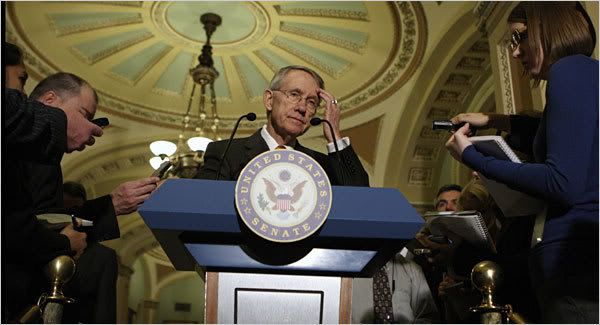
The New York Times reports:
After more than a year of wrangling, the Senate handed the White House a major victory on Tuesday by voting to broaden the government’s spy powers and to give legal protection to phone companies that cooperated in President Bush’s program of eavesdropping without warrants.
One by one, the Senate rejected amendments that would have imposed greater civil liberties checks on the government’s surveillance powers. Finally, the Senate voted 68 to 29 to approve legislation that the White House had been pushing for months. Mr. Bush hailed the vote and urged the House to move quickly in following the Senate’s lead.
The outcome in the Senate amounted, in effect, to a broader proxy vote in support of Mr. Bush’s wiretapping program. The wide-ranging debate before the final vote presaged discussion that will play out this year in the presidential and Congressional elections on other issues testing the president’s wartime authority, including secret detentions, torture and Iraq war financing.
Republicans hailed the reworking of the surveillance law as essential to protecting national security, but some Democrats and many liberal advocacy groups saw the outcome as another example of the Democrats’ fears of being branded weak on terrorism.
“Some people around here get cold feet when threatened by the administration,” said Senator Patrick J. Leahy, the Vermont Democrat who leads the Judiciary Committee and who had unsuccessfully pushed a much more restrictive set of surveillance measures.
Among the presidential contenders, Senator John McCain, Republican of Arizona, voted in favor of the final measure, while the two Democrats, Senator Barack Obama of Illinois and Senator Hillary Rodham Clinton of New York, did not vote. Mr. Obama did oppose immunity on a key earlier motion to end debate. Mrs. Clinton, campaigning in Texas, issued a statement saying she would have voted to oppose the final measure.
The measure extends, for at least six years, many of the broad new surveillance powers that Congress hastily approved last August just before its summer recess. Intelligence officials said court rulings had left dangerous gaps in their ability to intercept terrorist communications.
The bill, which had the strong backing of the White House, allows the government to eavesdrop on large bundles of foreign-based communications on its own authority so long as Americans are not the targets. A secret intelligence court, which traditionally has issued individual warrants before wiretapping began, would review the procedures set up by the executive branch only after the fact to determine whether there were abuses involving Americans.
“This is a dramatic restructuring” of surveillance law, said Michael Sussmann, a former Justice Department intelligence lawyer who represents several telecommunication companies. “And the thing that’s so dramatic about this is that you’ve removed the court review. There may be some checks after the fact, but the administration is picking the targets.”
The Senate plan also adds one provision considered critical by the White House: shielding phone companies from any legal liability for their roles in the eavesdropping program approved by Mr. Bush after the Sept. 11 attacks. The program allowed the National Security Agency to eavesdrop without warrants on the international communications of Americans suspected of having ties to Al Qaeda.
AT&T and other major phone companies are facing some 40 lawsuits from customers who claim their actions were illegal. The Bush administration maintains that if the suits are allowed to continue in court, they could bankrupt the companies and discourage them from cooperating in future intelligence operations.
The House approved a surveillance bill in November that intentionally left out immunity for the phone companies, and leaders from the two chambers will now have to find a way to work out significant differences between their two bills.
Democratic opponents, led by Senators Russ Feingold of Wisconsin and Christopher J. Dodd of Connecticut, argued that the plan effectively rewarded phone companies by providing them with legal insulation for actions that violated longstanding law and their own privacy obligations to their customers. But immunity supporters said the phone carriers acted out of patriotism after the Sept. 11 attacks in complying with what they believed in good faith was a legally binding order from the president.
“This, I believe, is the right way to go for the security of the nation,” said Senator John D. Rockefeller, the West Virginia Democrat who leads the intelligence committee. His support for the plan, after intense negotiations with the White House and his Republican colleagues, was considered critical to its passage but drew criticism from civil liberties groups because of $42,000 in contributions that Mr. Rockefeller received last year from AT&T and Verizon executives.
Senator Olympia J. Snowe, a Maine Republican on the intelligence panel, said the bill struck the right balance between protecting the rights of Americans and protecting the country “from terrorism and other foreign threats.”
Democratic opponents, who six months ago vowed to undo the results of the August surveillance vote, said they were deeply disappointed by the defection of 19 Democrats who backed the bill.
Mr. Dodd, who spoke on the floor for more than 20 hours in recent weeks in an effort to stall the bill, said future generations would view the vote as a test of whether the country heeds “the rule of law or the rule of men.”
But with Democrats splintered, Mr. Dodd acknowledged that the national security argument had won the day. “Unfortunately, those who are advocating this notion that you have to give up liberties to be more secure are apparently prevailing,” he said. “They’re convincing people that we’re at risk either politically, or at risk as a nation.”
There was a measure of frustration in the voice of Harry Reid, the Senate majority leader, as he told reporters during a break in the daylong debate, “Holding all the Democrats together on this, we’ve learned a long time ago, is not something that’s doable.”
Senate Republicans predict that they will be able to persuade the House to include immunity in the final bill, especially now that the White House has agreed to give House lawmakers access to internal documents on the wiretapping program. But House Democrats vowed Tuesday to continue opposing immunity.
Congress faces a Saturday deadline for extending the current law, but Democrats want to extend the deadline for two weeks to allow more time for talks. The White House has said it opposes a further extension.
Meanwhile, Senate Democrats hope to put some pressure on Republicans on Wednesday over another security-related issue by bringing up an intelligence measure that would apply Army field manual prohibitions against torture to civilian agencies like the Central Intelligence Agency.
Republicans plan to try to eliminate that provision, a vote that Democrats say will force Republicans to declare whether they condone torture. Democrats also say it could show the gap between Mr. McCain, who has opposed torture, and the administration on the issue.
“We know how we would feel if a member of the armed services captured by the enemy were, for example, waterboarded,” Mr. Reid said. “So I think that we’re headed in the right direction, and I hope that we’ll get Republican support on this.”
Senate roll call vote here.
Monday, February 11, 2008
| [+/-] |
The Chicken Doves |
Elected to end the war, Democrats have surrendered to Bush on Iraq and betrayed the peace movement for their own political ends
At the Rolling Stone, Matt Taibbi writes:
Quietly, while Hillary Clinton and Barack Obama have been inspiring Democrats everywhere with their rolling bitchfest, congressional superduo Harry Reid and Nancy Pelosi have completed one of the most awesome political collapses since Neville Chamberlain. At long last, the Democratic leaders of Congress have publicly surrendered on the Iraq War, just one year after being swept into power with a firm mandate to end it.
Solidifying his reputation as one of the biggest pussies in U.S. political history, Reid explained his decision to refocus his party's energies on topics other than ending the war by saying he just couldn't fit Iraq into his busy schedule. "We have the presidential election," Reid said recently. "Our time is really squeezed."
There was much public shedding of tears among the Democratic leadership, as Reid, Pelosi and other congressional heavyweights expressed deep sadness that their valiant charge up the hill of change had been thwarted by circumstances beyond their control — that, as much as they would love to continue trying to end the catastrophic Iraq deal, they would now have to wait until, oh, 2009 to try again. "We'll have a new president," said Pelosi. "And I do think at that time we'll take a fresh look at it."
Pelosi seemed especially broken up about having to surrender on Iraq, sounding like an NFL coach in a postgame presser, trying with a straight face to explain why he punted on first-and-goal. "We just didn't have any plays we liked down there," said the coach of the 0-15 Dems. "Sometimes you just have to play the field-position game...."
In reality, though, Pelosi and the Democrats were actually engaged in some serious point-shaving. Working behind the scenes, the Democrats have systematically taken over the anti-war movement, packing the nation's leading group with party consultants more interested in attacking the GOP than ending the war. "Our focus is on the Republicans," one Democratic apparatchik in charge of the anti-war coalition declared. "How can we juice up attacks on them?"
The story of how the Democrats finally betrayed the voters who handed them both houses of Congress a year ago is a depressing preview of what's to come if they win the White House. And if we don't pay attention to this sorry tale now, while there's still time to change our minds about whom to nominate, we might be stuck with this same bunch of spineless creeps for four more years. With no one but ourselves to blame.
The controversy over the Democratic "strategy" to end the war basically comes down to whom you believe. According to the Reid-Pelosi version of history, the Democrats tried hard to force President Bush's hand by repeatedly attempting to tie funding for the war to a scheduled withdrawal. Last spring they tried to get him to eat a timeline and failed to get the votes to override a presidential veto. Then they retreated and gave Bush his money, with the aim of trying again after the summer to convince a sufficient number of Republicans to cross the aisle in support of a timeline.
But in September, Gen. David Petraeus reported that Bush's "surge" in Iraq was working, giving Republicans who might otherwise have flipped sufficient cover to continue supporting the war. The Democrats had no choice, the legend goes, but to wait until 2009, in the hopes that things would be different under a Democratic president.
Democrats insist that the reason they can't cut off the money for the war, despite their majority in both houses, is purely political. "George Bush would be on TV every five minutes saying that the Democrats betrayed the troops," says Sen. Bernie Sanders of Vermont. Then he glumly adds another reason. "Also, it just wasn't going to happen."
Why it "just wasn't going to happen" is the controversy. In and around the halls of Congress, the notion that the Democrats made a sincere effort to end the war meets with, at best, derisive laughter. Though few congressional aides would think of saying so on the record, in private many dismiss their party's lame anti-war effort as an absurd dog-and-pony show, a calculated attempt to score political points without ever being serious about bringing the troops home.
"Yeah, the amount of expletives that flew in our office alone was unbelievable," says an aide to one staunchly anti-war House member. "It was all about the public show. Reid and Pelosi would say they were taking this tough stand against Bush, but if you actually looked at what they were sending to a vote, it was like Swiss cheese. Full of holes."
In the House, some seventy Democrats joined the Out of Iraq caucus and repeatedly butted heads with Reid and Pelosi, arguing passionately for tougher measures to end the war. The fight left some caucus members bitter about the party's failure. Rep. Barbara Lee of California was one of the first to submit an amendment to cut off funding unless it was tied to an immediate withdrawal. "I couldn't even get it through the Rules Committee in the spring," Lee says.
Rep. Lynn Woolsey, a fellow caucus member, says Democrats should have refused from the beginning to approve any funding that wasn't tied to a withdrawal. "If we'd been bold the minute we got control of the House — and that's why we got the majority, because the people of this country wanted us out of Iraq — if we'd been bold, even if we lost the votes, we would have gained our voice."
An honest attempt to end the war, say Democrats like Woolsey and Lee, would have involved forcing Bush to execute his veto and allowing the Republicans to filibuster all they wanted. Force a showdown, in other words, and use any means necessary to get the bloodshed ended.
"Can you imagine Tom DeLay and Denny Hastert taking no for an answer the way Reid and Pelosi did on Iraq?" asks the House aide in the expletive-filled office. "They'd find a way to get the votes. They'd get it done somehow."
But any suggestion that the Democrats had an obligation to fight this good fight infuriates the bund of hedging careerists in charge of the party. In fact, nothing sums up the current Democratic leadership better than its vitriolic criticisms of those recalcitrant party members who insist on interpreting their 2006 mandate as a command to actually end the war. Rep. David Obey, chair of the House Appropriations Committee and a key Pelosi-Reid ally, lambasted anti-war Democrats who "didn't want to get specks on those white robes of theirs." Obey even berated a soldier's mother who begged him to cut off funds for the war, accusing her and her friends of "smoking something illegal."
Rather than use the vast power they had to end the war, Democrats devoted their energy to making sure that "anti-war activism" became synonymous with "electing Democrats." Capitalizing on America's desire to end the war, they hijacked the anti-war movement itself, filling the ranks of peace groups with loyal party hacks. Anti-war organizations essentially became a political tool for the Democrats — one operated from inside the Beltway and devoted primarily to targeting Republicans.
This supposedly grass-roots "anti-war coalition" met regularly on K Street, the very capital of top-down Beltway politics. At the forefront of the groups are Thomas Matzzie and Brad Woodhouse of Americans Against the Escalation in Iraq, the leader of the anti-war lobby. Along with other K Street crusaders, the two have received iconic treatment from The Washington Post and The New York Times, both of which depicted the anti-war warriors as young idealist-progressives in shirtsleeves, riding a mirthful spirit into political combat — changing the world is fun!
But what exactly are these young idealists campaigning for? At its most recent meeting, the group eerily echoed the Reid-Pelosi "squeezed for time" mantra: Retreat from any attempt to end the war and focus on electing Democrats. "There was a lot of agreement that we can draw distinctions between anti-war Democrats and pro-war Republicans," a spokeswoman for Americans Against the Escalation in Iraq announced.
What the Post and the Times failed to note is that much of the anti-war group's leadership hails from a consulting firm called Hildebrand Tewes — whose partners, Steve Hildebrand and Paul Tewes, served as staffers for the Democratic Senatorial Campaign Committee (DSCC). In addition, these anti-war leaders continue to consult for many of the same U.S. senators whom they need to pressure in order to end the war. This is the kind of conflict of interest that would normally be an embarrassment in the activist community.
Worst of all is the case of Woodhouse, who came to Hildebrand Tewes after years of working as the chief mouthpiece for the DSCC, where he campaigned actively to re-elect Democratic senators who supported the Iraq War in the first place. Anyone bothering to look — and clearly the Post and the Times did not before penning their ardent bios of Woodhouse — would have found the youthful idealist bragging to newspapers before the Iraq invasion about the pro-war credentials of North Carolina candidate Erskine Bowles. "No one has been stronger in this race in supporting President Bush in the War on Terror and his efforts to effect a regime change in Iraq," boasted the future "anti-war" activist Woodhouse.
With guys like this in charge of the anti-war movement, much of what has passed for peace activism in the past year was little more than a thinly veiled scheme to use popular discontent over the war to unseat vulnerable Republicans up for re-election in 2008. David Sirota, a former congressional staffer whose new book, The Uprising, excoriates the Democrats for their failure to end the war, expresses disgust at the strategy of targeting only Republicans. "The whole idea is based on this insane fiction that there is no such thing as a pro-war Democrat," he says. "Their strategy allows Democrats to take credit for being against the war without doing anything to stop it. It's crazy."
Justin Raimondo, the uncompromising editorial director of Antiwar.com, regrets contributing twenty dollars to Americans Against the Escalation in Iraq. "Not only did they use it to target Republicans," he says, "they went after the ones who were on the fence about Iraq." The most notorious case involved Lincoln Chafee, a moderate from Rhode Island who lost his Senate seat in 2006. Since then, Chafee has taken shots at Democrats like Reid, Hillary Clinton and Chuck Schumer, all of whom campaigned against him despite having voted for the war themselves.
"Look, I understand partisan politics," says Chafee, who now concedes that voters were correct to punish him for his war vote. "I just find it amusing that those who helped get us into this mess now say we need to change the Senate — because we're in a mess."
The really tragic thing about the Democratic surrender on Iraq is that it's now all but guaranteed that the war will be off the table during the presidential campaign. Once again — it happened in 2002, 2004 and 2006 — the Democrats have essentially decided to rely on the voters to give them credit for being anti-war, despite the fact that, for all the noise they've made to the contrary, in the end they've done nothing but vote for war and cough up every dime they've been asked to give, every step of the way.
Even beyond the war, the Democrats have repeatedly gone limp-dick every time the Bush administration so much as raises its voice. Most recently, twelve Democrats crossed the aisle to grant immunity to phone companies who participated in Bush's notorious wiretapping program. Before that, Democrats caved in and confirmed Mike Mukasey as attorney general after he kept his middle finger extended and refused to condemn waterboarding as torture. Democrats fattened by Wall Street also got cold feet about upsetting the country's gazillionaires, refusing to close a tax loophole that rewarded hedge-fund managers with a tax rate less than half that paid by ordinary citizens.
But the war is where they showed their real mettle. Before the 2006 elections, Democrats told us we could expect more specifics on their war plans after Election Day. Nearly two years have passed since then, and now they are once again telling us to wait until after an election to see real action to stop the war. In the meantime, of course, we're to remember that they're the good guys, the Republicans are the real enemy, and, well, go Hillary! Semper fi! Yay, team!
How much of this bullshit are we going to take? How long are we supposed to give the Reids and Pelosis and Hillarys of the world credit for wanting, deep down in their moldy hearts, to do the right thing?
Look, fuck your hearts, OK? Just get it done. Because if you don't, sooner or later this con is going to run dry. It may not be in '08, but it'll be soon. Even Americans can't be fooled forever.
Thursday, January 24, 2008
| [+/-] |
Tentative Deal Reached on Stimulus Plan |
The New York Times reports:
House leaders and the White House on Thursday announced a tentative agreement on an economic stimulus package of roughly $150 billion that would pay stipends of $300 to $1,200 per family, and more for families with children, plus provide tax incentives for businesses to encourage spending.
The accord was announced by Speaker Nancy Pelosi of California, the Republican leader, Representative John A. Boehner of Ohio, and Treasury Secretary Henry M. Paulson Jr. at a Capitol news conference and hailed minutes afterward by President Bush as the fruit of “patience, determination and good will” in both parties.
The president and the speaker both described the accord as embracing the basic precepts of their respective parties. Mr. Bush called it “a powerful and effective way to help taxpayers and businesses” by letting people keep and spend more of their own money.
Ms. Pelosi said the package is aimed at the middle class “and to those who aspire to be in the middle class.” She described it as “timely, targeted and temporary — that was our standard.”
In addition to the tax rebates, or stipends, Ms. Pelosi said the package would offer some quick relief for those homeowners in danger of losing their houses.
Mr. Boehner called the package “simple, clean and neat.” Like Ms. Pelosi, he said none of the parties to the talks got everything they wanted. But in the end, he said, “This agreement is a big win for the American people.”
President Bush said the agreement was also a victory for the kind of bipartisanship that some politicians and analysts say is in short supply in Washington of late. And as he has many times, the president said the American economy is “structurally sound” despite rising energy prices and problems in the housing industry.
Democrats released a summary estimating that the rebates would go to 117 million families. About two-thirds of the total package would go toward the rebates, with the remaining one-third going toward business tax breaks, like write-offs for equipment purchases.
Both leaders pledged quick action in the House, and both pointedly urged similar alacrity by the Senate, whose members operate “with their very senatorial rules,” as Ms. Pelosi put it.
“Speed is of the essence,” Mr. Paulson said.
President Bush underscored that message, as he offered warm praise for the negotiators in both parties. He also took the opportunity to urge once again the extension of tax cuts that were approved by the Republican-controlled Congress early in the decade and are to expire within a few years.
Senator Harry Reid of Nevada, the Democratic majority leader, said minutes after the announcement that he was pleased an agreement had been reached, and that he wanted a package ready for Mr. Bush by the time Congress recesses around President’s Day. But he said senators would “work to improve the House package” through the addition of unemployment benefits and other items.
Late in the negotiations that preceded Thursday’s breakthrough, Ms. Pelosi agreed not to include two proposals that had broad support among Congressional Democrats: an extension of unemployment benefits and a temporary increase in food stamps.
In exchange for those concessions, the Bush administration and House Republicans agreed that the stipend of at least $300 would be paid to all workers who earned at least $3,000 last year, even those who did not earn enough to pay taxes.
As it was presented on Thursday afternoon, the package calls for workers who paid income taxes to receive $300 to $600, and couples to receive up to $1,200 — plus $300 more for each child. The stipend, which some lawmakers were calling a “tax rebate,” would be subject to income limits so that the wealthiest taxpayers would not receive it. Payments would go to individuals earning up to $75,000 and couples earning up to $150,000. He said roughly two-thirds of the overall package would be aimed at individual taxpayers and one-third at businesses.
Senators Reid and Mitch McConnell of Kentucky, the Republican minority leader, have yet to give their approval to the accord. But, while there may be some wrinkles to iron out between the House and Senate, there was nothing to suggest any disagreement so severe as to be a potential deal breaker.
Republicans immediately cheered the deal as “tilted toward taxpayers” and avoiding “extraneous spending” on unemployment benefits, food stamps, or infrastructure projects, which some Democrats had said should be included in a stimulus package.
But it was unclear how the package, without extended unemployment benefits or increased food stamps, would be received by Democrats in the Senate, including Senator Edward M. Kennedy of Massachusetts and Senator Charles E. Schumer of New York, who have said that those proposals offered the best prospects for quickly injecting added spending into the economy.
Senator Max Baucus, the Montana Democrat who is chairman of the Finance Committee, reiterated his interest in extending unemployment benefits at a hearing on Thursday morning, where he said his committee would mark up a fiscal stimulus bill next week.
“There are reports that a deal may be close on the House side,” Mr. Baucus said. “The Senate will want to speak, as well.”
That announcement of potential action by the Finance Committee could jar Democratic leaders who have been striving for a carefully coordinated effort on the economy. Earlier this week, Mr. Reid announced that the House would take the lead in developing the stimulus package and would conduct the immediate negotiations with the White House and Congressional Republicans.
Noting that tax rebates were one potentially cost-effective method to spur new spending, Mr. Baucus said: “Another example would be expanding unemployment insurance benefits. In recent recessions, Congress has extended the number of weeks that unemployed workers could receive benefits. We could do that again. We could provide a further extension for recipients in high unemployment states. And we could also temporarily increase the dollar amount of benefits to help unemployed workers to pay their bills.”
“Unfortunately, under current law, fewer than 4 in 10 unemployed workers receive unemployment insurance benefits,” Mr. Baucus continued. “To address this problem, we could extend eligibility. For example, we could extend benefits to part-time workers.”
Mr. Schumer, at the same hearing, also lamented Ms. Pelosi’s concession on unemployment benefits, but said he hoped that cooperation on a quick stimulus plan would continue. “While I may not agree with every element of the package — such as the decision to leave out extended unemployment benefits, which economists say would give us the greatest bang for the buck — there are some very positive developments around the tax rebate for families,” he said. “I encourage everyone to keep working in a bipartisan way.”
Ms. Pelosi met three times on Wednesday with Treasury Secretary Paulson and Mr. Boehner, who have served as chief architects of the plan in a rare show of bipartisanship.
On her way into a meeting Wednesday evening, Ms. Pelosi signaled that a deal might be close when she said there had been “tremendous” progress during the day.
Democratic leaders said that to speed the economic rescue package they would mostly bypass the usual committee process. Lawmakers said that they hoped the plan could be approved by mid-February and that it would be sufficient to soften an economic downturn and forestall a recession.
“One of the principal tenets of the administration and of ourselves is we have got to do this fast,” Representative Steny H. Hoyer of Maryland, the majority leader, said Wednesday. “To go through the regular process and have hearings and have mark-ups and subcommittee mark-ups, obviously we would be to some degree twiddling our thumbs while the economy burns.”
The progress toward a stimulus plan came as the Congressional Budget Office revised its economic projections to give a gloomier assessment of the economy, including a widening budget deficit and the first decline in corporate tax revenue since 2003.
The grimmer outlook prompted Senator Kent Conrad of North Dakota, chairman of the Budget Committee, to declare that a short-term stimulus package was insufficient.
“In addition to developing a bipartisan stimulus package,” Mr. Conrad said, “we also must work together to tackle the long-term fiscal challenges we face with the coming retirement of the baby boom generation. The American people rightly expect that we will come together to address these two significant challenges.”
House conservatives raised alarms about the emerging economic legislation, saying they feared it would focus too much on tax rebates and not enough on tax incentives to encourage businesses to create jobs.
They said any package should include provisions that would reduce the corporate tax rate, adjust capital gains for inflation and lower the capital gains rate for corporations.
“Giving temporary tax rebate checks to families, as important as that is, is not the same as economic growth,” said Representative Jeb Hensarling of Texas, chairman of the Republican Study Committee. “If you’re going to have an economic stimulus package, it ought to contain some economic stimulus.”
Wednesday, January 23, 2008
| [+/-] |
Cheney Wants Surveillance Law Expanded |
The Associated Press reports:
Vice President Dick Cheney prodded Congress on Wednesday to extend and broaden an expiring surveillance law, saying "fighting the war on terror is a long-term enterprise" that should not come with an expiration date.
"We're reminding Congress that they must act now," Cheney told the Heritage Foundation, a conservative think tank. The law, which authorizes the administration to eavesdrop on phone calls and see the e-mail to and from suspected terrorists, expires on Feb. 1. Congress is bickering over terms of its extension.
On Tuesday, Senate Republicans blocked an effort by Senate Majority Leader Harry Reid to extend the stopgap Protect America Act without expanding it, raising stakes for an expected showdown in the Senate later this week on a new version of the law.
"This cause is bigger than the quarrels of party and the agendas of politicians," Cheney said. "And if we in Washington, all of us, can only see our way clear to work together, then the outcome should not be in doubt."
Congress hastily adopted the stopgap act last summer in the face of warnings from the administration about dangerous gaps in the government's ability to gather intelligence in the Internet age.
Administration allies in Congress not only want the expiring law made permanent but amended to give telephone companies and other communications providers immunity from being sued for helping the government eavesdropping and other intelligence-gathering efforts.
Cheney said such providers "face dozens of lawsuits."
"The intelligence community doesn't have the facilities to carry out the kind of international surveillance needed to defend this country since 9-11. In some situations, there is no alternative to seeking assistance from the private sector. This is entirely appropriate," Cheney said.
At the White House, press secretary Dana Perino defended the proposal to protect phone companies from liability. "These are companies who helped their country right after 9-11," she said. She also criticized Democratic plans for a one-month extension of the current law. "Look, there's been six months to hash out the differences. Actually, there's been a whole year-and-a-half worth ... And there was robust debate, a hearty debate back in August when we got the bill that we have now."
At the heart of the controversy is whether the government's wireless surveillance program violated provisions of the original FISA law that requires warrants for wiretaps whenever one of the parties involved in the communication resides in the United States.
Cheney also said the administration "feels strongly that an updated FISA law should be made permanent, not merely extended again. ... There is no sound reason to pass critical legislation like the Protect America Act and slap an expiration date on it."
Reid plans to bring to the Senate floor on Thursday competing versions of the legislation.
If a bill is not approved then, Reid said he would require the Senate to work through the weekend to get a bill passed.
The original FISA law requires the government to get permission from a special court to listen in on the phone calls and e-mails of people in the United States. Changes in communications technology mean many purely foreign to foreign communications now pass through the United States and therefore require the government to get court orders to intercept them.
The Protect America Act, adopted in August, eased that restriction. Privacy and civil liberties advocates say it went too far, giving the government far more power to eavesdrop on American communications without court oversight.
Wednesday, January 16, 2008
| [+/-] |
Congress Reaches Deal On New Defense Bill After Bush Veto |
The Hill reports:
Congress has reached a compromise with the White House over a defense authorization bill provision that had drawn complaints from the Iraqi government.
Those complaints prompted President Bush to veto the defense bill last month. He complained that a provision in the bill that allowed victims of terrorism to be awarded compensation from frozen foreign assets of state sponsors of terror could have crippled the fledgling Iraqi government with billions of dollars in liability.
Under the compromise, Iraq is excluded from the provision, but other state sponsors of terrorism, such as Iran and Syria, could see frozen assets used as compensation. The compromise is likely to leave American victims taken hostage and tortured by Saddam Hussein’s regime during the first Gulf War without recourse in U.S. federal court.
The new language allows the president to waive the entire provision with regards to claims against Iraq for acts of terrorism that happened before or on the date of the enactment of the 2008 defense authorization bill. The president is required to make a national security determination before issuing a waiver and must notify Congress 30 days prior to issuing it.
However, the changed provision does give a nod to those who had wanted Iraq to be covered by the provision. It includes a sense of the Congress that the secretary of State should work with the government of Iraq to ensure compensation for any meritorious cases based on terrorist acts committed by Saddam’s regime against U.S. citizens or members of the military whose cases can’t be addressed in U.S. courts.
The Bush administration had argued that freezing Iraq’s assets, even temporarily, would deter Iraqis from working with U.S. businesses and could invite other nations to freeze American assets abroad.
The House is expected to vote on the revised defense authorization bill Wednesday night and send it to the Senate for approval.
Wednesday, January 2, 2008
| [+/-] |
Democrats Say Bush Can't Pocket Veto Defense Bill |
The Hill reports:
House Democrats and the Bush administration appear on the verge of a new constitutional fight over whether President Bush can pocket-veto the defense authorization bill.
The White House on Monday said it was pocket-vetoing the measure, but a spokesman for House Speaker Nancy Pelosi (D-Calif.) said the president cannot use such a measure when Congress is in session. The distinction over whether the president can pocket-veto the bill is important because such a move would prevent Congress from voting on an override.
“Congress vigorously rejects any claim that the president has the authority to pocket-veto this legislation, and will treat any bill returned to the Congress as open to an override vote,” said Nadeam Elshami, a spokesman for Pelosi. He said the Speaker is keeping all legislative options on the table.
White House Spokesman Tony Fratto responded by saying that the president returned the bill in an appropriate way and is looking forward to working with congressional leaders to fix it when Congress returns this month.
The defense bill passed both the House and Senate with veto-proof majorities. Still, it’s unclear whether those majorities would hold, since House Republican leaders have called on Pelosi and Senate Majority Leader Harry Reid (D-Nev.) to make changes to the bill demanded by the president.
A pocket veto occurs when the president neither vetoes nor signs a bill within 10 days, excluding Sundays, after its passage while Congress is adjourned. When Congress is in session, any bill that the president does not act on becomes law, according to the Constitution. The Senate has been in pro forma session over the last two weeks, while the House has been out of session.
The White House argues it pocket-vetoed the defense bill on Dec. 28 by sending it back to the House with a message of disapproval. It argues that a pocket veto was possible because the House, where the bill originated, was out of session.
“A pocket veto, as you know, is essentially putting it in your pocket and not taking any action whatsoever. And when Congress — the House is out of session — in this case it’s our view that bill then would not become law,” White House Spokesman Scott Stanzel told reporters Monday.
He said Congress should move quickly to send Bush a new defense bill with the demanded changes after it returns in January, and noted the White House had taken the “additional step” of returning the bill to the House with a message of disapproval.
Bush opposes parts of the bill that would allow lawsuits against Iraqis for acts committed when Saddam Hussein was in power to move forward in U.S. courts. Those lawsuits could slow down the Iraqi government’s reconstruction efforts, Bush has said.
Pelosi and Reid released a statement last week decrying Bush’s announcement that he intended to veto the bill, saying that it would delay the disbursement of money that troops needed. They also noted that the White House should have raised its objections to the bill before Congress had passed it.
In announcing the president planned to veto the bill last week, the White House did not specify it intended to use a pocket veto.
Louis Fisher, a constitutional scholar at the Library of Congress, said that the president is inviting a constitutional fight in trying a pocket veto.
“The administration would be on weak grounds in court because they would be insisting on what the Framers decidedly rejected: an absolute veto,” Fisher said.
True pocket vetoes are available only when Congress is away for months and unable to vote on an override, he said.
Wednesday, December 19, 2007
| [+/-] |
Hillary Clinton Vows Regular Pullout of Brigades |
The New York Times blog reports:
Iraq doesn’t come up on the presidential campaign trail as much as it once did, but Senator Hillary Rodham Clinton was asked here Wednesday afternoon when she would “bring the boys home” – and gave a blunter and less conditional answer than usual.
“I think we can bring home one to two combat brigades a month,” she told an audience member who posed the question. “I think we can bring nearly everybody home, you know, certainly within a year if we keep at it and do it very steadily.”
One of Mrs. Clinton’s main competitors in Iowa, Senator Barack Obama, has been proposing the one-to-two-brigade pace for many months now; her other chief rival, former Senator John Edwards, as well as Governor Bill Richardson, have argued that they would remove all combat troops more quickly than that.
Mrs. Clinton has said for months that, as president, she would begin removing troops as quickly as her team could put plans in place, and that she would move at an orderly and safety-conscious pace. But she has also said that she would leave a number of forces in the country for specific missions, such as fighting al Qaeda and other terrorist groups, protecting the Kurds, and acting as a bulwark against Iranian forces.
Asked in August if troops could be out in 2007, Mrs. Clinton pointed to experts’ estimates that only one to two brigades could be evacuated each month. There are now 20 combat brigades in Iraq.
She also said this year, “The best estimate is that we can probably move a brigade a month, if we really accelerate it, maybe a brigade and a half or two a month. That is a lot of months. My point is: They’re not even planning for that in the Pentagon.”
| [+/-] |
Is Hillary or Barack More Vulnerable? |
At ConsortiumNews.com, Robert Parry reports:
Even as Hillary Clinton’s operatives were dropping hints that Republicans would exploit Barack Obama’s youthful drug use, some Clinton insiders privately worried about her own vulnerability because the Bush administration possesses detailed knowledge of her movements – and her husband’s – over the past seven years.
Because of Sen. Clinton’s unique status as the first former First Lady to run for President – and because her husband was succeeded by a Republican – she is the first candidate to have both her and her spouse be subject to regular, long-term surveillance by an Executive Branch agency controlled by the opposing political party.
Since they left the White House in 2001, Bill and Hillary Clinton have been under the protection of the Secret Service, formerly a branch of the Treasury Department and now part of the Homeland Security Department. Records are maintained showing where they go and whom they meet.
Homeland Security is under the control of Michael Chertoff, a longtime Clinton nemesis dating back to his work as a Republican lawyer on the Senate’s Whitewater investigation in the 1990s. In 2003, Sen. Clinton cast the sole dissenting vote against Chertoff’s nomination as a federal judge in protest against his abrasive conduct during the Whitewater inquiry.
Though Secret Service records are supposed to be closely held secrets, a source close to the Clintons told me that it is believed that senior Republicans have received regular briefings about movements of the Clintons that might prove embarrassing if released during the general election campaign.
Given this possibility, Clinton operatives were walking a tightrope when they began raising questions about what bare-knuckled Republican operatives might do with Sen. Obama’s public acknowledgement that he experimented with drugs, including cocaine, as a young man.
As part of the Clinton campaign’s broader effort to raise doubts about Obama’s electability, Clinton’s New Hampshire co-chairman Bill Shaheen told the Washington Post that “one of the things [the Republicans are] certainly going to jump on is his drug use. …
“It’ll be, ‘When was the last time? Did you ever give drugs to anyone? Did you sell them to anyone?’ … There are so many openings for Republican dirty tricks. It’s hard to overcome.”
Though an uproar over the remarks soon forced Shaheen’s resignation, Clinton’s chief strategist Mark Penn managed to slip the word “cocaine” into a denial that the Clinton campaign was playing its own dirty trick.
"The issue related to cocaine use is not something the campaign is in any way raising," Penn said on MSNBC’s "Hardball."
The Clinton campaign’s gamesmanship prompted more protests from the Obama camp and a satire by New York Times columnist Maureen Dowd who recounted a mock Iowa debate in which Hillary Clinton inserted drug references at every possible opportunity. [NYT, Dec. 16, 2007]
Clinton/Bush Ties
But there is a history to the Clinton and Bush families possessing damaging secrets about the other, a kind of balance of terror in which the Bushes usually have the upper hand and the Clintons have chosen mostly to make concessions and seek favors from the more powerful family.
On Dec. 17 in South Carolina, Bill Clinton demonstrated that tendency, saying Hillary Clinton’s first act as President would be to send Bill Clinton and George H.W. Bush on an around-the-world mission to repair America’s image.
“The first thing she intends to do is to send me and former President Bush and a number of other people around the world to tell them that America is open for business and cooperation again,” said Bill Clinton, who is proud that he has accompanied the senior Bush on many international humanitarian missions.
Clinton’s comment could be viewed as both a slap at George W. Bush and a kiss-up to his father. But the elder Bush responded icily through a spokesman, saying he supports his son’s foreign policy and “never discussed an ‘around-the-world mission’ with either former President Bill Clinton or Sen. Clinton.”
It was not the first time that the senior Bush, the patriarch of America’s most prominent political family, had put down the upstart Clinton.
In 1992 when Clinton – as Arkansas governor – sought the White House, then-President Bush encouraged his subordinates to find a “silver bullet” that would kill off Clinton’s presidential hopes.
The senior Bush later acknowledged to FBI investigators that he was “nagging” his aides to push for more information about Bill Clinton’s student travels to the Soviet Union and Czechoslovakia and about right-wing rumors that Clinton had sought to renounce his U.S. citizenship.
“Hypothetically speaking, President Bush advised that he would not have directed anyone to investigate the possibility that Clinton had renounced his citizenship because he would have relied on others to make this decision,” according to an FBI report on its interview with the elder Bush. “He [Bush] would have said something like, ‘Let’s get it out’ or ‘Hope the truth gets out.’” [For details, see Robert Parry’s Secrecy & Privilege.]
With such high-level urging, White House chief of staff James Baker instructed his aide, Janet Mullins, to ask Steven Berry, assistant secretary of state for legislative affairs, about progress on right-wing press requests for information about Clinton’s student travel.
Eventually, the White House interest was communicated to State Department official Elizabeth Tamposi, a Bush political appointee who saw it as a green light to move ahead with the legally questionable search.
On the night of Sept. 30, 1992, Tamposi dispatched three aides to the federal records center in Suitland, Maryland, where they searched Clinton’s passport file as well as his mother’s, presumably because they thought it might contain some references to Clinton.
In a later press interview, Tamposi asserted that she ordered the search after Berry had pressured her to “dig up dirt on Clinton” for the Bush White House.
Press Leak
Though finding no letter renouncing citizenship, the State Department officials still made use of Clinton’s passport application, which had staple holes and a slight tear in the corner.
The tear was easily explained by the routine practice of stapling a photo or money order to the application, but Tamposi seized on the ripped page to justify a new suspicion, that a Clinton ally at the State Department had removed the renunciation letter.
Tamposi shaped that speculation into a criminal referral which was forwarded to the Justice Department. Thin as the case was, George H.W. Bush’s reelection campaign had its official action so the renunciation rumor could be turned into a public issue.
Within hours of the criminal referral, someone from the Bush camp leaked word about the confidential FBI investigation to reporters at Newsweek magazine.
The Newsweek story about the tampering investigation hit the newsstands on Oct. 4, 1992. The article suggested that a Clinton backer might have removed incriminating material from Clinton’s passport file, precisely the spin that the Bush people wanted.
Immediately, President George H.W. Bush took the offensive, using the press frenzy over the tampering story to attack Clinton’s patriotism on a variety of fronts, including his student trip to Moscow in 1970. With his patriotism challenged, Clinton saw his once-formidable lead shrink.
Clinton’s campaign ultimately was saved by quick-thinking Democrats on Capitol Hill who exposed the passport leak as a political dirty trick. That forced the elder Bush into a quasi-apology for the scandal, which became known as “Passport-gate.”
After Clinton won the election, however, the criminality of the dirty trick was swept under the rug by Republican special prosecutor Joseph DiGenova, who was appointed to investigate by a federal judicial panel run by right-wing appellate judge David Sentelle.
(Showing what a small world political Washington can be, DiGenova is married to Republican lawyer Victoria Toensing, a key figure in the public attacks on former U.S. Ambassador Joseph Wilson and his wife, CIA officer Valerie Plame, over Wilson’s criticism of the WMD intelligence that George W. Bush used to justify invading Iraq.)
Unearthing Dirt
As President, Clinton not only turned the other cheek in regard to “Passport-gate” but made sure that federal investigators averted their eyes from other scandals implicating former President Bush. Clinton presumably thought that his magnanimity could gain some reciprocity from Republicans when it came to his own scandals.
As Clinton was taking office in 1993, three important investigations were underway, all of which Clinton could have helped by ordering key documents declassified or giving other backing to the investigators.
Special prosecutor Lawrence Walsh was still battling the cover-up that had surrounded the Iran-Contra scandal of the 1980s; Democratic congressmen were digging into the “Iraqgate” scandal, the covert supplying of dangerous weapons to Iraq’s Saddam Hussein in the 1980s; and a House task force was suddenly inundated with evidence pointing to Republican guilt in the “October Surprise” case, alleged interference by the Reagan-Bush campaign in 1980 to undermine President Jimmy Carter’s efforts to free 52 American hostages then held in Iran.
Combined, those three investigations could have rewritten the history of the 1980s, exposing serious wrongdoing by Republicans who had held the White House for a dozen years. The full story also would likely have terminated the presidential ambitions of the powerful Bush family, since George H.W. Bush was implicated in all three scandals.
However, Clinton and the leaders of the Democratic majorities in Congress didn’t care enough about the truth to fight for it. Instead, they saw the truth as a bargaining chip that could be cheaply traded away.
Clinton agreed to let George H.W. Bush retreat gracefully into retirement despite Bush’s brazen attempt to destroy Walsh’s criminal investigation by issuing six pardons to Iran-Contra defendants on Christmas Eve 1992.
In his 2004 memoir, My Life, Clinton wrote that he “disagreed with the pardons and could have made more of them but didn’t.” Clinton cited several reasons for giving his predecessor a pass.
“I wanted the country to be more united, not more divided, even if that split would be to my political advantage,” Clinton wrote. “Finally, President Bush had given decades of service to our country, and I thought we should allow him to retire in peace, leaving the matter between him and his conscience.”
By his choice of words, Clinton revealed how he saw information – not something that belonged to the American people and that had intrinsic value to the democratic process – but as a potential weapon that could be put to “political advantage.”
Joining the Cover-ups
On the Iran-Contra pardons, Clinton saw himself as generously passing up a club that he could have wielded to bludgeon an adversary. He chose instead to join in a cover-up in the name of national unity.
Similarly, the Democratic congressional leadership ignored the flood of incriminating evidence pouring into the “October Surprise” task force in December 1992.
Chief counsel Lawrence Barcella told me later that he urged task force chairman Lee Hamilton to extend the investigation several months to examine this new evidence of Republican guilt, but Hamilton ordered Barcella simply to wrap up the probe with a finding that the Reagan-Bush campaign had done nothing wrong.
Some of the new incriminating evidence – including an unprecedented report from the Russian government about its knowledge of illicit Republican contacts with Iran – was simply hidden away in boxes that I discovered two years later and dubbed “The October Surprise X-Files.”
The “Iraqgate” investigation met a similar fate under Clinton’s Justice Department, which chose to ignore or dismiss evidence of covert shipments of dangerous war materiel to Saddam Hussein during the 1980s.
When former Reagan national security official Howard Teicher came forward with an affidavit describing secret U.S.-backed arms shipments to Iraq, Clinton’s Justice Department went on the offensive – against Teicher, bullying him into silence.
Even as Republicans pounded Clinton over his Whitewater real estate deal and other alleged misdeeds, his administration continued to see no evil when it came to criminal acts implicating Ronald Reagan or George H.W. Bush.
True to form, the Clinton administration did nothing when Reagan’s 1984 campaign chief Ed Rollins wrote in his 1996 memoir Bare Knuckles and Back Rooms that a top Filipino politician had admitted delivering an illegal $10 million cash payment to Reagan from Philippine dictator Ferdinand Marcos.
"I was the guy who gave the ten million from Marcos to your campaign," the Filipino told Rollins in 1991, according to the memoir. "I was the guy who made the arrangements and delivered the cash personally. ...It was a personal gift from Marcos to Reagan."
However, Rollins has refused since to divulge the name of either the Filipino politician or the Republican lobbyist who allegedly handled the pay-off. The stunning anecdote did attract some press coverage in 1996 but the story died because the Clinton administration made no effort to follow it up.
(Rollins is now chairman of Republican Mike Huckabee’s presidential campaign.) [For details on Marcos-Reagan case, see Consortiumnews.com’s “Huckabee’s Chairman Hid Payoff Secret.”]
Off the Radar
During Clinton’s presidency, I approached then-deputy White House chief of staff John Podesta and other senior officials to ask whether they had any plans to pursue important investigations that had been left undone in 1993. I was told those issues simply weren’t “on the radar scopes.”
However, if Clinton thought that his collaboration in keeping the Reagan-Bush secrets from the American people would earn him some bipartisan help from the Republicans, he was mistaken.
Clinton saw his prized domestic agenda, including Hillary Clinton’s health care reform, defeated; his party lose control of Congress in 1994; the House vote to impeach him in 1998 for lying about an extramarital sexual relationship; and George H.W. Bush’s oldest son steal the 2000 election from Clinton’s Vice President, Al Gore.
Now, as Campaign 2008 begins to unfold, a similar dynamic is in place.
George W. Bush has engaged in a variety of acts that appear to be illegal, extra-legal or unconstitutional, while the Clintons are again signaling that they have no intention of holding the Bush family accountable.
If Bill Clinton is right – that his wife’s first act as President would be to ask him and George H.W. Bush to go on an around-the-world goodwill mission – Hillary Clinton is making it clear that she has no intention of holding George W. Bush accountable for any wrongdoing.
There is no way that George H.W. Bush would help the Clintons on the diplomatic front if they were taking action against his eldest son.
So, the stage seems set for another Bush-Clinton revolving door where the Bushes get a free pass as they leave in exchange for the Clintons hoping against hope that the powerful family will show them a little respect and maybe a touch of mercy.
Or, as the Clinton friend suggested to me last week, maybe their real hope is that the Bushes won’t reveal what they’ve learned from the Secret Service records detailing where the Clintons have gone and with whom.
While “Passport-gate” is now only a little-remembered chapter of Campaign 1992, it does show how easily a sitting President can get subordinates to stretch – or even break – the law to unearth information that can serve a political purpose.
In George W. Bush’s case, the temptation will be strong to use whatever means he has at his disposal to ensure that his successor continues his “war on terror” policies and doesn’t authorize serious investigations into controversies such as torture and illegal wiretapping.
The Clintons also have to be nervous because the Republicans have the advantage of an ideologically committed news media, from popular talk-radio hosts and Internet bloggers to Rev. Sun Myung Moon’s Washington Times and Rupert Murdoch’s Fox News.
If Sen. Clinton wins the Democratic nomination, any information, especially some tidbit that suggests sexual improprieties, could be leaked to any number of right-wing media outlets and quickly jump into the mainstream press.
A scandal would prove especially devastating if backed by real information, like what might be available in Secret Service records.
One reason that civil libertarians have been alarmed about Bush’s assertion of nearly unlimited executive authority over such tactics as wiretapping, data-mining and domestic spy satellites is that it has coincided with a Republican goal for near-permanent political control of the U.S. government.
While the Clinton campaign is surely right that the Republicans will exploit whatever they can to discredit Sen. Obama, it appears to be equally true that they will use whatever they have to gain an advantage with the Clintons, too.
