Vice President's email lost for key week in CIA leak probe
MSNBC reports:
When Special Counsel Patrick Fitzgerald wanted to find out what was going on inside Vice President Dick Cheney's office, the prosecutor in the CIA leak probe made a logical move. He dropped a grand jury subpoena on the White House for all the relevant e-mail.
One problem: Even though White House computer technicians hunted high and low, an entire week's worth of e-mail from Cheney's office was missing. The week was Sept. 30, 2003, to Oct. 6, 2003, the opening days of the Justice Department's probe into whether anyone at the White House leaked the identity of CIA operative Valerie Plame.
That episode was part of the picture that unfolded Tuesday on Capitol Hill, where Democrats on a House committee released new information about one of the Bush White House's long-running issues, its problem-plagued e-mail system.
For the first time, a former White House computer technician went public with the details. Steven McDevitt revealed in written statements submitted to Congress how a plan was developed to try to recover the missing e-mail for Fitzgerald.
Ultimately, 250 pages of electronic messages were retrieved from the personal e-mail accounts of officials in Cheney's office, but whether that amounted to all the relevant e-mail is a question that may never be answered.
McDevitt made clear that it was a sensitive issue inside the White House.
"I worked with ... White House Counsel on efforts to provide an explanation to the special prosecutor," McDevitt wrote. "This included providing a briefing to the special prosecutor's staff on this subject."
McDevitt provided no details of the meetings with White House Counsel Harriet Miers and others in the counsel's office in late 2005 and early 2006. The White House refused to comment on those meetings.
White House on defensive
The White House put the best face on a bad hearing Tuesday of the House Oversight and Government Reform Committee, defending the administration's handling of its electronic messages.
McDevitt said that one estimate from a 2005 analysis was that more than 1,000 days of e-mail were missing from January 2003 to Aug. 10, 2005. McDevitt said "the process by which e-mail was being collected and retained was primitive and the risk that data would be lost was high." The "low end" estimate was about 470 days, he added.
The White House says a substantial amount of what had been believed to be missing e-mail had been located.
"We are very energized about getting to the bottom of this" issue, Theresa Payton, chief information officer at the White House Office of Administration, testified to the committee.
"This is a form of sandbagging," replied Oversight Committee Chairman Henry Waxman, D-Calif., who pointed out that by the time the White House fixes its e-mail problems, "you'll be out of office."
E-mail shortcomings
McDevitt's statements detailed shortcomings that he said have plagued the White House e-mail system for six years. He said:* The White House had no complete inventory of e-mail files.
* There was no automatic system to ensure that e-mail was archived and preserved.
* Until mid-2005 the e-mail system had serious security flaws, in which "everyone" on the White House computer network had access to e-mail. McDevitt wrote that the "potential impact" of the security flaw was that there was no way to verify that retained data had not been modified.
* A new e-mail archiving system that would have addressed the problems was "ready to go live" on Aug. 21, 2006.
Payton told Waxman's committee she canceled the new system in late 2006 because it would have required modifications and additional spending. An alternative system is under way, she said.
Payton's predecessor, Carlos Solari, told the House committee that he was puzzled that the new system had been rejected and that he had "absolutely" believed that the system Payton rejected would be implemented.
When President Bush leaves office, presidential records and federal records at the White House will be turned over to the National Archives. Waxman produced a memo pointing to a lack of cooperation between the White House and the Archives.
"We still know virtually nothing about the status of the alleged missing White House e-mails," the Archives' general counsel, Gary Stern, wrote to his boss last September.
Wednesday, February 27, 2008
| [+/-] |
Cheney's Subpoenaed E-Mails Missing |
Tuesday, February 26, 2008
| [+/-] |
GOP Halts Effort to Retrieve White House E-Mails |
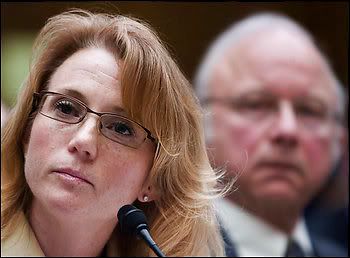 Theresa Payton, White House Office of Administration chief information officer, and Allen Weinstein, United States archivist, testify on Capitol Hill. (By Manuel Balce Ceneta -- Associated Press)
The Washington Post reports:
After promising last year to search its computers for tens of thousands of e-mails sent by White House officials, the Republican National Committee has informed a House committee that it no longer plans to retrieve the communications by restoring computer backup tapes, the panel's chairman said yesterday.
The move increases the likelihood that an untold number of RNC e-mails dealing with official White House business during the first term of the Bush administration -- including many sent or received by former presidential adviser Karl Rove -- will never be recovered, said House Democrats and public records advocates.
The RNC had previously told the House Oversight and Government Reform Committee that it was attempting to restore e-mails from 2001 to 2003, when the RNC had a policy of purging all e-mails, including those to and from White House officials, after 30 days. But Chairman Henry A. Waxman (D-Calif.) disclosed during a hearing yesterday that the RNC has now said it "has no intention of trying to restore the missing White House e-mails."
"The result is a potentially enormous gap in the historical record," Waxman said, including the buildup to the Iraq war.
Spokesman Danny Diaz said in a statement that the RNC "is fully compliant with the spirit and letter of the law." He declined further comment.
Administration officials have acknowledged that Rove and many other White House officials routinely used RNC accounts for government business, despite rules requiring that they conduct such business through official communications channels. The RNC deleted all e-mails until 2004, when it exempted White House officials from its e-mail purging policy.
About 80 White House aides used RNC accounts for official government business, committee staff members said. Rove, for example, sent or received 140,000 e-mails on RNC servers from 2002 to 2007, and more than half involved official ".gov" accounts, the panel has said.
The RNC dispute is part of a broader debate over whether the Bush administration has complied with long-standing statutory requirements to preserve official White House records -- including those reflecting potentially sensitive policy discussions -- for history and in case of future legal demands.
The committee is investigating allegations that vast stores of official Bush administration e-mails have also gone missing from the White House, which scrapped a Clinton-era archiving system and has struggled with data retention problems.
A former White House technology manager told the committee in statements released yesterday that the Bush administration's e-mail system "was primitive and the risk that data would be lost was high."
Steven McDevitt, who left the White House in 2006, said he supervised an internal study that found hundreds of days in which no electronic messages were stored for one or more White House offices from January 2003 to August 2005. The study stated a range when tallying the total number of days in which an office had no recorded e-mails, from 473 -- which had been previously reported -- to more than 1,000, McDevitt said.
McDevitt also said security was so lax that e-mail could be modified by anyone on the computer network until the middle of 2005.
Administration officials defended their efforts to fix the problems, and said they are still working to locate and identify e-mails reported as missing. "We are very energized about getting to the bottom of this," said Theresa Payton, chief information officer at the Office of Administration.
At the hearing, Payton and GOP lawmakers attacked the 2005 White House study overseen by McDevitt, calling it flawed and unreliable. McDevitt said the 250-page study involved numerous senior technology officials as well as outside contractors.
Rep. Thomas M. Davis III (Va.), the committee's ranking Republican, said in a statement that the missing e-mail allegations are "based on a discredited internal report conveniently leaked to the media." He also said that yesterday's hearing was "less about preserving records and more about resurrecting the spurious claim that the White House 'lost millions of official e-mails.'"
Davis also said, based on a briefing by Payton, that the actual number of days with missing e-mails was 202. "A substantial portion of the so-called 'missing' e-mails appear not to be missing at all, just filed in the wrong digital drawer," Davis said. No other committee member followed up on that allegation during the hearing.
| [+/-] |
Politicos Squabble Over 'Missing' White House E-Mails |
At NewsBlog, Anne Broache reports:
Democrats and Republicans were warring Tuesday over reports that the White House has "lost"--or simply failed to keep--archives of e-mails belonging to the president and his advisers.
Since last spring, the U.S. House of Representatives Committee on Oversight and Government Reform has been investigating reports that an estimated 5 million messages from 473 days between 2003 and 2005 allegedly vanished from e-mail servers housed within the president's office.
A hearing convened by the committee gave Democratic leaders a new chance to press White House officials publicly on how and when they expect to recover the files.
"We still know virtually nothing about the status of the alleged missing White House e-mails," said Committee Chairman Henry Waxman (D-Calif.).
Allen Weinstein, archivist of the United States, said the National Archives and Records Administration had similarly gotten no response from the White House to its queries about what's going on. "I'm concerned about maintaining the fullest possible presidential records," he told the committee.
Republican leaders said they were also concerned about the prospect of missing nuggets of presidential history, but they accused the Democrats of failing to acknowledge the White House's ongoing efforts to retrieve the messages. Republican Ranking Member Tom Davis (R-Va.) said the White House has said it has since reduced the number of days' worth of missing e-mails from 473 to 202 after discovering that those messages had been filed "in the wrong digital drawer" as part of a switch from the Lotus Notes to Microsoft Exchange e-mail system in 2002.
White House Chief Information Officer Theresa Payton assured the committee that her office is working actively on a multi-step restoration process. Their early results have identified an unspecified number of the previously "missing" messages, though those results still have to be validated.
When pressed by Davis, Payton also said she felt "very comfortable" that they would be able to reconstruct any remaining lost documents from "disaster recovery backup tapes," although she said that process would be time-consuming and could cost at least $15 million.
Did advisers use Republican National Committee accounts?
A separate issue under scrutiny revolves around charges that Karl Rove and some 50 other presidential advisers were using Republican National Committee accounts to conduct official business and thus subvert federal record-keeping laws. The RNC has said it had virtually no records of e-mails sent on its servers by Rove and others before November 2003, which Democrats argue is troubling because those messages may contain important official information about the president's decision to go to war in Iraq.
Waxman said he heard from RNC officials as recently as Monday that the White House had made no effort to request backup tapes from the committee that may contain those files. He scolded White House officials for their inaction. Both Payton and her boss, White House Office of Administration director Alan Swendiman, said they wouldn't be responsible for making such requests but would look into who is.
Republicans accused the Democrats of pursuing the investigation simply to dig up dirt on Rove and waste hundreds of thousands of dollars of money that the RNC could be using to shore up its candidates' campaigns.
"Are we simply going on a fishing expedition at $40,000 to $50,000 a month?" Rep. Darrell Issa (R-Calif.) asked National Archives and White House officials at the hearing. "Do any of you know of a single document, because this committee doesn't, that should've been in the archives but in fact was done at the RNC?"
"I think the issue is always, were there official government public records on that system?" responded Gary Stern, general counsel to the National Archives.
The loss of documents in either case is potentially significant because federal laws, including the Presidential Records Act, requires the White House to preserve all documents related to the president and vice president's official business and turn them over to the National Archives. Personal records, including political campaign-related materials, are expected to be filed separately and not subject to the same restrictions. The matter has already sparked a lawsuit from an advocacy group called Citizens for Responsibility and Ethics in Washington.
Clinton administration's archiving problems
The Bush administration isn't the first to encounter problems with missing e-mails. During the mid-1990s, the Clinton administration at one point relied on a flawed e-mail archiving system that failed, among other things, to preserve e-mails sent by people whose names began with the letter D. The situation resulted in congressional hearings and some $11 million spent on reconstructing the some 200,000 missing e-mails, Waxman said.
The problems for the Bush administration apparently started soon after the White House decided to shift its e-mail system from Lotus Notes to Microsoft Exchange in 2002. It also replaced the automated records storage system devised by the Clinton administration with a system that one of its own experts described as "primitive," according to Waxman.
According to the committee, the archive system is an "ad hoc" process called "journaling," in which a White House staffer or contractor manually copies e-mails and saves them on various White House servers. Democrats cast more than a little suspicion on that practice. They cited testimony outside the hearing from a former White House technology worker who said, at least during some points in 2005, those files and directories were available to all 3,000 employees under the umbrella of the executive office of the president.
White House CIO Payton, who began her job in May 2006, said she was unaware of anything of the sort. She also said she had no knowledge of anyone intentionally deleting or tampering with files and later said the copying of messages is automatic, not manual.
"We want to make sure we get all the e-mails over to the (National Archives) at transition" to the next president, she told the committee.
Monday, February 4, 2008
| [+/-] |
Rule By Fear Or Rule By Law? |
"The power of the Executive to cast a man into prison without formulating any charge known to the law, and particularly to deny him the judgment of his peers, is in the highest degree odious and is the foundation of all totalitarian government whether Nazi or Communist."
- Winston Churchill, Nov. 21, 1943
At SFgate.com, Lewish Seillor and Dan Hamburg write:
Since 9/11, and seemingly without the notice of most Americans, the federal government has assumed the authority to institute martial law, arrest a wide swath of dissidents (citizen and noncitizen alike), and detain people without legal or constitutional recourse in the event of "an emergency influx of immigrants in the U.S., or to support the rapid development of new programs."
Beginning in 1999, the government has entered into a series of single-bid contracts with Halliburton subsidiary Kellogg, Brown and Root (KBR) to build detention camps at undisclosed locations within the United States. The government has also contracted with several companies to build thousands of railcars, some reportedly equipped with shackles, ostensibly to transport detainees.
According to diplomat and author Peter Dale Scott, the KBR contract is part of a Homeland Security plan titled ENDGAME, which sets as its goal the removal of "all removable aliens" and "potential terrorists."
Fraud-busters such as Rep. Henry Waxman, D-Los Angeles, have complained about these contracts, saying that more taxpayer dollars should not go to taxpayer-gouging Halliburton. But the real question is: What kind of "new programs" require the construction and refurbishment of detention facilities in nearly every state of the union with the capacity to house perhaps millions of people?
Sect. 1042 of the 2007 National Defense Authorization Act (NDAA), "Use of the Armed Forces in Major Public Emergencies," gives the executive the power to invoke martial law. For the first time in more than a century, the president is now authorized to use the military in response to "a natural disaster, a disease outbreak, a terrorist attack or any other condition in which the President determines that domestic violence has occurred to the extent that state officials cannot maintain public order."
The Military Commissions Act of 2006, rammed through Congress just before the 2006 midterm elections, allows for the indefinite imprisonment of anyone who donates money to a charity that turns up on a list of "terrorist" organizations, or who speaks out against the government's policies. The law calls for secret trials for citizens and noncitizens alike.
Also in 2007, the White House quietly issued National Security Presidential Directive 51 (NSPD-51), to ensure "continuity of government" in the event of what the document vaguely calls a "catastrophic emergency." Should the president determine that such an emergency has occurred, he and he alone is empowered to do whatever he deems necessary to ensure "continuity of government." This could include everything from canceling elections to suspending the Constitution to launching a nuclear attack. Congress has yet to hold a single hearing on NSPD-51.
U.S. Rep. Jane Harman, D-Venice (Los Angeles County) has come up with a new way to expand the domestic "war on terror." Her Violent Radicalization and Homegrown Terrorism Prevention Act of 2007 (HR1955), which passed the House by the lopsided vote of 404-6, would set up a commission to "examine and report upon the facts and causes" of so-called violent radicalism and extremist ideology, then make legislative recommendations on combatting it.
According to commentary in the Baltimore Sun, Rep. Harman and her colleagues from both sides of the aisle believe the country faces a native brand of terrorism, and needs a commission with sweeping investigative power to combat it.
A clue as to where Harman's commission might be aiming is the Animal Enterprise Terrorism Act, a law that labels those who "engage in sit-ins, civil disobedience, trespass, or any other crime in the name of animal rights" as terrorists. Other groups in the crosshairs could be anti-abortion protesters, anti-tax agitators, immigration activists, environmentalists, peace demonstrators, Second Amendment rights supporters ... the list goes on and on. According to author Naomi Wolf, the National Counterterrorism Center holds the names of roughly 775,000 "terror suspects" with the number increasing by 20,000 per month.
What could the government be contemplating that leads it to make contingency plans to detain without recourse millions of its own citizens?
The Constitution does not allow the executive to have unchecked power under any circumstances. The people must not allow the president to use the war on terrorism to rule by fear instead of by law.
Lewis Seiler is the president of Voice of the Environment, Inc. Dan Hamburg, a former congressman, is executive director.
Sunday, August 19, 2007
| [+/-] |
How Rove Directed Federal Assets For GOP Gains |
The Washington Post reports:
Thirteen months before President Bush was reelected, chief strategist Karl Rove summoned political appointees from around the government to the Old Executive Office Building. The subject of the Oct. 1, 2003, meeting was "asset deployment," and the message was clear:
The staging of official announcements, high-visibility trips and declarations of federal grants had to be carefully coordinated with the White House political affairs office to ensure the maximum promotion of Bush's reelection agenda and the Republicans in Congress who supported him, according to documents and some of those involved in the effort.
"The White House determines which members need visits," said an internal e-mail about the previously undisclosed Rove "deployment" team, "and where we need to be strategically placing our assets."
Many administrations have sought to maximize their control of the machinery of government for political gain, dispatching Cabinet secretaries bearing government largess to battleground states in the days before elections. The Clinton White House routinely rewarded big donors with stays in the Lincoln Bedroom and private coffees with senior federal officials, and held some political briefings for top Cabinet officials during the 1996 election.
But Rove, who announced last week that he is resigning from the White House at the end of August, pursued the goal far more systematically than his predecessors, according to interviews and documents reviewed by The Washington Post, enlisting political appointees at every level of government in a permanent campaign that was an integral part of his strategy to establish Republican electoral dominance.
Under Rove's direction, this highly coordinated effort to leverage the government for political marketing started as soon as Bush took office in 2001 and continued through last year's congressional elections, when it played out in its most quintessential form in the coastal Connecticut district of Rep. Christopher Shays, an endangered Republican incumbent. Seven times, senior administration officials visited Shays's district in the six months before the election -- once for an announcement as minor as a single $23 government weather alert radio presented to an elementary school. On Election Day, Shays was the only Republican House member in New England to survive the Democratic victory.
"He didn't do these things half-baked. It was total commitment," said Rep. Thomas M. Davis III (Va.), who in 2002 ran the House Republicans' successful reelection campaign in close coordination with Rove. "We knew history was against us, and he helped coordinate all of the accoutrements of the executive branch to help with the campaign, within the legal limits."
In the past few months, revelations about a few dozen political briefings that Rove's team conducted at federal agencies and several election-related slides from those briefings have touched off investigations into whether the White House improperly politicized federal workers or misused government assets to win elections.
Investigators, however, said the scale of Rove's effort is far broader than previously revealed; they say that Rove's team gave more than 100 such briefings during the seven years of the Bush administration. The political sessions touched nearly all of the Cabinet departments and a handful of smaller agencies that often had major roles in providing grants, such as the White House office of drug policy and the State Department's Agency for International Development.
The U.S. Office of Special Counsel and the House Government Reform and Oversight Committee are investigating whether any of the meetings violated the Hatch Act, which prohibits government employees from using federal resources for election activities. They also want to know whether any Bush appointees pressured government for favorable actions such as grants to help GOP electoral chances.
"What we are seeing is the tip of a whole effort to make the federal government a subsidiary of the Republican Party. It was all politics, all the time," Rep. Henry A. Waxman (D-Calif.), chairman of the oversight committee, said last week.
The White House has repeatedly said that Rove's team stayed within the confines of federal law and that the meetings were an effort to ensure the president's agenda and those who supported it were fully promoted.
But the Office of the Special Counsel, which protects whistleblowers, has concluded that the Hatch Act was violated during one such briefing, conducted for General Services Administration political appointees by J. Scott Jennings, the White House's deputy director of political affairs. Special Counsel Scott J. Bloch said he hopes his investigation of political briefings will have "an educational benefit and a deterrent effect" in reminding federal employees about their legal obligations. "Yes, people have their political parties, and that is good. But they have to check those affiliations at the door when you do the people's business," he said in an interview last week.
'How We Can Work Together'
An invitation to a March 12, 2001, political briefing for federal officials -- one of the Rove team's earliest -- framed the mission this way: "How we can work together."
In practical terms, that meant Cabinet officials concentrated their official government travel on the media markets Rove's team chose, rolling out grant decisions made by agencies with red-carpet fanfare in GOP congressional districts, and carefully crafted announcements highlighting the release of federal money in battleground states.
"We did that from Day One of the administration, strategically utilizing the president's appointees to sell his agenda," Drew DeBerry, the Agriculture Department's liaison to the White House between 2001 and 2005, recalled in an interview last week.
The scope of Rove's ambitions was unprecedented.
"Karl's ability to see the chessboard and deploy all of the various pieces to the maximum effect is flat-out unrivaled," said Mark Corallo, a longtime GOP operative who worked with Rove as a top Justice Department communications official and later as a private consultant. "At the same time, he was always thoroughly aware of the limits and of the boundaries."
To lead the charge, Rove had his "asset deployment team." It comprised the chief White House liaison official at each Cabinet agency. The team members met -- sometimes as often as once a month -- to coordinate the travel of Cabinet secretaries and senior agency officials, the announcement of grant money, and personnel and policy decisions. Occasionally, the attendees got updates on election strategies.
White House officials say Rove had two basic rules: the first was to avoid meddling with grant and contract decisions made by career government employees; the second was to make sure they complied with the Hatch Act. "What was surprising was how adamant Karl and his whole team was that we involve the lawyers in our discussions to make sure we didn't come up with things that ran afoul of the law," DeBerry said. In March 2002, then-White House lawyer Brett Kavanaugh gave such a briefing on the "do's and don'ts regarding your participation in politically related activities," according to the invitation.
Most of the political briefings, officials said, were held at the White House or Old Executive Office Building for the liaisons or the agency chiefs of staff. But once or twice a year, Rove's team sought to spread the message beyond this core team. Attendees were presented a slide show with the latest polling data, election talking points and maps identifying competitive media markets, congressional races and presidential battleground states.
The subjects for such meetings -- which involved at least 18 agencies -- ranged from "a political update" and "mid-term election trends" to "outreach" and "coalition activities/organization," according to invitations gathered by congressional investigators.
DeBerry requested one such meeting at the Agriculture Department about five months before the 2004 election.
"We would like to hold a briefing for our political appointees on the strategy we should focus on over the next several months," he wrote on June 15, 2004, to Barry Jackson, the White House chief of strategic initiatives. "The briefing you gave the Asset Deployment team about a year ago would be perfect."
DeBerry's e-mail captures what administration officials said was the essence of Rove's approach: making sure that political appointees at every level of government pushed a uniform agenda in key media markets and on behalf of White House-backed candidates. That meant resisting the natural tendencies of the federal bureaucracy to cater just to congressional purse-string holders, officials said.
"I feel like people need to hear the message about resisting the urge to travel to the districts of the key committee chairmen and members for the sake of building relationships . . . that the White House determines which members need visits and where we need to be strategically placing our assets," DeBerry wrote.
Some briefings targeted political appointees because of their race or ethnicity. On Aug. 11, 2006, for instance, Hispanic political appointees were summoned to a meeting with Rove's team to discuss the administration's accomplishments for Hispanic Americans.
Even agencies traditionally considered to be above the elections fray sent representatives to such briefings. A White House-arranged meeting that year for Justice Department appointees at the Old Executive Office Building included "a presentation about what the Department of Justice is doing for Hispanic American citizens," the department recently told Waxman's committee.
During the Clinton administration, White House officials made their own attempt to harness the federal bureaucracy's grant announcements and travel, but they were far less systematic. The White House political office held two or three meetings in the 18 months before the 1996 election with each Cabinet secretary and one or two top aides, deeming some agencies such as Justice and State as off limits to politics, former Clinton officials said.
"It was not a full-scale agency briefing. There were no targets; we were not calling them in and giving them lists of who to take care of and punish," said Douglas Sosnik, White House political director in 1995 and 1996. "It was an overview of where we were headed with the campaign."
Helping Endangered Republicans
Politically embattled Republicans such as Shays were frequent beneficiaries.
Between April 2006 and Election Day, Shays was able to announce at least 25 new federal grants or projects totaling more than $46 million, including a new veterans medical facility and a long-awaited installment of federal money for ferry service, according to a Post analysis of his news releases. Seven different Bush administration officials, including two Cabinet secretaries and the chief of the highway administration, visited his district during that time.
In contrast, Shays announced just $39 million in grants and got just one visit by a federal official in the prior 15 months, the analysis shows.
No federal generosity was too small to tout. A top official of the National Oceanic and Atmospheric Administration was on hand with Shays when the NOAA awarded a single severe-weather alert radio, valued at $23, to an elementary school in Norwalk, Conn., two months before Election Day.
Shays wrote Bush on Sept. 8, 2006, to seek the early release -- before the election -- of heating assistance money for low-income residents in his state. Just four days later, the White House released $6 million. Asked to comment on the administration's help, Shays's campaign manager Michael Sohn said, "Chris was grateful to be returned to office based on his record of hard work and accomplishment."
Similar efforts to promote grants in key states took place across the government. When the Department of Health and Human Services, for example, released 22 grants totaling $35.7 million for community health and disease-prevention programs in late September 2004, The Post analysis found, half the awards went to targeted election states or congressional districts, the rest to noncompetitive areas that included Democratic strongholds such as Boston and New Orleans.
The agency's news release about those grants, however, detailed at the top just four recipients -- in Florida, Ohio, Pennsylvania and an Oklahoma congressional district -- that Rove's team identified in earlier 2004 briefings as key to the GOP's reelection strategy.
The White House briefings also frequently identified key media markets where Republicans most wanted their message out. A Post review of trips announced by several Bush Cabinet members during the 2004 election showed that their travel fell neatly into the markets listed on a slide included in briefings that year.
Labor Secretary Elaine L. Chao made 13 official visits in the last two months of the election, never straying more than 50 miles from the media markets on Rove's office list, the analysis showed. That August, she attended three local Fraternal Order of Police meetings in the battleground states of Pennsylvania, Ohio and Michigan to tout new overtime rules that would soon go into effect. Likewise, she traveled to Tampa -- another targeted media market -- to announce grants for recipients who actually lived in Jacksonville, Fla., a less competitive area.
Aside from her home town of Denver, Interior Secretary Gale A. Norton visited just five cities in the first two months of 2004, according to the public announcements. But that pace changed between June and November, when -- in visits to 37 cities -- she hit the target election markets 32 times, the announcements show.
Those visits occurred after Interior liaison William Kloiber wrote to White House political affairs aide Matt Schlapp to thank him for a briefing about the political landscape. In an e-mail obtained by congressional investigators, Kloiber wrote, "Sometimes these folks need to be reminded who they work for and how their geographic travel can benefit the President."
Friday, July 20, 2007
| [+/-] |
Broader Privilege Claimed In U.S. Attorney Firings |
The Washington Post reports:
Bush administration officials unveiled a bold new assertion of executive authority yesterday in the dispute over the firing of nine U.S. attorneys, saying that the Justice Department will never be allowed to pursue contempt charges initiated by Congress against White House officials once the president has invoked executive privilege.
The position presents serious legal and political obstacles for congressional Democrats, who have begun laying the groundwork for contempt proceedings against current and former White House officials in order to pry loose information about the dismissals.
Under federal law, a statutory contempt citation by the House or Senate must be submitted to the U.S. attorney for the District of Columbia, "whose duty it shall be to bring the matter before the grand jury for its action."
But administration officials argued yesterday that Congress has no power to force a U.S. attorney to pursue contempt charges in cases, such as the prosecutor firings, in which the president has declared that testimony or documents are protected from release by executive privilege. Officials pointed to a Justice Department legal opinion during the Reagan administration, which made the same argument in a case that was never resolved by the courts.
"A U.S. attorney would not be permitted to bring contempt charges or convene a grand jury in an executive privilege case," said a senior official, who said his remarks reflect a consensus within the administration. "And a U.S. attorney wouldn't be permitted to argue against the reasoned legal opinion that the Justice Department provided. No one should expect that to happen."
The official, who spoke on the condition of anonymity because he was not authorized to discuss the issue publicly, added: "It has long been understood that, in circumstances like these, the constitutional prerogatives of the president would make it a futile and purely political act for Congress to refer contempt citations to U.S. attorneys."
Mark J. Rozell, a professor of public policy at George Mason University who has written a book on executive-privilege issues, called the administration's stance "astonishing."
"That's a breathtakingly broad view of the president's role in this system of separation of powers," Rozell said. "What this statement is saying is the president's claim of executive privilege trumps all."
The administration's statement is a dramatic attempt to seize the upper hand in an escalating constitutional battle with Congress, which has been trying for months, without success, to compel White House officials to testify and to turn over documents about their roles in the prosecutor firings last year. The Justice Department and White House in recent weeks have been discussing when and how to disclose the stance, and the official said he decided yesterday that it was time to highlight it.
Yesterday, a House Judiciary subcommittee voted to lay the groundwork for contempt proceedings against White House chief of staff Joshua B. Bolten, following a similar decision last week against former White House counsel Harriet E. Miers.
The administration has not directly informed Congress of its view. A spokeswoman for Rep. John Conyers Jr. (D-Mich.), the Judiciary Committee's chairman, declined to comment . But other leading Democrats attacked the argument.
Senate Majority Leader Harry M. Reid (D-Nev.) called it "an outrageous abuse of executive privilege" and said: "The White House must stop stonewalling and start being accountable to Congress and the American people. No one, including the president, is above the law."
Sen. Charles E. Schumer (N.Y.) said the administration is "hastening a constitutional crisis," and Rep. Henry A. Waxman (D-Calif.) said the position "makes a mockery of the ideal that no one is above the law."
Waxman added: "I suppose the next step would be just disbanding the Justice Department."
Under long-established procedures and laws, the House and Senate can each pursue two kinds of criminal contempt proceedings, and the Senate also has a civil contempt option. The first, called statutory contempt, has been the avenue most frequently pursued in modern times, and is the one that requires a referral to the U.S. attorney in the District.
Both chambers also have an "inherent contempt" power, allowing either body to hold its own trials and even jail those found in defiance of Congress. Although widely used during the 19th century, the power has not been invoked since 1934 and Democratic lawmakers have not displayed an appetite for reviving the practice.
In defending its argument, administration officials point to a 1984 opinion by the Justice Department's Office of Legal Counsel, headed at the time by Theodore B. Olson, a prominent conservative lawyer who was solicitor general from 2001 to 2004. The opinion centered on a contempt citation issued by the House for Anne Gorsuch Burford, then administrator of the Environmental Protection Agency.
It concluded: "The President, through a United States Attorney, need not, indeed may not, prosecute criminally a subordinate for asserting on his behalf a claim of executive privilege. Nor could the Legislative Branch or the courts require or implement the prosecution of such an individual."
In the Burford case, which involved spending on the Superfund program, the White House filed a federal lawsuit to block Congress's contempt action. The conflict subsided when Burford turned over documents to Congress.
The Bush administration has not previously signaled it would forbid a U.S. attorney from pursuing a contempt case in relation to the prosecutor firings. But officials at Justice and elsewhere say it has long held that Congress cannot force such action.
David B. Rifkin, who worked in the Justice Department and White House counsel's office under presidents Ronald Reagan and George H.W. Bush, praised the position and said it is consistent with the idea of a "unitary executive." In practical terms, he said, "U.S. attorneys are emanations of a president's will." And in constitutional terms, he said, "the president has decided, by virtue of invoking executive privilege, that is the correct policy for the entire executive branch."
But Stanley Brand, who was the Democratic House counsel during the Burford case, said the administration's legal view "turns the constitutional enforcement process on its head. They are saying they will always place a claim of presidential privilege without any judicial determination above a congressional demand for evidence -- without any basis in law." Brand said the position is essentially telling Congress: "Because we control the enforcement process, we are going to thumb our nose at you."
Rozell, the George Mason professor and authority on executive privilege, said the administration's stance "is almost Nixonian in its scope and breadth of interpreting its power. Congress has no recourse at all, in the president's view. . . . It's allowing the executive to define the scope and limits of its own powers."
Saturday, July 14, 2007
| [+/-] |
White House Denies Request For Documents In Pat Tillman's Death |
The Washington Post reports:
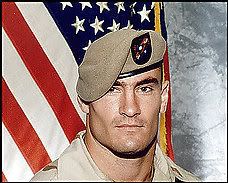
The White House has refused to give Congress documents about the death of former NFL player Pat Tillman, with White House counsel Fred F. Fielding saying that certain papers relating to discussion of the friendly-fire shooting "implicate Executive Branch confidentiality interests."
Reps. Henry A. Waxman (D-Calif.) and Thomas M. Davis III (R-Va.), the leading members of the House Committee on Oversight and Government Reform, objected to the refusal yesterday in letters to the White House and the Defense Department.
White House and Pentagon officials have turned over about 10,000 pages of material, but Waxman and Davis said those papers do not include critical documents that would show communications between senior administration officials and top military officers shortly after Tillman was killed in Afghanistan in 2004.
Tillman's celebrity, as one who gave up a professional football contract to join the Army after the Sept. 11, 2001, attacks, made his death major news. The military at first concocted a heroic story about how Tillman, a specialist posthumously promoted to corporal, had been killed in a fierce firefight with the enemy, despite obvious evidence that he had been shot by his own men at close range. More than a month later, a military investigation reported publicly that the death was not linked to enemy fire.
"The main focus of the committee's investigation is to examine what the White House and the leadership of the Department of Defense knew about Corporal Tillman's death and when they knew it," Waxman and Davis said in a letter to Fielding. "Unfortunately, the document production from the White House sheds virtually no light on these matters."
After an oversight hearing in April -- in which Tillman's family members testified -- the committee sought the documents to learn about the alleged coverup and the high-level discussions about how to spin the case. Waxman and Davis plan to hold another hearing on Aug. 1.
Friday, June 22, 2007
| [+/-] |
Cheney says, "Records' Law Doesn't Apply To My Office" |
Arguing that it does not apply to his office, Vice President Dick Cheney has refused to comply with a new classified document security law -- angering congressional Democrats.
The Miami Herald reports:
Vice President Dick Cheney and congressional Democrats are sparring over the vice president's refusal to comply with a 2003 presidential executive order that requires all agencies and the executive branch to protect classified material.
The skirmish is the latest in a long battle between Congress and the Bush White House -- particularly Cheney's office -- over the administration's campaign to expand the powers of the executive branch and increase the amount of information labeled as classified.
In a letter to Cheney on Thursday, House Oversight and Government Reform Committee Chairman Henry Waxman, D-Calif., questioned ''both the legality and wisdom'' of the vice president claiming an exemption from the order, noting recent controversies involving members of Cheney's staff and classified information.
Former Cheney Chief of Staff I. Lewis ''Scooter'' Libby was convicted in March of perjury and obstruction of justice in connection with a federal investigation into the identification, in a leak to the media, of CIA undercover operative Valerie Plame.
In May 2006, Leandro Aragoncillo, an aide in the vice president's office, admitted in federal court that he stole classified U.S. intelligence information and passed it on to officials plotting a coup in the Philippines.
`SECURITY BREACHES'
''This record does not inspire confidence in how your office handles the nation's most sensitive security information,'' Waxman wrote. ``Indeed, it would appear particularly irresponsible to give an office with your history of security breaches an exemption from the safeguards that apply to all other executive branch officials.''
Cheney's office says it is exempt from Bush's executive order because it's not an entity within the executive branch. The order, issued in March 2003, directed all agencies and executive branch offices to report on their classified and nonclassified files to the National Archives and Records Administration.
Cheney says his office is ''unique'' because it has dual responsibilities in the executive branch and legislative branches. In addition to serving as vice president, Cheney is president of the U.S. Senate.
National Archives officials and Waxman disagree.
They say Cheney and his staff fall under the executive order because of their executive branch business. The Archive's Information Security Oversight Office has been trying to get Cheney to comply with the order since it was denied access to the vice president's office for a routine inspection in 2004.
COMPLIANCE SOUGHT
'According to a letter that the National Archives sent to your staff in June 2006, you asserted that the Office of the Vice President is not an `entity within the executive branch,' and hence is not subject to presidential executive orders,'' Waxman wrote. ``To my knowledge, this was the first time in the nearly 30-year history of the Information Security Oversight Office that a request for access to conduct a security inspection was denied by a White House office.''
Archives officials fired off letters to Cheney's office in June and August 2006 seeking compliance to Bush's order but to no avail.
In January 2007, they wrote to Attorney General Alberto Gonzales in hopes of getting Cheney to comply.
Gonzales has not responded to the letter, according to Waxman's office. Justice Department spokesman Dean Boyd told McClatchy that the matter is under review.
