There may be some Democrats talking about reimposing the Fairness Doctrine, but one very important one does not: presumptive presidential nominee Barack Obama.
Over at Broadcasting & Cable, John Eggerton reports:
There may be some Democrats talking about reimposing the Fairness Doctrine, but one very important one does not: presumptive presidential nominee Barack Obama.
The Illinois senator’s top aide said the issue continues to be used as a distraction from more pressing media business.
"Sen. Obama does not support reimposing the Fairness Doctrine on broadcasters," press secretary Michael Ortiz said in an e-mail to B&C late Wednesday.
"He considers this debate to be a distraction from the conversation we should be having about opening up the airwaves and modern communications to as many diverse viewpoints as possible," Ortiz added. "That is why Sen. Obama supports media-ownership caps, network neutrality, public broadcasting, as well as increasing minority ownership of broadcasting and print outlets."
The Fairness Doctrine issue flared up in recent days after reports that House Speaker Nancy Pelosi (D-Calif.) was talking about a Democratic push to reinstate it, although it was unclear at press time whether that was a new pledge or the restating of a long-held position.
Conservative paper Human Events reported that Pelosi was not planning to bring to a vote a bill to block the reimposition of the doctrine.
The paper went on to say that Pelosi “added that ‘the interest in my caucus is the reverse’ and that New York Democratic Rep. ‘Louise Slaughter has been active behind this [revival of the Fairness Doctrine] for a while now.’”
But it was unclear whether Pelosi was talking about a push, or simply restating her long-held view that the doctrine should return.
President George W. Bush pledged to veto any attempt to legislatively establish the doctrine, and Rep. Ed Markey (D-Mass.) told B&C in an interview last fall that there were no plans to try to bring the doctrine back.
One year ago, the House passed a bill, from Indiana Republican and former radio talker Mike Pence, that put a one-year moratorium on funding any Federal Communications Commission reimposition of the doctrine. Democrats, led by David Obey (D-Wis.), suggested that the amendment was a red herring, a nonissue and that it was being debated, such as it was -- no Democrats stood to oppose it -- to provide sound bites for conservative talkers and "yap yap TV," who had ginned up the issue.
In a Shakespearian mood, Obey said the amendment was "much ado about nothing" and "sound and fury, signifying nothing."
It was a permanent version of that moratorium, also pushed by Pence, that Pelosi was reportedly saying would have no chance.
But other Democrats suggested that the sticking point was the current administration, and some big names, including Sen. John Kerry (Mass.), talked about the possibility of bringing it back. Sen. John Edwards (N.C.) went so far as to say he would make the doctrine part of his media agenda.
The Fairness Doctrine required broadcasters to air both sides of controversial issues. The FCC found the doctrine unconstitutional back in 1987, and President Reagan vetoed an attempt by congressional Democrats to reinstate it.
It is a sensitive topic with Republicans, who fear that Democrats will use it to try and rein in conservative talk radio, the rise of which followed the scrapping of the doctrine.
In the wake of press reports about Pelosi's comments, Rep. John Boehner (R-Ohio), a longtime foe of the doctrine, said its return would be "nothing less than a sweeping takeover by Washington bureaucrats of broadcast media, and it is designed to squelch conservative speech on the airwaves."
Pelosi's office had not returned calls at press time on what she said, and meant, by her comments to the paper.
Wednesday, June 25, 2008
| [+/-] |
Obama Does Not Support Return of Fairness Doctrine |
Friday, February 15, 2008
| [+/-] |
Rove Bars Recording From University of Iowa Lecture |
Karl Rove will speak at the University of Iowa on Sunday, but under conditions that inhibit media access.
The compromise reached between Rove and the university's lecture committee was that reporters could use recording equipment and flash photography only during the first five minutes of the lecture.
Rove, former deputy chief of staff for President George W. Bush, originally did not want media personnel to attend the event at all, said Sharon Benzoni, student and co-chairwoman of the lecture committee at the University of Iowa.
However, she said, the lecture board informed him that excluding the media simply was not possible at a public event on a university campus.
She said it took some time for the lecture committee and Rove to work out a contract.
"We have some very strict guidelines about what we require from our speakers," she said.
One of these guidelines, she said, was that there has to be a classroom discussion or question-and-answer session with the student body.
Rove is fulfilling this requirement by having a question-and-answer session during the last part of the event that follows an interview with Frank Durham, associate professor of journalism and mass communication at the University of Iowa.
Benzoni said part of Rove's appeal was that he is a well-known conservative and the college has been getting calls to bring in more conservative speakers.
"This is a fairly liberal college, and we tend to have a fairly liberal lecture committee," she said.
So, she said, when they started looking for someone to speak, Rove seemed like a good choice because he was part of the Bush administration and has played a role in shaping current American politics.
Durham, the professor slated to interview Rove, is known to be on the opposite end of the political spectrum, Benzoni said. But he said that, as a journalist, he will be able to be objective and still ask the tough questions some members of the audience will want to hear.
Pat Miller, director of the lectures program at Iowa State, said a lot of speakers have restrictive contracts and this type of stipulation is not new, but it is strange that Rove would not allow recorders during the question-and-answer portion.
"I've been doing this for 27 years, and this is unique," Miller said.
She said a concerns many speakers have is that their material will be used out of context.
Rove will be paid $40,000, which will come from student activities fees at the University of Iowa and private funding from the F. Wendell Miller Fund.
Benzoni said University of Iowa TV is supposed to be recording the whole presentation for broadcast at a later date, but there are still some issues with contractual obligations that need to be worked out.
Rich Adams, staff member at UITV, said he wasn't sure if they had worked anything out with Rove, so they may not be able to record the entire lecture.
Lyombe Eko, associate professor of journalism and mass communication at the University of Iowa, wrote in an e-mail that he believed "Rove was using the media-control reflex that he honed so well in the White House."
Eko wrote Rove could also be benefiting commercially by controlling what parts of his speeches can or cannot be broadcast to media.
"He wants to commercialize his experience in government," Eko wrote.
"He will soon probably sign a multimedia deal for his memoirs. He does not want the juiciest tidbits in the media before the book is out.
"Rove has no qualms putting his contract above free speech. To him, copyright and contract law take precedence over the First Amendment, at least in this instance."
Monday, February 11, 2008
| [+/-] |
How The Spooks Took Over The News |
In his controversial new book, Nick Davies argues that shadowy intelligence agencies are pumping out black propaganda to manipulate public opinion – and that the media simply swallow it wholesale
From The Independent:
On the morning of 9 February 2004, The New York Times carried an exclusive and alarming story. The paper's Baghdad correspondent, Dexter Filkins, reported that US officials had obtained a 17-page letter, believed to have been written by the notorious terrorist Abu Musab al Zarqawi to the "inner circle" of al-Qa'ida's leadership, urging them to accept that the best way to beat US forces in Iraq was effectively to start a civil war.
The letter argued that al-Qa'ida, which is a Sunni network, should attack the Shia population of Iraq: "It is the only way to prolong the duration of the fight between the infidels and us. If we succeed in dragging them into a sectarian war, this will awaken the sleepy Sunnis."
Later that day, at a regular US press briefing in Baghdad, US General Mark Kimmitt dealt with a string of questions about The New York Times report: "We believe the report and the document is credible, and we take the report seriously... It is clearly a plan on the part of outsiders to come in to this country and spark civil war, create sectarian violence, try to expose fissures in this society." The story went on to news agency wires and, within 24 hours, it was running around the world.
There is very good reason to believe that that letter was a fake – and a significant one because there is equally good reason to believe that it was one product among many from a new machinery of propaganda which has been created by the United States and its allies since the terrorist attacks of September 2001.
For the first time in human history, there is a concerted strategy to manipulate global perception. And the mass media are operating as its compliant assistants, failing both to resist it and to expose it.
The sheer ease with which this machinery has been able to do its work reflects a creeping structural weakness which now afflicts the production of our news. I've spent the last two years researching a book about falsehood, distortion and propaganda in the global media.
The "Zarqawi letter" which made it on to the front page of The New York Times in February 2004 was one of a sequence of highly suspect documents which were said to have been written either by or to Zarqawi and which were fed into news media.
This material is being generated, in part, by intelligence agencies who continue to work without effective oversight; and also by a new and essentially benign structure of "strategic communications" which was originally designed by doves in the Pentagon and Nato who wanted to use subtle and non-violent tactics to deal with Islamist terrorism but whose efforts are poorly regulated and badly supervised with the result that some of its practitioners are breaking loose and engaging in the black arts of propaganda.
Like the new propaganda machine as a whole, the Zarqawi story was born in the high tension after the attacks of September 2001. At that time, he was a painful thorn in the side of the Jordanian authorities, an Islamist radical who was determined to overthrow the royal family. But he was nothing to do with al-Q'aida. Indeed, he had specifically rejected attempts by Bin Laden to recruit him, because he was not interested in targeting the West.
Nevertheless, when US intelligence battered on the doors of allied governments in search of information about al-Q'aida, the Jordanian authorities – anxious to please the Americans and perhaps keen to make life more difficult for their native enemy – threw up his name along with other suspects. Soon he started to show up as a minor figure in US news stories – stories which were factually weak, often contradictory and already using the Jordanians as a tool of political convenience.
Then, on 7 October 2002, for the first time, somebody referred to him on the record. In a nationally televised speech in Cincinnati, President George Bush spoke of "high-level contacts" between al-Q'aida and Iraq and said: "Some al-Q'aida leaders who fled Afghanistan, went to Iraq. These include one very senior al-Q'aida leader who received medical treatment in Baghdad this year, and who has been associated with planning for chemical and biological attacks."
This coincided with a crucial vote in Congress in which the president was seeking authority to use military force against Iraq. Bush never named the man he was referring to but, as the Los Angeles Times among many others soon reported: "In a speech [on] Monday, Bush referred to a senior member of al-Q'aida who received medical treatment in Iraq. US officials said yesterday that was Abu al Musab Zarqawi, a Jordanian, who lost a leg during the US war in Afghanistan."
Even now, Zarqawi was a footnote, not a headline, but the flow of stories about him finally broke through and flooded the global media on 5 February 2003, when the Secretary of State, Colin Powell, addressed the UN Security Council, arguing that Iraq must be invaded: first, to stop its development of weapons of mass destruction; and second, to break its ties with al-Q'aida.
Powell claimed that "Iraq today harbours a deadly terrorist network headed by Abu Musab al Zarqawi"; that Zarqawi's base in Iraq was a camp for "poison and explosive training"; that he was "an associate and collaborator of Osama bin Laden and his al-Q'aida lieutenants"; that he "fought in the Afghan war more than a decade ago"; that "Zarqawi and his network have plotted terrorist actions against countries, including France, Britain, Spain, Italy, Germany and Russia".
Courtesy of post-war Senate intelligence inquiries; evidence disclosed in several European trials; and the courageous work of a handful of journalists who broke away from the pack, we now know that every single one of those statements was entirely false. But that didn't matter: it was a big story. News organisations sucked it in and regurgitated it for their trusting consumers.
So, who exactly is producing fiction for the media? Who wrote the Zarqawi letters? Who created the fantasy story about Osama bin Laden using a network of subterranean bases in Afghanistan, complete with offices, dormitories, arms depots, electricity and ventilation systems? Who fed the media with tales of the Taliban leader, Mullah Omar, suffering brain seizures and sitting in stationery cars turning the wheel and making a noise like an engine? Who came up with the idea that Iranian ayatollahs have been encouraging sex with animals and girls of only nine?
Some of this comes from freelance political agitators. It was an Iranian opposition group, for example, which was behind the story that President Mahmoud Ahmadinejad was jailing people for texting each other jokes about him. And notoriously it was Iraqi exiles who supplied the global media with a dirty stream of disinformation about Saddam Hussein.
But clearly a great deal of this carries the fingerprints of officialdom. The Pentagon has now designated "information operations" as its fifth "core competency" alongside land, sea, air and special forces. Since October 2006, every brigade, division and corps in the US military has had its own "psyop" element producing output for local media. This military activity is linked to the State Department's campaign of "public diplomacy" which includes funding radio stations and news websites. In Britain, the Directorate of Targeting and Information Operations in the Ministry of Defence works with specialists from 15 UK psyops, based at the Defence Intelligence and Security School at Chicksands in Bedfordshire.
In the case of British intelligence, you can see this combination of reckless propaganda and failure of oversight at work in the case of Operation Mass Appeal. This was exposed by the former UN arms inspector Scott Ritter, who describes in his book, Iraq Confidential, how, in London in June 1998, he was introduced to two "black propaganda specialists" from MI6 who wanted him to give them material which they could spread through "editors and writers who work with us from time to time".
In interviews for Flat Earth News, Ritter described how, between December 1997 and June 1998, he had three meetings with MI6 officers who wanted him to give them raw intelligence reports on Iraqi arms procurement. The significance of these reports was that they were all unconfirmed and so none was being used in assessing Iraqi activity. Yet MI6 was happy to use them to plant stories in the media. Beyond that, there is worrying evidence that, when Lord Butler asked MI6 about this during his inquiry into intelligence around the invasion of Iraq, MI6 lied to him.
Ultimately, the US has run into trouble with its propaganda in Iraq, particularly with its use of the Zarqawi story. In May 2006, when yet another of his alleged letters was handed out to reporters in the Combined Press Information Centre in Baghdad, finally it was widely regarded as suspect and ignored by just about every single media outlet.
Arguably, even worse than this loss of credibility, according to British defence sources, the US campaign on Zarqawi eventually succeeded in creating its own reality. By elevating him from his position as one fighter among a mass of conflicting groups, the US campaign to "villainise Zarqawi" glamorised him with its enemy audience, making it easier for him to raise funds, to attract "unsponsored" foreign fighters, to make alliances with Sunni Iraqis and to score huge impact with his own media manoeuvres. Finally, in December 2004, Osama bin Laden gave in to this constructed reality, buried his differences with the Jordanian and declared him the leader of al-Q'aida's resistance to the American occupation.
Wednesday, November 28, 2007
| [+/-] |
Journalists Believe Conditions in Iraq Have "Gotten Worse" |
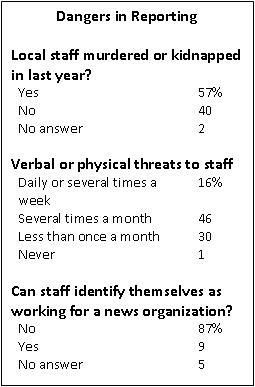
Journalists in Iraq - A Survey of Reporters on the Front Lines
After four years of war in Iraq, the journalists reporting from that country give their coverage a mixed but generally positive assessment, but they believe they have done a better job of covering the American military and the insurgency than they have the lives of ordinary Iraqis. And they do not believe the coverage of Iraq over time has been too negative. If anything, many believe the situation over the course of the war has been worse than the American public has perceived, according to a new survey of journalists covering the war from Iraq.
Above all, the journalists—most of them veteran war correspondents—describe conditions in Iraq as the most perilous they have ever encountered, and this above everything else is influencing the reporting.
Saturday, November 10, 2007
| [+/-] |
Seattle Crowd Blasts FCC On Big Media |
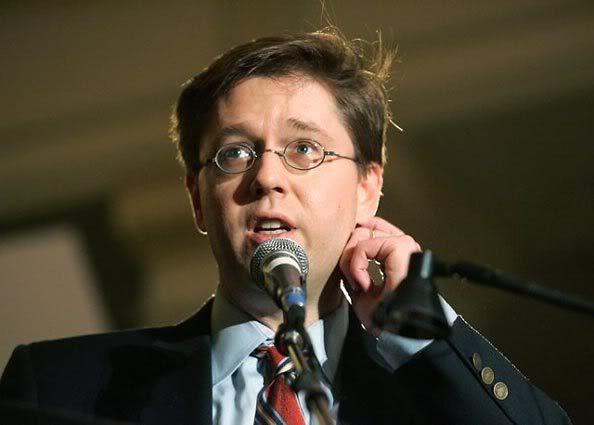 FCC Chairman Kevin Martin, who has voted in the past for more media consolidation, was met with boos and catcalls when he opened hearings at Seattle's Town Hall on Friday.
The Seattle Times reports:
That was the overwhelming message an overflow crowd delivered to the Federal Communications Commission Friday night at a hearing on media ownership at Seattle's Town Hall.
Four FCC commissioners heard it from Gov. Christine Gregoire and Attorney General Rob McKenna, and from young media-reform activists costumed as "media-consolidation zombies" — a dig at what many perceive as the FCC's willingness to do industry's bidding.
"You become a zombie when your voice isn't heard," said Monica Olsson, dressed as a zombie. "That's what we're here to stop."
The FCC is reviewing rules that restrict how many local media outlets a single company can own. Among them: a 32-year-old regulation barring a company from owning a daily newspaper and TV or radio station in the same market.
Most media companies say the restrictions should be eased or eliminated. Many people who spoke Friday said they're certain that's what the FCC's Republican majority already has decided to do.
If the FCC quickly proposes new rules, "you know your input was dismissed," said Jonathan Adelstein, one the five-member commission's two Democrats.
More than 200 people signed up to testify, almost all of them opposed to the proposed rules.
They included directors of several cable-access channels in smaller markets, such as South King County, Olympia and Salem, Ore., where local news and issues rarely get mentioned on TV news channels based in Seattle, Portland or Eugene.
"These markets that everybody mentions, these are towns, cities, communities, full of people," said Chris Miller, operations director of Puget Sound Access in Kent.
Miller recounted growing up in a small South Dakota town where local media were bought out by corporate interests. He said he learned about it the hard way as a 17-year-old, calling his favorite radio station to request a song, only to discover the station no longer employed a local disc jockey.
The FCC adopted looser rules in 2003 over the objection of the commission's two Democratic members, touching off widespread protests. A federal appeals court struck down the changes, ruling the commission had not adequately justified them.
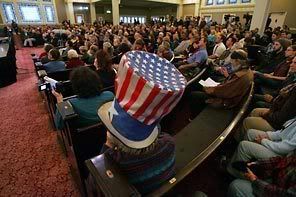 More than 200 people signed up to testify at Friday's hearing; almost all opposed new rules that would relax restrictions on how many local media outlets a company can own.
Last year, however, the commission announced it would take up the issue again. Chairman Kevin Martin, who supported the 2003 changes, indicated recently he wants a vote next month.
The FCC gave just one week's advance notice for the Seattle hearing. Many who attended cited that as evidence the commission majority isn't really interested in the public's views.
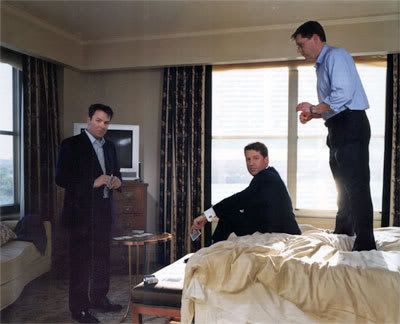 FCC Chairman and former lobbyist, Kevin Martin (right) playing cards with a telecom lobbyist (center) and a radio industry executive (left).
The general managers of Seattle's KING-TV and KCPQ-TV were among the handful of witnesses who did not call for preserving the current media-ownership rules. Their respective owners, Dallas-based Belo and Chicago-based Tribune, already own newspaper-TV combinations in other cities that predate the FCC ban.
KCPQ's Pamela Pearson said she had worked in two of those markets, Chicago and Los Angeles. "We do not combine our newsrooms or smoosh them together. They run independently to produce the best journalism," she said.
Major media companies say the ownership restrictions no longer are needed because new technology — the Internet, cable TV, satellite radio — has produced new media voices.
But Ian Page-Echols, a Seattle documentary filmmaker and artist, said unbridled access to the Internet is threatened by media conglomerates who could control the Internet and restrict access to it.
Seattle Times Publisher Frank Blethen, an outspoken foe of more consolidation, urged the commission to not only maintain existing restrictions, but adopt new ones — including a ban on cross-ownership of national print and broadcast outlets to supplement the existing prohibition on local cross-ownership.
Rupert Murdoch's News Corp., which owns the Fox network, recently acquired The Wall Street Journal.
Concentrated absentee media ownership has resulted in "a disinvestment in journalism, causing serious erosion in America's public-policy literacy and civic engagement," Blethen said.
Mark Allen, president and chief executive of the Washington State Association of Broadcasters, disagreed. "It is simply not true that fewer owners equals less service and more owners equals more service in every instance," he said.
John Carlson, KVI-AM talk show host and former Republican candidate for governor, said chains aren't necessarily bad, but since a limited number of radio and TV frequencies are available, "a referee must protect the ability of local, smaller media companies to compete."
Diana Kramer, associate publisher of Renton Magazine and The Business Report, sounded a similar note.
"I do not want one company to provide all my food or all my fuel. And I do not want one company to provide all my news," she said.
When Martin, the FCC chairman, rose to deliver opening remarks, he was greeted with catcalls and boos.
He said Blethen is in the minority among newspaper publishers in supporting the current rules. Most, he said, say they need more opportunities to diversify to avoid more newsroom cuts.
Since last summer, according to a database on the FCC's Web site, Washington residents have submitted more than 6,000 comments on media-ownership rules. Almost all oppose looser restrictions.
"With local consolidation, you simply have fewer original voices and fewer innovative voices being heard," said Lynn Ziegler, a local advocate for quality children's television. "That already is happening."
Friday, November 9, 2007
| [+/-] |
Q&A with FCC Commissioner Michael Copps |
Michael Copps, who is in his second term on the Federal Communications Commission,
is in Seattle, with the other four commissioners, for the final FCC media ownership hearing at 4 p.m. Friday at Town Hall. Copps has been a voice against media concentration since being named to the commission in 2001. He answers questions from the Seattle Times' readers.
Q: Commissioner Copps, thanks for your very important stance against media concentration exclusively in the hands of a few. -- Just a question and a couple of comments. Do you think it is in the public interest for the FCC to silently
consent to the Hearst Corp. gobbling up ownership interest of numerous radio and TV
stations in the same media market? If not, what can the average citizen do?
Is it better to write FCC Chair Kevin Martin or should we be really writing our Senators & Congresspersons? Do we have to cite specific examples of anti-competitive practices used by these mega-owners?
In case you're keeping tally, I'll share with you the feelings of people on my block in Wallingford and nearby Fremont. We need independent radio, independent newspapers and independent local stations to keep America vibrant! Many of us who are age 30 & above REMEMBER the days before TV and newspaper consolidation. The FCC, all the way through the Clinton era under the wonderful leadership of FCC Chair Reed Hundt, protected a media marketplace where there was and could be a variety of views and opinions. The FCC guarded the "public interest" from monopolization and collusion with rules that limited media ownership. Then, the radical right took over the White House and used their FCC appointments to dismantle ownership rules. As a result, we are blasted Rupert's views and political agenda through the New York Post, on FOX TV and Fox Cable. News Corp just bought the internet portal MySpace and have recently gobbled up the Wall Street Journal.
Murdoch's News Corp & others like Hearst leverage market power to offer advertising deals that underbid market competitors. There are MANY examples of those outlets
underselling competitors because they can afford to absorb reduced rates and their mom and pop competitors cannot.
Seattle is already a one-paper town, and that's a paper owned by the Hearst mega-corporation. The corporations have little regard for localism and for a diversity of views.
A: I've been reading the Seattle Times coverage of tonight's hearing, and it years-long coverage of how media conslidation has diminished localism and diversity, so this area is more fortunate than most in having that information available to it. Just yesterday, Frank Blethen of the Times testified before the United States Senate on this issue, and I suspect you would agree with much that he said, judging from your message today. You ask what a citizen can do. Just what you're doing--make your feelings known, from your house to the White House. Tell the FCC how you feel. If you cannot attend tonight (I hope you can!), then go to www.fcc.gov and let us know. Don't foregt your elected respresentatives, although I must say Washington has some really outstanding leaders in Congress. You might want to thank those folks.
Q: When is the FCC going to approve the Sirius and XM merger? I think it is in the consumers best interest if the merger is approved. Satelite radio will always compete with terestrial radio and so the merger is not going to reduce the consumers choices. With the merger, the consumer will get more channels and the difficult business of providing satelite radio may someday be profitable.
A: That's pretty much up to the Chairman, who controls the agenda. But just recently the Commission requested additional information and data from the companies, so final action may be slowed a bit. One of the questions we need to answer is whether satellite radio is a separate market with separate characteristics and just two players, or is it part of a larger media competition with free over-the-air programming. We must also deal with a current rule that prescribes that there be at least two players in satellite radio. Merger approval would require us to change that rule in the process. So the Commissioners are working our way through these issues.
Q: I think the reason our country rushed to war in Iraq was due in large part to the misinformation about WMD echoed by our corporate media. Doesn’t it suggest that further consolidation of corporate media would only exacerbate the problem of combating misinformation about such important and weighty matters?
A: I think the danger is when just a few companies are controlling the gateways and the content that we see every day on teleivison, contrary thoughts and other perspectives get lost. That's been costly for us! Further consolidation can only make a bad problem worse.
Q: What is the threat Bell forbearance efforts pose to Seattle?
A: I am willing to look at these items pending before us and am not able to say much about such active petitions. But, as I said earlier, forbearance is not the vehicle we should so often turn to and, when we do, there has to be a granular analysis accurately depicting conditions in specific telecom markets, such as Seattle. The lack of such records is one major reason why I have not been enthusiastic about some other companies' petitions in the past. For example, they sometimes focus on broadband as a national market and ignore the local competitive implications.
Q: Why should we let Comcast have a monopoly on Cable use?
The cable system should be allowed to have competition for better rates for the consumers.
A: I believe in encouraging more competition in all of our communications and media platforms. Unfortunaely, we have been going in exactly the wrong direction for quite a few years now. The big get bigger, competition is diminished, and the people end up paying the price. There isn't much competition in cable in the vast majority of markets. That's bad.
Q: What are the benefits that the members of the commission who favor further consolidation recieve for accomodating consolidation. They must be getting something for thier corrupt behavior.
A: I think that my colleagues are generally sincere in what they believe. It's not that they are bad people; it's just that their mind-sets lead to some very bad results. I believe they are wrong on the merits of the argument, but I try not to impugn anyone's motives.
Q: First, let me thank you for standing against the insanity of further media consolidation. If in fact, "we the people" still own the public airwaves and the FCC is the agency empowered to protect the public interest, how can the FCC justify this trend? We used to endure advertising to fund programing. Now, so much of the programing exists only as a backgound for adverising with no public benefit at all. There is no argument that justifies media concentration to a handful of companies as representing the public interest. How can "we the people" hold the FCC accountable to its original mandate?
A: I haven't heard anything remotely resembling such a justification. The people do own the airwaves, but if we don't reassert our ownership rights, the claim to ownership doesn't accomplish much. The FCC is supposed to be the public's protector and the agency which ensures that broadcasters live up to their obligation to serve the public interest.
Q: Qwest has filed a "forbearance" petition with the FCC asking to be free from wholesaling obligations in Seattle as early as April 2008. What effect would a grant of that petition have on my ability to obtain phone and Internet service from one of Qwest's competitors?
A: I believe their petition goes primarily to business services rather than residential. I am concerned, however, that forbearance as a process is being used to eviscerate competition and by-pass our rules. I don't believe Congress wanted the FCC to conduct its business so often via this truncated process which usually lacks adequate economic analysis and provides an insufficient record when the parties take our decisions to court--which often happens.
Q: Isn't it true that cross-ownership (newspaper/television) could have saved media diversity in many cities that used to have two newspapers, but now have only one?
A: I'm always willing to look market-by-market and if a convincing case can be made that some consolidation is all that can keep a station from shutting down and depriving a community of servce, we ought to look at that and even approve. But big media wants more than that--they want an always-on green light that assures everyone in advance that the media bazaar is open to all sorts of combinations, no questions asked. If the FCC wants localism, it ought to be willing to look at local markets and local conditions. Right now, we don't.
Q: I understand the historic duty of the FCC is to allocate frequencies within the broadcast bandwidth, so to ensure licensee's signals are not interfered with. In allocating the frequencies, I presume there's an objective & mechanism in place that attempts to ensure the use of those frequencies in any market area are adequately responsive to the public in that market.
My question is whether the definition of 'public responsiveness' encompasses the carriage of voices fairly representative of the market OR whether 'public responsiveness' simply means endowing broadcast licensees with expanded 'network power' (i.e. a larger permissible footprint in any and all markets in which they hold a license)?
I believe that's the practical challenge presently before the Commission. Can fair representation exist when today's principal allocation method simply rewards frequencies to the highest bidder?
A: The sad reality is the FCC doesn't appear to care how well the public interest is served. In 1981, a new Chairman took over at the FCC and he said a television set was just "a toaster with pictures." And that's how they proceeded to treat it--just another applicance. All the public interest guidelines we had, and which we used when a broadcaster came in to renew his or her (mostly his, because women have been excluded from owning their fair share of stations) were "deregulated" away. Broadcasters formerly had to justify their performance every three years in order to keep their licenses. Now they send in a post-card once every EIGHT years, and we never deny a license on public interest grounds. So don't blame just big media for the current excesses--blame the FCC, too.
Q: Is there any conceivable way you could persuade one of the FCC's Republican commissioners that any further broadening of ownership rules to benefit corporations as opposed to individuals or public groups goes against the American heritage? The people own the airwaves; yet a few corporations dominate them and disseminate their points of view only. But the American heritage is one of democracy and local inventiveness.
Perhaps you could remind your Republican colleagues that domination by one corporate point of view is far more similar to Soviet totalitarianism.
A: I'm trying, I'm trying! Maybe tonight's hearing can succeed more effectively than me. But, to be frank, my fear is that the fix is in insorfar as loosening the limits on newspaper-broadcast cross ownership. The result of that will be more newspaper-broadcast combinations in lots of markets and that translates into fewer voices, less news, and a diminished civic dialogue. I think that's too costly a price to pay, don't you?
Q: A few years ago we saw the music group called the Dixie Chicks be boycotted by over 200 radio stations, all under one ownership. Wasn't that a prime example of censorship and the affects of multiple media outlets with one ownership?
A: Yes, and it's not the only one, either. That's what happens when too much power in cocentrated in too few hands. In previous years we had enough diversity and local control that if someone committed some sort of act like you mention, it didn't affect the whole nation. Now it does.
Q: I have been in radio since I was a kid. I'm now 55. Radio is at an all time low with bad product and poor community service. Plus the lost of jobs has been shocking. Why hasn't the FCC talked to any of us who are in the talent end of broadcasting? Granted, a lot of folks would not want to come forward for fear of loss of their job. Why not put us under oath and make us tell you and the others on the commission about the damage done by media concentration? I might lose my job just for asking this question. But it's worth the gamble because I care about radio and my country.
A: You know, I have talked to many people in the creative community who feel like you do but who are still trying to eke out a living and many are afraid to testify and go public. So in 2003, I asked then-Chairman Michael Powell to set up some kind of process where we could receive such testimony anonymously. He replied with all sorts of excessively legalistic arguments why this couldn't be done. The result--we don't have nearly enough of that kind of testimony on the public record.
Q: Hello and thank you for coming to listen to folks in our city.
Do you think that all cable providers should be required to provide, on basic cable, public access stations and governmental proceedings (city, county, state and CSPAN)?
When I was a child, this kind of thing was provided often by the networks. My mother made us watch current events on television and always set the standard for us of being an active informed citizen. She spent the summer watching the Watergate hearings on network TV. Later, she was an avid CSPAN watcher, and she and her sister and friends would comment on what they say Congress doing on CSPAN coverage in thier weekly letters to each other.
With that upbringing I find myself watching these channels more than broadcast or other cable. It's the only way I have of seeing my local government at work as I can tape the City Council meetings while I am at my job during the day.
A: I think you and I have some similar viewing habits! I am a huge supporter of PEG channels and public access. I am disappointed that, just very recently, the Commission voted to remove much of the negotiating power that Local Franschising Authorities had to demand these and other services from cable as a condition of their being able to build out and provide service to customers. These local authroties understand what is needed in a community better than we in Washington do, so to preempt them is another mistaken FCC decision against localism, diversity and competition.
Q: What is the FCC progress or assessment of the 800MHz rebanding with SPRINT NEXTEL frequency spectrum? They have been very slow to implement rebanding in key cities across the USA delaying civic efforts to protect their citizens. It is imperative for first responders to be able to communicate in these frequencies.
A: We really need to approach this with urgency, and I believe that my colleagues are now doing that. You are correct that there have been too many delays, and I have been pushing the Commission to keep the parties working hard to make this transition work well and quickly. I have also talked with the private parties concerned to make sure they understand the FCC is not going to tolerate unending delay.
Q: What is the FCC doing to assure fairness and accessibility to high speed internet for individuals and small companies. I have a concern that large "internet / communication companies" will begin limiting access and/or start charging premiums for the internet that should be readily available with a high quality of service for all.
Electric Power companies do not charge (for all practical purposes) for "higher quality" power - the standard power to everyone is of high quality; this is the same for Natural Gas companies, water companies, and other basic utilities.
A: I share your concern and have labored hard to have the Commission adopt serious and enforceable network neutrality rules. I succeeded only insofar as getting a statement of Internet principles adopted: freedom to access content of your choice, to attach devices of your choice, to run applications of your choice, and to enjoy the benefits of competition. But these principles need to be backed up by enforceable rules and the present Commission is not inclined to do that. We did get some enforceability attached to the AT&T/Bell South merger, but this is something we need industry-wide. Congress may have to legislate on this issue. The Internet has so much potential, so we need to ensure it openess and guarantree that it doesn't become a gated community controlled by a few telecom behemoths.
Q: How is it that the issue of cross-ownership is up for consideration again after there was such a huge outcry from the public against further consolidation on this same issue within the last two years? America’s airwaves and broadcast entities are supposed to be held in the public trust. Meaning, very simply, that the American people own the airwaves. And the programming sent over those airwaves is entrusted to be in the public’s best interest. If that is the case, why is this being brought up again for consideration? The lobbying efforts and influence of big business on the FCC seem all too apparent. Futhermore, media consolidation is an encroachment on our rights: Freedom of the Press.
A: Another good question I hope the FCC is asked tonight. I'm with you in believing the people's airwaves should be used to add diverse voices and to encourage local content, rather than bringing in more homogenized, nationalized and sterile corporate "entertainment" and letting Big Media shut down the civic dialogue upon which the future of our democracy rests.
Q: Given that this country's political roots are in dissent, why is the FCC even considering increasing the power of media/communications companies to dominate a political point of view and way of looking at the world?
A: Good question. Come out to the hearing tonight and ask some of my colleagues why they would want to foist additional consolidation on our media environment and what public inrterest good they see in diminishing the number of viewpoints available in our media markets.
Q: I want a choice in providers of content and service – please do your job to ensure that happens.
I have two questions for the FCC,
First how can you possibility justify endorsing the AT&T - SBC take over.
This is possibly the single worst decision in term of competition in the past decade in my opinion.
Second why are you allowing companies to own more media outlets?
Do you not think that this leads to a mind share issue where the relatively few can impact public opinion with a narrow point of view?
A: I don't like consolidation any more in telecom companies than I do with media companies. The result on the AT&T merger you mention was pretty much preordained, but I worked hard to attach some conditions to it--such as enforceable netweork neutrality provisions. On your second question, I have been an outspoken opponent of the excess media consolidation we have had to endure in recent years. I want to avoid encouraging more consolidation through ill-advised new rules and then revisit the current rules that got us into our present mess.
Q: In your opinion, what can we, as citizens and consumers, do to assure that the we develop more diversity in the media?
A: Any satisfactory outcome to this issue will be in large part grassroots-driven. So people need to make their opinions felt. Hearings like tonight's Seattle venue are one vehicle. But we should all be speaking out; talking to friends, family and community; writing letters to the editor; talk radio; write the FCC Commissioners; contact your elected representatives. Elected officials need to know that your opinions on this issue count as you judge their campaigns for office.
Thursday, October 4, 2007
| [+/-] |
Senate Judiciary Committee Backs Journalist Shield Bill |
The JURIST reports:
The US Senate Judiciary Committee [official website] Thursday voted 15-2 to send a federal shield bill, which would protect reporters from being compelled to disclose confidential sources, to the full Senate for consideration. The Bush administration and the US Department of Justice have continuously opposed the enactment of a federal reporter shield law citing national security concerns, while proponents of the bill, including media outlets, argue the legislation is necessary to protect freedom of the press.
According to a statement from one of the bill's sponsors, Sen. Arlen Specter (R-PA):
This legislation establishes a federal reporters' privilege to protect and encourage the free flow of information between journalists and confidential sources. It seeks to reconcile reporters' need to maintain confidentiality, in order to ensure that sources will speak openly and freely, with the public's right to effective law enforcement and fair trials.
In order to balance these competing interests, this bill creates a qualified privilege for reporters to withhold information they obtain under a promise of confidentiality. It ensures that a federal court can only force a journalist to reveal confidential source information where the information is truly critical to a case or investigation. It also requires the party seeking a reporter's confidential information to exhaust all reasonable alternative sources before turning to the media.
The bill also contains exceptions to the privilege for those situations where information sharing is critical. A reporter may not withhold his source information where it is needed to prevent a terrorist attack, significant harm to our national security, death, kidnapping, or substantial bodily harm. Journalists who witness crimes also cannot refuse to share their eyewitness observations.
The US House Judiciary Committee approved similar legislation in August. That bill has not yet been debated on the House floor. AP has more.
The Senate Judiciary Committee postponed further consideration of a similar proposed shield bill in September 2006 in the wake of strong opposition from Justice Department officials.
Wednesday, October 3, 2007
| [+/-] |
From the State Department, All the News for Inquiring Minds |
From the Washington Post, Al Kamen writes:
Fox News, launched with such high hopes 11 years ago as the "fair and balanced" network, apparently hasn't lived up to its billing. CNN never had a chance. The other networks? Please. No citizen could dare trust the agenda-driven print media -- The Washington Post, the Wall Street Journal, the New York Times -- to figure out, let alone accurately tell, the "real" story.
But now the State Department is in the blogosphere, and says it "offers the public an alternative source to mainstream media for U.S. foreign policy information." The blog, launched last week and called "Dipnote," is "taking you behind the scenes."
This is what we've all been waiting for! No more media filters and distortions. Unbiased news directly from the federal government, a news source long noted for truthful, unbiased reporting. The Clinton administration and most all its predecessors vowed to end-run the media, and they finally have the new electronic media to help them to do it.
One of the first diplo-bloggers last week was the assistant secretary for international organizations, Kristen Silverberg, who blogged from the United Nations.
"Another busy day in New York!" she gushed Tuesday. ("I'm exhausted!" she wrote in a later dispatch that day.) "First thing this morning, President Bush met with President Karzai" to discuss progress in Afghanistan.
"We have a lot of hope," she wrote, "for the future of Afghanistan," where child mortality has declined 20 percent in the past five years and 80 percent of the public has access to basic health care and "primary school enrollment for both boys and girls has increased by five hundred percent over the past five years."
But that's not all! "Later in the morning," Silverberg reported, "Secretary Rice attended a meeting" and "issued a joint statement calling on the government of Burma to end violence against the peaceful demonstrators."
"The Security Council this afternoon issued a statement of concern about the events in Burma, which were also discussed at today's G8 Foreign Ministers lunch," Silverberg reported, and Rice "raised the issue of Burma when she met this afternoon" with India's foreign minister. She also met with the Korean foreign minister about North Korea's nukes.
"While Secretary Rice will be back in Washington, D.C., for part of the day tomorrow to open the President's meeting of major economies on energy security and climate, I'll still be in New York and will keep you updated!" Thank goodness.
Public diplomacy czarina Karen Hughes's blog from the United Nations yesterday gave us a real insider's view of diplomacy in action.
"This morning I spoke live with hundreds of thousands of people in the Arab world by appearing on Al Arabiya," she wrote, "one of the leading television networks in the Middle East. Whenever I visit a country, and I've been to about 40 during the last two years, I usually do television and radio interviews (I've even appeared on what was described as the Indonesian version of 'Oprah')."
Would the conservative or liberal media give you that insight? Hardly.
Meanwhile, the blog appears to be getting a tremendous response worldwide and -- with the exception of people complaining that the type is too small and that the white print on a black background makes it hard to read -- readers have been overwhelmingly positive.
The first comment to one of Silverberg's blogs was refreshing. "Wong in China writes: 'Hello, I come from China. I hate such countries: North Korea, Iran, Burma, Cuba and Iraq (before liberated by US army).' " Well, thank you, Wong, for your informed perspective. Please report immediately to the embassy in Beijing for your free visa and green card.
State Department folks may be feeling good about their official blog, but the Pentagon, as is usually the case, has been working that venue for a while. In fact it has, within the New Media Directorate, an office that's being called "Blogosphere Initiatives," and one of the truly unsung heroes of the Bush Florida recount machine has been tapped to help out.
He's Michael Allan Leach, who, "it could be argued, played a more direct role" than most anyone else in George W. Bush's victory in Florida in 2000, the St. Petersburg Times reported at the time. Leach, an Air Force veteran, then-recent Florida State graduate and state GOP field worker, "used a laptop computer to salvage hundreds of Republican absentee votes which were in danger of not being counted because they didn't have voter identification numbers."
The Times reported that Leach blamed President Clinton and media liberals for a decline in morals, and wrote in a 1998 Internet posting: "I can no longer sit idly by while liberals in Washington with seven brain cells drag this country into the muck and mire of stupidity."
So, after the election, Leach spent six years as a political appointee as special assistant to the administrator of the Agriculture Department's rural development office, minus time out to handle press duties for the CPA in Iraq. He also picked up a master's degree in international affairs from Georgetown and worked most recently in public affairs at the Department of Homeland Security.
Thursday, July 19, 2007
| [+/-] |
SEC Plans Suit Against Dow Jones Director |
The WSJ reports:
The Securities and Exchange Commission intends to file civil charges against a Dow Jones & Co. board member in connection with an unfolding insider-trading case, according to people familiar with the matter.
In recent days, the SEC has notified Dow Jones director David Li, chairman and chief executive of Bank of East Asia Ltd., through a Wells notice, that it plans to recommend filing civil charges against him, these people said.
A Wells notice is the final step before the SEC files a lawsuit. It allows the person or entity one last chance to persuade the agency to not bring the case. The SEC's five-member commission has to sign off on any lawsuit. It isn't clear exactly what the SEC case against Mr. Li is built on or what law they might charge him with violating.
The development comes the same week that Dow Jones's board of directors agreed in principle to sell the company -- owner of The Wall Street Journal, Dow Jones Newswires, Barron's and other entities -- to Rupert Murdoch's News Corp. A final deal needs approval from the Bancroft family, the controlling shareholder of Dow Jones, which is split on whether to sell to Mr. Murdoch.
Mr. Li remains a member of Dow Jones's board of directors. It is unclear how the SEC's case might affect his future role on the board. An SEC spokesman declined to comment.
In a press statement Thursday, Mr. Li acknowledged receipt of the Wells notice and denied the allegations against him.
"I have broken no laws and deny the apparent allegations being made by the staff of the Commission. If the Commission does commence proceedings against me, I will defend myself vigorously. In the meantime, I will continue to carry out all my business and public duties while defending my good name and reputation," Mr. Li said.
When news of his potential involvement first became public, Mr. Li told the Journal: "I did not disclose to anyone, not even my wife, any information about Dow Jones."
Mr. Li's connection to the case is through Hong Kong businessman Michael Leung Kai Hung. The two men have a series of social and business ties. In May, Mr. Leung's daughter and son-in-law were charged with insider trading by the SEC in federal court in Manhattan. The SEC complaint says Mr. Leung transferred money to his daughter and son-in-law. The couple bought 415,000 shares of Dow Jones -- some with the funds from Mr. Leung -- two weeks before Mr. Murdoch's initial overture was made public. They made about $8 million in profit when they sold the stock three days after news of the bid was reported. A federal judge has frozen those assets.
At the time, Mr. Li said Mr. Leung "is a friend, but I certainly did not talk to him about Dow Jones." Mr. Leung couldn't be reached to comment. The SEC didn't name Mr. Li in its initial complaint, and Mr. Leung wasn't named as a defendant.
A Dow Jones spokeswoman declined to comment.
It is unclear if the SEC intends to charge Mr. Li with insider trading or another securities-law violation. As a member of Dow Jones's board, Mr. Li has a duty to keep material, nonpublic information about the company private. If Mr. Li breached that duty by sharing it with somebody outside the company with the expectation that the person would trade on it, Mr. Li could be considered a "tipper" and charged with insider trading.
Insider-trading cases are often hard to make. Investigators have to connect the flow of information to trades and prove that people along the chain knew that the information was improperly disclosed.
The office of New York's attorney general, which has criminal-prosecution authority, is also investigating the trading and sent subpoenas to Dow Jones and News Corp. after news of the trading broke. It hasn't filed any charges to date.
Mr. Li comes from a family that has long been a central player in Hong Kong's close-knit society. The Bank of East Asia, one of the first Chinese-owned and -operated banks in the former British territory, was founded by the family. Mr. Li serves on several boards, including those of the company that owns the luxury Peninsula Hotel chain, the publisher of the South China Morning Post newspaper and PCCW Ltd., the city's dominant telecommunications company.
His influence in the banking sector is reflected in his position as an appointed lawmaker representing Hong Kong's financial community. Mr. Li joined the Dow Jones board in 1993, becoming in the process its first non-American member.
| [+/-] |
For Bancrofts, Decision Time Is Near On Sale Of Dow Jones |
News Corp. Seeks To Know 'Promptly' If Deal Is Supported
OnlineWSJ reports:
Tuesday's late-night decision by the board of Dow Jones & Co. to endorse News Corp.'s $5 billion offer for the publisher sets the stage for a dramatic meeting of the company's controlling shareholder, the Bancroft family, to consider the future of the company it has controlled for more than a century.
The Bancrofts, who have a 64% voting stake in Dow Jones, plan to meet Monday in Boston to hear a presentation about News Corp.'s offer. The family will then have about a week to make a decision, a time frame requested by News Corp., which wants to hear "promptly" whether enough Bancroft family members are willing to back the deal, Dow Jones said in a statement late Tuesday. Dow Jones owns The Wall Street Journal, Barron's and Dow Jones Newswires.
The Bancroft family remains divided about the News Corp. offer, however, with two prominent members, Leslie Hill and Christopher Bancroft, actively working to find alternatives. Their stance was reflected in the course of Tuesday night's board meeting. Ms. Hill abstained from the vote because she said she believes Dow Jones's business is in a "trough," according to people familiar with the matter, and the company may be better off waiting several years for business conditions to improve.
Ms. Hill didn't return calls seeking comment.
Mr. Bancroft, who has been trying to raise money to buy enough shares to block the deal, left Tuesday night's nearly three-hour board meeting shortly after it began, according to people familiar with the matter. He interjected during a presentation on the News Corp. bid from M. Peter McPherson, the board's chair, to ask directors if they would prefer he leave the meeting given his continuing efforts to work on an alternative transaction. The directors had a brief discussion and agreed he should leave, according to the people familiar with the matter. Mr. Bancroft couldn't be reached for comment.
The two other family directors, Elizabeth Steele and family trustee Michael B. Elefante, voted in favor of the deal. Dieter von Holtzbrinck, an independent director who is one of the heirs to the Holtzbrinck publishing empire, abstained from the vote. David Li, chairman and chief executive of Bank of East Asia Ltd., was absent from the meeting. Mr. Li has received a Wells notice from the SEC, notifying him that it plans to recommend filing civil charges against him in an unfolding insider-trading investigation.
Ms. Steele's branch of the family was originally seen as the one most opposed to selling the company. In an emotional statement to the board Tuesday night, Ms. Steele said the company had been in her family for 100 years and that she "never thought we would get to this point." She told directors that she would never know how safe the paper would be in Mr. Murdoch's hands, but that after examining the overall business conditions of the newspaper industry, it was better to sell the paper now than to wait, these people said. Ms. Steele couldn't be reached.
Monday's meeting could be one of the family's last reunions as owners of Dow Jones. The meeting is expected to include all 35 adult members of the Bancroft family as well as all of the trustees from the numerous family trusts managed by Boston law firm Hemenway & Barnes and other firms. Family adviser Wachtell Lipton and other individual family lawyers and financial advisers are also invited to attend.
At the meeting, Mr. Elefante is expected to give the family a detailed summary of the process followed by the family's trustees and Dow Jones advisers to evaluate the News Corp. proposal and explore possible alternatives. Family members, including Ms. Hill and Mr. Bancroft, also will be able to present their views to the family. Ms. Hill has been talking to representatives from supermarket magnate Ron Burkle's Yucaipa fund, which has been working with a union representing some of Dow Jones's employees to find alternatives to Mr. Murdoch. Mr. Bancroft has spoken to Internet entrepreneur Brad Greenspan about his efforts, according to people familiar with the matter.
As Dow Jones and News Corp. await the result of the family vote, they are considering candidates for the proposed five-member editorial-oversight board they have agreed will be created to preserve the editorial integrity of Dow Jones publications. Among potential candidates being considered by News Corp. and Dow Jones are: Theodore B. Olson, the former solicitor general of the U.S. and partner at Gibson, Dunn & Crutcher's Washington D.C. office; Jack Fuller, former president of Tribune Publishing and a director of the board of the John D. and Catherine T. MacArthur Foundation; Thomas Bray, the former editorial-page editor of the Detroit News and a writer for OpinionJournal.com; and Susan Hockfield, president of Massachusetts Institute of Technology. It was unclear how many of the candidates had been approached, if any, about the board. The candidates under consideration couldn't be reached for comment.
News Corp. is a media company whose properties include TV networks, newspapers, satellite TV interests, a film studio and MySpace Web site.
Monday, May 14, 2007
| [+/-] |
Pentagon Blocks MySpace & YouTube |
The Defense Department has decided to make it impossible to reach 13 Web sites from its network, citing an overabundance of “recreational traffic.”
The ban also includes Metacafe, IFilm, StupidVideos, FileCabi, BlackPlanet, Hi5, Pandora, MTV, 1.fm, live365 and Photobucket.
The NY Times reports:
In the policy released today, General B.B. Bell, commander in South Korea, said use of those sites “impacts our official DoD network and bandwidth ability, while posing a significant operational security challenge.” The memo is available in pdf format.
A spokeswoman for the United States Strategic Command was more specific in framing the issue as a technical limitation. “We’ve got to have the networks open to do our mission. They have to be reliable, timely and secure,” Julie Ziegenhorn said in an interview with Stars & Stripes, an independent newspaper published for the American military.
Private internet connections still have access, but most troops in Iraq and Afghanistan are limited to Pentagon service, Stars and Stripes notes.
Today’s Web site ban and last month’s revision of military blogging policy were partly justified by operational security concerns. Both also prompted questions about whether leaders were trying to reduce the voices of individual soldiers by making it more difficult to publish their own material.
The ban also arrived as the American military started to increase its profile on YouTube, posting official footage that aimed “to show another side of operations in Iraq beyond news reports of ‘the car bomb of the day,’” the BBC said.
A writer for Wired Magazine told The Associated Press that individual soldiers were also helping to present a more positive picture of the situation in Iraq. “They are muzzling their best voices,” Noah Shachtman said.
| [+/-] |
Iraq To Bar Press From Blast Scenes |
Iraq's interior ministry has decided to bar news photographers and camera operators from the scenes of bomb attacks, operations director Brigadier General Abdel Karim Khalaf said on Sunday (local time).
 Iraqis jubilate next to a burning Danish military vehicle near Basra, Iraq's second-largest city, 550 kilometers (340 miles) southeast of Baghdad, Iraq, Monday, May 14, 2007. A Danish soldier was killed and five others were injured by a roadside bomb Monday in southern Iraq, the army said. An Iraqi interpreter was also injured in the explosion, which occurred as the Danish unit was on a routine patrol in several vehicles near Basra, said Maj. Kim Gruenberger of the Danish Army Operational Command. The injured soldiers were in stable condition, he said. (AP Photo / Nabil al-Jurani)
ABC News reports:
His announcement was the latest in a series of attempts to curtail press coverage of the ongoing conflict, which has already attracted criticism from international human rights bodies.
"There are many reasons for this prohibition," he said.
"We do not want evidence to be disturbed before the arrival of detectives, the ministry must respect human rights and does not want to expose victims and does not want to give terrorists information that they achieved their goals.
"This decision does not imply a curtailment of press freedom, it is a measure followed all over the world."
International and local media coverage of Iraq's deadly sectarian conflict generates dozens of images and reports of carnage every day, as insurgent bomb attacks continue.
Sunday, May 13, 2007
| [+/-] |
DoD Blocking YouTube, Others |
To save bandwidth, officials say several sites to be off-limits at work.
Stars and Stripes report:
Starting Monday, the Defense Department will block access to MySpace, YouTube and a host of other sites on official department computers worldwide, in an effort to boost its network efficiency.
Troops and families living on U.S. bases will still be able to view the sites through private Internet networks, but the move leaves servicemembers in Iraq and Afghanistan who use the popular picture- and video-sharing sites with little or no access to them.
Defense officials said the move is solely a reaction to the heavy drain the streaming video and audio can put on the defense computer network.
“We’re not passing any judgment on these sites, we’re just saying you shouldn’t be accessing them at work,” said Julie Ziegenhorn, spokeswoman for U.S. Strategic Command. “This is a bandwidth and network management issue. We’ve got to have the networks open to do our mission. They have to be reliable, timely and secure.”
In a message to troops from U.S. Forces Korea commander Gen. B.B. Bell on Friday, he acknowledged many of the sites being blocked are used by troops to keep in touch with family and friends.
“This recreational traffic impacts our official DOD network and bandwidth availability, while posting a significant operational security challenge,” he wrote.
Ironically, the Defense Department this year had just begun expanding its own use of YouTube to reach a younger, broader audience and show clips of U.S. troops in action.
Multi-National Force — Iraq, U.S. Army Civil Affairs Command in Afghanistan, and the U.S. Army Corps of Engineers in the Gulf Region have all launched new channels on the Web site to highlight recent successes overseas.
Ziegenhorn said that wasn’t taken into consideration when the Joint Task Force Global Network Operations began reviewing and flagging sites that posed problems to the network.
“This is all about what is a drain on the system,” she said.
A review of the banned sites has been under way since February, she said. And the task force is still considering other problematic addresses to add to the list.
“This will be an ever-evolving discussion, because we need to constantly make sure those networks are available and secure,” she said.
The official policy blocking the sites will be released Monday, the same day they go into effect. But Ziegenhorn said most network administrators are already aware of the change.
The individual services have already blocked some sites for the same bandwidth issues. In addition, Defense Department policy prohibits troops or civilian workers from using government computers from accessing inappropriate sites because of inappropriate content, such as pornography.
Sunday, February 11, 2007
| [+/-] |
New York Times Reveals “Reporter” Michael Gordon Actually Voice-Activated Tape Recorder |
New York Times Executive Editor Bill Keller today announced that the paper’s longtime staff writer Michael Gordon is not an actual person, but rather a voice-activated tape recorder.
“I’m not sure why everyone didn’t figure this out before now,” said Keller, pointing to the fact that, in Gordon’s 26-year career, all of “his” stories have consisted entirely of transcribed statements by anonymous government officials.
According to Jill Abramson, the paper’s Managing Editor, Gordon was purchased for $27.95 at a Radio Shack on West 43rd Street. Describing the situation as “a prank” that had “gotten slightly out of hand,” Abramson said the paper had decided to acknowledge Gordon’s identity because—after the tape recorder’s front page story today, “Deadliest Bomb in Iraq Is Made by Iran, U.S. Says”—there “was no place left to take the joke.”
Keller described how he and Abramson “really had a good laugh” while preparing the Iran story, which is based on the following sourcing:U.S. Says…United States intelligence asserts…reflects broad agreement among American intelligence agencies…civilian and military officials from a broad range of government agencies provided…military officials say…The officials said…The assessment was described in interviews over the past several weeks with American officials…Administration officials said…according to the intelligence…According to American intelligence…Some American intelligence experts believe…they assert…notes a still-classified American intelligence report…a senior administration official said…according to Western officials…Officials said…An American intelligence assessment described to The New York Times said…Other officials believe…American military officers say…American officials say…According to American intelligence agencies…Assessments by American intelligence agencies say…Marine officials say…American intelligence agencies are concerned…Gen. Peter Pace, the chairman of the Joint Chiefs of Staff, said last week.
“You can’t deny that’s funny,” said Keller, adding that the lack of skepticism displayed by Gordon was “literally inhuman.” Keller and Abramson asserted that the Iran article is “even more hilarious” than Gordon’s 2002 stories on Iraq’s purported nuclear program, written with Judith Miller.
According to the paper’s management, the Times plans to keep the tape recorder on its staff indefinitely, given that it does not require health insurance and its voice-activation feature “saves a lot of tape.” Indeed, the tape recorder formerly known as Michael Gordon has already filed its own story on the matter, consisting entirely of transcribed statements from anonymous government officials.
Thursday, September 14, 2006
| [+/-] |
U.S. Press Bigwigs Screw Up, Again |
In Consortium News, Robert Parry writes:
So, right-wing columnist Robert Novak now says that Richard Armitage, Novak’s initial source on the identity of CIA officer Valerie Plame, wasn’t just some loose-lipped gossip blurting out her name, but rather that Armitage urged Novak to write about Plame’s alleged role in her husband’s fact-finding trip to Niger.
In a Sept. 14 column, Novak calls Armitage’s recent depiction of their July 2003 conversation “deceptive” for suggesting that Armitage’s leaking of Plame’s CIA identity was innocent and inadvertent, when Novak recalled it as intentional and even calculating.
Yet, for the past two weeks, major Washington journalists have been treating Armitage’s account as the gospel truth and, further, as proof that George W. Bush’s White House had gotten a bum rap on the Plame-leak scandal.
This misplaced “conventional wisdom” extended from the Washington Post’s editorial pages to virtually every major TV chat show – and even touched off another round of personal attacks by Bush allies against Plame’s husband, former U.S. Ambassador Joseph Wilson, for having dared to stand up to the President over his false claims that Iraq sought uranium ore from Niger.
According to these press pundits, the real victim in the Plame case was Bush’s political adviser Karl Rove, who had suffered under suspicions that he had orchestrated a smear campaign against Wilson for becoming, in July 2003, one of the first Washington insiders to accuse Bush of having “twisted” intelligence to justify invading Iraq.
Despite reams of evidence that Rove did participate in such a smear campaign – and also was a source on Plame’s identity for at least two journalists – prominent opinion leaders rallied to Rove’s defense, chastising news outlets that had pointed fingers at Rove.
In a Sept. 7 article, entitled “One Leak and a Flood of Silliness,” veteran Washington Post columnist David Broder wrote that publications which had made these allegations “owe Karl Rove an apology. And all of journalism needs to relearn the lesson: Can the conspiracy theories and stick to the facts.”
But it now appears that it was Broder and other see-no-evil pundits who were ignoring the facts as well as the well-worn pattern of the Bush administration attacking Iraq War critics.
Indeed, if anyone deserves chastising for unprofessional journalism, it would be Broder and other mainstream journalists who continue wearing blinders that so limit their field of vision that – after all these years – they still can’t believe that Rove and the White House would play dirty to discredit anyone who challenges Bush.
On Sept. 3, I wrote that this clueless behavior of these Washington journalists – in the face of so much damning evidence – justified the old “Shawshank Redemption” question posed to the corrupt prison warden: “How can you be so obtuse?” [See Consortiumnews.com’s “How Obtuse Is the U.S. Press?”]
Armitage Myth
Beyond the specific evidence of a White House campaign to out covert CIA officer Valerie Plame and the broader Republican hostility toward anyone who gets in Bush’s way, there is also the notion that Armitage, long considered a tough team player, was an independent soul who would never help the administration discredit a troublesome critic.
Though Armitage may not have been one of Bush’s intimates nor a leading enthusiast for invading Iraq in 2003, the Washington press corps is exaggerating both Armitage’s independence and his anti-war credentials.
Virtually forgotten in all the news coverage was the fact that in 1998, Armitage was one of the 18 signatories to a seminal letter from the neoconservative Project for the New American Century urging President Bill Clinton to oust Saddam Hussein by military force if necessary.
Armitage joined a host of neoconservative icons, such as Elliott Abrams, John Bolton, William Kristol, Richard Perle and Paul Wolfowitz. Many of the signers, including Donald Rumsfeld, would become architects of Bush’s Iraq War policy five years later.
A well-placed conservative source, who knows both Armitage and Rove, told me that the two operatives are much closer than many in official Washington understand. Armitage and Rove grew to be friends when they were negotiating plans for bringing Colin Powell into the Bush administration in 2000, when Armitage represented Powell and Rove stood in for Bush.
After the administration took office, Rove and Armitage remained in frequent communication, becoming a back channel for sharing sensitive information between the White House and the State Department, the source said.
Beyond these relationships, there is also evidence that Armitage was part of a classic Washington scheme to slip Plame’s identity into the newspapers, albeit with plenty of deniability for all involved.
The evidence about Armitage’s role in leaking Plame’s identity – and thus destroying her CIA career as an undercover counter-proliferation operative – now includes Novak’s account of their July 8, 2003, interview as Novak described it in his Sept. 14, 2006, column, entitled “Armitage’s Leak.”
Toward the end of the hour-long meeting, Novak wrote, he asked Armitage, the then-Deputy Secretary of State, why former Ambassador Wilson, had been sent on the trip to Africa. (Novak doesn’t say whether he was one of the journalists who had been urged by the White House to pursue that line of questioning.)
Novak wrote that Armitage “told me unequivocally that Mrs. Wilson worked in the CIA’s Counter-proliferation Division and that she had suggested her husband’s mission. As for his current implication that he [Armitage] never expected this to be published, he noted that the story of Mrs. Wilson’s role fit the style of the old Evans-Novak column – implying to me that it continued reporting Washington inside information.”
In other words, Novak acknowledges two significant points: that he asked why Ambassador Wilson was chosen and that Armitage knew that Plame held a sensitive CIA position, yet still wanted her exposed.
Deniable Leak
What is not clear from Novak’s account is whether anyone in the administration planted the idea of asking about Wilson’s trip in Novak’s head, knowing that the Plame information had been distributed sufficiently at senior levels of the administration that it likely would be divulged by someone.
Rather than Broder’s claim that this idea of an orchestrated leak is some kind of “conspiracy theory,” it actually is a fairly common Washington technique for getting out damaging information about an adversary, spreading the news around the government and then urging reporters to ask about it.
Plus, there is solid evidence that the White House conducted just such an operation.
A month before Wilson’s Iraq-Niger Op-Ed article appeared in the New York Times on July 6, 2003, Vice President Dick Cheney already was anticipating possible trouble from the former ambassador whose trip to Africa had helped disprove the bogus claims that Iraq was seeking yellowcake uranium ore from Niger.
So, Cheney’s chief of staff Lewis Libby requested a report on Wilson from Undersecretary of State Marc Grossman, a neoconservative ally. In violation of the strict rules against jeopardizing the covert identity of CIA officers, Grossman’s report, dated June 10, 2003, tossed in a reference to “Valerie Plame” as Wilson’s wife.
CIA Director George Tenet also divulged to Cheney that Wilson’s wife worked for the CIA and had a hand in arranging Wilson’s trip to Niger – information that Cheney then passed on to Libby in a conversation on June 12, 2003, according to Libby’s notes as described by lawyers in the case. [NYT, Oct. 25, 2005]
Those two facts – Plame’s work for the CIA and her minor role in Wilson’s Niger trip (which was approved and arranged at higher levels of the CIA) – were transformed into attack points against Wilson, to suggest nepotism and to question Wilson’s manhood.
On June 23, 2003, still two weeks before Wilson’s article, Libby briefed New York Times reporter Judith Miller about Wilson and, according to a later retrospective by the Times, may then have passed on the tip that Wilson’s wife worked at the CIA.
The anti-Wilson campaign gained new urgency when the ex-ambassador penned his Op-Ed article for the New York Times on July 6, 2003.
As Cheney read Wilson’s article, “What I Didn’t Find in Africa,” the Vice President scribbled down questions he wanted pursued. “Have they [CIA officials] done this sort of thing before?” Cheney wrote. “Send an Amb[assador] to answer a question? Do we ordinarily send people out pro bono to work for us? Or did his wife send him on a junket?”
Though Cheney did not write down Plame’s name, his questions indicated that he was aware that she worked for the CIA and was in a position (dealing with WMD issues) to have a hand in her husband’s assignment to check out the Niger reports. [Cheney’s notations were disclosed in a May 12, 2006, court filing by special prosecutor Patrick Fitzgerald.]
On the morning of July 6, 2003, Wilson appeared on NBC’s “Meet the Press” to elaborate on the Niger dispute. Later that day, Armitage arranged for a copy of Grossman’s memo to be sent to Air Force One, where Secretary of State Powell was accompanying President Bush and other senior officials on a state trip to Africa.
On July 8, 2003, two days after Wilson’s article, Libby gave Judith Miller more details about the Wilsons. Cheney’s chief of staff said Wilson’s wife worked at a CIA unit responsible for weapons intelligence and non-proliferation. It was in the context of that interview, that Miller wrote down the words “Valerie Flame,” an apparent misspelling of Mrs. Wilson’s maiden name. [NYT, Oct. 16, 2005]
On that same day, Novak elicited the information from Armitage about the role of Wilson’s wife in arranging the Niger trip.
Planted Question
Meanwhile, Time magazine correspondent John Dickerson, who was on the presidential trip to Africa, was getting prodded by other administration officials to ask about the seemingly insignificant question of who had been involved in arranging Wilson’s trip.
On July 11, 2003, as Bush was finishing a meeting with the president of Uganda, Dickerson said he was chatting with a “senior administration official” who was tearing down Wilson and disparaging Wilson’s Niger investigation. The message to Dickerson was that “some low-level person at the CIA was responsible for the mission” and that Dickerson “should go ask the CIA who sent Wilson.”
Later, Dickerson discussed Wilson with a second “senior administration official” and got the same advice: “This official also pointed out a few times that Wilson had been sent by a low-level CIA employee and encouraged me to follow that angle,” Dickerson recalled.
“At the end of the two conversations I wrote down in my notebook: ‘look who sent.’ … What struck me was how hard both officials were working to knock down Wilson.” [See Dickerson’s article, “Where’s My Subpoena?” for Slate, Feb. 7, 2006]
Back in Washington on July 11, 2003, Dickerson’s Time colleague, Matthew Cooper, was getting a similar earful from Bush’s political adviser Rove, who tried to steer Cooper away from Wilson’s critical statements about the “twisted” Niger intelligence.
Rove added that the Niger trip was authorized by “Wilson’s wife, who apparently works at the agency [CIA] on WMD issues,” according to Cooper’s notes of the interview. [See Newsweek, July 18, 2005, issue]
Cooper later got the information about Wilson’s wife confirmed by Cheney’s chief of staff Libby, who had already been peddling the information to Miller.
On July 12, 2003, in a telephone conversation, Miller and Libby returned to the Wilson topic. Miller’s notes contain a reference to a “Victoria Wilson,” another misspelled reference to Wilson’s wife. [NYT, Oct. 16, 2005]
Two days later, on July 14, 2003, Novak – having gotten confirmation about Plame’s identity from Karl Rove – published a column, citing two administration sources outing Plame as a CIA officer and portraying Wilson’s Niger trip as a case of nepotism.
But the White House counterattack against Wilson had only just begun. On July 20, 2003, NBC’s correspondent Andrea Mitchell told Wilson that “senior White House sources” had called her to stress “the real story here is not the 16 words [from Bush’s State of the Union speech about the Niger suspicions] but Wilson and his wife.”
The next day, Wilson said he was told by MSNBC’s Chris Matthews that “I just got off the phone with Karl Rove. He says and I quote, ‘Wilson’s wife is fair game.’”
'Given to Me'
When Newsday spoke with Novak – before he decided to clam up – the columnist said he had been approached by administration sources with the information about Plame. “I didn’t dig it out, it was given to me,” Novak said. “They thought it was significant, they gave me the name and I used it.” [Newsday, July 22, 2003]
More than three years later, in his Sept. 14, 2006, column, Novak is reiterating that early claim, indicating that Armitage was one of those who pushed Plame’s identity. But, also note Novak’s use of the plural in referring to the administration officials who gave him the Plame information: “They thought it was significant, they gave me the name.”
Novak’s comment and the wealth of other evidence suggest that he was, indeed, just one cog in a broader campaign to get Plame’s name into the press. It wasn’t a case of some tidbit casually mentioned as “gossip” by Armitage and then reluctantly confirmed by “poor” Karl Rove, which is the current “conventional wisdom” of Washington.
Novak’s contemporaneous comment to Newsday fits with the pattern of facts that is now established about the administration’s organized leak of Plame’s name, as well as with a common-sense understanding of how this White House operates when Bush faces criticism.
In a court filing – after indicting Libby on five counts of perjury, lying to investigators and obstruction of justice – special prosecutor Fitzgerald said his investigation had uncovered government documents that “could be characterized as reflecting a plan to discredit, punish, or seek revenge against Mr. Wilson” because of his criticism of the administration’s handling of the Iraq-Niger allegations.
Without doubt – based simply on the public record – the evidence clearly supports Fitzgerald’s conclusion.
Beyond the Plame leak, the White House also oversaw a public-relations strategy to denigrate Wilson. The Republican National Committee put out talking points ridiculing Wilson, and the Republican-run Senate Intelligence Committee made misleading claims about his honesty in a WMD report.
Rather than thank Wilson for undertaking a difficult fact-finding trip to Niger for no pay – and for reporting accurately about the dubious Iraq-Niger claims – the Bush administration and its many media allies sought instead to smear the former ambassador.
The Republican National Committee even posted an article entitled “Joe Wilson’s Top Ten Worst Inaccuracies and Misstatements,” which itself used glaring inaccuracies and misstatements to discredit Wilson. [For details, see Consortiumnews.com’s “Novak Recycles Gannon on ‘Plame-gate.’”]
Meanwhile, with her undercover work and her career in ruins, Plame quit the CIA. She and her husband have since filed a lawsuit against some of the administration officials implicated in the leak.
Yet, David Broder and many other Washington journalists either still don’t get it – how the administration set out to destroy this couple and make them an example for other potential critics – or perhaps the pundits are as willfully obtuse as the corrupt prison warden in “Shawshank Redemption.”
