The NY Times reports:
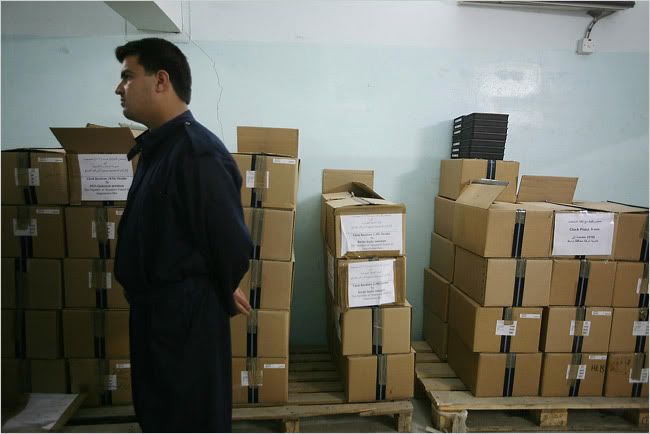
As the insurgency in Iraq escalated in the spring of 2004, American officials entrusted an Iraqi businessman with issuing weapons to Iraqi police cadets training to help quell the violence.
By all accounts, the businessman, Kassim al-Saffar, a veteran of the Iran-Iraq war, did well at distributing the Pentagon-supplied weapons from the Baghdad Police Academy armory he managed for a military contractor. But, co-workers say, he also turned the armory into his own private arms bazaar with the seeming approval of some American officials and executives, selling AK-47 assault rifles, Glock pistols and heavy machine guns to anyone with cash in hand — Iraqi militias, South African security guards and even American contractors.
“This was the craziest thing in the world,” said John Tisdale, a retired Air Force master sergeant who managed an adjacent warehouse. “They were taking weapons away by the truckload.”
Activities at that armory and other warehouses help explain how the American military lost track of some 190,000 pistols and automatic rifles supplied by the United States to Iraq’s security forces in 2004 and 2005, as auditors discovered in the past year.
These discoveries prompted criminal inquiries by the Pentagon and the Justice Department, and stoked fears that the arms could fall into enemy hands and be used against American troops. So far, no missing weapons have been linked to any American deaths, but investigators say that in a country awash with weapons, it may be impossible to trace where some ended up.
While the Pentagon has yet to offer its own accounting of how the weapons channel broke down, it is clear from interviews with two dozen military and civilian investigators, contracting officers, warehouse managers and others that military expediency sometimes ran amok, the lines between legal and illegal were blurred and billions of dollars in arms were handed over to shoestring commands without significant oversight.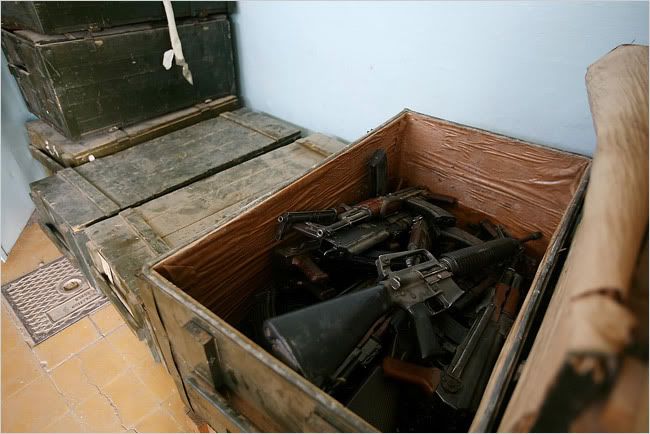
In the armory that Mr. Saffar presided over, for example, his dealings were murky. Mr. Tisdale, who recalled seeing a briefcase stuffed with stacks of $20 bills under Mr. Saffar’s desk, said he thought Mr. Saffar enriched himself selling American stocks along with guns he acquired from the streets. Mr. Tisdale was supposed to sign off on any transactions by Mr. Saffar, but he said many shipments left the armory without his approval and without the required records.
Ted Nordgaarden, an Alaska state trooper who worked as the police academy’s supply chief, said most of the weapons he saw leaving the armory went with a military escort. For his part, Mr. Saffar denies any wrongdoing, including any arms dealings. Nearly a half-dozen American and Iraqi workers say his gun business was an open secret at the armory.
Elsewhere, American officers short-circuited the chain of custody by rushing to Baghdad’s airport to claim crates of newly arrived weapons without filing the necessary paperwork. And Iraqis regularly sold or stole the American-supplied weapons, American officers and contractors said.
A shipment of 3,000 Glocks issued to police cadets disappeared within a week when they were sold on the black market, said an American official involved in distributing weapons. Other military sources said the weapons would fetch between five and seven times more than the $200 a police cadet would earn in a month. American military commanders say Iraqi security guards are suspected of stealing hundreds of weapons last year in about 10 major thefts at arms depots at Taji and Abu Ghraib.
The investigations into missing weapons are among the most serious in the widening federal inquiries into billions of dollars in military contracts for the purchase and delivery of weapons, supplies and other matériel to Iraqi and American forces.
Already there is evidence that some American-supplied weapons fell into the hands of guerrillas responsible for attacks against Turkey, an important United States ally. Some investigators said that because military suppliers to the war zone were not required to record serial numbers, it was unlikely that the authorities would ever be able to tell where the weapons went.
Many of those weapons were issued when Gen. David H. Petraeus, now the top American commander in Iraq, was responsible for training and equipping Iraqi security forces in 2004 and 2005. General Petraeus has said that he opted to arm the Iraqi forces as quickly as possible, before tracking systems were fully in place. The Pentagon says it has since tightened its record keeping for the weapons, but government auditors said in interviews that they were not yet convinced that an effective system was in place.
“The problem goes well beyond bookkeeping,” said Joseph A. Christoff, the director of international affairs and trade for the Government Accountability Office. Another G.A.O. official said, “There were inquiries from soldiers finding enemy weapons caches, finding AK-47s, and they would ask, ‘Did we give these to them?’”
Some military officials involved in supplying the Iraqis describe the sense of urgency they felt and the need to cut through what they saw as a cumbersome military bureaucracy.
A few miles from Mr. Saffar’s armory, Maj. John Isgrigg III and Maj. Timmy W. Cox were assigned to issue weapons to the Iraqi military and national guard from early 2004 to 2005. As soon as they heard that a new shipment was arriving, the officers said, they put together a convoy to be the first to claim it, barreling onto the tarmac at Baghdad International Airport and loading the crates of Glocks and AK-47s.
In several telephone interviews and e-mail exchanges, Majors Cox and Isgrigg described a race between themselves and the system. They acknowledged that they did not do everything by the book. They did not always call ahead to the airport to say they were coming. They signed receipts but did not always wait around to fill out inspection reports, known as DD-250s. And they told only certain superior officers about their plans for where the weapons would be delivered.
Major Isgrigg, 46, described the chain of custody as a maze of red tape. Once weapons went into it, it took days for them to be released, he said. Sometimes, he said, a competing unit distributing weapons to the Iraqi police would get to a shipment first, so he and Major Cox would have to wait for the next one. He said that warehouse crews had been infiltrated by Iraqis sympathetic to insurgents, and that sometimes weapons would disappear.
“We had folks getting killed because equipment wasn’t moving,” said Col. Randy Hinton, the majors’ superior officer. “Were there times when all the right forms were not signed? Probably. But we had a mission to do, and we were going to do it the best way we could at that time.”
In a phone interview from Bangkok, John Hess, who worked as the assistant director of operations for an American-owned company that helped manage supplies for Iraq, said payments to the companies that supplied arms to Iraq were often delayed because of missing DD-250s. He said he believed that the officers had the right motives but used dangerous methods.
“Once those weapons left normal channels,” Mr. Hess said, “none of us were ever sure where they were really going.”
Several co-workers complained about the unorthodox tactics of the two officers, including an accusation that Major Cox, 38, was stealing weapons, Major Isgrigg said. However, federal officials said the officers were not the targets of an investigation.
Even when they managed to get weapons to the Iraqi military, Major Isgrigg said, it was hard for him and Major Cox to feel triumphant. The Iraqi commanders could barely keep track of their troops, much less stocks of new weapons, he said. He estimated that 30 percent of the equipment he and Major Cox delivered went to Iraqi soldiers who showed up for duty one day, and disappeared the next.
“There were times we would issue a batch of weapons and within 10 days they would show up at the Enemy Weapons Purchase Program,” Major Cox, who is on his second tour in Baghdad, wrote by e-mail, referring to a military effort to buy guns from the streets.
“We didn’t always think we were going about things the right way,” said Major Isgrigg, who left Iraq in July. But he said he believed that his actions were necessary, saying of his commanders: “They rushed it. Their goal was to get those units standing as fast as possible, and then to get out of there. There was no planning for the long term.”
As the American military hurried to train and equip Iraqi security forces in the spring of 2004, the Pentagon turned to contractors to operate warehouses to store equipment and weapons.
Mr. Saffar managed an armory on the grounds of the Baghdad Police Academy, which along with a nearby warehouse was operated by an American-owned company based in Kuwait.
In July, the company, American Logistics Services, which later became Lee Dynamics International, was suspended by the Army from doing future business with the government amid accusations that the company paid hundreds of thousands of dollars in bribes to military contracting officers. The company had won $11 million in contracts to manage five warehouses with arms and other equipment in Iraq.
The company’s armory, a long concrete building divided into two sections in the back, was a logistics hub for the new Iraqi police. Crates of AK-47s and Glock pistols purchased by the Pentagon were trucked to the armory by armed convoys from a large warehouse at Abu Ghraib, and Mr. Saffar issued them to cadets.
It was also from this 1,800-square-foot building and six adjacent 40-foot-long metal shipping containers that Mr. Saffar plied his personal arms trade, co-workers said. He sold guns from the black market and from captured stocks. “There wasn’t anybody there who didn’t know what he was doing,” said Mr. Nordgaarden, the Alaska state trooper.
Mr. Tisdale said Mr. Saffar had a steady stream of customers, from Iraqis to South African private security contractors. “There were truckloads of stuff moving out of that armory without my authorization,” Mr. Tisdale said.
Mr. Tisdale said that he complained repeatedly to two top American Logistics executives, but they assured him that Mr. Saffar’s dealings were proper. The company has not responded to requests for comment.
Mr. Tisdale and other co-workers said they believed that an American military official, Lt. Col. Levonda Joey Selph, an Army officer who oversaw the warehouse contract and whose activities have been part of the investigation into American Logistics, also must have known about the arms dealings. Mr. Tisdale said the colonel regularly visited the armory and met with Mr. Saffar. Mr. Nordgaarden recalled seeing Colonel Selph at the warehouse 8 to 10 times over a year.
In an brief encounter outside her Northern Virginia home, Colonel Selph would say only that she was not guilty of any wrongdoing, and that she was under orders not to speak to the press. She would not say whose orders.
Mr. Saffar, who said he left Iraq in August 2005 when his contract to manage the armory ended, denied that he had run a private arms business. “My work was to issue weapons and ammunition to the Iraqi police,” he said in an e-mail message from Bahrain.
Mr. Hess, who was the assistant director of operations for American Logistics, defended Colonel Selph as the one person trying to establish order in the chaos that characterized the early months of the reconstruction effort. And he said that though Mr. Saffar’s arms business might look bad from a distance, it hardly raised an eyebrow in Baghdad.
“You’re talking about a war zone,” Mr. Hess said. “In Iraq, weapons are everywhere.”
Sunday, November 11, 2007
| [+/-] |
Broken Supply Channel Sent Arms for Iraq Astray |
Tuesday, November 6, 2007
| [+/-] |
Commanders Pushed To Make Bomb Disposal Choices |
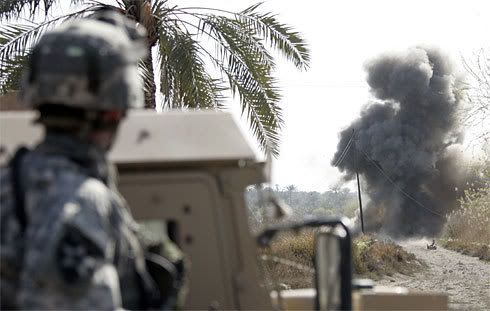 A U.S. soldier takes cover as an improvised explosive device is detonated near Baghdad. A new order lets officers decide whether to blow up IEDs or have technicians dismantle them.
USA Today reports:
During their last six months in Baghdad last year, Navy Lt. Sarah Wilson and her team of explosive ordnance disposal technicians said goodbye to each other more than 70 times.
Each time they were called to dismantle a roadside bomb, they'd bump fists. Then, Wilson says, "we'd all say we love each other because if we never got to say anything else" — if the bomb ended up exploding — "we wanted to be able to say goodbye."
After they arrived at the scene, they would often begin a perilous, painstaking task: taking apart the bombs, bagging the components and sending the parts back to a unit that analyzes them, much as investigators do on the television show CSI.
They were willing to take such risks, Wilson says, because "it's the best shot our guys on the ground have of … catching the bad guys." If forensic teams can lift a fingerprint or identify materials used in a series of bombs, "we can connect him," says Wilson, 27. "We know he's a bombmaker."
When roadside bombs became the insurgency's weapon of choice in Iraq, explosives disposal teams became increasingly important in efforts to protect U.S. troops and crack the bombmaking networks. But now, top military officials appear to be compromising efforts to catch bombmakers in favor of expedience and mobility, a USA TODAY investigation shows.
 U.S. Marine Sgt. Raphael Hernandez, an explosives technician, examines a device that was fired from an improvised rocket launcher near a bridge in Habaniyah, Iraq, last January.
A classified order, issued May 30 and reviewed by USA TODAY, gives commanders the authority to forgo calling in explosives technicians like Wilson to glean intelligence from improvised explosive devices, or IEDs. Instead, commanders may use engineers traveling with their regular units to simply detonate the bombs — without gathering evidence from them. Engineers receive about 10% of the explosives training of technicians, and they're not allowed to dismantle bombs.
Commanders and others see the process, dubbed "blow and go," as a way to keep convoys and combat teams moving and safe from snipers and ambushes. But the Army's new approach also runs counter to military doctrine — and to the Pentagon's long-term goal of getting one step ahead of the insurgency by learning about the networks that build, plant and trigger IEDs. The weapon is responsible for at least 60% of U.S. casualties in Iraq.
"The blow-and-go strategy undermines and compromises those overall efforts by losing key biometrics and evidence needed to identify and capture the network of insurgents," says Rep. Solomon Ortiz, D-Texas, a senior member of the House Armed Services Committee and chairman of the subcommittee on military readiness.
"This is a huge step backward in the long-term effort to prevent IED attacks from occurring in the first place," Ortiz says, "and puts the troops at risk of facing more IED attacks for a long time to come."
The head of the Army Asymmetric Warfare Office, which helps combat forces counter IEDs, also is concerned. "What are we accomplishing by blowing and going?" asks Col. Dick Larry. "You rid yourself of that one device, but the problem is … you have not gotten any kind of exploitative information off it."
In July, a USA TODAY investigation showed that, until last year, the Pentagon balked at pleas from officers in the field for safer vehicles to protect against IEDs. One of the explanations offered by Defense officials for not spending more money on the life-saving armor: that the military's focus was on stopping bombmaking networks before they planted the explosives.
In its annual report last year, the military's Joint IED Defeat Organization (JIEDDO), called attacking the networks "the lynchpin of our success." Its deputy director, Robin Keesee, estimated last month that as many as 160 such insurgent cells have been identified in Iraq.
And the organization's report listed forensic analysis of bombs — determining how the devices were manufactured, and what parts and types of explosives were used — among the efforts that were providing "unprecedented" intelligence capability.
Among the successes touted by the Pentagon: linking Iran to a particularly dangerous incarnation of the IED, the explosively formed penetrator. "Iranian TNT blocks removed from their packages have been seen on numerous occasions as IED components," according to a Feb. 11 Pentagon PowerPoint presentation in Baghdad.
"I don't want to give away the king's secrets here, but yes, (forensic analysis) was fruitful," says Paul Plemmons, a retired Army colonel who used to command a task force that dismantled bombs. "A bomber is a bomber, and they leave signatures. We saw patterns. We could track patterns."
"We know the engineers are not going to collect forensic data, and the way you defeat that weapon is getting at the forensics," Plemmons says. "We may lose the one device that will lead us to take a whole cell down if you blow and go."
JIEDDO spokeswoman Christine DeVries would not characterize the importance of such analysis, saying that the group is wary about giving too much information to the enemy. But she did say it is "one of the tools that have enabled forces in theater to eliminate a significant number of IED cells."
The need for mobility
When U.S. forces invaded Iraq in March 2003, few foresaw how prevalent or deadly roadside bombs would become. But by that fall, IEDs had emerged as the biggest threat to troops, and the teams that would dismantle the bombs — the explosives technicians — were stretched thin.
In the first months of the war, only a few dozen technicians were in Iraq. Today, including commanders, more than 500 are deployed, many embedded within units.
"When we were first there, the rules of engagement were, 'Let's just destroy all these IEDs,' " recalls Marine Master Sgt. Michael Burghardt, an explosives technician.
During the past two years, Burghardt says, that approach changed. When he was working in Ramadi, Burghardt says, he was collecting intelligence from about 90% of the IEDs he handled.
Today, explosives technician teams try to collect evidence from "every scene," says Army Col. Karl Reinhard, who commands the Army, Navy and Air Force explosives disposal teams in Iraq. From December 2006 through September 2007, he says technicians have handled more than 6,000 IEDs. Since the war began, he says, records show about 80,000 such bombs were planted.
"Some of the information we would glean would be negligible. Other times, it would be important," Reinhard says. The danger of blowing and going, he says, is that "you never know which needle in the haystack is going to be an important needle."
Military doctrine — specifically, a publication titled Barriers, Obstacles and Mine Warfare for Joint Operations and prepared by the Joint Chiefs of Staff — reinforces the unique role of explosives disposal teams. The document, dated April 26, characterizes the work of those teams as "an essential part of the overall effort to develop a detailed forensic database to target centers of gravity in the IED system."
"In addition to developing actionable intelligence to support future operations," the document says, reports from explosives disposal teams have "an immediate impact on refining unit level force protection-related tactics, techniques and procedures."
Since 2006, the military has taken significant steps to get more explosives disposal teams throughout the war zone.
Col. Kevin Lutz, an explosives technician set to replace Reinhard next year, says the military has tripled the number of explosives disposal teams in Iraq during the past 18 months — going from about 50 to about 150 three-person teams. Even so, when the tech teams are called to an IED, getting them to the site and letting them gather the intelligence often takes time. Sometimes, the delay is 30 minutes. Occasionally, it extends for hours.
Engineers have been lobbying to take a more active approach in destroying roadside bombs for the past few years, Lutz and others say. The engineers' traditional mission — to breach obstacles to keep units mobile — was arguably more important during the invasion of Iraq than it is now, given the military's current role policing the country.
Nevertheless, officials set up a training course, taught by explosives technicians, to help prepare engineers to detonate IEDs. Reinhard says those engineers receive less than 100 hours of training. Explosives technicians train for more than 1,100 hours, he says.
On May 30, Lt. Gen. Raymond Odierno, the second-ranking U.S. commander in Iraq, issued the order that empowers commanders to let engineers blow and go.
"The intent of the order was to allow qualified individuals to detonate explosives rather than waiting for others who may not be readily available," explains Brig. Gen. Michael Silva, an Army engineer who says he lobbied Odierno for the change. "It was a way to improve the efficiency of the route clearing team operations so we were actually enabling the soldiers to do the job that they needed to get done."
IEDs 'just an obstacle'
An instructor who teaches engineers at Fort Leonard Wood in Missouri says the order makes sense.
"If you look at IEDs as just an obstacle, one of the engineer functions is just to remove obstacles," says Maj. Eric Goser, executive officer of the Counter Explosive Hazard Center. "Bottom line: The IED to an engineer is no different than a log obstacle," Goser says. "A log … is an obstacle. You deal with that obstacle in a certain way."
Goser's logic troubles explosives technicians. "The difference is, the log obstacle won't kill you," says Reynold Hoover, a former explosives technician who worked as a special agent with the Bureau of Alcohol, Tobacco and Firearms and served in the first Gulf War.
"You're gaining mobility," Hoover says, "but what you're losing is the ability to find the bombmaker and the supply chain."
Moreover, the amount of time saved by blowing and going may not be much, Reinhard says. He says a study done this year by his task force estimates "the expected value of the time they could save would be 20 minutes, on average."
"Nobody wants to sit out on the battlefield for three to four hours," he says. "Two or three years ago, they were waiting that long. It's definitely not like that any more."
Statistics on response times are classified, but Reinhard says explosives technicians are now able to arrive relatively quickly at IED sites. "For instance, in the north, 85% of the responses in the last week of September were 90 minutes or less," he says. Lutz says a long wait for explosives technicians today is "an outlier."
Engineer Silva, who is no longer on active duty, is skeptical. He believes information released by the explosives technicians may be "skewed" against giving engineers more of a role.
"My belief is that there was a parochialism engaged there — parochial in the fact that they want to be the only ones … blowing" IEDs, Silva says of explosives technicians.
Do risks outweigh benefits?
It's unclear how often commanders have used the blow-and-go approach. Reinhard says records he reviewed showed engineers detonated "approximately 120" IEDs from June through mid-October — about one a day.
But Army Col. Peter DeLuca, commander of the 20th Engineering Brigade, estimates engineers he oversees blow and go at least three or four IEDs each day — far more than the records reviewed by Reinhard indicate.
"There's been a ramp-up," Reinhard explains. "They may both be true" he says of the figures.
Others aren't certain. "No one is keeping good track of that," says Larry, who heads the Army's anti-IED efforts. "How do we know what they're doing," he says of engineers, "if they don't report it?"
Odierno's order specifies that engineers can only detonate relatively simple IEDs, using devices such as robots and the robotic arm of Mine Resistant Ambush Protected vehicles — machines that keep troops out of harm's way.
"We have very, very strict limitations about what we are and what we're not supposed to blow up," says Army Spc. Walter Hayden, the 1st Platoon team leader with the 1203rd Engineer Battalion. "If I ever have any kind of doubt," he says, he calls in explosives technicians.
Silva says he can see the amount handled by engineers growing — and the limitations on engineers being lifted as training improves. To date, neither DeLuca nor Reinhard believes any engineers have been hurt while blowing and going.
Despite reservations, Reinhard says he doesn't "object to the engineers doing this provided that they can live within the bounds that sometimes you need to pause and take the time to exploit."
But some explosives technicians fear that engineers will overstep their mission — and make deadly mistakes. Burghardt says he and his team dismantled more than 900 IEDs during his three tours in Iraq. The one that detonated — the one that left six holes in his body, cracked his tailbone, threw him 10 feet and knocked him unconscious in September 2005, despite the protective gear he wore — was unlike any he had seen.
"It was the first time we saw the tactic of where they double stacked it," says Burghardt, 37, now stationed at Camp Fuji, Japan. "I was standing on top of the device when I was clearing it … and they just leave enough earth in between" that the device beneath the other IED was difficult to spot.
Burghardt's experience is what makes explosives technicians wary of the new order — particularly, the idea that engineers will be able to discern a simple IED from a more sophisticated one. "What's simple?" Burghardt asks rhetorically. "You're not going to know that until it's too late."
Such mistakes put troops and civilians at risk. In a 2005 paper for the Marine Corps War College, Lutz chronicled cases in which mistakes by engineers cost lives.
Two different cases during the first Gulf War in 1991 "led to the massive chemical exposure and contamination of thousands of coalition forces and non-combatants, and the loss of seven United States soldiers," Lutz wrote. The reason for one of the mishaps at As Salman Airfield in Iraq: "Engineers were clearing munitions they were unfamiliar with and that turned out to be some of the most deadly unexploded ordnance our inventory can produce."
He wrote that, "buried within the … investigations, point papers, after-action reports, lessons learned from the various units (now in Iraq) … one can find repetitive incidents where the improper destruction of (explosives) led to severe contamination of the surrounding area and caused injury, death and destruction of equipment and facilities to both United States Armed Forces and to the local Iraqi civilian population."
Explosives technician Plemmons put it more tersely. He says the difference between an engineer and an explosives technician handling an IED is like the difference between "your physician's assistant" and "an orthopedic surgeon."
Tuesday, October 23, 2007
| [+/-] |
Item in War Request Stokes Fears of Iran Strike |
Congressional Quarterly reports:
Some Democrats are worried that President Bush’s funding request to enable B-2 “stealth” bombers to carry a new 30,000-pound “bunker buster” bomb is a sign of plans for an attack on Iran.
Buried in the $196.4 billion supplemental war spending proposal that Bush submitted to Congress on Oct. 22 is a request for $88 million to modify B-2 bombers so they can drop a Massive Ordnance Penetrator, or MOP, a conventional bomb still in development that is the most powerful weapon designed to destroy targets deep underground.
A White House summary accompanying the supplemental spending proposal said the request for money to modify B-2s to carry the bombs came in response to “an urgent operational need from theater commanders.” The summary provided no further details. The White House and the Air Force, in response to queries, did not provide additional clarification.
Previous statements by the Defense Department and the program’s contractors, along with interviews with military experts, suggest the weapon is meant for the kind of hardened targets found chiefly in Iran, which Bush suspects of developing nuclear weapons capability, and North Korea, which already has tested a nuclear device.
Bush has said repeatedly that he prefers to use diplomacy to resolve tensions with Iran over its nuclear program. But his request for funding to deliver the new bunker buster comes amid a sharp escalation of tough White House rhetoric about Iran’s nuclear program in recent days.
On Oct. 18, Bush said a nuclear-armed Iran could lead to “World War III.” Three days later, Vice President Dick Cheney warned of “serious consequences” if Tehran continued to enrich uranium.
Against that backdrop, the proposed funding for bunker busters has some in Congress worried.
James P. Moran, D-Va., a senior member of the House Appropriations Defense Subcommittee, said he did not believe the MOP could be used in Iraq or Afghanistan and cited Iran as the potential target for the bomb. He said he would oppose the funding.
“That’s a clear red flag,” Moran said.
Jim McDermott, D-Wash., an outspoken critic of Bush’s war policies, said the funding request was the latest of many signs that indicated Bush was contemplating an attack on Iran. McDermott said such a scenario was his “biggest fear between now and the election.”
“We are not authorizing Bush to use a 30,000-pound bunker buster,” he said. “They’ve been banging the drums the same way as they did in 2002 with Iraq.”
Stealth Delivery
The Boeing Co., in conjunction with Elgin Air Force Base in Florida, has been developing the Massive Ordnance Penetrator for several years and first tested the bomb in March. The 15-ton bomb would be dropped by B-52 or B-2 bombers.
In June, the Northrop Grumman Corp., maker of the B-2, won a $2.5 million contract from the Air Force to retro fit the bat-winged, stealth bombers so they could drop the new weapon. The new funding, if approved, would significantly expand that initiative.
The B-2 made its battlefield debut during the Kosovo War in 1999. It is optimal for use against sophisticated enemy air defenses because its radar-evading surface is difficult to detect.
In interviews Tuesday, military experts said the new weapon was not designed for the kind of counterinsurgency campaign being conducted by U.S. forces in Iraq and Afghanistan. They said the MOP could prove useful against other targets, notably underground Iranian facilities that are said to be producing nuclear weapons materials.
“A weapon like this is designed to deal with extremely hard and buried targets such as you would find in Iran or North Korea,” said Loren Thompson, a defense analyst with the conservative military think tank the Lexington Institute, who is also a consultant for some defense contractors.
“Clearly, in the case of North Korea, the likelihood of military action is receding as the Pyongyang government becomes more tractable,” said Thompson, referring to recent progress in diplomatic efforts to persuade North Korea to dismantle its nuclear programs.
John Pike, an expert on defense and intelligence policy with Globalsecurity.org, said the MOP could be used against Iran’s main uranium enrichment facility at Natanz.
“It’ll go through it like a hot knife through butter,” Pike said. He noted that the B-2 would be the best aircraft to deliver the bomb “if you want it to be a surprise party.”
It is not clear how quickly the new weapon could be ready for delivery by a B-2 if the $88 million were enacted. A spokesman for Northrop Grumman declined to provide a time frame.
Not all Democratic lawmakers oppose the weapon. Non-nuclear bunker busters have emerged in recent years as favorites of Democrats concerned about Bush administration’s earlier plans to conduct research on nuclear models.
“We need to have this as a conventional weapon,” said Norm Dicks, D-Wash., a member of the House Defense Appropriations Subcommittee. “It adds to our deterrent.”
Saturday, October 20, 2007
| [+/-] |
Chain of Errors Blamed for Nuclear Arms Going Undetected |
An Air Force inquiry says weapons officers failed five times to check missiles before they were flown across the country to another base.
The LA Times reports:
Air Force weapons officers assigned to secure nuclear warheads failed on five occasions to examine a bundle of cruise missiles headed to a B-52 bomber in North Dakota, leading the plane's crew to unknowingly fly six nuclear-armed missiles across the country.
That August flight, the first known incident in which the military lost track of its nuclear weapons since the dawn of the atomic age, lasted nearly three hours, until the bomber landed at Barksdale Air Force Base in northern Louisiana.
But according to an Air Force investigation presented to Defense Secretary Robert M. Gates on Friday, the nuclear weapons sat on a plane on the runway at Minot Air Force Base in North Dakota for nearly 24 hours without ground crews noticing the warheads had been moved out of a secured shelter.
"This was an unacceptable mistake," said Air Force Secretary Michael W. Wynne at a Pentagon news conference. "We would really like to ensure it never happens again."
For decades, it has been military policy to never discuss the movement or deployment of the nuclear arsenal. But Wynne said the accident was so serious that he ordered an exception so the mistakes could be made public.
On Aug. 29, North Dakota crew members were supposed to load 12 unarmed cruise missiles in two bundles under the B-52's wings to be taken to Louisiana to be decommissioned. But in what the Air Force has ruled were five separate mistakes, six missiles contained nuclear warheads.
According to the investigation, the chain of errors began the day before the flight when Air Force officers failed to inspect five bundles of cruise missiles inside a secure nuclear weapons hangar at Minot. Some missiles in the hangar have nuclear warheads, some have dummy warheads, and others have neither, officials said.
An inspection would have revealed that one of the bundles contained six missiles with nuclear warheads, investigators said.
"They grabbed the wrong ones," said Maj. Gen. Richard Newton, the Air Force's deputy chief of staff in charge of operations.
After that, four other checks built into procedures for checking the weapons were overlooked, allowing the plane to take off Aug. 30 with crew members unaware that they were carrying enough destructive power to wipe out several cities.
Newton said that even though the nuclear missiles were hanging on the B-52's wings overnight without anyone knowing they were missing, the investigation found that the Minot's tarmac was secure enough that the military was never at risk of losing control of the warheads.
The cruise missiles were supposed to be transported to Barksdale without warheads as part of a treaty that requires the missiles to be mothballed. Newton said the warheads are normally removed in the Minot hangar before the missiles are assigned to a B-52 for transport.
The Air Force did not realize the warheads had been moved until airmen began taking them off the plane at Barksdale. The B-52 had been sitting on the runway there for more than nine hours, however, before they were offloaded.
Newton did not say what explanation the Minot airmen gave investigators for their repeated failure to check the warheads once they left the secured hangar, saying only that there was inattention and "an erosion of adherence to weapons-handling standards."
Air Force officials who were briefed on the findings said investigators found that personnel lacked neither the time nor the resources to perform the inspections, indicating that the weapons officers had become lackadaisical in their duties.
One official noted that until the Air Force was given the task of decommissioning the cruise missiles this year, it had not handled airborne nuclear weapons for more than a decade, implying that most of the airmen lacked experience with the procedures.
The Air Force has fired four colonels who oversaw aircraft and weapons operations at Minot and Barksdale, and some junior personnel have also been disciplined, Newton said. The case has been handed to a three-star general who will review the findings and determine whether anyone involved should face court-martial proceedings.
Despite the series of failures, Newton said, the investigation found that human error, rather than inadequate procedures, were at fault. Gates has ordered an outside panel headed by retired Gen. Larry D. Welch, a former Air Force chief of staff, to review the Pentagon's handling of nuclear weapons.
Thursday, October 18, 2007
| [+/-] |
Anti-IED Drills Improve, But Not Every Soldier Goes Through Them |
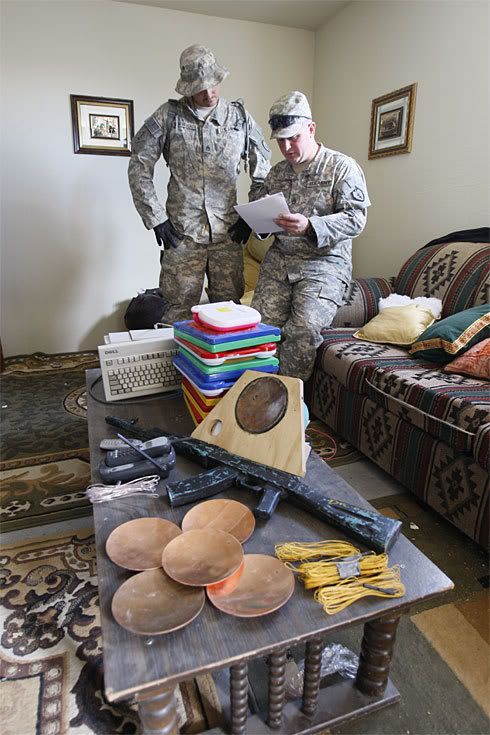 Soldiers from Schofield Barracks, Hawaii, practice house searches for IED components during training at Ft. Irwin, Calif. The U.S. Army's National Training Center in Death Valley replicates Iraqi houses and villages and even hires Iraqis living in the United States to act as role players.
USA Today reports:
The troops arrive to pure chaos. The Humvee lies smoking on the road, blown apart by a roadside bomb. One soldier moans on the ground, a leg torn off at the knee. Another slumps unconscious nearby. Iraqis crowd in, pointing and yelling. Snipers lurk on every roof.
Some soldiers secure the area; others provide first aid. They call for support. As they load the injured for evacuation, sniper fire rains down.
Fortunately, the wounded soldiers are only lifelike mannequins. And the entire episode is a training exercise aimed at preparing soldiers for the chief threat they'll face in combat: improvised explosive devices, or IEDs.
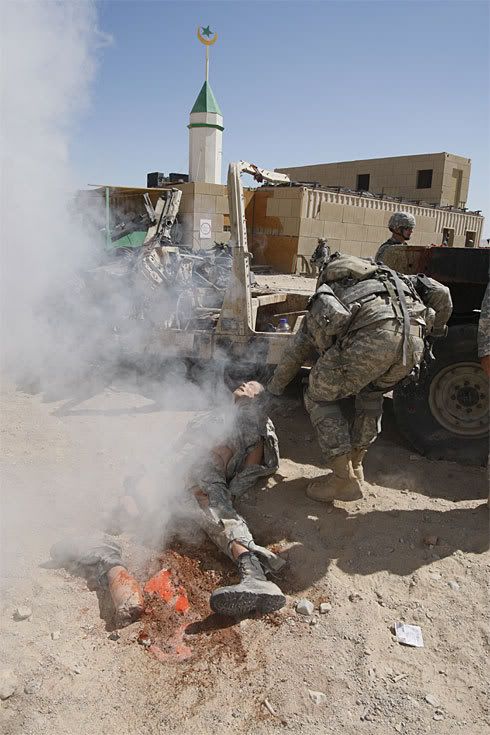 A medical simulation mannequin lies next to a smoking HUMVEE to simulate an IED attack, creating a realistic training for units preparing to deploy to Iraq.
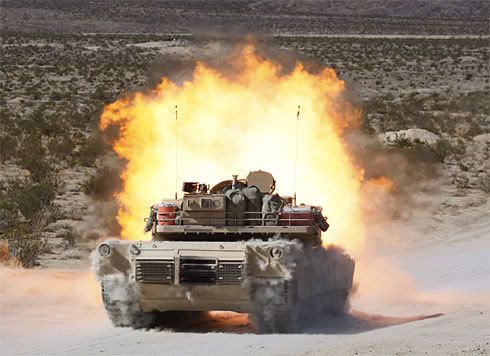 Soldiers from the 11th Armored Cavalry Regiment fire at targets with their M1A1 Abrams tanks, during a live-fire exercise at Ft. Irwin, Calif.
In the war's early years, troops were deployed with little or no knowledge of IEDs, even as the devices came to account for 60% of combat deaths.
Today, many troops still head to Iraq without the best available training. Three of the 20 Army combat brigades now in Iraq — nearly 15,000 troops — didn't have time to visit Fort Irwin or one of the two other combat training centers where brigades are supposed to do final pre-deployment exercises. Regardless of where they train, most soldiers and Marines still practice without the armored vehicles, electronic equipment and other tools they will rely on to avoid and survive IEDs in combat.
Fort Irwin has almost no armored Humvees, though commanders concede that the top-heavy vehicles are far harder to control than standard Humvees in the abrupt maneuvers often needed to survive an IED attack. Camp Shelby, Miss., a National Guard training site, uses fake "surrogates" to simulate the electronic jammers that block the wireless signals insurgents use to detonate IEDs.
Across the Pentagon's entire training complex, there are no more than a few of the new Mine Resistant Ambush Protected vehicles, known as MRAPs, that are being rushed to Iraq as the latest response to the IED threat.
Marine Corps Lt. Gen. James Mattis, selected in September to head the U.S. Joint Forces Command, told Congress in confirmation testimony that all troops are prepared when they reach combat.
But Mattis acknowledged that "units are challenged in their readiness by equipment needs … and (lack of) time to train." Many don't get to practice with the equipment they'll use in combat because there's only enough to supply troops already in the theater, he said, and they don't reach a combat-ready state until "just in time" for their deployment.
It's impossible to assess the costs of inadequate training: There are no statistics on how many of the 1,600 troops killed by IEDs might have lived if they had been better prepared. Commanders and rank-and-file troops alike acknowledge that they've had to play catch-up in training for the IED threat.
In recent years, that training has evolved and improved dramatically, but "it hasn't been quick enough," says Lt. Gen. Russel Honore, commander of the 1st Army, which trains all National Guard and reserve troops in the mainland USA. "It's gotten better and better, but we're still a long way from perfect."
A father haunted
Army Spc. Stephen Castner's complaints about his pre-deployment training still haunt his father. Castner, 27, a veteran of four years active duty in the Air Force, was back in uniform in the spring of 2006 as a National Guardsman doing exercises at Camp Shelby.
Castner's calls home were full of concerns, especially about the lack of realistic training for IEDs and the shortage of Humvees. His father, a former Army reservist also named Stephen, was so troubled that he wrote to his congressman, Rep. F. James Sensenbrenner, R-Wis.
Two months after the letter went out, Spc. Castner was dead.
On his first mission in Iraq, his Humvee was hit by a roadside bomb while providing security for a long convoy. Blown into a marshy ditch, the truck went unseen in the smoke as the rest of the convoy passed. A short time later, commanders noticed it missing, but by the time they returned and called for a medical evacuation, 25 minutes had passed. Castner's pulse stopped just as the helicopter got to the hospital; he died from blood loss.
Prodded by Sensenbrenner, the Pentagon's inspector general is investigating whether Castner's unit was properly trained and equipped. Regardless of whether such problems were decisive factors in Castner's death, the training concerns Castner raised reflect the Pentagon's continuing struggle to properly prepare troops for IEDs.
First anti-IED training
The Army began to set substantive servicewide IED training requirements for all soldiers in May 2004 — more than six months after attacks with the devices reached 100 per month.
Within weeks after the order from Maj. Gen. Raymond Barrett, the Army's Training and Doctrine Command began releasing IED "training support packages" to commanders. They've continued since, as often as every two months, tracking the constant changes in the ways insurgents make and trigger IEDs.
But change came slowly.
At the end of 2004, when Staff Sgt. Scott Molle deployed, his training at Fort Benning, Ga., included "some IEDs, but … most of the (IED) training we got you could pretty much throw out the window as soon as you got (to Iraq). It just didn't compare to what was happening" there.
The lag in IED training mirrored the reluctance of top Pentagon officials to acknowledge the potency of the insurgency — and the persistence of IEDs.
"We had a period there where the Pentagon wouldn't even acknowledge that there was an insurgency," says Rep. Vic Snyder, D-Ark., who chairs the House Armed Services subcommittee on military oversight. "So we were behind every step of the way — on training, equipment, technology."
These days, with far more robust instructional programs in place, there still isn't enough time and money to make sure that all war fighters get all the best possible IED training.
The three brigade combat teams that skipped training at Fort Irwin didn't have the 10 days it takes to get soldiers and equipment to and from the base. Instead, the training center dispatched trainers and equipment to put the three 4,500-soldier units through final exercises at their home bases.
"It's not quite as good as being at one of the combat training centers," says Dennis Tighe, deputy director of the Army's Combined Arms Center for Training. "But it was as good as we could make it given the time and resource constraints."
Then there are the equipment problems. The conventional Humvees that soldiers use for training at Fort Irwin were replaced in Iraq more than two years ago by a new, armored version that is thousands of pounds heavier, making it more unwieldy and prone to rollovers. But as the Pentagon struggles to provide enough armored Humvees just for units in combat, there aren't enough for training.
Now, many of the armored Humvees in Iraq are being replaced by the more IED-resistant MRAP vehicles. But there are no plans to move them into the training system.
Lt. Col. Tom Perison, a training chief at Army Forces Command at Fort McPherson, Ga., says all soldiers get some exposure to armored Humvees and other equipment as they rotate through Kuwait on their way to Iraq. "Certainly, if you (train on) the exact same thing you're taking to theater, that's the best thing," Perison says. But equipment has to go where "it's most needed," in Iraq.
There's evidence that the services' increased emphasis on IED training makes a difference. In the early months of the war, nearly every IED that exploded caused casualties, but today only about one in six IED detonations produce a death or injury, the Pentagon says. U.S. troops detect about half of all IEDs before they go off.
Dramatic change
In November 2004, Rep. Gene Taylor, D-Miss., visited Camp Shelby in his district where National Guard soldiers get final training before heading to Iraq.
Taylor pulled aside a soldier in a Humvee and asked whether he was training with jammers. "He kind of looked at me and said, 'Huh?' " Taylor recalls. "So I said, 'Jammers: The things that block the signals they use to set off IEDs.' And he said, 'Oh, yeah,' and pointed inside the Humvee to a cigar box on the dashboard with 'JAMMER' written on it."
Much would change in the next two years. The base's technicians fitted Humvees with plywood sides to simulate the restricted sight lines and shooting space of the armored versions.
They set up a mock Iraqi village and built fake IEDs that explode with small charges when soldiers fail to detect them — a big change from earlier years, when the fakes lacked the smoke and sound of the real thing. This year, the camp also received three dozen "surrogate" jammers.
But Congress remains concerned about resources at Shelby and other training sites across the services.
"Equipment and personnel shortfalls in non-deployed units limit their ability to fully train for combat," said a congressional staff report prepared in September 2006 for Rep. John Murtha, D-Pa., who now chairs the House Appropriations subcommittee. A bill the House passed this year on a bipartisan vote authorized a $250 million increase in Pentagon spending on training. That bill must be reconciled with a Senate version, which also called for increases in training budgets. The bills are being reconciled in conference.
Since 2006, the Pentagon has dramatically expanded an office called the Joint IED Defeat Organization, or JIEDDO, which has spent $500 million on IED training initiatives in the past two years. Among other things, the office has developed simulated jammers, IED "smart cards" that give troops tips on how to spot and handle different types of devices, and websites where troops can get the latest information on IEDs. JIEDDO also has helped funnel intelligence on IEDs from Iraq to units at home that are training for deployment.
"JIEDDO has an extraordinary flexibility to react quickly to emerging needs, including training," because it isn't subject to rules requiring that the services plan their spending far in advance, says Col. Michael Mahoney, JIEDDO's operations chief.
These days, training centers get the latest IED intelligence from Iraq on a near-daily basis.
At Fort Irwin, trainers "get (information from war zones) on training Day 2, and on training Day 5, it's in the (exercise) rotation," says Maj. Brent Dixon, a training coordinator at the Army's Combined Arms Center. Some changes are as simple as adding a new type of IED to the "petting zoo," a hands-on display where soldiers study explosive devices used by insurgents.
The bigger goal is to make training at Fort Irwin — with its mock Iraqi villages and 110-degree heat — even more realistic. Native Arabic speakers are hired by the Army to play roles as insurgents, as Iraqi troops and as bystanders during training exercises. They interact with soldiers training to interrogate troublemakers or to search Iraqi homes for IED components.
"This is the best training in the world," says Col. Steven Salazar, who heads operations at the training center. The emphasis on IEDs, he adds, "is huge."
Conflict over Castner's death
It will be up to the Pentagon's inspector general to sort through the conflicting accounts to determine whether better IED training would have saved Stephen Castner.
Sensenbrenner called the soldier's complaints about training "chillingly prophetic." In a statement, the congressman said, "No American soldier should be sent to Iraq with inadequate training."
In the initial investigation into Castner's death, several soldiers spoke of confusion in the convoy after the IED blew his Humvee into the roadside marsh. Castner's crewmates, two of whom also were injured, struggled to get him out of the vehicle, but he was stuck. After other troops from the convoy returned and pulled him out, they did not put a tourniquet above the deep shrapnel wound on his thigh.
One soldier in the Humvee with Castner — the Pentagon blacked out his name in the report — told investigators in a sworn statement that he would have been better prepared if he'd had "training on what to do when the vehicle is in water, and more medical training."
The initial report on the attack, written by Col. James Haun, a commander with an Army transportation unit, found that training was not a factor. "The soldiers at the scene reacted by the book," Haun's report said. "There is no relationship to Spc. Castner's death and any training he could receive or any training by the other soldiers that might have saved him."
Castner's father, a lawyer in Cedarburg, Wis., disputes that, citing witness statements, conversations with his son's crewmates and lapses in the investigation.
"There were a lot of training failures," he says. "The commanders lost command and control. … They relied on extremely undisciplined, helter-skelter broadcasts over the radio to make assumptions that were totally incorrect about whether all vehicles were accounted for.
"If they'd handled it properly, they would have been back (at the explosion site) in just a few minutes, there would have been people there who could have given Stephen proper medical attention, and the medevac would have been there a lot sooner."
It's unclear when the inspector general will finish its review. But the elder Castner, who supports the war, says it's important to see the probe through to its conclusion.
"I want to make sure the right lessons are learned from Stephen's death," he says. "Our mission in Iraq is important, but we have a responsibility to make sure that our (troops) are trained and prepared properly. That's our obligation."
Eisler reported from Camp Shelby, Miss., and Fort Leavenworth, Kan.; Vanden Brook from Milwaukee and Fort Irwin, Calif.; Morrison from Fort McPherson, Ga.
Sunday, September 30, 2007
| [+/-] |
Shifting Targets |
The Administration's plan for Iran.
In the New Yorker, Seymour Hersh writes:
In a series of public statements in recent months, President Bush and members of his Administration have redefined the war in Iraq, to an increasing degree, as a strategic battle between the United States and Iran. “Shia extremists, backed by Iran, are training Iraqis to carry out attacks on our forces and the Iraqi people,” Bush told the national convention of the American Legion in August. “The attacks on our bases and our troops by Iranian-supplied munitions have increased. . . . The Iranian regime must halt these actions. And, until it does, I will take actions necessary to protect our troops.” He the concluded, to applause, “I have authorized our military commanders in Iraq to confront Tehran’s murderous activities.
The President’s position, and its corollary—that, if many of America’s problems in Iraq are the responsibility of Tehran, then the solution to them is to confront the Iranians—have taken firm hold in the Administration. This summer, the White House, pushed by the office of Vice-President Dick Cheney, requested that the Joint Chiefs of Staff redraw long-standing plans for a possible attack on Iran, according to former officials and government consultants. The focus of the plans had been a broad bombing attack, with targets including Iran’s known and suspected nuclear facilities and other military and infrastructure sites. Now the emphasis is on “surgical” strikes on Revolutionary Guard Corps facilities in Tehran and elsewhere, which, the Administration claims, have been the source of attacks on Americans in Iraq. What had been presented primarily as a counter-proliferation mission has been reconceived as counterterrorism.
The shift in targeting reflects three developments. First, the President and his senior advisers have concluded that their campaign to convince the American public that Iran poses an imminent nuclear threat has failed (unlike a similar campaign before the Iraq war), and that as a result there is not enough popular support for a major bombing campaign. The second development is that the White House has come to terms, in private, with the general consensus of the American intelligence community that Iran is at least five years away from obtaining a bomb. And, finally, there has been a growing recognition in Washington and throughout the Middle East that Iran is emerging as the geopolitical winner of the war in Iraq.
During a secure videoconference that took place early this summer, the President told Ryan Crocker, the U.S. Ambassador to Iraq, that he was thinking of hitting Iranian targets across the border and that the British “were on board.” At that point, Secretary of State Condoleezza Rice interjected that there was a need to proceed carefully, because of the ongoing diplomatic track. Bush ended by instructing Crocker to tell Iran to stop interfering in Iraq or it would face American retribution.
At a White House meeting with Cheney this summer, according to a former senior intelligence official, it was agreed that, if limited strikes on Iran were carried out, the Administration could fend off criticism by arguing that they were a defensive action to save soldiers in Iraq. If Democrats objected, the Administration could say, “Bill Clinton did the same thing; he conducted limited strikes in Afghanistan, the Sudan, and in Baghdad to protect American lives.” The former intelligence official added, “There is a desperate effort by Cheney et al. to bring military action to Iran as soon as possible. Meanwhile, the politicians are saying, ‘You can’t do it, because every Republican is going to be defeated, and we’re only one fact from going over the cliff in Iraq.’ But Cheney doesn’t give a rat’s ass about the Republican worries, and neither does the President.”
Bryan Whitman, a Pentagon spokesman, said, “The President has made it clear that the United States government remains committed to a diplomatic solution with respect to Iran. The State Department is working diligently along with the international community to address our broad range of concerns.” (The White House declined to comment.)
I was repeatedly cautioned, in interviews, that the President has yet to issue the “execute order” that would be required for a military operation inside Iran, and such an order may never be issued. But there has been a significant increase in the tempo of attack planning. In mid-August, senior officials told reporters that the Administration intended to declare Iran’s Revolutionary Guard Corps a foreign terrorist organization. And two former senior officials of the C.I.A. told me that, by late summer, the agency had increased the size and the authority of the Iranian Operations Group. (A spokesman for the agency said, “The C.I.A. does not, as a rule, publicly discuss the relative size of its operational components.”)
“They’re moving everybody to the Iran desk,” one recently retired C.I.A. official said. “They’re dragging in a lot of analysts and ramping up everything. It’s just like the fall of 2002”—the months before the invasion of Iraq, when the Iraqi Operations Group became the most important in the agency. He added, “The guys now running the Iranian program have limited direct experience with Iran. In the event of an attack, how will the Iranians react? They will react, and the Administration has not thought it all the way through.”
That theme was echoed by Zbigniew Brzezinski, the former national-security adviser, who said that he had heard discussions of the White House’s more limited bombing plans for Iran. Brzezinski said that Iran would likely react to an American attack “by intensifying the conflict in Iraq and also in Afghanistan, their neighbors, and that could draw in Pakistan. We will be stuck in a regional war for twenty years.”
In a speech at the United Nations last week, Iran’s President, Mahmoud Ahmadinejad, was defiant. He referred to America as an “aggressor” state, and said, “How can the incompetents who cannot even manage and control themselves rule humanity and arrange its affairs? Unfortunately, they have put themselves in the position of God.” (The day before, at Columbia, he suggested that the facts of the Holocaust still needed to be determined.)
“A lot depends on how stupid the Iranians will be,” Brzezinski told me. “Will they cool off Ahmadinejad and tone down their language?” The Bush Administration, by charging that Iran was interfering in Iraq, was aiming “to paint it as ‘We’re responding to what is an intolerable situation,’ ” Brzezinski said. “This time, unlike the attack in Iraq, we’re going to play the victim. The name of our game seems to be to get the Iranians to overplay their hand.”
General David Petraeus, the commander of the multinational forces in Iraq, in his report to Congress in September, buttressed the Administration’s case against Iran. “None of us, earlier this year, appreciated the extent of Iranian involvement in Iraq, something about which we and Iraq’s leaders all now have greater concern,” he said. Iran, Petraeus said, was fighting “a proxy war against the Iraqi state and coalition forces in Iraq.
Iran has had a presence in Iraq for decades; the extent and the purpose of its current activities there are in dispute, however. During Saddam Hussein’s rule, when the Sunni-dominated Baath Party brutally oppressed the majority Shiites, Iran supported them. Many in the present Iraqi Shiite leadership, including prominent members of the government of Prime Minister Nuri al-Maliki, spent years in exile in Iran; last week, at the Council on Foreign Relations, Maliki said, according to the Washington Post, that Iraq’s relations with the Iranians had “improved to the point that they are not interfering in our internal affairs.” Iran is so entrenched in Iraqi Shiite circles that any “proxy war” could be as much through the Iraqi state as against it. The crux of the Bush Administration’s strategic dilemma is that its decision to back a Shiite-led government after the fall of Saddam has empowered Iran, and made it impossible to exclude Iran from the Iraqi political scene.
Vali Nasr, a professor of international politics at Tufts University, who is an expert on Iran and Shiism, told me, “Between 2003 and 2006, the Iranians thought they were closest to the United States on the issue of Iraq.” The Iraqi Shia religious leadership encouraged Shiites to avoid confrontation with American soldiers and to participate in elections—believing that a one-man, one-vote election process could only result in a Shia-dominated government. Initially, the insurgency was mainly Sunni, especially Al Qaeda in Mesopotamia. Nasr told me that Iran’s policy since 2003 has been to provide funding, arms, and aid to several Shiite factions—including some in Maliki’s coalition. The problem, Nasr said, is that “once you put the arms on the ground you cannot control how they’re used later.”
In the Shiite view, the White House “only looks at Iran’s ties to Iraq in terms of security,” Nasr said. “Last year, over one million Iranians travelled to Iraq on pilgrimages, and there is more than a billion dollars a year in trading between the two countries. But the Americans act as if every Iranian inside Iraq were there to import weapons.”
Many of those who support the President’s policy argue that Iran poses an imminent threat. In a recent essay in Commentary, Norman Podhoretz depicted President Ahmadinejad as a revolutionary, “like Hitler . . . whose objective is to overturn the going international system and to replace it . . . with a new order dominated by Iran. . . . [T]he plain and brutal truth is that if Iran is to be prevented from developing a nuclear arsenal, there is no alternative to the actual use of military force.” Podhoretz concluded, “I pray with all my heart” that President Bush “will find it possible to take the only action that can stop Iran from following through on its evil intentions both toward us and toward Israel.” Podhoretz recently told politico.com that he had met with the President for about forty-five minutes to urge him to take military action against Iran, and believed that “Bush is going to hit” Iran before leaving office. (Podhoretz, one of the founders of neoconservatism, is a strong backer of Rudolph Giuliani’s Presidential campaign, and his son-in-law, Elliott Abrams, is a senior adviser to President Bush on national security.)
In early August, Army Lieutenant General Raymond Odierno, the second-ranking U.S. commander in Iraq, told the Times about an increase in attacks involving explosively formed penetrators, a type of lethal bomb that discharges a semi-molten copper slug that can rip through the armor of Humvees. The Times reported that U.S. intelligence and technical analyses indicated that Shiite militias had obtained the bombs from Iran. Odierno said that Iranians had been “surging support” over the past three or four months.
Questions remain, however, about the provenance of weapons in Iraq, especially given the rampant black market in arms. David Kay, a former C.I.A. adviser and the chief weapons inspector in Iraq for the United Nations, told me that his inspection team was astonished, in the aftermath of both Iraq wars, by “the huge amounts of arms” it found circulating among civilians and military personnel throughout the country. He recalled seeing stockpiles of explosively formed penetrators, as well as charges that had been recovered from unexploded American cluster bombs. Arms had also been supplied years ago by the Iranians to their Shiite allies in southern Iraq who had been persecuted by the Baath Party.
“I thought Petraeus went way beyond what Iran is doing inside Iraq today,” Kay said. “When the White House started its anti-Iran campaign, six months ago, I thought it was all craziness. Now it does look like there is some selective smuggling by Iran, but much of it has been in response to American pressure and American threats—more a ‘shot across the bow’ sort of thing, to let Washington know that it was not going to get away with its threats so freely. Iran is not giving the Iraqis the good stuff—the anti-aircraft missiles that can shoot down American planes and its advanced anti-tank weapons.”
Another element of the Administration’s case against Iran is the presence of Iranian agents in Iraq. General Petraeus, testifying before Congress, said that a commando faction of the Revolutionary Guards was seeking to turn its allies inside Iraq into a “Hezbollah-like force to serve its interests.” In August, Army Major General Rick Lynch, the commander of the 3rd Infantry Division, told reporters in Baghdad that his troops were tracking some fifty Iranian men sent by the Revolutionary Guards who were training Shiite insurgents south of Baghdad. “We know they’re here and we target them as well,” he said.
Patrick Clawson, an expert on Iran at the Washington Institute for Near East Policy, told me that “there are a lot of Iranians at any time inside Iraq, including those doing intelligence work and those doing humanitarian missions. It would be prudent for the Administration to produce more evidence of direct military training—or produce fighters captured in Iraq who had been trained in Iran.” He added, “It will be important for the Iraqi government to be able to state that they were unaware of this activity”; otherwise, given the intense relationship between the Iraqi Shiite leadership and Tehran, the Iranians could say that “they had been asked by the Iraqi government to train these people.” (In late August, American troops raided a Baghdad hotel and arrested a group of Iranians. They were a delegation from Iran’s energy ministry, and had been invited to Iraq by the Maliki government; they were later released.)
“If you want to attack, you have to prepare the groundwork, and you have to be prepared to show the evidence,” Clawson said. Adding to the complexity, he said, is a question that seems almost counterintuitive: “What is the attitude of Iraq going to be if we hit Iran? Such an attack could put a strain on the Iraqi government.”
A senior European diplomat, who works closely with American intelligence, told me that there is evidence that Iran has been making extensive preparation for an American bombing attack. “We know that the Iranians are strengthening their air-defense capabilities,” he said, “and we believe they will react asymmetrically—hitting targets in Europe and in Latin America.” There is also specific intelligence suggesting that Iran will be aided in these attacks by Hezbollah. “Hezbollah is capable, and they can do it,” the diplomat said.
In interviews with current and former officials, there were repeated complaints about the paucity of reliable information. A former high-level C.I.A. official said that the intelligence about who is doing what inside Iran “is so thin that nobody even wants his name on it. This is the problem.”
The difficulty of determining who is responsible for the chaos in Iraq can be seen in Basra, in the Shiite south, where British forces have earlier presided over relatively secure area. Over the course of this year, however, the region became increasingly ungovernable, and by fall the British had retreated to fixed bases. A European official who has access to current intelligence told me that “there is a firm belief inside the American and U.K. intelligence community that Iran is supporting many of the groups in southern Iraq that are responsible for the deaths of British and American soldiers. Weapons and money are getting in from Iran. They have been able to penetrate many groups”—primarily the Mahdi Army and other Shiite militias.
A June, 2007, report by the International Crisis Group found, however, that Basra’s renewed instability was mainly the result of “the systematic abuse of official institutions, political assassinations, tribal vendettas, neighborhood vigilantism and enforcement of social mores, together with the rise of criminal mafias.” The report added that leading Iraqi politicians and officials “routinely invoke the threat of outside interference”—from bordering Iran—“to justify their behavior or evade responsibility for their failures.”
Earlier this year, before the surge in U.S. troops, the American command in Baghdad changed what had been a confrontational policy in western Iraq, the Sunni heartland (and the base of the Baathist regime), and began working with the Sunni tribes, including some tied to the insurgency. Tribal leaders are now getting combat support as well as money, intelligence, and arms, ostensibly to fight Al Qaeda in Mesopotamia. Empowering Sunni forces may undermine efforts toward national reconciliation, however. Already, tens of thousands of Shiites have fled Anbar Province, many to Shiite neighborhoods in Baghdad, while Sunnis have been forced from their homes in Shiite communities. Vali Nasr, of Tufts, called the internal displacement of communities in Iraq a form of “ethnic cleansing.”
“The American policy of supporting the Sunnis in western Iraq is making the Shia leadership very nervous,” Nasr said. “The White House makes it seem as if the Shia were afraid only of Al Qaeda—but they are afraid of the Sunni tribesmen we are arming. The Shia attitude is ‘So what if you’re getting rid of Al Qaeda?’ The problem of Sunni resistance is still there. The Americans believe they can distinguish between good and bad insurgents, but the Shia don’t share that distinction. For the Shia, they are all one adversary.”
Nasr went on, “The United States is trying to fight on all sides—Sunni and Shia—and be friends with all sides.” In the Shiite view, “It’s clear that the United States cannot bring security to Iraq, because it is not doing everything necessary to bring stability. If they did, they would talk to anybody to achieve it—even Iran and Syria,” Nasr said. (Such engagement was a major recommendation of the Iraq Study Group.) “America cannot bring stability in Iraq by fighting Iran in Iraq.”
The revised bombing plan for a possible attack, with its tightened focus on counterterrorism, is gathering support among generals and admirals in the Pentagon. The strategy calls for the use of sea-launched cruise missiles and more precisely targeted ground attacks and bombing strikes, including plans to destroy the most important Revolutionary Guard training camps, supply depots, and command and control facilities.
“Cheney’s option is now for a fast in and out—for surgical strikes,” the former senior American intelligence official told me. The Joint Chiefs have turned to the Navy, he said, which had been chafing over its role in the Air Force-dominated air war in Iraq. “The Navy’s planes, ships, and cruise missiles are in place in the Gulf and operating daily. They’ve got everything they need—even AWACS are in place and the targets in Iran have been programmed. The Navy is flying FA-18 missions every day in the Gulf.” There are also plans to hit Iran’s anti-aircraft surface-to-air missile sites. “We’ve got to get a path in and a path out,” the former official said.
A Pentagon consultant on counterterrorism told me that, if the bombing campaign took place, it would be accompanied by a series of what he called “short, sharp incursions” by American Special Forces units into suspected Iranian training sites. He said, “Cheney is devoted to this, no question.”
A limited bombing attack of this sort “only makes sense if the intelligence is good,” the consultant said. If the targets are not clearly defined, the bombing “will start as limited, but then there will be an ‘escalation special.’ Planners will say that we have to deal with Hezbollah here and Syria there. The goal will be to hit the cue ball one time and have all the balls go in the pocket. But add-ons are always there in strike planning.”
The surgical-strike plan has been shared with some of America’s allies, who have had mixed reactions to it. Israel’s military and political leaders were alarmed, believing, the consultant said, that it didn’t sufficiently target Iran’s nuclear facilities. The White House has been reassuring the Israeli government, the former senior official told me, that the more limited target list would still serve the goal of counter-proliferation by decapitating the leadership of the Revolutionary Guards, who are believed to have direct control over the nuclear-research program. “Our theory is that if we do the attacks as planned it will accomplish two things,” the former senior official said.
An Israeli official said, “Our main focus has been the Iranian nuclear facilities, not because other things aren’t important. We’ve worked on missile technology and terrorism, but we see the Iranian nuclear issue as one that cuts across everything.” Iran, he added, does not need to develop an actual warhead to be a threat. “Our problems begin when they learn and master the nuclear fuel cycle and when they have the nuclear materials,” he said. There was, for example, the possibility of a “dirty bomb,” or of Iran’s passing materials to terrorist groups. “There is still time for diplomacy to have an impact, but not a lot,” the Israeli official said. “We believe the technological timetable is moving faster than the diplomatic timetable. And if diplomacy doesn’t work, as they say, all options are on the table.”
The bombing plan has had its most positive reception from the newly elected government of Britain’s Prime Minister, Gordon Brown. A senior European official told me, “The British perception is that the Iranians are not making the progress they want to see in their nuclear-enrichment processing. All the intelligence community agree that Iran is providing critical assistance training, and technology to a surprising number of terrorist groups in Iraq and Afghanistan, and, through Hezbollah, in Lebanon, and Israel/Palestine, too.
There were four possible responses to this Iranian activity, the European official said: to do nothing (“There would be no retaliation to the Iranians for their attacks; this would be sending the wrong signal”); to publicize the Iranian actions (“There is one great difficulty with this option—the widespread lack of faith in American intelligence assessments”); to attack the Iranians operating inside Iraq (“We’ve been taking action since last December, and it does have an effect”); or, finally, to attack inside Iran.
The European official continued, “A major air strike against Iran could well lead to a rallying around the flag there, but a very careful targeting of terrorist training camps might not.” His view, he said, was that “once the Iranians get a bloody nose they rethink things.” For example, Ali Akbar Rafsanjani and Ali Larijani, two of Iran’s most influential political figures, “might go to the Supreme Leader and say, ‘The hard-line policies have got us into this mess. We must change our approach for the sake of the regime.’ ”
A retired American four-star general with close ties to the British military told me that there was another reason for Britain’s interest—shame over the failure of the Royal Navy to protect the sailors and Royal Marines who were seized by Iran on March 23rd, in the Persian Gulf. “The professional guys are saying that British honor is at stake, and if there’s another event like that in the water off Iran the British will hit back,” he said.
The revised bombing plan “could work—if it’s in response to an Iranian attack,” the retired four-star general said. “The British may want to do it to get even, but the more reasonable people are saying, ‘Let’s do it if the Iranians stage a cross-border attack inside Iraq.’ It’s got to be ten dead American soldiers and four burned trucks.” There is, he added, “a widespread belief in London that Tony Blair’s government was sold a bill of goods by the White House in the buildup to the war against Iraq. So if somebody comes into Gordon Brown’s office and says, ‘We have this intelligence from America,’ Brown will ask, ‘Where did it come from? Have we verified it?’ The burden of proof is high.”
The French government shares the Administration’s sense of urgency about Iran’s nuclear program, and believes that Iran will be able to produce a warhead within two years. France’s newly elected President, Nicolas Sarkozy, created a stir in late August when he warned that Iran could be attacked if it did not halt is nuclear program. Nonetheless, France has indicated to the White House that it has doubts about a limited strike, the former senior intelligence official told me. Many in the French government have concluded that the Bush Administration has exaggerated the extent of Iranian meddling inside Iraq; they believe, according to a European diplomat, that “the American problems in Iraq are due to their own mistakes, and now the Americans are trying to show some teeth. An American bombing will show only that the Bush Administration has its own agenda toward Iran.”
A European intelligence official made a similar point. “If you attack Iran,” he told me, “and do not label it as being against Iran’s nuclear facilities, it will strengthen the regime, and help to make the Islamic air in the Middle East thicker.”
Ahmadinejad, in his speech at the United Nations, said that Iran considered the dispute over its nuclear program “closed.” Iran would deal with it only through the International Atomic Energy Agency, he said, and had decided to “disregard unlawful and political impositions of the arrogant powers.” He added, in a press conference after the speech, “the decisions of the United States and France are not important.”
The director general of the I.A.E.A., Mohamed ElBaradei, has for years been in an often bitter public dispute with the Bush Administration; the agency’s most recent report found that Iran was far less proficient in enriching uranium than expected. A diplomat in Vienna, where the I.A.E.A. is based, said, “The Iranians are years away from making a bomb, as ElBaradei has said all along. Running three thousand centrifuges does not make a bomb.” The diplomat added, referring to hawks in the Bush Administration, “They don’t like ElBaradei, because they are in a state of denial. And now their negotiating policy has failed, and Iran is still enriching uranium and still making progress.”
The diplomat expressed the bitterness that has marked the I.A.E.A.’s dealings with the Bush Administration since the buildup to the 2003 invasion of Iraq. “The White House’s claims were all a pack of lies, and Mohamed is dismissive of those lies,” the diplomat said.
Hans Blix, a former head of the I.A.E.A., questioned the Bush Administration’s commitment to diplomacy. “There are important cards that Washington could play; instead, they have three aircraft carriers sitting in the Persian Gulf,” he said. Speaking of Iran’s role in Iraq, Blix added, “My impression is that the United States has been trying to push up the accusations against Iran as a basis for a possible attack—as an excuse for jumping on them.”
The Iranian leadership is feeling the pressure. In the press conference after his U.N. speech, Ahmadinejad was asked about a possible attack. “The want to hurt us,” he said, “but, with the will of God, they won’t be able to do it.” According to a former State Department adviser on Iran, the Iranians complained, in diplomatic meetings in Baghdad with Ambassador Crocker, about a refusal by the Bush Administration to take advantage of their knowledge of the Iraqi political scene. The former adviser said, “They’ve been trying to convey to the United States that ‘We can help you in Iraq. Nobody knows Iraq better than us.’ ” Instead, the Iranians are preparing for an American attack.
The adviser said that he had heard from a source in Iran that the Revolutionary Guards have been telling religious leaders that they can stand up to an American attack. “The Guards are claiming that they can infiltrate American security,” the adviser said. “They are bragging that they have spray-painted an American warship—to signal the Americans that they can get close to them.” (I was told by the former senior intelligence official that there was an unexplained incident, this spring, in which an American warship was spray-painted with a bull’s-eye while docked in Qatar, which may have been the source of the boasts.)
“Do you think those crazies in Tehran are going to say, ‘Uncle Sam is here! We’d better stand down’? ” the former senior intelligence official said. “The reality is an attack will make things ten times warmer.”
Another recent incident, in Afghanistan, reflects the tension over intelligence. In July, the London Telegraph reported that what appeared to be an SA-7 shoulder-launched missile was fired at an American C-130 Hercules aircraft. The missile missed its mark. Months earlier, British commandos had intercepted a few truckloads of weapons, including one containing a working SA-7 missile, coming across the Iranian border. But there was no way of determining whether the missile fired at the C-130 had come from Iran—especially since SA-7s are available through black-market arms dealers.
Vincent Cannistraro, a retired C.I.A. officer who has worked closely with his counterparts in Britain, added to the story: “The Brits told me that they were afraid at first to tell us about the incident—in fear that Cheney would use it as a reason to attack Iran.” The intelligence subsequently was forwarded, he said.
The retired four-star general confirmed that British intelligence “was worried” about passing the information along. “The Brits don’t trust the Iranians,” the retired general said, “but they also don’t trust Bush and Cheney.”
Saturday, September 29, 2007
| [+/-] |
Presidential Race Influencing Congress on Iraq |
By the time Congress finishes a supplemental spending plan for the Iraq War, senior Democrats say, it is likely that voters in Iowa, New Hampshire, Nevada and South Carolina will have made their choice on White House hopefuls.
The “Super Tuesday” primaries probably will be over, too.
Congressional Quarterly reports:
That political calendar — combined with the reality of how hard it is for Democrats to get left and center to agree — has caused some senior lawmakers to conclude that Congress will soon end up letting the parties’ presidential candidates take the lead on Iraq policy.
“The outcome of the presidential primaries will help to bring focus to the debate on Iraq in Congress,” said Rep. John P. Murtha, D-Pa., chairman of the Defense Appropriations Subcommittee.
House Majority Leader Steny H. Hoyer, D-Md., agreed, saying, “There’s no question that the presumptive presidential nominee will carry a lot of influence on the Iraq debate.”
Murtha, a close adviser to Speaker Nancy Pelosi, D-Calif., said he has advised the leadership to put off the supplemental spending debate until early 2008 to allow time for Democrats to form more consensus on Iraq.
The supplemental will be the vehicle for the big showdown on whether to continue funding for the war, and “it will be decided in January or early February,” he said.
Congress has a target adjournment of Nov. 16, and there won’t be any urgency to make a decision before January, Murtha argued. “There is enough money in the pipeline until then,” he said.
The leadership is not willing at this stage to be pinned down on a timetable for the supplemental. “We will be discussing it over the next few weeks,” Hoyer said. There are a lot of factors. I don’t want to pinpoint any one factor.”
But senior appropriators James P. Moran, D-Va., and David E. Price, D-N.C., said Murtha’s opinion would carry considerable weight. “The short answer is we will probably follow Mr. Murtha’s advice,” said John B. Larson of Connecticut, vice chairman of the House Democratic Caucus.
Hoyer and Majority Whip James E. Clyburn, D-S.C., confirmed that the supplemental had no place on the immediate floor calender and said it was unclear when it would go to the floor.
Liberals, Republicans Want Action
But the push to delay action on funding has run into flak from liberal Democrats, who fear they are losing votes for their position.
“I would like to see the showdown now, rather than waiting until next year,’’ said Judiciary Chairman John Conyers Jr., D-Mich.
Some Republicans also criticized the notion.
“I’d like to see the Democrats move the supplemental as soon as possible. They should not be playing politics with this,’’ said Eric Cantor, R-Va., the chief deputy whip.
“I think it’s inane for us to wait,” said Jerry Lewis of California, ranking Republican on Appropriations.
But Deborah Pryce, R-Ohio, a moderate who is not running again, predicted that many Republicans would welcome putting off further showdowns on Iraq until the winners for each party emerge from the primaries.
“Each party will be looking for its presumptive leader to begin to lead at that point,” she said. “The Democrats almost already have that in Hillary [Clinton]. I hope that the candidates for both parties will help to move us to the center.”
Former House Speaker J. Dennis Hastert, R-Ill., also predicted a softening of the debate’s ideological edges.
“By early next year, there will be a coming together [for] both parties and their presidential candidates. And they will be moving to the center on Iraq and other issues. By March, it will all be about presidential politics,” he said.
February Milestone
Minority Whip Roy Blunt, R-Mo., said Republicans would closely watch where the front-runners for the two parties line up on Iraq after Super Tuesday, on Feb. 5.
“A lot will depend on the situation [in Iraq] at the time. And a lot will depend on what the presidential candidates are saying about Iraq after Feb. 5,” Blunt said.
Clinton, New York’s junior senator and the front-runner so far for the Democratic presidential nomination, said on “Meet the Press” on Sept. 23 that she would vote against the next supplemental “because I think that it’s the only way that we can demonstrate clearly that we have to change direction.”
But she has also distanced herself from proposals that would rapidly reduce troop levels and end the war next year.
At the Democratic presidential debate in Hanover, N.H., on Sept. 26, she said it would be “my goal to have all troops out by the end of my first term.”
But she and the two other Democratic front-runners, Sen. Barack Obama of Illinois and former Sen. John Edwards of North Carolina (1999-2005), declined to promise that all troops would be withdrawn from Iraq by the end of their first term.
The leading GOP presidential candidates — former New York Mayor Rudy Giuliani, former Sen. Fred Thompson (1995-2003) of Tennessee, Sen. John McCain, R-Ariz., and former Massachusetts Gov. Mitt Romney — have allowed little daylight between themselves and Bush on the war. Only Rep. Ron Paul, R-Texas, who trails in polls, has taken a strong anti-war stand with his proposal (HR 2605) to end the authorization for the war (PL 107-243).
Senate Majority Leader Harry Reid, D-Nev., said he believed that the Democratic presidential candidates in the Senate — who also include Joseph R. Biden Jr. of Delaware and Christopher J. Dodd of Connecticut — were already having a big impact on the Iraq debate by promoting their own initiatives.
Reid said he had made no decision on when the supplemental would move but added that the emergence of a presumptive Democratic nominee would help build consensus on Iraq.
Plus, he said, “It will take a lot of attention off of me, which will be nice.”
| [+/-] |
Republican Senators Call For End to Iraq War, But Only After Bush Leaves Office |
The International Herald Tribune reports:
A small group of Republicans facing election fights next year have rallied around war legislation they think could unite the party: Call for an end to U.S. combat in Iraq, but wait until President George W. Bush is almost out of office.
The majority Democrats deemed the proposal a nonstarter and underscored on Friday the difficulty Congress has in striking a bipartisan compromise about the war. What attracts Democrats has repelled Republicans and vice versa, making it impossible so far to find middle ground.
"I don't support it at all," said Senate Majority Leader Harry Reid. "It doesn't do anything."
The proposal, by Republican Sen. George Voinovich, would require that Bush change the mission of U.S. troops from combat to primarily support roles, such as training Iraqi security forces and protecting U.S. infrastructure in Iraq. His legislation would set a goal of completing such a mission transition within 15 months.
If enacted immediately, that timeline would not kick in until Bush's last couple of weeks in office.
"That's very courageous," Reid quipped when a reporter asked him Friday about the proposal.
Co-sponsors of the bill include Sen. Lamar Alexander, Elizabeth Dole and Norm Coleman, all Republicans. Of the sponsors, only Voinovich is not up for re-election in 2008.
In response to Reid's rejection, a Voinovich spokesman said the senator "will continue to work for a bipartisan, nonpolitical compromise so our nation finally speaks with one voice."
Likewise, Alexander said the country is ready for consensus on the war.
"It is inexcusable for the Senate to keep lecturing Baghdad about being in a political stalemate when we continue to be stuck in our own political stalemate on Iraq," he said in an e-mailed statement Friday.
The Senate is in the midst of wrapping up debate on a $672 billion (€474 billion) defense policy bill that would authorize more than a one-half trillion dollars (€350 billion) in annual defense spending and $150 billion (€106 billion) for the wars in Iraq and Afghanistan, including $23 billion (€16 billion) added for Mine Resistant Ambush Protected vehicles.
The bill, on track to be passed on Monday, also would make it easier for Iraqi refugees to apply for U.S. visas. An amendment by Democratic Sen. Edward Kennedy, adopted on Thursday, would provide 5,000 special immigrant visas each year for five years; the new visas would be given to Iraqis who fear retribution because they worked for the U.S. government in Iraq.
Senate Democrats tried to attach legislation ordering an end to combat but repeatedly failed to muster the 60 votes needed to overcome parliamentary hurdles.
Sen. Carl Levin, the Democratic chairman of the Armed Services Committee, said he worked closely with Voinovich until late Thursday in the hopes of striking a compromise. Levin wants to set the goal in nine months, but acknowledges he lacks the votes to pass it.
After Voinovich suggested extending the goal to 15 months, Democratic support dissipated, said Levin.
"To try to put this off until after the election, rather than a reasonable period of completion, I believe would be to unnecessarily introduce a political element to what is a bipartisan effort," he said.
Voinovich, Alexander and Coleman have been outspoken critics of Bush's war strategy, citing voter frustration with what they say seems an open-ended military commitment in Iraq. Coleman in particular has become a popular political target by anti-war groups hoping to replace him with a Democratic candidate willing to demand troop withdrawals.
But each of the Republican senators has rejected Democratic legislation that includes a timetable for troop withdrawals, contending they do not want to tie the hands of military generals and a wartime president.
While the defense policy bill approves war spending for next year, it does not guarantee it; Bush will have to wait for Congress to pass a separate appropriations bill that transfers money to the military's coffers.
Democratic leaders say the recent passage of a stopgap spending bill that funds the Pentagon at 2007 levels gives the military enough money to keep the war going for a few more months. A spending bill to pay for combat through next September might not be passed until early next year, officials said.
Tuesday, September 18, 2007
| [+/-] |
The Future of U.S. Weaponry |
Run away the ray-gun is coming : The US army's new secret weapon
At the Daily Mail, Michael Hanlon writes:
"Where do I put my finger? There ... OK? Nothing's happening ... is it on?"
"Yes, it's on. Move your finger a bit closer."
"Er ... ow! OW!" Not good. I try again. "OWWW!" I pull my hand away sharpish. My finger is throbbing, but seems undamaged.
I was told people can take it for a second, maximum. No way, not for a wimp like me.
I try it again. It is a bit like touching a red-hot wire, but there is no heat, only the sensation of heat. There is no burn mark or blister.
Its makers claim this infernal machine is the modern face of warfare. It has a nice, friendly sounding name, Silent Guardian.
I am told not to call it a ray-gun, though that is precisely what it is (the term "pain gun" is maybe better, but I suppose they would like that even less).
And, to be fair, the machine is not designed to vaporise, shred, atomise, dismember or otherwise cause permanent harm.
But it is a horrible device nonetheless, and you are forced to wonder what the world has come to when human ingenuity is pressed into service to make a thing like this.
Silent Guardian is making waves in defence circles. Built by the U.S. firm Raytheon, it is part of its "Directed Energy Solutions" programme.
What it amounts to is a way of making people run away, very fast, without killing or even permanently harming them.
That is what the company says, anyway. The reality may turn out to be more horrific.
I tested a table-top demonstration model, but here's how it works in the field.
A square transmitter as big as a plasma TV screen is mounted on the back of a Jeep.
When turned on, it emits an invisible, focused beam of radiation - similar to the microwaves in a domestic cooker - that are tuned to a precise frequency to stimulate human nerve endings.
It can throw a wave of agony nearly half a mile.
Because the beam penetrates skin only to a depth of 1/64th of an inch, it cannot, says Raytheon, cause visible, permanent injury.
But anyone in the beam's path will feel, over their entire body, the agonising sensation I've just felt on my fingertip. The prospect doesn't bear thinking about.
"I have been in front of the full-sized system and, believe me, you just run. You don't have time to think about it - you just run," says George Svitak, a Raytheon executive.
Silent Guardian is supposed to be the 21st century equivalent of tear gas or water cannon - a way of getting crowds to disperse quickly and with minimum harm. Its potential is obvious.
"In Iraq, there was a situation when combatants had taken media as human shields. The battalion commander told me there was no way of separating combatants from non-combatants without lethal force," Mr Svitak tells me.
He says this weapon would have made it possible because everyone, friend or foe, would have run from it.
In tests, even the most hardened Marines flee after a few seconds of exposure. It just isn't possible to tough it out.
This machine has the ability to inflict limitless, unbearable pain.
What makes it OK, says Raytheon, is that the pain stops as soon as you are out of the beam or the machine is turned off.
But my right finger was tingling hours later - was that psychosomatic?
So what is the problem? All right, it hurts, but then so do tear gas and water cannon and they have been used by the world's police and military for decades.
Am I being squeamish?
One thing is certain: not just the Silent Guardian, but weapons such as the Taser, the electric stun-gun, are being rolled out by Britain's police forces as the new way of controlling people by using pain.
And, as the Raytheon chaps all insist, you always have the option to get out of the way (just as you have the option to comply with the police officer's demands and not get Tasered).
But there is a problem: mission creep. This is the Americanism which describes what happens when, over time, powers or techniques are used to ends not stated or even imagined when they were devised.
With the Taser, the rules in place in Britain say it must be used only as an alternative to the gun. But what happens in ten or 20 years if a new government chooses to amend these rules?
It is so easy to see the Taser being used routinely to control dissent and pacify - as, indeed, already happens in the U.S.
And the Silent Guardian? Raytheon's Mac Jeffery says it is being looked at only by the "North American military and its allies" and is not being sold to countries with questionable human rights records.
An MoD spokesman said Britain is not planning to buy this weapon.
In fact, it is easy to see the raygun being used not as an alternative to lethal force (when I can see that it is quite justified), but as an extra weapon in the battle against dissent.
Because it is, in essence, a simple machine, it is easy to see similar devices being pressed into service in places with extremely dubious reputations.
There are more questions: in tests, volunteers have been asked to remove spectacles and contact lenses before being microwaved. Does this imply these rays are not as harmless as Raytheon insists?
What happens when someone with a weak heart is zapped?
And, perhaps most worryingly, what if deployment of Silent Guardian causes mass panic, leaving some people unable to flee in the melee? Will they just be stuck there roasting?
Raytheon insists the system is set up to limit exposure, but presumably these safeguards can be over-ridden.
Silent Guardian and the Taser are just the first in a new wave of "non-lethal" weaponry being developed, mostly in the U.S.
These include not only microwave ray-guns, but the terrifying Pulsed Energy Projectile weapon. This uses a powerful laser which, when it hits someone up to 11/2 miles away, produces a "plasma" - a bubble of superhot gas - on the skin.
A report in New Scientist claimed the focus of research was to heighten the pain caused by this semi-classified weapon.
And a document released under the U.S. Freedom of Information Act talks of "optimal pulse parameters to evoke peak nociceptor activation" - i.e. cause the maximum agony possible, leaving no permanent damage.
Perhaps the most alarming prospect is that such machines would make efficient torture instruments.
They are quick, clean, cheap, easy to use and, most importantly, leave no marks. What would happen if they fell into the hands of unscrupulous nations where torture is not unknown?
The agony the Raytheon gun inflicts is probably equal to anything in a torture chamber - these waves are tuned to a frequency exactly designed to stimulate the pain nerves.
I couldn't hold my finger next to the device for more than a fraction of a second. I could make the pain stop, but what if my finger had been strapped to the machine?
Dr John Wood, a biologist at UCL and an expert in the way the brain perceives pain, is horrified by the new pain weapons.
"They are so obviously useful as torture instruments," he says.
"It is ethically dubious to say they are useful for crowd control when they will obviously be used by unscrupulous people for torture."
We use the word "medieval" as shorthand for brutality. The truth is that new technology makes racks look benign.