The Washington Post reports:
Alaska Gov. Sarah Palin (R) owes income taxes on nearly $17,000 paid to her as travel reimbursements when she spent nights in her Wasilla residence, according to a state legal opinion that the payments were not legitimate business expenses, a state official said yesterday.
During her first 19 months in office, Palin charged the state $16,951 in "per diem" allowances for spending 312 nights in her home. The allowances were intended to cover meals and incidental expenses while she was traveling on state business.
The state this week reversed a policy that had treated the payments as legitimate business expenses under the Internal Revenue Code, said state administrator Annette Kreitzer. Payments to employees charging "per diem" expenses to stay in their own homes will be treated as income subject to taxes, Kreitzer said, and the state will update the employees' W-2 forms.
Palin's expenses were reported by The Washington Post last year after the Republican presidential nominee, Sen. John McCain (Ariz.), named Palin as his running mate. The Post reviewed records from late 2006 through early August 2008, and the story prompted a review by state officials. The governor continued to seek the payments through the end of the year, according to the Anchorage Daily News, which first reported this week that she owed taxes on the payments.
The additional income will have to be reported on Palin's 2008 tax returns, due April 15. It is not known whether the governor, whose state salary is $125,000 a year, plans to pay back taxes for per diem reimbursements she received in 2007. If Palin refunded the expense payments, she probably would not have to pay taxes on them, tax lawyers said.
The governor's spokeswoman, Sharon Leighow, acknowledged that the governor had received legal guidance in a report, but she declined to comment further.
Kreitzer refused to release the report. She said there were other "affected employees" in addition to Palin but did not provide further details.
Leighow said in September that "the governor is entitled to a per diem, and she claims it." At the time, the state finance director said the practice was permitted because Palin's official "duty station" is Juneau, the state capital, which is 600 miles from Wasilla.
Palin often stayed in her lakeside home in Wasilla and drove 45 miles to Anchorage, to a state office building where she conducts most of her business.
Reimbursement for legitimate business expenses is not considered taxable income under the Internal Revenue Code, tax lawyers said. At the time of The Post's story, some tax lawyers and liberal groups suggested that Palin's per diem expenses should be treated as income.
Palin collected the per diem allowance from April 22, 2008, four days after the birth of her fifth child, until June 3, when she flew to Juneau for two days. She also charged the state a per diem on Thanksgiving Day 2007, citing her attendance at the Great Alaska Shootout college basketball tournament in Anchorage.
"We've always followed the law and fully disclosed all that," Palin said in an interview on Fox News during the campaign.
Palin said many of the per diem expenses occurred while plumbing was being repaired in the governor's mansion in Juneau. She said she could have billed the state for hotel or apartment lodging but opted against that, "knowing that we're going to spend quite a bit of time here [in Wasilla], especially those months where the remodels were taking place in the governor's mansion. And we would disclose my per diem, we wouldn't try to hide it."
On the initial expense reports, Palin wrote "Lodging -- own residence" or "Lodging -- Wasilla residence" more than 30 times on the days she charged a per diem, the reports show. But in two dozen undated amendments, the governor deleted the references to her residence or home.
Wednesday, February 18, 2009
| [+/-] |
Palin Now Owes Taxes on Payments for Nights at Home, State Rules |
Monday, February 9, 2009
| [+/-] |
Sarah Palin's $159,050 Conflict of Interest |
At Huffington Post, Chris Kelly writes:
While you read this, Alaska's First Dude, Todd Palin, is riding a snowmobile -- I'm sorry, snow machine -- 1971 miles from Big Lake to Fairbanks. In the course of performing this awesome feat, his Arctic Cat's powerful two-stroke engine will emit the same amount of hydrocarbons as an automobile driving from Chicago to San Francisco and back 150 times.
A small price for the rest of us to pay to honor the indomitability of the human spirit and one man's ability to sit and hold on.
It's not just a blaze of glory and aromatic hydrocarbon. A conventional two-stroke engine emits as much as a quarter of its fuel unburned, directly into the air. This week, as a participant in the Iron Dog™ snow machine race, Todd Palin will release as many cancer-causing and smog-forming pollutants as a Chevy Malibu driven around the Earth at its equator 28 times.
Seems like a lot of work, just to get away from Sarah Palin.
But Todd's not just doing it because he hates his home life and likes things that make loud noises and emit benzene. He does it because it's there. And for hundreds of thousands of dollars in cash and gifts from corporations who do business with the Governor's office.
For riding a snowmobile.
Something you could train a bear to do.
The Emperor Nero used to clean up at the Olympic games. It was eerie. He won everything. According to Suetonius, he once won a chariot race despite falling off and not finishing the course. That's how good he was. He also never wore the same clothes twice. So he would have fit right in with the Palins there also.
I'm not insinuating anything. I'm just saying.
The total purse value of this year's Iron Dog™ is $159,050. The sponsors include the petroleum giants Tesoro and Conoco-Phillips; State Farm, Wells Fargo, Frontier Airlines, Alaska Airlines and the Alaska First National Bank.
The Iron Dog™ has fewer than 40 entrants a year, and one of them is always Todd.
Does this smell? I'm probably the wrong person to ask. I hate the cold and I think motor sports is an oxymoron. But he is Alaska's First Lady, and Tesoro is an oil company.
Let's say this was Louisiana in the '30s. If Texaco sponsored a pancake-eating contest, and Huey Long's wife kept winning it, there would have been talk.
To be fair, Todd can't win the whole purse. There are lots of little door prizes just for rookies and women and steak dinners for Cutest Hat. Just like in Jack London days.
And, to be fair, Todd doesn't always walk away from the camping trip with the hundred grand first prize. He's only won four times.
Once after Sarah was elected to the Wasilla City Council, once after she was elected mayor, the year she was appointed to the Alaska Oil and Gas Commission, and the year she was elected governor.
Wednesday, September 17, 2008
| [+/-] |
Alaska's 'First Dude' Digs Into Job Creation |
The Associated Press reports:
Todd Palin _ oil worker, champion snowmobiler, hunter and commercial fisherman _ also has been boning up on mining lately in his role as Alaska's first spouse.
On two separate occasions last fall, the husband of the Republican vice presidential candidate boarded planes chartered by mining companies that want to dig for gold, zinc and lead in remote Alaska valleys.
The trips cost $1,005, according to Gov. Sarah Palin's financial disclosure forms, which described them as gifts. The travel showcased the niche Palin has filled in his wife's administration _ helping find jobs for Alaskans who, like him, didn't graduate from college.
Palin, a member of the United Steelworkers Local 4959, himself learned on the job. He began working in oil fields on Alaska's North Slope for BP Exploration Alaska in 1989, a year after he eloped with his high school sweetheart.
He took a leave from his position as a production operator at a Prudhoe Bay facility where oil is separated from water and natural gases when his wife became governor but returned six months later.
During the summer, Palin heads west to his birthplace in Dillingham to work in the Bristol Bay commercial salmon fishery.
In 2007, he earned $46,791 working part-time on the oil fields and fishing.
"For those of us who learn by touching and tearing stuff apart and for those who don't have the financial background to go to college, just being a product of that on-the-job training is really important," Palin told the Associated Press in an interview last year.
Todd Palin joined with state officials on the two mining trips, and the costs of his travel were disclosed by his wife as gifts in compliance with state ethics laws. The excursions coincide with a mini metals boom in Alaska fueled by high prices. Two new hard-rock mines are scheduled to open soon, and three more are on the drawing board. There are only four large metal mines active in Alaska now.
The companies that paid for the flights, a normal means of travel to remote and often roadless parts of Alaska, are both in the early stages of a lengthy approval process. Barrick Gold Corp. spent $805 flying Todd Palin in September 2007 to Donlin Creek, where it hopes to build an open-pit gold mine on Native-owned land. The company hasn't submitted any permit applications yet.
Palin, who sometimes refers to himself as "first dude," traveled with other state officials to the site. The company anticipates employing 150 people, making it the largest employer in the area.
An environmental consultant for the project, William Jeffress, also donated $1,000 to Gov. Sarah Palin's gubernatorial campaign. A company representative said that donation has little relevance in a process that requires hundreds of permits from federal and state authorities.
"It's hard to image what influence any governor would really have ... other than wanting to be kept informed," said Greg Johnson, a vice president for NovaGold Resources Inc., Barrick's partner in the project.
A month after the first visit, Todd Palin toured the Red Dog Mine, a lead and zinc operation in the northwestern part of the state. The $200 trip, which he took with Alaska's labor commissioner, was paid for by Teck Cominco Alaska Inc. and included a stop at a technical training center. That company is currently seeking permission to mine a new deposit, which would extend the life of the mine to 2031.
John Bitney, a childhood friend of the governor's who worked on her campaign and served as her legislative liaison until last summer, said Todd Palin was a common fixture in her office on the third floor of the state Capitol when he was in Juneau. But his role wasn't a formal one.
Bitney said that besides workforce development, Todd Palin showed interest in oil and gas issues and the shooting of wolves from aircraft to boost caribou and moose herds.
Palin's spokeswoman, Sharon Leighow, said Thursday that Todd Palin does not attend high-level cabinet meetings.
He does participate in the ceremonial duties of a first gentleman and recently hosted a tea at the governor's mansion in Juneau for former first ladies of the state.
Saturday, August 30, 2008
| [+/-] |
Palin Accused Of Using 'Bridge To Nowhere" Issue To Gain Stature |
The AP reports:
Before Alaska Gov. Sarah Palin was tapped by Sen. John McCain to be his presidential running mate, she made a shrewd political move, using the infamous "Bridge to Nowhere" issue to catapult herself onto the national political stage, critics say.
In her acceptance speech Friday, Palin described herself as a champion reformer who put a stop to the $400 million bridge project in Alaska in her effort to "end the abuses" of earmark spending in Congress.
With McCain at her side, Palin received thunderous applause when she mentioned the bridge during her acceptance speech in Dayton, Ohio.
"I have championed reform to end the abuses of earmark spending by Congress," Palin said. "In fact, I told Congress, I told Congress 'thanks but no thanks' on that Bridge to Nowhere.
"If our state wanted a bridge, I said we'd build it ourselves," she said.
Palin pulled the plug on the project last fall. The bridge would have connected the city of Ketchikan to its airport on a nearby island in southeast Alaska. The only way to the airport now is by water taxis.
McCain, Washington's most outspoken critic of pork barrel spending, frequently uses the Alaska bridge project to illustrate what's wrong with out-of-control special interest spending in Washington.
Andrew Halcro, who ran as an independent and came in third to Palin in the 2006 gubernatorial election, said Palin sang a different tune on the campaign trail, an accusation backed up by news stories.
According to the Ketchikan Daily News, the bridge issue came up on Sept. 20, 2006, during an appearance the gubernatorial candidates made in Ketchikan.
"The money that's been appropriated for the project, it should remain available for a link, an access process as we continue to evaluate the scope and just how best to just get this done," Palin is quoted as saying in the paper's edition on Sept. 21, 2006. "This link is a commitment to help Ketchikan expand its access, to help this community prosper."
The newspaper quotes Palin as saying, "I think we're going to make a good team as we progress that bridge project."
Not only did she express support for the bridge but seemed less concerned than himself and Democrat Tony Knowles, who finished second, over the cost, Halcro said Saturday.
Halcro, who has a Web site and blog that frequently takes shots at Palin, said it took bloggers hardly any time at all to zero in on her comments about the bridge in Friday's speech.
"It took bloggers less than two or three hours to pick up on her comments in her speech yesterday in Dayton and say, 'Wait a second, this is not what she said,'" Halcro said. "She has obviously changed her position for political purposes."
Halcro said Palin used the bridge project for political purposes. She timed the release of the news to make a big splash on the East Coast, he said.
"This was a shrewd political move. The thought was that she would establish a name for herself," he said.
The history of the bridge goes back several years. Former Republican Gov. Frank Murkowski, who had served as an Alaska senator for 22 years, wanted the bridge. Murkowski's longtime colleagues, U.S. Sen. Ted Stevens and Rep. Don Young, pushed the project through Congress. They secured $452 million in a federal transportation bill for two bridges, the one in Ketchikan and the other in Anchorage.
With pressure mounting over pork projects, Congress stripped the earmark, requiring instead that some of the money be used for an airport. Alaska eventually received about half the money. Palin last fall directed that money to transportation projects statewide instead of for Ketchikan's bridge.
Ketchikan Mayor Bob Weinstein, who campaigned for Knowles, said he was there in September 2006 when Palin visited Ketchikan with the other candidates and the bridge issue came up.
"She was asked about the bridge and she supported it," he said.
Then, last year she pulled the project without telling anyone in Ketchikan first, Weinstein said.
Palin "absolutely" used the issue for political purposes, Weinstein said, accusing the governor of playing to media outlets on the East Coast when she killed it.
"Look at how she communicated the decision to the community. It went east at 5 a.m. (Alaska time). That was the beginning of her effort to promote herself as a candidate for national office," he said.
Weinstein said at the time there was talk that Palin would challenge Stevens in this year's GOP primary.
Bill McAllister, Palin's press secretary, asked how could Palin have used the Bridge to Nowhere issue to propel herself into national politics when the overriding response to Friday's announcement was surprise?
"How could she have foreseen that she would be at this point now? Everybody is surprised by this development," McAllister said.
McAllister, who was a reporter for Anchorage television station KTUU during the 2006 campaign, said he remembers well Palin's position on the bridge project. She was lukewarm as a candidate and cooled to it as governor, he said.
"Of course when you become governor things come into much sharper focus than when you are a candidate," he said. "Then she is forced to pay very close attention to the fiscal realities of it."e
Friday, April 4, 2008
| [+/-] |
Palin Signs Capitol Spending Bill, But Vetoes Majority of Projects |
But Did She Really?
The AP's Anne Sutton reports:
Gov. Sarah Palin signed a hotly disputed state supplemental budget bill Thursday, using her line item veto pen to strike more than 80 percent of $70 million in capital projects that were inserted by lawmakers.
But it’s not all bad news for them. She’s recommending that most of those vetoed projects be funded in the 2009 capital budget instead, using this year’s surplus revenues from high oil prices. That’s a promise legislators are banking on.
“Overall I’m pretty pleased with it,” said House Finance Committee Co-Chairman Kevin Meyer, R-Anchorage. “It’s my understanding she approved the projects; she just wants them vetted in a different vehicle.”
Local members of the Republican Senate minority largely credited Palin for her approach.
“The minority was on board to have them all moved — if any of them were to remain,” said Sen. Gene Therriault, R-North Pole. “But I think the way she split it was fair.”
Sen. Gary Wilken, R-Fairbanks, a former Senate Finance Committee co-chair, called the move a “reasonable approach.”
He said he’d never heard of any other governor doing it, but added, “We’ve never done capital in the supplemental, either.”
Capital projects have been included in the supplemental budget before, but not in the manner they were this year.
The supplemental budget bill became the battleground in recent weeks between lawmakers asserting their power of appropriation and the governor asserting her right to constrain and shape government spending.
Although the $4.3 billion budget contains significant items, such as $3.6 billion in savings, $18 million for senior benefits and $125 million in tax credits for oil and gas producers, it was capital projects that captured the most attention.
Palin left 52 projects worth $12.4 million in the bill, mostly for rural areas where she said timing was critical for barging in equipment and supplies for this year’s building season.
She is recommending that 155 projects totaling $35.4 million be added to the capital budget.
The remaining 16 projects totaling $22.3 million were vetoed outright.
“It’s time to move beyond the supplemental and work together in a cooperative manner to move Alaska forward,” Palin said.
The House Finance Committee begins work this week on the Senate’s version of the capital budget, which Palin roundly criticized, saying it lacked critical projects.
Now Palin must work with Meyer to see her own items, such as Dalton Highway repairs and deferred maintenance on state-owned facilities, reinserted. Meyer expects to work cooperatively.
“What we found out with the supplemental is that she is listening to us,” Meyer said. “I’m anticipating that we are going to be working closer with the governor as we put together the capital budget on the House side.”
Palin’s decision ends two weeks of meetings with individual lawmakers over the construction projects and equipment that were among the scores of community and school district priorities that she vetoed last summer, to the surprise and anger of lawmakers.
All but five legislators accepted her invitation to meet and explain why their districts’ projects should be included in a bill that is normally reserved for emergencies and cost overruns in the current fiscal year.
The exercise was invaluable, Palin said.
“My staff and I listened and learned a great deal about the many needs across the state. The needs are great and vary dramatically from one community to another,” Palin wrote in a letter to House Speaker John Harris, R-Valdez, announcing the bill’s signing.
Palin left $4 million in the budget for the design and construction of a public safety building in Nome and $1.3 million to extend electrical service to key airport safety equipment in Juneau. The bill also includes numerous school maintenance and water and sewer upgrades in rural villages as well as Anchorage traffic improvements.
Of the projects that were vetoed outright, four had already been completed while others had other funding sources available. A $10 million expansion of the Anchorage port was recommended for a bond package and $5 million for Palmer Wasilla Highway improvements was recommended for funding in the 2010 budget.
House lawmakers met with Palin in March in an unsuccessful effort to ward off another round of vetoes. House Minority Leader Beth Kerttula, D-Juneau, was disappointed when the talks fell through but is pleased with the final outcome.
“I think there are still difficulties, but this was very smart. The way the supplemental was worked through made sense,” Kerttula said. “I hope everybody comes out of their corners and starts working well with each other. We want to see a good working relationship on all levels.”
The Senate resisted invitations to negotiate with Palin about the supplemental budget.
Sen. Bert Stedman, R-Sitka, said the capital budget should ideally be crafted “so whomever the governor is has little or no need to use the veto, and they don’t use the veto pen as a de facto budget-writing vehicle.
“The more communication the governor has with the Legislature, which is the appropriating body, the better.”
The bill is Senate Bill 256.
Staff writer Stefan Milkowski and Associated Press writer Steve Quinn contributed to this report.
Gov. Sarah Palin has used her line item veto to strike two-thirds of the capital projects that lawmakers had earlier inserted into a spending bill for the current year.
She left 52 projects worth $12 million in the bill, mostly for rural areas where she said timing was critical for barging in equipment and supplies.
She is recommending that 155 projects totaling $35 million be added to next year's capital budget instead. Some Fairbanks-area projects also survived the cuts; others were set aside. See list below.
The remaining 16 projects totaling $22 million were vetoed outright. These were projects that she had vetoed last summer in the 2008 capital budget.
Palin's staff visited lawmakers' offices ahead of time to inform them of her decision.
The governor signed Senate Bill 256 into law on Thursday. The $4.3 billion supplemental budget bill also adds $3.6 billion to savings accounts and pays for revenue sharing and weatherization programs.
Fairbanks-area projects that survived the cuts include:
-$140,000 Weller Elementary water tanks
-$160,000 North Pole water treatment plant roof
Projects Palin wants moved to the capital budget:
-$500,000 Delta Junction street paving and lighting
-$360,000 J.P. Jones Community Development Center improvements
-$220,000 Tanana Valley Sportsmen’s Association shooting range
-$100,000 Tanana Valley Farmers Market upgrades
-$50,000 Cultural Heritage & Education Institute
-$32,000 Salcha Fair Association playground and fair building
-$25,000 Tanana Valley Sportsmen’s Association facilities
-$20,000 Fairbanks Downtown Association downtown upgrades
-$15,000 Tanana Valley State Fair Association
-$10,000 Fairbanks Youth Facility climbing wall
-$5,000 Fairbanks Soil and Water Conservation District noxious weed project
Saturday, April 28, 2007
| [+/-] |
Bush's Interior Department To Announce Plans To Drill For Oil & Gas In Virginia, Alaska & Gulf of Mexico Waters |
U.S. Proposal Would Allow Oil Drilling Off Virginia - Five-Year Plan Would Also Open Alaskan, Gulf Waters:
The Interior Department will announce a proposal Monday to allow oil and gas drilling in federal waters near Virginia that are currently off-limits and permit new exploration in Alaska's Bristol Bay and the Gulf of Mexico, according to people who have seen or been told about drafts of the plan.
The department issued a news release yesterday that was lacking details but said that it had finished a five-year plan that will include a "major proposal for expanded oil and natural gas development on the U.S. Outer Continental Shelf." Department officials declined to describe the plan.
Congress would still have to agree to open areas currently off-limits before any drilling could take place off Virginia's coast. Every year since 1982, after an oil spill off Santa Barbara, Calif., Congress has reaffirmed a moratorium on drilling off the nation's Atlantic and Pacific coasts. Last year, after a vigorous push by drilling advocates, Congress opened new waters in the Gulf of Mexico.
The Interior Department might still go ahead with environmental and geological seismic studies off Virginia, but the plan does not envision drilling there before 2011, according to a congressional source who saw an earlier version of the proposal. The sources who described the plan spoke on the condition of anonymity because they didn't want to compromise relationships with people who showed them drafts.
Environmental groups said yesterday that they were troubled by the idea of oil exploration and drilling so near the wildlife refuge on Assateague Island and in an area closely linked to the Chesapeake Bay. Some of the bay's best-known species, such as blue crabs and rockfish, migrate to the ocean.
Activists said that simply looking for oil and gas could cause environmental harm if waste products used to lubricate or cool drill bits are cast overboard. Such materials are often toxic, and could threaten marine life in the area, said Richard Charter of Defenders of Wildlife.
Richard Ayers of the environmental group Virginia Eastern Shorekeeper said he was concerned about development along the state's lightly populated Atlantic shoreline. He said he was worried that oil drilling would create boomtowns, a new influx of people and pollution.
The Virginia shore is dotted with barrier islands and lagoons, most of them largely unspoiled. The Virginia coast has been designated a World Biosphere Reserve by the United Nations, and a National Natural Landmark by the Interior Department.
"This is one of the few places on the East Coast that just never got developed," Ayers said. "A disturbance of any magnitude would be something the place hasn't seen since the '30s," when a hurricane hit the area.
Many drilling advocates say that the oil industry has had a good environmental record in the Gulf of Mexico and that the nation needs to develop domestic oil and gas reserves to bring down prices and reduce reliance on foreign oil.
Advocates of increased drilling have campaigned in several states, many of which are attracted to the prospect of negotiating shares of federal royalties. Bills endorsing more drilling have twice passed the Virginia legislature.
Kevin Hall, a spokesman for Virginia Gov. Timothy M. Kaine (D), said Kaine was "supportive of exploration to see what, if anything, is out there." But Hall said Kaine had received "assurances" from federal officials that the proposed exploration would not violate state law. Last year, the General Assembly and Kaine agreed on a bill to prohibit drilling within 50 miles of Virginia's shoreline.
One place that doesn't need approval from Congress is the area north of the Alaska Peninsula near the Aleutian Islands, known as Bristol Bay. Home to one of the world's largest salmon runs, according to the Sierra Club, Bristol Bay was not covered by the same ban on drilling.
President Bush used his executive power to lift the ban in January. Congress has 60 days to reimpose it, or else drilling preparations could start in Bristol Bay as soon as July 1.
Athan Manuel, offshore drilling expert at the Sierra Club, said, "We need to do more to drill in Detroit by finding more oil efficiency in our cars and trucks rather than drilling off of some of our most sensitive coasts that are important environmentally, but also economically in driving billion-dollar fishing and tourist industries."
Thursday, April 26, 2007
| [+/-] |
Alaska's U.S. Atty Nelson Cohen, A Patriot Act Appointment, Announces Gun & Drug Arrests |
Type your summary here
Cocaine, ecstasy, methamphetamine, guns and repeat offenders -- federal authorities are announcing a major crackdown on the people they say are peddling drugs and weapons of the street.
Today the U.S. Attorney's Office made an announcement and unsealed four separate cases.
"We have now unsealed four different indictments, all dealing with guns and drugs," said Nelson Cohen, U.S. Attorney for Alaska.
There are 10 suspects in custody and each faces serious charges.
For some, life sentences and millions of dollars in fines are at stake.
The arrests and indictments are being hailed as proof that efforts on the ground by law enforcement to suppress gun violence are working.
In one of the cases, Nicholas Blackwell is named as the ring leader of a gang that used guns to protect themselves, their profits, and to enforce payment of drug debts.
He's not the only one who got caught; four other men are indicted with him: Sinoun Moth, Lamar Facine, Chase Walters, and Jeffrey Sanders.
In August, the victim of a drive-by shooting near Lake Otis Parkway and Northern Lights Boulevard told Anchorage Police, "The person that shot me last night was Nick Blackwell."
He went on to say he thought Blackwell was preparing to flee the state.
At some point, though, the law caught up with him.
The federal indictment said Blackwell was operating from Washington as recently as December, sending cocaine and ecstasy into Anchorage to his associates from the state of Washington.
Court records obtained by Channel Two show Blackwell is a member of the Soldier Click Gang.
But the feds won't say if that same gang is part of the current federal charges or is tied to any of the defendants.
Also, the same day that December drug shipment came in, codefendant Chase Walters led police on a chase through midtown, trying to escape capture after receiving a package of cocaine and meth.
Law enforcement credits teamwork with this and the other busts.
Police said all the busts have something in common.
"They all work in that realm of drugs and distributing. A lot of times they are more violent, or into drugs themselves," said Lt. Carolyn Stevens with the Anchorage Police Department.
Cohen said more arrests will be coming soon.
"This is not the end of the story today. This is simply the beginning of the story. There will be future indictments down the road," Cohen said.
He credited the interagency teamwork for bringing the suspects into custody.
In many of the cases, the maximum sentence is life. Many of the defendants have prior convictions.
Monday, April 23, 2007
| [+/-] |
Alaska's U.S. Attorney Nelson Cohen - Another Patriot Act Appointment? |
JuneauEmpire.com reports:
The recent U.S. attorney scandal could cost the state's chief federal prosecutor, Nelson Cohen, his job because of recently amended legislation that changes how district attorneys are appointed. Alaska's two senators said they are already looking for candidates to replace him.
Cohen was appointed under a provision inserted into the Patriot Act in 2006. It allowed interim U.S. attorney appointments to become permanent without Senate approval.
Eight U.S. attorneys were fired, then replaced under that provision, which was requested by the White House.
As the scandal over the firings unfolded this year, the House and Senate passed bills restoring the previous selection method. Cohen would lose his appointment if the bill is approved, according to a statement from the office of Sen. Ted Stevens, R-Alaska.

| [+/-] |
Alaska Fails To Sell State Jet On Ebay |
JuneauEmpire.com reports:
After four failed attempts to sell Alaska's unwanted state jet through the Internet, Gov. Sarah Palin's administration has enlisted the help of an Anchorage aircraft broker.
The state has signed a contract with Robert Heckmann, owner of Turbo North Aviation, who said his company has sold more than 1,800 planes - including about two dozen jets - in the past 27 years.
Heckmann suggested an asking price of $2.45 million based on the current jet market, state officials said. The administration promised Heckmann a 1.49 percent cut of the selling price.
"The eBay thing didn't work out very well," said Dan Spencer, director of administrative services for the Department of Public Safety.
In the meantime, the state is making quarterly payments of about $62,000 on the jet.
Spencer is in charge of trying to get rid of the Westwind II, purchased for $2.6 million in state dollars by former Gov. Frank Murkowski despite protests from the Legislature.
Murkowski used the jet to fly around the state, sometimes mixing campaign errands with government business.
| [+/-] |
U.S. Scandal Threatens Alaska's Prosecutor |
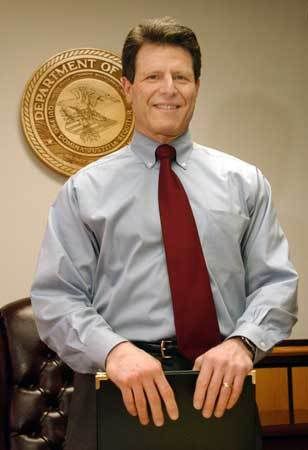 Nelson Cohen was appointed U.S. attorney for Alaska in August 2006.
The Anchorage Daily News reports:
The state’s chief federal prosecutor, Pittsburgh native Nelson Cohen, owes his job to the U.S. attorney in his hometown, who succeeded in getting him the Anchorage post over Alaskans nominated by Sens. Lisa Murkowski and Ted Stevens.
But now, the U.S. attorney scandal threatening to topple Attorney General Alberto Gonzales may cost Cohen his job here. His “interim” appointment will vanish when that classification is amended out of the U.S.A. Patriot Act, which is expected to happen in the next few months.
At the same time, Mary Beth Buchanan, Cohen’s well-connected benefactor and former boss, is in trouble herself, with investigators from the House Judiciary Committee wanting to question her over what role she may have played in deciding which U.S. attorneys got fired, allegedly for partisan reasons.
There are no claims that Cohen got his job here to help or hinder political prosecutions in Alaska, as is alleged in New Mexico, San Diego and other areas where U.S. attorneys were replaced. Pittsburgh Democrats who worked with him and defended clients against him described Cohen, a registered Republican, as a skilled career prosecutor who distanced himself from the Bush administration’s agenda.
Nevertheless, Murkowski and Stevens say they are looking for an “Alaskan” to replace him.
Cohen, who spent about a decade in Alaska before returning home to Pittsburgh in 1987, said he’d like to keep the job but is not actively politicking to do so. He’d like to stay in Alaska, he said, but he still owns his house in Pennsylvania. “I did not come here seeking to be a presidential-appointed U.S. attorney,” he said.
ALASKA SENATORS BLINDSIDED
U.S. attorneys in districts across the country manage teams of prosecutors who enforce federal laws on drugs, immigration, natural resources, weapons and taxes, among others. They are also playing an increasing role in counterterrorism efforts.
The U.S. attorney position in Alaska opened Jan. 23, 2006, when Timothy Burgess left to become a U.S. district judge. His first assistant, Deborah Smith, was named acting U.S. attorney that day. U.S. attorneys are typically nominated by the president and approved by the Senate. Traditionally, Alaska’s two U.S. senators send the names of one or more Alaskans to the White House for consideration. Sen. Murkowski said her clear choice was Smith, a career prosecutor who started out in the federal prosecutor’s office in Anchorage in 1982 and worked in Boston and Washington.
Sen. Stevens wouldn’t reveal his choices.
After submitting Smith’s name, Murkowski said in a telephone interview, her legislative director periodically called the White House during the first part of 2006 to check the status of the nomination.
“We’d get these vague, 'Oh, we’re still working on it, still working on it,’ ” Murkowski said. “So it gets to the point where you’re thinking, 'Wait a minute, this has been a heck of a long time. What is happening?’ And so the response to my inquiry is, 'We still haven’t, there’s some issues,’ and ultimately what we got back was, 'The picks were not acceptable by the White House,’ and yet no explanation as to why they’re not acceptable.”
When she was in Alaska for the August 2006 recess, Murkowski’s Blackberry vibrated with a message. It was her chief aide in Alaska, Mary Hughes, citing a media report that Nelson Cohen had been named interim U.S. attorney.
“You just think, 'It can’t be, wait.’ There was no consulting, no process, no nothing. That’s where I was certainly caught blindsided,” Murkowski said.
Stevens, himself a former federal prosecutor in Alaska, was enraged. “I am just furious at the way the attorney general handled this,” he said at the time.
In an interview at his office in the Federal Building last week, Cohen said he was unaware of all the political forces that resulted in his appointment. But he knew his boss, Buchanan, was well-connected, and it was she who told him about the opening in Alaska.
HE LONGED FOR ALASKA
Through a spokeswoman, Buchanan declined a request for an interview. But the Pittsburgh Post-Gazette recently reported that she pushed the White House agenda, prosecuting such targets as famed cinematic pothead Tommy Chong, of Cheech and Chong fame, for selling bongs over the Internet. She also went after pornographers in California.
The Post-Gazette said Buchanan’s office prosecuted a host of public corruption cases - all against Democrats. One of them, former Allegheny County medical examiner Cyril Wecht, was in Anchorage last week to lecture at the University of Alaska.
Wecht, a physician and lawyer in his 70s who is awaiting trial, said it was ridiculous to think that only Democrats were worthy of public corruption cases in western Pennsylvania.
Cohen was Buchanan’s chief deputy for white-collar crime, but Wecht’s attorney, Mark Rush, said he didn’t appear to have a role in Wecht’s case.
“Nelson Cohen is a professional federal prosecutor,” Rush said. “That’s what Nelson Cohen wants to be, and that’s what I think he will do for the rest of his life. I don’t see political ambition.” Tom Farrell, another former Pittsburgh colleague, said of Cohen: “He’s smart, he’s hardworking, very fair.” Years ago, when President Clinton was in office, the attorneys sharply divided on partisan grounds about whether he should be impeached, Farrell said. Cohen was one of the few at the water cooler “who never got heated.” Farrell, a Democrat, said he hadn’t known that Cohen was a registered Republican. What he seemed to be, though, was a man longing to return to Alaska, Farrell said. His office was decorated with photographs and mementos from his 10 years in Anchorage. Cohen’s wife, Colleen, grew up in Fort Yukon and Fairbanks, the daughter of noted Wien Air bush pilot Keith Harrington. Their three children were born in Alaska.
Gonzales named Cohen to the job in Alaska under a provision inserted into the Patriot Act at the request of the White House when the law was amended by Congress in 2006. It allowed interim U.S. attorney appointments to become permanent without Senate approval.
Eight U.S. attorneys were fired, then replaced under that provision. As the scandal unfolded this year, the House and Senate passed bills restoring the previous selection method, but the bills are slightly different and need to be resolved in a conference committee before they become law. President Bush has said he would sign a final bill. According to a statement from Sen. Stevens’ office, Cohen would then lose his appointment.
“Senator Murkowski and I will continue to look for a candidate that we could nominate and who will serve Alaska with distinction,” Stevens said in a prepared statement.
