Friday, March 23, 2007
| [+/-] |
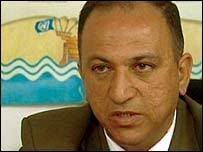
Profile: Dr. Haidr al-Maliki, Iraqi Psychiatrist |
The BBC reports:
Dr Haidr al-Maliki was an army psychiatrist during Saddam Hussein's regime.
He now works as a child psychiatrist at Ab Ibn Rushed Hospital in Baghdad. He lives with his wife and four children.
There used to be about 80 psychiatrists in Iraq, now there are just 20 to 25.
And some of them will leave. Fifteen or so will eventually go to the UAE or to Jordan; it's difficult.
About a year ago, during Ramadan, four boys aged about 15 to 20 came into my private clinic, in front of my patient.
They asked "Are you Dr Haidr?" I said yes. And they shot me several times.
One bullet went into my right shoulder, another into my right arm. I am left with nerve injury and muscle atrophy.
Afterwards they told me I couldn't go to my clinic and that I had to leave the country. They didn't say why.
So, now I don't go out, I just stay at home. My own private jail.
During Saddam's regime we could take our families to the cinema.
Most Iraqi people ... show disturbed behaviour
I want to drink, I want to dance, I want to visit my friends. But I can't do anything. If I even think about going for a drink in my club 500m from my house, I will be killed.
Iraqi people are living in difficult times. Most of us have been exposed to aggression: attacks in the street, car bombings, kidnappings.
Most Iraqi people now deal with each other in an aggressive way; they show disturbed behaviour; they have lost their civility.
We don't know how to treat these problems really.
But I can't leave Iraq. If I and my friends leave, who will help our people?
Limitations of care
I was asked to open the child psychiatry centre in Ab Ibn Rushed hospital, but I have no training in children, really.
I read books and I try to help.
Most of the children are suffering from post-traumatic stress disorder, especially those who have been exposed to kidnapping.
Most of the children I see are bedwetting. They have disturbed behaviour or epilepsy.
We treat them with simple medication; it is very difficult.
Most of the families come here for help and sometimes we can do nothing for them, except offer support and advice.
Thursday, March 22, 2007
| [+/-] |
Profile: Baghdad Baker |
The BBC reports:
Some of our customers come from as far away as Jordan, Syria and Lebanon.
We make sure our sweets have a good flavour. We make our baklava with animal fat and we flavour it with cardamom. We use good quality pistachio nuts.
If we don't think it's good enough, we throw it away immediately. We won't sell sub-standard baklava to our customers.
Iraqis are very fond of sweet things, especially during special occasions such as the month of Ramadan.
One of the changes we have seen since 2003 is the rise in the price of fuel. This has affected the price of our products.
We need liquid gas for the cookers and kerosene for the ovens. And we need diesel fuel for the generators.
The other thing is that we have quite limited working hours.
We used to start at eight in the morning and close at midnight. Now we close at five in the evening.
But we struggle on.
Customer loyalty
We have more customers than we did four years ago.
We used to sell between 20-25 trays of baklava a day - now it's more than 50 a day.
People can't go out in the evening anymore, so they tend to stay at home and eat sweet things.
That's one way they can still enjoy themselves - through what they eat.
Some bakers have started to cheat in the way they make sweets. They have started to mix vegetable oil with the animal fat.
Customers travel long distances to buy Abdul's sweets
But we have stuck to the traditional recipes and ingredients.
Once we finish work we go straight home. I don't allow any member of my family to go out because we would worry about them. I don't go anywhere either.
The presence of coalition troops is not in our interest.
They attack many people. Once they hit my car, but I didn't say anything to them.
And they speak rudely - Iraqis don't approve of that. I would rather they speak softly to people.
It's true they helped rid us of the old regime and of that criminal Saddam. But now they've made things worse.
Wednesday, March 21, 2007
| [+/-] |
How U.S. Attorneys Were Used To Spread Voter-Fraud Fears |
At Salon.com, Mark Follman, Alex Koppelman and Jonathan Vanian write:
Under intense criticism for firing eight United States attorneys, the Bush administration has spent the past few weeks casting about for an explanation for the dismissals that involves performance rather than politics. On March 13, White House spokesman Dan Bartlett tried to come up with one. "Over the course of several years, we have received complaints about U.S. attorneys," he insisted, "particularly when it comes to election fraud cases." On Tuesday, President Bush pressed home this claim with a similar statement during his defense of embattled Attorney General Alberto Gonzales. "We did hear complaints and concerns about U.S. attorneys," said Bush. "Some complained about the lack of vigorous prosecution of election fraud cases."
Bush and Bartlett were arguing that some of the fired attorneys had underperformed by failing to prosecute the raft of offenses that make up voter fraud -- things like vote buying, double voting, and voting by felons, illegal aliens and the deceased. And it is true that at least two of the prosecutors who were let go might not have pursued voter fraud cases to the satisfaction of their bosses at the Department of Justice. But under the Bush administration, pursuing voter fraud is not always about performance. It's often about politics.
A belief in rampant voter fraud in Democratic strongholds -- big cities, minority neighborhoods -- is widespread among Republicans, and claims of vote buying and the like have long been a mainstay of GOP rhetoric. The party has used these claims of voter fraud to help build public support for what it considers electoral reforms, like requiring voters to show photo ID -- reforms that also tend to suppress Democratic turnout on Election Day.
During the Bush administration, a rhetorical tool became public policy. The Republicans could not get a photo ID law through the Senate, but they were able to enlist the 93 United States attorneys in their crusade against voter fraud. In 2002, then-Attorney General John Ashcroft announced an initiative that required "all components of the [Justice] Department" to "place a high priority on the investigation and prosecution of election fraud."
Five years later, Ashcroft's initiative hasn't produced all that much in the way of convictions, at least relative to the overall Department of Justice caseload. Prosecutions for electoral fraud remain a minuscule part of the federal criminal docket. In 2002 alone, there were 80,424 criminal cases concluded nationwide in the 94 U.S. District Courts. By comparison, according to a DOJ document, between the fall of 2002 and the fall of 2005, there were only 95 defendants charged with federal election-fraud-related crimes in the whole country.
After all, election fraud on the federal level can be hard to prove, since proving it often requires that the fraud was committed with the intent of preventing a "fair and impartially conducted election." In New Mexico in 2004, U.S. Attorney David Iglesias, one of the two fired U.S. attorneys who allegedly failed to pursue electoral fraud cases, took a pass on an especially dubious prosecution. A swing state that Gore won by 366 votes in 2000 and Kerry lost by fewer than 7,000, New Mexico is also the site of a long, bitter and ongoing battle between Republicans and Democrats over requiring voters to show photo ID. In 2004, state Republicans pressured Iglesias to file charges in the case of a 13-year-old boy who was illegally registered to vote. The boy had been registered without his or his parents' knowledge, and Iglesias declined to indict anyone. In an interview with Salon, Iglesias conceded that some local Republicans may have been especially disappointed to learn he would not be pursuing criminal charges for election fraud because they would have liked the extra political ammunition.
But sometimes pursuing an investigation can be just as effective as a conviction in providing that ammunition and creating an impression with the public that some sort of electoral reform is necessary. The battle between Democrats and Republicans over photo ID has been most contentious in so-called battleground states like New Mexico. In one such purple state, the GOP used repeated and very public accusations of fraud to ram a photo ID law through the state legislature. In Missouri, Republicans have been accusing Democrats of fraud since the 2000 election. During the Bush administration, three different U.S. attorneys have launched investigations into electoral fraud in Missouri, indicting nine people. Last year, prior to the midterm elections, the administration even dispatched a key voting fraud expert from Washington to assume the job of U.S. attorney in Missouri's Eastern District.
It all began in November of 2000, when then-Sen. John Ashcroft lost a close election to a dead man, Democrat Mel Carnahan. That election was a controversial one in Missouri -- polls remained open past the official closing time in St. Louis, a city dominated by African-American Democrats. This infuriated Republicans, especially Sen. Kit Bond, who delivered a podium-pounding denunciation of alleged voter fraud at the Missouri GOP's victory party on election night. Bond later spearheaded calls for an investigation, pushing Republican lawyers to put together a dossier of allegations that was then delivered to the outgoing, Clinton-appointed U.S. attorney for the Eastern District.
When Bush appointee Raymond W. Gruender took over as U.S. attorney for the St. Louis-based Eastern District, a federal grand jury was hearing testimony about electoral fraud by Gruender's third day on the job. However, before long the grand jury apparently shifted its emphasis from the 2000 race to improprieties in yet another election, the March 2001 Democratic mayoral primary. Investigation of the 2000 election became the province of DOJ lawyers in Washington. Ultimately, neither Gruender nor his superiors in D.C. filed any charges, but after Gruender kicked the investigation of the mayoral primary back to St. Louis city officials, eight individuals were convicted in state court. Gruender was later named to the U.S. Court of Appeals for the 8th Circuit.
Missouri Republicans used the multiple investigations, which together lasted more than a year, as evidence in a push for tougher election laws. By spring of 2002, they were proposing a law requiring that voters show photo ID. The state Legislature finally passed a Republican-sponsored photo ID law four years later, in May 2006. Helping the Republican cause was yet another major investigation of voter fraud by the state's other U.S. attorney, Todd P. Graves of Missouri's Western District, headquartered in Kansas City. In 2004 and 2005 he prosecuted and convicted four people for voting in both Missouri and neighboring Kansas.
Missouri's photo ID law was struck down by the state Supreme Court in October 2006, just before the midterm elections. But by then, the Bush administration had used a loophole in the Patriot Act to appoint Bradley Schlozman, who had supervised the voting section of the Civil Rights Division of the DOJ at headquarters in Washington, as Graves' successor in the Western District. The loophole was closed by a vote of the Senate on Tuesday, but in March of 2006 Alberto Gonzales was able to make Schlozman a U.S. attorney without seeking confirmation from the Senate.
The appointment, the first under the controversial Patriot Act provision, raised eyebrows at DOJ, one former senior Justice Department official told Salon. "Schlozman was one of Gonzales' guys," the former senior official said, "but several of us were scratching our heads when we heard about it because he was not a very well-regarded trial attorney."
Schlozman, who graduated from law school in 1996, was a clerk for three years and an appellate attorney in Washington for two years before joining the Department of Justice. He certainly had less experience (PDF) as a criminal prosecutor than many of his fellow U.S. attorneys. But as the head of the voting section of the DOJ's civil right division, he knew a lot about election fraud. In 2005, he had penned an editorial for the Atlanta Journal-Constitution supporting a bill passed by the Republican-dominated Georgia state Legislature requiring voters to show photo ID. Schlozman argued that the bill would not be an impediment to minority voters.
Less than a week before the 2006 midterm election, in which Missouri was the scene of one of the year's tightest Senate contests, Schlozman announced the indictment of four people for voter fraud. The four had allegedly submitted false voter registrations while working for the group ACORN in the inner city of Kansas City. An organization that conducts registration drives in poor and minority urban neighborhoods, i.e., areas of Democratic strength, ACORN has often been a target of fraud accusations by the right. "This national investigation is very much ongoing," said Schlozman in a statement issued Nov. 1. The indictments were trumpeted by myriad conservative blogs and such national outlets as Fox News, the Wall Street Journal and the Washington Times.
More than four months after he announced them -- and after incumbent Republican Sen. Jim Talent lost a close election to Democrat Claire McCaskill -- Schlozman's four indictments have produced one guilty plea. An indictment against a fifth person was dropped. In the wake of the U.S. attorneys scandal, meanwhile, Schlozman is suddenly on his way out. On Jan. 16, two days before he gave his annual testimony to Congress, during which Democrats questioned him about the mass firing of U.S. attorneys, Attorney General Gonzales announced that John Wood would be taking Schlozman's place in Kansas City. "Schlozman had [only] been there for 10 months," the former senior Justice Department official told Salon. Until the firings became an issue, "They weren't going to replace him."
Political considerations aside, are the types of prosecutions pursued by Schlozman and his peers valid? Is real fraud actually common? As Bud Cummins, one of the eight U.S. attorneys just fired by the Bush administration, tells Salon, cases involving registration drives by groups like ACORN do crop up. But Cummins notes that when there is fraud connected to groups like ACORN, it is often perpetrated upon them, not by them. The groups sometimes pay workers by the number of registrations they turn in, which can lead some of the workers to falsify registrations to earn more money. Others, paid by the hour, falsify registrations so they can appear to have logged extra time.
The "voters" whose names wind up on the phony registrations are usually oblivious. "Those people that are registered in those ways either don't exist or don't know they're registered," said Cummins, who was U.S. attorney for the Eastern District of Arkansas. He also notes that most of these fraudulent registrations will never be used to vote. He provided one example of a case he investigated, in which a registration worker had simply used a phone book to pick out names at random. "You'd see something like Bud Smith, then Kate Smith," he recalled, "and then there was Smith Auto Body."
More generally, there seems to be little statistical basis for the Republican fixation on voter fraud. The few studies that have been done show fraud to be insignificant to the outcome of elections; it has been measured at levels as low as .0004 percent (PDF) of all ballots cast. Loraine Minnite, an assistant professor of political science at Barnard College, conducted a study of elections from 1992 to 2002 for Demos, a London- and New York-based public-policy think tank. Her analysis of the numbers showed that "the incidence of election fraud in the United States is low and that fraud has had a minimal impact on electoral outcomes." A 2006 report from the United States Election Assistance Commission, an independent agency created by Congress to "[conduct] research on election administration issues," calls Minnite's study the "most systematic look at fraud" (PDF).
The problem with the data cited by Minnite and other researchers is that it only counts people who were caught. And for people who believe that voter fraud is widespread, meaning Republicans, the other problem is the source. Numeric research on voter fraud tends to be conducted by and for people who don't believe it's widespread, meaning liberals. Demos, the think tank for which Minnite conducted her study, is progressive. Minnite also just wrote a new paper debunking voter fraud for Project Vote -- a group affiliated with ACORN. Despite a federal agency's endorsement, don't expect Republicans to read and heed Minnite's "systematic study" or to believe anyone else who suggests voter fraud is less than rampant. In fact, the USEAC report that includes an endorsement of Minnite's study was initially withheld. The USEAC delayed releasing it, according to the agency's chairman, a Bush appointee, because of "a division of opinion." The report had failed to give much credence to the issue of voter fraud.
Wednesday, March 14, 2007
| [+/-] |
Goodbye, Houston. Hello, Dubai |
Time magazine reports:
While you weren't looking, the center of the oil world shifted several thousand miles to the east.
The Houston Petroleum Club, now high atop the city's ExxonMobil building, had always been where oil executives and adventurers gathered to discuss "bidness." But these days, more and more energy executives are meeting at the Emirates Golf Club in Dubai, where Tiger Woods recently played, to discuss their deals. So, it shouldn't have been too surprising when Halliburton Chairman and CEO David Lesar announced that he was moving the headquarters of the enormous oil construction and logistics company to the business capital of the United Arab Emirates. The rest of the industry was migrating that way already.
But some folks were badly surprised. The move prompted cries of outrage and calls for investigations from some in Congress. Was the move by Halliburton, the bete noire of left-wing blogs, an attempt to evade congressional inquiry? A move to dodge taxes? Halliburton and many business experts say no. But oil industry analysts say U.S. consumers and political leaders should be asking questions about the move, because the answers will inform America's energy policy — or lack of one. Halliburton is not running from its past, but toward the future.
Just look at other major players in Texas oil. Many Houston companies and law firms have already boosted their Middle Eastern presence, including Halliburton's business rivals, Baker Hughes and Schlumberger. Baker Hughes is building a regional headquarters and manufacturing center in the UAE and Schlumberger has a training center. Just one day after Lesar's announcement, Texas Gov. Rick Perry announced he will attend a three- day celebration marking the opening of permanent buildings at the Texas A&M University at Qatar, set to graduate its first engineering class in 2007 — evidence that the oil and gas industry will be relying on engineers trained in the Middle East as the number of U.S. petroleum engineers continues to fall.
Many of the city's oil and gas companies have a long symbiotic relationship with the Middle East. Indeed, Emirates Airline announced last month that it would set up daily direct flights between Dubai and Houston by the end of this year. The flights will utilize several of the Emirates' 44 recently purchased Boeing 777s and will come equipped with eight private first-class cabins. But that still places top energy executives 17 hours away from what is becoming the new center of the oil industry. Lesar's move shows Halliburton is aware of business customs in much of the Eastern Hemisphere. "It is very important in this part of the world to do business face-to-face," says Amy Myers Jaffe, a Princeton Arabic Studies graduate and current director of Rice University's Energy Program. She adds, "Halliburton is not deleting jobs. They are not closing the office in Houston. They are not moving to the Caymans to escape prosecution. They are adding new elements."
Apart from knowing their clients, says Jaffe, the company has recognized how the petroleum industry is going to look in the coming decades: "Halliburton is looking to the future. [The industry is] moving away from the Seven Sisters, the major oil companies, and towards national oil companies. Between 1970 and 2000, 40% of the increase in oil in the world came from the majors like Shell. [But] in the next 30 years, 90% of the new oil will come from the Middle East and Africa and will not be produced by Exxon and Shell, but by the nationally owned oil companies."
Halliburton's move is a clear sign that American consumers will be relying more and more on oil and gas produced by nationally owned companies, some in emerging democracies like Indonesia where bureaucracies are often unwieldy, others in strife-torn African nations or corrupt former Soviet republics. The move also puts Halliburton's CEO closer to emerging markets in fast-industrializing China and India.
In the past, oil services companies like Halliburton more typically served as subcontractors to the major oil companies, but as the nationally owned oil companies have gained greater market share, the service companies have contracted directly with them. That has boosted service companies' profits and prompted them to shift their operations to the east, closer to the action. Some 38% of Halliburton's $13 billion in oil services revenue came from its Eastern Hemisphere operations last year.
The move, which was greeted as a "powerful statement" by Merrill Lynch industry analyst Alan Lewis, overshadowed a second part of Lesar's announcement: Halliburton stock will be listed on one of the Middle East's stock exchanges. Most analysts believe it will be the Dubai Financial Market. That, says Jaffe, will enable the company to gain access to the vast amount of capital in the region. It also serves a wider purpose: giving regional investors a stake in the stability of global companies. When nationally owned oil companies have been listed on various exchanges, Jaffe says, it has generally led to greater transparency within those companies and motivation to avoid volatility and disruption in geopolitical affairs.
While the Gulf of Mexico remains a vital area for exploration, the shift eastward means the old Energy Capital must diversify. "A lot of us in Houston have been saying that the energy industry in Houston needs to be a lot more innovative," Jaffe said.
\Energy industry and political leaders are beginning to develop wind energy offshore in the Gulf, and look to other alternatives. From now on, the "bidness" discussions at the Petroleum Club are more likely to focus on new energy technologies like carbon sequestration than wildcatting.
Tuesday, March 13, 2007
| [+/-] |
Whose Oil Is It, Anyway? |
Today more than three-quarters of the world’s oil is owned and controlled by governments. It wasn’t always this way. Until about 35 years ago, the world’s oil was largely in the hands of seven corporations based in the United States and Europe. Those seven have since merged into four: ExxonMobil, Chevron, Shell and BP. They are among the world’s largest and most powerful financial empires. But ever since they lost their exclusive control of the oil to the governments, the companies have been trying to get it back.
In the NYTimes, Antonia Juhasz writes:
Iraq’s oil reserves — thought to be the second largest in the world — have always been high on the corporate wish list. In 1998, Kenneth Derr, then chief executive of Chevron, told a San Francisco audience, “Iraq possesses huge reserves of oil and gas — reserves I’d love Chevron to have access to.” A new oil law set to go before the Iraqi Parliament this month would, if passed, go a long way toward helping the oil companies achieve their goal. The Iraq hydrocarbon law would take the majority of Iraq’s oil out of the exclusive hands of the Iraqi government and open it to international oil companies for a generation or more.
In March 2001, the National Energy Policy Development Group (better known as Vice President Dick Cheney’s energy task force), which included executives of America’s largest energy companies, recommended that the United States government support initiatives by Middle Eastern countries “to open up areas of their energy sectors to foreign investment.” One invasion and a great deal of political engineering by the Bush administration later, this is exactly what the proposed Iraq oil law would achieve. It does so to the benefit of the companies, but to the great detriment of Iraq’s economy, democracy and sovereignty.
Since the invasion of Iraq, the Bush administration has been aggressive in shepherding the oil law toward passage. It is one of the president’s benchmarks for the government of Prime Minister Nuri Kamal al-Maliki, a fact that Mr. Bush, Secretary of State Condoleezza Rice, Gen. William Casey, Ambassador Zalmay Khalilzad and other administration officials are publicly emphasizing with increasing urgency. The administration has highlighted the law’s revenue sharing plan, under which the central government would distribute oil revenues throughout the nation on a per capita basis. But the benefits of this excellent proposal are radically undercut by the law’s many other provisions — these allow much (if not most) of Iraq’s oil revenues to flow out of the country and into the pockets of international oil companies.
The law would transform Iraq’s oil industry from a nationalized model closed to American oil companies except for limited (although highly lucrative) marketing contracts, into a commercial industry, all-but-privatized, that is fully open to all international oil companies. The Iraq National Oil Company would have exclusive control of just 17 of Iraq’s 80 known oil fields, leaving two-thirds of known — and all of its as yet undiscovered — fields open to foreign control. The foreign companies would not have to invest their earnings in the Iraqi economy, partner with Iraqi companies, hire Iraqi workers or share new technologies. They could even ride out Iraq’s current “instability” by signing contracts now, while the Iraqi government is at its weakest, and then wait at least two years before even setting foot in the country. The vast majority of Iraq’s oil would then be left underground for at least two years rather than being used for the country’s economic development.
The international oil companies could also be offered some of the most corporate-friendly contracts in the world, including what are called production sharing agreements. These agreements are the oil industry’s preferred model, but are roundly rejected by all the top oil producing countries in the Middle East because they grant long-term contracts (20 to 35 years in the case of Iraq’s draft law) and greater control, ownership and profits to the companies than other models. In fact, they are used for only approximately 12 percent of the world’s oil. Iraq’s neighbors Iran, Kuwait and Saudi Arabia maintain nationalized oil systems and have outlawed foreign control over oil development. They all hire international oil companies as contractors to provide specific services as needed, for a limited duration, and without giving the foreign company any direct interest in the oil produced.
Iraqis may very well choose to use the expertise and experience of international oil companies. They are most likely to do so in a manner that best serves their own needs if they are freed from the tremendous external pressure being exercised by the Bush administration, the oil corporations — and the presence of 140,000 members of the American military. Iraq’s five trade union federations, representing hundreds of thousands of workers, released a statement opposing the law and rejecting “the handing of control over oil to foreign companies, which would undermine the sovereignty of the state and the dignity of the Iraqi people.” They ask for more time, less pressure and a chance at the democracy they have been promised.
Friday, March 9, 2007
| [+/-] |
Justice Department: FBI Acted Illegally On Data |
Audit finds agency misused Patriot Act to obtain information on citizens
MSNBC reports:
The FBI improperly and, in some cases, illegally used the USA Patriot Act to secretly obtain personal information about people in the United States, a Justice Department audit concluded Friday.
And for three years the FBI has underreported to Congress how often it forced businesses to turn over the customer data, the audit found.
FBI agents sometimes demanded the data without proper authorization, according to the 126-page audit by Justice Department Inspector General Glenn Fine. At other times, the audit found, the FBI improperly obtained telephone records in non-emergency circumstances.
FBI Director Robert Mueller said he was to blame for not putting more safeguards into place.
“I am to be held accountable,” Mueller said. He told reporters he would correct the problems and did not plan to resign.
“The inspector general went and did the audit that I should have put in place many years ago,” Mueller said.
The audit blames agent error and shoddy record-keeping for the bulk of the problems and did not find any indication of criminal misconduct.
Still, "we believe the improper or illegal uses we found involve serious misuses of national security letter authorities," the audit concludes.
Attorney General Alberto Gonzales, who oversees the FBI, said the problems outlined in the report involved no intentional wrongdoing. In remarks prepared for delivery to privacy officials late Friday, Gonzales said that “there is no excuse for the mistakes that have been made, and we are going to make things right as quickly as possible.”
At issue are the security letters, a power outlined in the Patriot Act that the Bush administration pushed through Congress after the Sept. 11, 2001, terror attacks. The letters, or administrative subpoenas, are used in suspected terrorism and espionage cases. They allow the FBI to require telephone companies, Internet service providers, banks, credit bureaus and other businesses to produce highly personal records about their customers or subscribers — without a judge's approval.
About three-fourths of the national security letters were issued for counterterror cases, and the other fourth for spy investigations.
Chief acknowledges deficiencies
In an earlier statement, Mueller called Fine's audit "a fair and objective review of the FBI's use of a proven and useful investigative tool."
The finding "of deficiencies in our processes is unacceptable," Mueller said.
"We strive to exercise our authorities consistent with the privacy protections and civil liberties that we are sworn to uphold," Mueller said. "Anything less will not be tolerated. While we've already taken some steps to address these shortcomings, I am ordering additional corrective measures to be taken immediately."
Fine's annual review is required by Congress, over the objections of the Bush administration.
The audit released Friday found that the number of national security letters issued by the FBI skyrocketed in the years after the Patriot Act became law.
In 2000, for example, the FBI issued an estimated 8,500 letters. By 2003, however, that number jumped to 39,000. It rose again the next year, to about 56,000 letters in 2004, and dropped to approximately 47,000 in 2005.
Over the entire three-year period, the FBI reported issuing 143,074 national security letters requesting customer data from businesses, the audit found. But that did not include an additional 8,850 requests that were never recorded in the FBI’s database, the audit found.
Also, Fine’s audit noted, a 2006 report to Congress showing that the FBI delivered only 9,254 national security letters during the previous year — on 3,501 U.S. citizens and legal residents — was only required to report certain types of requests for information. That report did not outline the full scope of the national security letter requests in 2005, nor was it required to, Fine’s office said.
Additionally, the audit found, the FBI identified 26 possible violations in its use of the national security letters, including failing to get proper authorization, making improper requests under the law and unauthorized collection of telephone or Internet e-mail records.
Of the violations, 22 were caused by FBI errors, while the other four were the result of mistakes made by the firms that received the letters.
Unauthorized signatures
The FBI also used so-called "exigent letters," signed by officials at FBI headquarters who were not authorized to sign national security letters, to obtain information. In at least 700 cases, these exigent letters were sent to three telephone companies to get toll billing records and subscriber information.
"In many cases, there was no pending investigation associated with the request at the time the exigent letters were sent," the audit concluded.
In a letter to Fine, Gonzales asked the inspector general to issue a follow-up audit in July on whether the FBI had followed recommendations to fix the problems.
“To say that I am concerned about what has been revealed in this report would be an enormous understatement,” Gonzales said in remarks prepared for delivery to the privacy officials. “Failure to adequately protect information privacy is a failure to do our jobs.”
Senators outraged over the conclusions signaled they would provide tougher oversight of the FBI — and perhaps limit its power.
"I am very concerned that the FBI has so badly misused national security letters," said Sen. Arlen Specter, R-Pa., top Republican on the Senate Judiciary Committee, which oversees the FBI.
Sen. Russ Feingold, D-Wis., another member of the judiciary panel, said the report "proves that 'trust us' doesn't cut it."
The American Civil Liberties Union said the audit proves Congress must amend the Patriot Act to require judicial approval anytime the FBI wants access to sensitive personal information. “The attorney general and the FBI are part of the problem, and they cannot be trusted to be part of the solution,” said Anthony D. Romero, the ACLU’s executive director.
Justice spokeswoman Tasia Scolinos said Gonzales "commends the work of the inspector general in uncovering serious problems in the FBI's use of NSLs."