Have the dramatic changes in the U.S. meat industry compromised the safety of America's beef? ...[Cows] can take this grass which we can't digest, very few creatures can digest, and turn it into [fuel]. What is so amazing about that? Pollan, a former editor at Harper's Magazine, is the author of The Botany of Desire and several other books that examine the intersections between science and culture. Here, he talks about his experience as a small-scale rancher and his decision to buy a cow and track its journey through the cattle system for The New York Times Magazine. He also discusses the widespread use of antibiotics in the meat industry, and why he thinks the system is fragile and susceptible to microbes and pathogens. What do you mean? You could not crowd animals into these feedlots or feed them this highly concentrated ration without giving them antibiotics. But the antibiotics, in turn, lead to resistance; resistant microbes that then come and infect us. So most people think of a cow as something that's out grazing, and then is taken to the slaughterhouse.
Frontline interviews Michael Pollan:
Well, a cow out on grass is just an incredible thing to behold. ... Cows and other ruminants can do things we just can't do. They have the most highly evolved digestive organ on the planet, called the rumen. And the rumen can digest grass. It takes grass, cellulose in grass, and turns it into protein, very nutritious protein.
We can't do that. We can't digest grass. So to take land that is not good enough for agriculture -- that's growing grass and nothing else, that's been doing that for 10,000 years since the buffalo -- and put a cow on it ... there's something beautiful about that, and it's just the way it was meant to be.
And I went into this story [for the New York Times] thinking, "Well, that's how we get meat." But alas, it's not true.
By the time a modern American beef cow is six months old, it has seen its last blade of grass for the rest of its life. As soon as they wean, they spend the first six months out on the pasture with their moms, nursing, nibbling grass. The mom is converting the grass's protein that's turning into milk for the animal, doing the way they've done it for millions of years. We take them off grass. We put them in pens, called backgrounding pens, and we teach them how to eat something that they are not evolved to eat, which is grain, and mostly corn.
Why do we do this? Well, it's a very good question, because it makes absolutely no sense from an ecological standpoint. From a financial standpoint, it does. It makes them grow much more quickly. It makes them get fat, and we like our meat really fat and marbled. And it allows us to speed up the lifespan. In capitalism, time is money.
We're taking cows that we used to let grow to be four or five years old before we eat them [and] we've got it down to 14 months, and we're heading toward 11 months. What allows us to do this is getting them [on] corn, getting them off this whole evolutionary relationship they've had with grass....
...No, not true. Cows see very little grass nowadays in their lives. They get them on corn as fast as they can, which speeds up their lifespan, gets them really fat, and allows you to slaughter them within 14 months.
The problem with this system, or one of the problems with this system, is that cows are not evolved to digest corn. It creates all sorts of problems for them. The rumen is designed for grass. And corn is just too rich, too starchy. So as soon as you introduce corn, the animal is liable to get sick.
It creates a whole [host] of changes to the animal. So you have to essentially teach them how to eat corn. You teach their bodies to adjust. And this is done in something called the backgrounding pen at the ranch, which is kind of the prep school for the feedlot. Here's where you teach them how to eat corn.
You start giving them antibiotics, because as soon as you give them corn, you've disturbed their digestion, and they're apt to get sick, so you then have to give them drugs. That's how you get in this whole cycle of drugs and meat. By feeding them what they're not equipped to eat well, we then go down this path of technological fixes, and the first is the antibiotics. Once they start eating the [corn], they're more vulnerable. They're stressed, so they're more vulnerable to all the different diseases cows get. But specifically they get bloat, which is just a horrible thing to happen. They stop ruminating.
You have the image of a cow on grass of the cow ruminating, which is chewing its cud and burping a lot. In fact, a lot of greenhouse gases come out of the stock as methane emerges from their mouth as they eructate -- it's a technical term. And they bring down saliva in this process, and it keeps their stomach very base rather than acid.
So you put in the corn, and this layer of slime forms over the rumen. You've got to picture the rumen. It's a 45-gallon fermentation tank. It's essentially fermenting the grass. Suddenly your slime forms and the gas can't escape, and the rumen just expands like a balloon. It's pressing against the lungs and the heart, and if nothing is done, the animal suffocates.
So what is done is, if you catch it in time, you stick a hose down the esophagus and you release the gas and maybe give the animal some hay or grass, and it's a lot healthier. But it's one of the things that happens to cows on corn. ...
Not all cows get bloat. They're prone to bloat. It's a serious problem on feedlots. They also get acidosis, which is an acidifying of the rumen. ... And when the animals get acid stomach, it's a really bad case of heartburn, and they go off their feed. Eventually, if you give them too much corn too quickly, it ulcerates the rumen; bacteria escape from the rumen into the blood stream, and end up in the liver, creating liver abscesses.
What do we do about that? Another antibiotic. ... Most cows on feedlots eating this rich diet of corn are prone to having their livers damaged. So to prevent that, or limit the incidence of liver disease, we have to give them another antibiotic.
We spoke with a guy, Bill Haw, who runs a lot of these big feedlots. I asked him about the livers. And he said, "We've learned that the livers are not very economically viable, and there's a willingness to sacrifice the liver for the overall growth, which far transcends the value of the liver that may be damaged in the process." What's he saying?
He's saying that the economic calculus justifies ruining their liver. ... The fact is, we don't eat a lot of beef liver any more. So the fact that you have to throw out a significant percentage of the liver -- I've heard between 15 percent to 30 percent of the livers are too abscessed for people to eat -- it's worth it. ...
But that's a symptom. ... It means you have a sick cow. When your liver fails, other things fail. It's simply a symptom of a sick animal. So we try to treat [it] as best we can, but we tolerate it.
I've talked to many people who've said that if you kept animals on this diet indefinitely, they couldn't survive. They're eating a diet on feedlots at 80 percent to 90 percent corn that would sooner or later, as one vet told me, blow out their liver. They could not continue that. And in fact, dairy cows, which we want to live up to 8-10 years, we don't feed them like this, because we know that it hurts their health. So yes, economically, we tolerate sick cows. ...
But the issue is, you have an economic logic, and you have an evolutionary and natural logic. And when you get to the cow, you see them come into conflict. It may well make sense economically to feed cows what we feed them, but ecologically, it's a disaster. It's a disaster for them because they're getting sick. If you look at a cow on a feedlot, it is not a happy camper. ...
Instead, we take the Midwest and we pave it essentially [with] corn and soybeans, and the environmental consequences of growing all that corn -- and most of the corn grown in this country goes to feed livestock -- is environmental degradation of the Midwest and the Gulf. There's a dead zone in the Gulf of Mexico a thousand miles wide that is the result of nitrogen runoff coming down the Mississippi and killing all the life in this zone in the Gulf. And that's coming directly from corn.
So you see the cow is connected to that dead zone in the Gulf, and the cow is connected to our health, too. All these things are connected. There is an ecological logic that is very different than the economic logic. And in that ecological logic, you can't separate the health of the cow, the health of the environment, and the health of the eater.
[Why] do we feed them corn in the first place? When did that start happening, and what was the reason for it?
We feed them corn because it's the cheapest, most convenient thing we can give them. Corn is incredibly cheap; it costs about $2.25 for a bushel of corn, which is like 50 pounds. It actually costs less to buy than it costs to grow, because of subsidy. We pay the farmer to grow the corn -- see, this is a hidden cost to this supposedly cheap feed. I think it costs about $3 to grow a bushel of corn, and the feedlots only have to pay $2.25.
It's also very compact, so corn allows you to urbanize your livestock population in America. Since the corn takes up so little space relative to its food value, you can bring all the animals into a small space, and have 50,000 or 100,000. You could never bring in that much hay -- the sheer volume of the hay would just overwhelm the shipping cost and everything. So it's very compact.
How long have we been doing it? To some extent, for a long time. In the 19th century, we would grow animals on grass up to a few months before slaughter, and then we'd give them some corn mixed in. We like meat to get fatter, and corn definitely does make the meat fatter, and it makes it more tender and tasty, in a lot of people's judgment. I'm not so sure it's true, but we've learned to think that that's how beef should taste.
But it's only post-World War II that we began putting them on feedlots in this concentrated way and giving them a diet that's quite as hot, as ranchers call it, a hot ration. And the reason for that is that's when you had the explosion of corn surpluses. That's when you've got corn that people are giving away.
The yield of an acre of American farmland went from 20 bushels ... of corn in 1900 to 138 in the 1990s. So because of the improvements in technology in American agriculture -- but specifically because of chemical agriculture, because of chemical fertilizer -- we were able to get so much corn off the land that they didn't know how to get rid of it. So the USDA made it its policy to encourage people to feed corn, not just to cows, but to chicken and even fish and now in pigs. We had to get rid of corn.
Sounds like a good idea. We had this surplus.
Yes, and economically, it is a good idea. But economics is not the measure of all things. And so we're passing half of the corn crop in America through the guts of animals, some of which are well adapted to using it. I don't know that much about chickens and pigs, but they don't seem to have the same digestive problems that cows do. Cows are ruminants; they're designed for another kind of food.
Nevertheless, [corn] has so much food energy that it does put fat on them quickly. And so it makes sense to do.
...Explain to somebody in New York City what the abbreviated life of a cow is these days.
A cow is born in the late winter on a ranch; could be the product of artificial insemination or traditional sexual reproduction. It spends the first six months of its life with its mother on pasture and grass. The American food chain, when it comes to beef, starts out like the wide end of the funnel. It's as big as the Great Plains. There are hundreds of thousands of ranchers with millions of acres. And so it starts right out in the open, grazing, ruminating, doing what cows and ruminants have always done.
At weaning, which is normally in the fall of the first year after about six months, seven months, eight months, cows are taken off the grass, moved into the backgrounding pen. They're sorted and separated from their mother. Actually [it's one of] the more traumatic [events] in a cow's life, because the mothers just bellow and look around for their calves for several days.
You separate them. You get the cows as far away as you can, so they can't hear one another. And you start them on this ration of corn. You start out, though, pretty modest, with some silage, which is whole cornstalks and everything, and some corn or other grain, and still some hay. And you start with the drugs because to get them to tolerate that diet, they must have a drug called [Rumensin], which is a kind of antibiotic, a very powerful drug. It's toxic, and therefore it's not used in human medicine. In fact, you can't even give it to dairy cows -- it's very toxic.
They spend a few months in the backgrounding pen and then they are up to, say, 600-700 pounds. I should say they start at about 80 pounds; they grow very quickly. And once they go to the backgrounding pen, they grow even more quickly. You can actually say how fast you want your animal to grow. You can say, "I want to put two pounds a day on them." You feed that into a computer. You feed in the weather, the humidity, and it will tell you exactly what to feed it to put on two pounds a day.
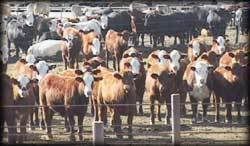
They're getting up to 600-700 pounds, and then the cow gets on a truck and goes to the feedlots. When it gets to the feedlot, its life changes in a substantial way. It will never see any grass ever again. ... A feedlot is a city of cows. I saw several of them in western Kansas, and it was a stunning experience. You're driving down these ramrod straight roads through Kansas, and it's just empty, empty prairie. And suddenly there was this giant subdivision, only it's a city for animals. It's cattle pens, black earth, as far as you can see. Of course it's not really earth, you learn as you get a little closer; it's manure, reaching to the horizon.
[There are] 35,000, 50,000, 100,000 animals in the space of a couple of hundred acres. And in the middle of the city is rising the single landmark, which is the feedmill. It's several stories high. It's silvery. It's sort of this cathedral in the midst of this, and everything rotates around it. ...
But they really are medieval cities in many respects, I realized, because they are cities in the days before modern sanitation. They're from the time when cities really were stinky. When they were teeming and filthy and pestilential and liable to be ridden with plague, because you had people coming from many, many different places, bringing many, many different microbes into a concentrated area where they could spread them around.
The only reason this doesn't happen in the city of animals, the modern city of animals, is of course the modern antibiotics. That is the only thing that keeps the modern feedlots from being different than the 14th-century city where everybody was dying of plague. We can, to some extent, control the disease with drugs. Absent the drugs, these places would be as plague-ridden and pestilential as a 14th-century city....
Every hour I was on this feedlot, another tanker truck came in filled with liquefied fat. Another one with liquefied protein. Every hour there was another truck with 50,000 pounds of corn. You see all the feedstuff coming into the city, and you see the waste going out. The wastes, by and large, are manure, trucks coming in from farms carrying it away. But a lot of this was pooled in these lagoons, which were just full of this.
I haven't even mentioned the smell. I mean, it is overwhelming, the smell of these places. ... You get used to it, after a couple of hours, but initially, it is [overwhelming]. And it's not the smell of a cow on a farm. This is the smell of the bus station men's room. It's fierce. And you wear it in your clothing for days afterward.
It sounds rather disgusting the way you describe it. What's the purpose, what's the advantage of the system?
It's a wonderfully efficient system; it's a factory for producing protein. What it does is, it takes in corn and fat and vitamins and drugs, passes through that mill, which in a way is the hub of this factory, and then passes it through the bovine digestive system. And these animals put on three-and-a-half to four pounds a day, half of which is edible meat.
So it is an excellent factory for producing meat. And the factory farm metaphor makes perfect sense. You've got cheap inputs, more expensive outputs, although, the margins are very tight. It costs about $1.60 a day right now to keep an animal on a feedlot, which seems pretty cheap for 32 pounds of food, all you can eat. But nevertheless, the price of meat isn't very high, either. So they operate on very tight margins.
We spoke with Bill Haw, and he said that if you could interview a cow, a cow would probably choose to be in the feedlot, because it gets all the food it wants, and it's treated if it has medical conditions.
It's treated if it has medical conditions it would not have anywhere else, that's true. You know, that's an interesting thought experiment. I would love to see one of these guys open the gate and have some green grass out beyond the feed yard, and see how many cows stick around.
My guess is, I don't know. I don't know cow psychology very well. I asked the ranchers the same question about the backgrounding pen, and their sense was that they would leave. There's a reason that you lock the gate. And they might come back to eat some food, because they're lazy. But if you compare an image of a cow on grass, and a cow on a feedlot, you don't have to be the Freud of the bovine world to say, "Well, this one is happier than that one." I think we can say that.
It's very hard to speculate about what animal happiness is. But one definition is, an animal doing what it's evolved to do. And what cows have evolved to do is be out on grass, eating grass. And they sure look happy when they're doing it.
Tell me from a personal experience the difference between what a cow looks like that you've seen grazing and a cow in a feedlot....
...The cows I saw on the feedlot looked sullen. I'm very concerned not to anthropomorphize them, but that was how they appeared to me. They're standing around in their manure all day long. Animals have evolved basically to avoid their feces. Natural selection discourages this, because there are parasites in diseases. So in general, animals will stay away from that.
They're forced to exist with their feces all the time. When they go to sleep, that's what they lie down in. The beds in these feedlots, you look and you say, "Oh, there's dirt. They're in dirt." And of course no grass could grow there. But you look a little closer and it is manure, as far as you can see. They only scrape them out between classes, which is every six months.
So I can't say that that bothers a cow. I'm speculating. My guess is that, at some level, it does. But cows are very forgetful. Cows live in the present. So whether they're nostalgic for their days on grass, I would doubt that, too. ... But they love grass. When they're sick, as soon as they get on the feedlot, they give them nice long-stem hay. And they love it. And I saw them go to that.
I was on another ranch where the rancher was giving a little bit of corn to his animals in the hopper. Then we came onto the field and we had hay in the back of the truck, and we wanted to give them some hay. And he put that down in another hopper. They all left the grain and came over to the hay. They like not just the taste of hay but what it does to their stomachs. It stimulates the rumen, allows them to ruminate, to regurgitate. They love to chew their cud, and they can't chew their cud when they're on corn.
Speculating about animal happiness is dangerous turf. But common sense tells you that animals doing what they evolved to do are the happier animals.
...First of all, why did you buy a cow?
...I decided to become a small-scale rancher basically to learn about the business. I wanted to see it from the inside. So I purchased a steer, a calf, from these ranchers in South Dakota ... and followed it through the whole process. It's now on a feedlot in southwestern Kansas. And I'm using this animal, No. 534, as the hero of my story.
I'm chronicling everything he eats, and the drugs that he gets, and how much money he brings at the end. One of the things I wanted to understand -- better than I could from outside the calculation a rancher makes when he's deciding, for instance, whether to give a hormone implant to his animal, which strikes me as a bad idea -- [is] just in a general way, [if we should] be eating meat that has residues of hormones, even though no one has proved that it's bad for you. ... Why do it?
Well, if you own a cow, you understand why. It costs $1.50, and it puts 40-50 pounds on the final weight of your animal, which is worth $25-$35. So the economic calculus is just irresistible, and it's legal. That's why you do it. And if I don't do it, I will surely lose money on this animal.
So I wanted to understand things from the cow's perspective to some extent, and from the rancher's perspective. And I figured the best way to do that was to buy a cow. And at the end of the process, I'll see whether I want to eat my cow. But that's an option.
So when will your cow meet its end?
My cow has a date with the knocker, or the stunner, in June. One day in June, he will be judged sufficiently fat, because they really do get obese. And they move around at the end with that kind of the lugubrious awkwardness of the truly obese. And the owner of the feedlot, the manager, will say, "This pen is ready."
Then they will get on another truck and travel 100 miles to Liberal, Kansas, to a National Beef plant there. They will be put in a pen in a parking lot and wait their turn, and go up the ramp, and through a blue door. I was not allowed to go through the blue door. The kill floor is not something that journalists are allowed to see, even if you own the animal, I learned.
But I have reconstructed what happens on the other side of the blue door. What happens is that the animals go in single file. At a certain point, they pass over a bar, their legs on both sides, and the floor slowly drops away, and at that point they're being carried along sort of on that bar, which is a conveyor belt, and they then pass through a station where there's a man on the catwalk above. He's holding an object that looks like a power nailing gun or something. It's a pneumatic device called a stunner.
This essentially injects a metal bolt. It's about the size and length of a thick pencil into its brain, right between the eyes, and that should render the animal brain dead.
At that point, chains will be attached to his rear legs. He will be lifted up by the chains. The chains are attached to an overhead trolley, and then he will be bled. Another person in another station will stick a long knife in and cut his aorta and bleed the animal. And then he will be completely dead.
And from there he goes through a series of stations to clean him and to remove his hide. One of the real problems is that the animals have spent their [lives] lying in their manure, are smeared and caked with the stuff, and they're entering the food plant. And so many steps are taken to make sure that the manure doesn't infect the meat, which can happen very easily.
And this is really just the source of food-safety problems in the industry, in the beef industry, is microbes in the manure getting into the meat. So how do you stop that?
...Be explicit about what it means that they have manure caked on them, and why that becomes a problem.
Well, when the animals arrive at the meatpacking plant from their homes on the feedlot, they're carrying quite a bit of manure. They've been sleeping in it and resting in it, so their bodies are caked with it. They are then, of course, passing through that door on their way to becoming food. So you need to make sure that you remove their hides in such a way that you get all of the manure, and none of it ends up on the meat. And a great deal of the effort, which is now 99.9 percent of the time successful, is essentially keeping the manure out of the meat. But it doesn't; it's not a perfect system. And it's bound to happen, and does happen.
The problem is that that manure is particularly lethal, because it contains now certain microbes like E. coli O157, is a strain of a common intestinal bacteria which is now very common in the manure of feedlot animals. It's principally a feedlot microbe. And if we ingest only 10 of those bacteria, they can kill us, because they release this lethal toxin. The great problems that you've read about, of contaminated hamburgers and the Jack in the Box episode from several years ago, are a result of this particular pathogen.
The story of this pathogen really illustrates the ecological links between the health of these animals and the health of us. I was surprised to learn that E. coli O157 is relatively new -- it wasn't isolated until the early 1980s -- and that it essentially doesn't exist in the gut of animals that eat grass. It is a problem associated with feeding animals corn.
And here's how it works. The rumen, which is not an acidic environment normally, becomes acidic when it's fed corn. These [E. coli] bacteria evolved to be able to withstand the acid of the rumen. So they are acid-tolerant bacteria. Therefore, when they get into our guts -- through the manure, onto the carcass of the animal, into the hamburger -- they can survive our digestive processes; whereas in the past, if you had an equally lethal microbe resident in the gut of a cow, it probably was not acid-tolerant, since it didn't live in such an environment, so our stomachs gave it a gastric shock.... All the acids in our stomach would just kill it off. This is one of the protections built into the food chain that we've messed with by acidifying the guts of these animals....
The industry's response -- and the industry is working very hard to keep the meat clean, there's no question about it -- is a series of high-tech solutions, such as sprays. There's a spray based on milk, made from milk, that seems to kill it. They have these steam cabinets that they pass the meat through -- bags of hot water. This kills a lot of the bacteria, or most of the bacteria.
And now irradiating it. This is why we want to irradiate meat. Make no mistake, the need to irradiate meat is because there is a certain amount of manure in the meat. So the idea is to kill the microbes in the manure rather than keep the manure out, which they're trying to do also. But better to kill it after; it's easier and cheaper.
There is, it turns out, a much simpler solution. There is research that's been done that shows simply by putting cows on grass or hay for the last several days of their life, the E. coli population in their gut plummets by as much as 80 percent because, again, they can't tolerate the change in the pH in the stomach. A scientist, a very well-respected researcher at Cornell named James Russell, has proposed this in a series of articles.
But as far as I can tell, the industry doesn't want to hear about it. It would just be too cumbersome to bring all that hay into a feedlot. They would lose gain; they would lose pounds at the end, switching them to hay, because they don't grow as fast. ... It's King Corn. King Corn runs the American cattle business. And this is considered an anti-corn message. So this research, as far as I can see, has fallen largely on deaf ears.
And it's classic, in a way. Rather than going back and fixing the system, you figure out a way to make more money solving the problem with a new technology.
What's wrong with that? If we have a system that, because of the technology, results in cheap meat and this enormous efficiency, and if we can keep that system going by introducing more technology, why not?
Well, cheap meat is a bit of a myth. Cheap feed in general is a bit of a myth. The real costs of cheap food, when you look at it, are just being borne by someone other than the consumer. There is no free lunch in nature. And what happens is our cheap meat is a product of these drugs, for instance, antibiotics. We are using so many antibiotics in livestock -- over half of the antibiotics in this country go to livestock -- that these drugs no longer work for us. The reason I have trouble finding a good antibiotic when my son has an ear infection is directly related to the cost of that cheap hamburger. There is an expense, a public health cost.
Food poisoning too.... There's another public health cost. There's the environmental cost of all of this corn, which is polluting the Gulf of Mexico. That's a cost not reflected in that cheap hamburger. And then finally there's the cost to the animals, too, and their own health. I mean, nobody counts that. So when I hear the expression, "cheap food," "cheap meat," yes, it's true in a very narrow sense. But it depends on the way you do your math. And the way we do the math, it is cheap food.
Specifically in terms of food safety, irradiating the meat is better than not doing anything. And I'm not saying we shouldn't do these technologies. But isn't it interesting that we don't go back and just look at the whole system? It's like feedlots. If you talk to environmentalists, they're very concerned about feedlots. They become a serious environmental issue, and they treat them as this point-source pollution ... because of all of the water that comes out of them. The water and the waste is also full of pharmaceuticals. There are hormones in the water. They are finding fish with strange sexual characteristics downstream from feedlots. The antibiotics get into the environment also.
But they've kind of accepted it as, "Well, this is the cost of food. We'll just deal with the effluents." Rather than [saying], "Let's step back a little further and look at the whole system and see if we can't change the system. Maybe there's a more sustainable way to do this."
...There is another cost, too, that never gets counted. When you eat meat, you're eating oil .... This goes back to the cost of corn. The reason we can grow corn so cheaply is because we give the corn chemical fertilizer that is a fossil fuel product.... So you've taken the rumen, which is this sustainable solar organ, and we've turned it into just another fossil fuel burner. Which is the last thing we need.
And working with an economist at Cornell ... I wanted to figure out how much oil it took to grow my cow to slaughter with. It turns out it's about 100 gallons of oil to grow a single animal. So there's a cost that you're not seeing. It's the cost of the oil; it's the cost of having a military to defend the Gulf. It's all there.
The great lesson of ecology is that everything is connected. And it's true. So next time you're reaching for that cheap food, you might ask, is it really so cheap?
So cheapness is one of the arguments. But also we don't have the kind of population where everyone has a few cows and can slaughter their own.... You can do this on less space. That's another argument....
There's no question that the beef industry has done something quite incredible, which is, they've taken a feed that once belonged to the upper classes -- it was a very special occasion to eat meat; not everybody got to eat beef, and those who did, just on Sundays -- ... and made it a staple for everybody.
Is that a good thing? Well, yes and no. Beef is not very good for us. Maybe we shouldn't be eating so much beef. ... Animals raised on corn produce fattier meat, but it's not just that it's fattier, it's the kinds of fats. Corn-fed beef produces lots of saturated fats. So that the heart disease we associate with eating meat is really a problem with corn-fed meat. If you eat grass-fed beef, it has much more of the nutritional profile of the wild meat. Hunter-gatherers subsisted on lots of meat, and they never had heart disease.
So the so-called diseases of civilization that we're prone to such as heart disease are really the result of what we're feeding the animals. We always say, "You are what you eat." But that's only half the story. We're also what what we eat eats, too. And cows that eat corn are different meat. So when we're eating that corn-fed, oil-fed meat, we're incurring another kind of cost as well.
But yes, we've made the meat cheaper. We've democratized meat. But in the process, we've made it a less healthy product with much more serious consequences for the environment....
So is there a clear link between the system of agriculture and beef production and the problems we have with E. coli O157 and other virulent pathogens?
Yes and no. I would say that, yes, this system of industrial meat production, there's always been food-safety problems. There has always been sloppy slaughter practices. Probably slaughterhouses are cleaner now than they've been ever. OK? Major improvements have happened as a result of these problems like the Jack in the Box incident and others.
However, the animals are coming into the slaughterhouses with these new microbes that they're picking up in the feedlots, or they're developing because of what we feed them. So there are some novel threats as a result of this.
The fact is, the incidence of food poisoning generally has gone up. Most people don't realize this, but it's a much more serious problem than it was 100 years ago. Does that have to do with industrial agriculture? In part, it does. It has to do with a lot of things. It has to do with the fact that we take food from all over the world, and we can't really inspect it very well.
But a lot of it has to do with the way we grow our food, and the fact that we mix 100 different cows in a single burger. We never used to do that. The butcher used to take the scraps from that one animal and make his hamburger right in front of your eyes. ... Now, you get one infected carcass, and that meat can spread all around the country, because we have this centralized national system.
So there is a sense in which you rationalize things when you make them bigger and more centralized. But that's an environment in which microbes can thrive and spread. The best thing that ever happened to microbes is this centralization of agriculture. ... There were very few diseases until we had cities. When people were hunter-gatherers, they didn't spend enough time close together to communicate diseases. But when you bring everything together and you make it really build and you mix up microbes from all these different places in the feedlot and then in the hamburger, then it spans out to millions of people. Yes, that's a petri dish for food poisoning.
So the efficient system is also efficient for the microbes?
Yes, the efficient system is very efficient for the microbes. It is a fragile system. The bigger any system is, the more centralized it is. You know we've learned this about all monocultures. Take a system, centralize it to that extent, and a small problem can destroy it. It's like a computer virus can take out everybody's mail system, because we all have the same program in our computers. We have Microsoft, so it's a very vulnerable system....
Let's switch over to antibiotics.... Why are we using so much antibiotics? ... And are we using a lot of them?
Well, nobody knows exactly how many antibiotics we're using in agriculture, because the industry is very tight-lipped about it. But the Union of Concerned Scientists did a study last year, and they found it was well over half the antibiotics used do go to animals, for many reasons. Some of them are to treat animals, which no one really has a problem with. Some of them, though, are for what's called growth promotion. In many animals -- and this is particularly true in chickens and pigs for reasons we don't even understand -- if you give low levels of antibiotics to an animal, it will grow more quickly. It may be that it kills off low-level disease that was harming its productivity or something like that. No one really understands why.
But in many cases -- and this is definitely true in beef -- we give them antibiotics to keep them from getting sick from other things we're doing to them. ... So a lot of it is prophylactic, is being used to prevent them from getting sick. Then you also have the antibiotics used to keep them from having liver disease because they can't digest the corn.
And so there were many, many reasons that we were using them. Very few of them have to do with treating sick animals, although the beef case kind of confounds the usual argument. If you talk to public health advocates, they say, "It's fine to use antibiotics on sick animals; we just don't want them used for growth promotion." But exactly how do you categorize an antibiotic you've giving an animal because you've made it sick? And that's what we're doing. So that kind of falls in the middle.
Why is this a problem? We exist in the same microbial environment as these animals. So whatever you do to that ecosystem of germs, to them, is going to redound to us. ... Evolution is going on, and microbes are evolving to withstand those antibiotics. This is how evolution works. When there is a threat to the survival of any population, whatever members of that population ... are not susceptible, they then grow. Their population explodes. You select for resistance.
And that's what's happening. We're selecting for resistance in the guts of these animals, in the manure on the ground, in the water downstream of these places. And microbes are evolving that can withstand Cipro, that can withstand Tetracycline, that can withstand [other antibiotics].
This is helping in hospitals, too. I mean, this is not the only cause of antibiotic resistance. But given that most of the antibiotics are used in agriculture, the belief is that a lot of these superbugs that are showing up in hospitals that are not susceptible to any antibiotics are being created by their process. ... And so you have this phenomenon [that] we simply can't treat. We're getting antibiotic-resistant gonorrhea. We're getting antibiotic-resistant tuberculosis.
Public health advocates think perhaps this is the most serious threat to our public health over the next several years, because new antibiotics are not coming along as fast as we thought they would. ...
One of the things we hear is that the industry is reducing its amounts of antibiotics.... Is it?
That's what they say. The chicken industry claims that they have reduced their use of antibiotics, which is great, if true. It's on their own say-so.... So there is an effort to do it....
For many, many years, agribusiness claimed that there was no public health problem with their use of antibiotics. But the proof had not been found; the link between human health and using antibiotics in agriculture had not been established. Nobody makes that argument any more, except some real die-hard spokesmen for the industry. The FDA, the CDC, every public health expert in the country will tell you that there is a link between human health and the use of antibiotics in agriculture.
As a result, the industry, I think in an effort to forestall regulations which are on their way, has taken voluntary steps. The chicken industry, they say, has reduced their use substantially, several companies. If true, it's terrific. And it needs to be done. Whether they can do it without changing their practices is an interesting question. Have they changed anything else? And if they can reduce antibiotic use without having epidemics of disease on their chicken farms or such loss of productivity, then why would they do it in the first place?
So there are still a lot of questions about it. But we're definitely moving in the right direction on that issue....
[How does the current system make antibiotic resistance] a bigger problem? ...
You have the system that could not survive without antibiotics. You could not crowd animals into these feedlots or feed them this highly concentrated ration without giving them antibiotics. But the antibiotics, in turn, lead to resistance; resistant microbes that then come and infect us. So they're hidden costs.
If you follow the lines, ecology teaches you to see how things are connected. And there was a direct result between feeding the animals corn, and then antibiotics, and then us developing infections that we can't treat. ... Everything is connected. ...
So with these new threats, with the globalization of the microbial threat, with these superbugs that we're creating, what are we to do?
I think it's possible to build a more sustainable food system. I think if we really tried to calculate the costs in a saner way, and realized that this was the actual cost, that there's a cost in oil, there's a cost in public health, we would redesign the food system.
Antibiotics is a great example. Let's say we banned the non-clinical use, the non-therapeutic use of antibiotics in livestock. A lot of other things would change too. You couldn't go on with the level of crowding.... So the whole system would slow down a little bit, be a little less concentrated. And it can be done. The Europeans have done it. They're not using these drugs on animals, and they're still producing food at reasonable prices. Yes, the price would go up. The price would go up 5 percent to 10 percent for beef. It seems to me that is not just a fair price, but a more accurate price of what's really involved. So the system can be made more sustainable.
Ideally, I'd like to see us go back to a system where we relied more on grass. Imagine if [some of] the Midwestern farm belt, all those millions of acres of corn and soybean ... were turned back to pasture on which animals grazed. That system worked pretty well. It makes very healthy, very healthy meat, and does a lot less environmental damage....
We've heard a lot about overgrazing on the Western range, and it certainly is an environmental problem. But in recent years, the environmentalists will tell you, that's not the big environmental impact of the cattle business. It's all on the feedlot. The reason is that the ranchers have gotten a lot better at rotational grazing. They're basically having the animals imitate the buffalo's grazing patterns, which the grasses can handle, which the waterways can handle.
This is a sustainable system if you don't overdo it. So I would like to see us take a few steps back. I think the way we were growing beef 50 years ago was much better for the environment; much better for our health; and actually, I think, tastes great. I like the taste of grass-fed meat. It is chewier, I'll own that.... The Argentines make excellent beef that's grass-fed. They've learned how to age it, and they've gotten good at it. We've forgotten how to do it. We don't age our meat any more.
You phrased it interestingly there. You'd like to take a few steps back. What do you mean?
Well, I think the whole food system in the last, say, 50 years, as it has industrialized, it has made some incredible strides in terms of productivity, efficiency, cheapness. But it has also given a system that is incredibly fragile, that is making us sick. We're not very healthy. Our diets are killing us. If the food system were to step back a few paces to the point before it was quite as industrialized, before it became as dependent on drugs, as dependent on technology, as dependent on oil.... It's a very complicated issue.
Globally, we are dependent on this efficient system.... The definition of sustainability is that it can last. This is an unsustainable system. When I say that, I mean it's going to break down. And it is already breaking down in various ways. We have symptoms of the breakdown. The breakdown is the food-safety problem, the fact that more of us are getting sick. Add Mad Cow Disease, [it's] a sign of the breakdown of the system.... So the system is showing great signs of stress. And the idea that we have a choice between going on with the current system that we have and slowing things down a bit, we may not have that choice. The industrial system may collapse of its own weight.
You make a very persuasive case for one approach, and that's stepping back just a little bit to something that's a little more tenable, a little more sustainable. There seem to be two other basic approaches out there, and I want to talk to you about them. One of them is sort of the regulatory approach, where we're trying to control the food safety issue by regulating changes that will minimize the effects of this other system.
These are Band-Aids.
What do you mean?
You have a food-safety problem that, in some part, is the product of the system. Rather than reexamining the system, it's much more appealing to put a Band-Aid on it. Now, Band-Aids are often necessary. You want to stop bleeding. If people are getting sick, you apply whatever tourniquet you can find. But Band-Aids don't solve problems, really. You need to look at the system, I think, and not just the symptoms....
Would you call the enormous effort that's going into changing the regulatory system to look for microbes, to clean carcasses, to prevent the spread of E. coli, would you call that a Band-Aid?
Yes. Yes, it is. All the regulatory efforts are Band-Aids to solve a problem that could be solved in other ways. Band-Aids aren't bad.... [But] they don't get at the underlying unsustainability of the system....
But the argument would be that even if we've done everything we can, ... given that we have this industrial system, given that people depend on this kind of fast food in their lives, that they've made those choices.
And we may have, as a society. We may have made those choices as a society by insisting on cheap food. I think it's an enormous choice with great consequences that we have made, and it's a bad choice. But some regulation I think is fundamental, and not a Band-Aid.
For instance, were we to decide that antibiotics cannot be used in livestock except when they're specifically sick, that is a systemic change. I think it would be a very healthy change, because I think it would force changes all the way back through the system. You couldn't keep so many animals so close together, because you couldn't feed the cattle quite that hard. So I think that that would be a really salutary change. ...
Industry is also making some very positive changes. McDonald's has become a force for change in the cattle business in terms of humane slaughter. ... A single company like McDonald's can get the entire industry to change its practices overnight. When they said, "We're unhappy with the way you're stunning these animals, because it's not working all the time and occasionally the animals are getting past the stun process and being skinned alive." They said, "Let's audit this process. We're going to do something about it." And the change was night and day.
So they can make changes. McDonald's is in a unique position. They can decide they don't want meat with hormones in it, and that will be the end of hormones in meat. I actually think exerting pressure on McDonald's is probably just as important as on the Department of Agriculture.
The other approach -- a smaller-scale approach, the regulatory approach -- is sort of a technological approach. The industry certainly seems to be advocating that. Isn't that where the solutions are? Dave Theno, who is the guy who changed the whole Jack in the Box food-safety system and is one of the sort of respected people in food safety, basically says, "I believe in technology. It is going to make our food safer. It is going to make our food better."
Yes and no. I don't think you can make any blanket statements about technology. There are good technologies and bad technologies. I tend not to look at technologies so much as at systems. Genetic engineering is a technology that may or may not be a good technology, depending on how it gets used in the system. So I'm not prepared to make any kind of blanket condemnation or praise of technology.
I just think it's very interesting that we have a broken system, and rather than look at the system, it's much more appealing to sort of figure out a new business: food irradiation. There's more money to be made now solving this problem for a whole set of other companies than actually [saying], "Well, let's go back and see how did we get here, and maybe we can get off that road and get on a slightly different road."
You know, that may be very utopian. But I don't have any problems with using these technologies to keep people healthy. I'd hate to say, "No, don't irradiate," because it probably will save some lives. But you must look at a situation that's gotten to the point where irradiating our food is the only way to keep us healthy. We just never should have gotten there....
[Is irradiation safe?]
It's probably fine. I don't know. It's basically bombarding food with gamma rays.... Is there a health problem with that? I don't know. Probably not. But will that system do the work? ... The agent that appears to cause Mad Cow Disease, what distinguishes it is it doesn't have any nucleic acid, so therefore it would not be helped; radiation would not kill it. Something will get through that system, too. Every technology will need another technology. Nature will outwit any technology. This is what evolution has been doing for billions of years -- figuring out ways to outwit threats to a given population.
So yes, irradiation, maybe it'll work for a few years. And then we'll need something else.
Tuesday, April 30, 2002
| [+/-] |
Modern Meat |
Sunday, March 31, 2002
| [+/-] |
This Steer's Life |
The highly unnatural journey of No. 534, from calf to steak
Michael Pollan writes:
Garden City, Kan., missed out on the suburban building boom of the postwar years. What it got instead were sprawling subdivisions of cattle. These feedlots -- the nation's first -- began rising on the high plains of western Kansas in the 50's, and by now developments catering to cows are far more common here than developments catering to people.
You'll be speeding down one of Finney County's ramrod roads when the empty, dun-colored prairie suddenly turns black and geometric, an urban grid of steel-fenced rectangles as far as the eye can see -- which in Kansas is really far. I say ''suddenly,'' but in fact a swiftly intensifying odor (an aroma whose Proustian echoes are more bus-station-men's-room than cow-in-the-country) heralds the approach of a feedlot for more than a mile. Then it's upon you: Poky Feeders, population 37,000. Cattle pens stretch to the horizon, each one home to 150 animals standing dully or lying around in a grayish mud that it eventually dawns on you isn't mud at all. The pens line a network of unpaved roads that loop around vast waste lagoons on their way to the feedlot's beating heart: a chugging, silvery feed mill that soars like an industrial cathedral over this teeming metropolis of meat.
I traveled to Poky early in January with the slightly improbable notion of visiting one particular resident: a young black steer that I'd met in the fall on a ranch in Vale, S.D. The steer, in fact, belonged to me. I'd purchased him as an 8-month-old calf from the Blair brothers, Ed and Rich, for $598. I was paying Poky Feeders $1.60 a day for his room, board and meds and hoped to sell him at a profit after he was fattened.
My interest in the steer was not strictly financial, however, or even gustatory, though I plan to retrieve some steaks from the Kansas packing plant where No. 534, as he is known, has an appointment with the stunner in June. No, my primary interest in this animal was educational. I wanted to find out how a modern, industrial steak is produced in America these days, from insemination to slaughter.
Eating meat, something I have always enjoyed doing, has become problematic in recent years. Though beef consumption spiked upward during the flush 90's, the longer-term trend is down, and many people will tell you they no longer eat the stuff. Inevitably they'll bring up mad-cow disease (and the accompanying revelation that industrial agriculture has transformed these ruminants into carnivores -- indeed, into cannibals). They might mention their concerns about E. coli contamination or antibiotics in the feed. Then there are the many environmental problems, like groundwater pollution, associated with ''Concentrated Animal Feeding Operations.'' (The word ''farm'' no longer applies.) And of course there are questions of animal welfare. How are we treating the animals we eat while they're alive, and then how humanely are we ''dispatching'' them, to borrow an industry euphemism?
Meat-eating has always been a messy business, shadowed by the shame of killing and, since Upton Sinclair's writing of ''The Jungle,'' by questions about what we're really eating when we eat meat. Forgetting, or willed ignorance, is the preferred strategy of many beef eaters, a strategy abetted by the industry. (What grocery-store item is more silent about its origins than a shrink-wrapped steak?) Yet I recently began to feel that ignorance was no longer tenable. If I was going to continue to eat red meat, then I owed it to myself, as well as to the animals, to take more responsibility for the invisible but crucial transaction between ourselves and the animals we eat. I'd try to own it, in other words.
So this is the biography of my cow.
The Blair brothers ranch occupies 11,500 acres of short-grass prairie a few miles outside Sturgis, S.D., directly in the shadow of Bear Butte. In November, when I visited, the turf forms a luxuriant pelt of grass oscillating yellow and gold in the constant wind and sprinkled with perambulating black dots: Angus cows and calves grazing.
Ed and Rich Blair run what's called a ''cow-calf'' operation, the first stage of beef production, and the stage least changed by the modern industrialization of meat. While the pork and chicken industries have consolidated the entire life cycles of those animals under a single roof, beef cattle are still born on thousands of independently owned ranches. Although four giant meatpacking companies (Tyson's subsidiary IBP, Monfort, Excel and National) now slaughter and market more than 80 percent of the beef cattle born in this country, that concentration represents the narrow end of a funnel that starts out as wide as the great plains.
The Blairs have been in the cattle business for four generations. Although there are new wrinkles to the process -- artificial insemination to improve genetics, for example -- producing beef calves goes pretty much as it always has, just faster. Calving season begins in late winter, a succession of subzero nights spent yanking breeched babies out of their bellowing mothers. In April comes the first spring roundup to work the newborn calves (branding, vaccination, castration); then more roundups in early summer to inseminate the cows ($15 mail-order straws of elite bull semen have pretty much put the resident stud out of work); and weaning in the fall. If all goes well, your herd of 850 cattle has increased to 1,600 by the end of the year.
My steer spent his first six months in these lush pastures alongside his mother, No. 9,534. His father was a registered Angus named GAR Precision 1,680, a bull distinguished by the size and marbling of his offspring's rib-eye steaks. Born last March 13 in a birthing shed across the road, No. 534 was turned out on pasture with his mother as soon as the 80-pound calf stood up and began nursing. After a few weeks, the calf began supplementing his mother's milk by nibbling on a salad bar of mostly native grasses: western wheatgrass, little bluestem, green needlegrass.
Apart from the trauma of the April day when he was branded and castrated, you could easily imagine No. 534 looking back on those six months grazing at his mother's side as the good old days -- if, that is, cows do look back. (''They do not know what is meant by yesterday or today,'' Friedrich Nietzsche wrote, with a note of envy, of grazing cattle, ''fettered to the moment and its pleasure or displeasure, and thus neither melancholy or bored.'' Nietzsche clearly had never seen a feedlot.) It may be foolish to presume to know what a cow experiences, yet we can say that a cow grazing on grass is at least doing what he has been splendidly molded by evolution to do. Which isn't a bad definition of animal happiness. Eating grass, however, is something that, after October, my steer would never do again.
Although the modern cattle industry all but ignores it, the reciprocal relationship between cows and grass is one of nature's underappreciated wonders. For the grasses, the cow maintains their habitat by preventing trees and shrubs from gaining a foothold; the animal also spreads grass seed, planting it with its hoofs and fertilizing it. In exchange for these services, the grasses offer the ruminants a plentiful, exclusive meal. For cows, sheep and other grazers have the unique ability to convert grass -- which single-stomached creatures like us can't digest -- into high-quality protein. They can do this because they possess a rumen, a 45-gallon fermentation tank in which a resident population of bacteria turns grass into metabolically useful organic acids and protein.
This is an excellent system for all concerned: for the grasses, for the animals and for us. What's more, growing meat on grass can make superb ecological sense: so long as the rancher practices rotational grazing, it is a sustainable, solar-powered system for producing food on land too arid or hilly to grow anything else.
So if this system is so ideal, why is it that my cow hasn't tasted a blade of grass since October? Speed, in a word. Cows raised on grass simply take longer to reach slaughter weight than cows raised on a richer diet, and the modern meat industry has devoted itself to shortening a beef calf's allotted time on earth. ''In my grandfather's day, steers were 4 or 5 years old at slaughter,'' explained Rich Blair, who, at 45, is the younger of the brothers by four years. ''In the 50's, when my father was ranching, it was 2 or 3. Now we get there at 14 to 16 months.'' Fast food indeed. What gets a beef calf from 80 to 1,200 pounds in 14 months are enormous quantities of corn, protein supplements -- and drugs, including growth hormones. These ''efficiencies,'' all of which come at a price, have transformed raising cattle into a high-volume, low-margin business. Not everybody is convinced that this is progress. ''Hell,'' Ed Blair told me, ''my dad made more money on 250 head than we do on 850.''
Weaning marks the fateful moment when the natural, evolutionary logic represented by a ruminant grazing on grass bumps up against the industrial logic that, with stunning speed, turns that animal into a box of beef. This industrial logic is rational and even irresistible -- after all, it has succeeded in transforming beef from a luxury item into everyday fare for millions of people. And yet the further you follow it, the more likely you are to wonder if that rational logic might not also be completely insane.
In early October, a few weeks before I met him, No. 534 was weaned from his mother. Weaning is perhaps the most traumatic time on a ranch for animals and ranchers alike; cows separated from their calves will mope and bellow for days, and the calves themselves, stressed by the change in circumstance and diet, are prone to get sick.
On many ranches, weaned calves go directly from the pasture to the sale barn, where they're sold at auction, by the pound, to feedlots. The Blairs prefer to own their steers straight through to slaughter and to keep them on the ranch for a couple of months of ''backgrounding'' before sending them on the 500-mile trip to Poky Feeders. Think of backgrounding as prep school for feedlot life: the animals are confined in a pen, ''bunk broken'' -- taught to eat from a trough -- and gradually accustomed to eating a new, unnatural diet of grain. (Grazing cows encounter only tiny amounts of grain, in the form of grass seeds.)
It was in the backgrounding pen that I first met No. 534 on an unseasonably warm afternoon in November. I'd told the Blairs I wanted to follow one of their steers through the life cycle; Ed, 49, suggested I might as well buy a steer, as a way to really understand the daunting economics of modern ranching. Ed and Rich told me what to look for: a broad, straight back and thick hindquarters. Basically, you want a strong frame on which to hang a lot of meat. I was also looking for a memorable face in this Black Angus sea, one that would stand out in the feedlot crowd. Almost as soon as I started surveying the 90 or so steers in the pen, No. 534 moseyed up to the railing and made eye contact. He had a wide, stout frame and was brockle- faced -- he had three distinctive white blazes. If not for those markings, Ed said, No. 534 might have been spared castration and sold as a bull; he was that good-looking. But the white blazes indicate the presence of Hereford blood, rendering him ineligible for life as an Angus stud. Tough break.
Rich said he would calculate the total amount I owed the next time No. 534 got weighed but that the price would be $98 a hundredweight for an animal of this quality. He would then bill me for all expenses (feed, shots, et cetera) and, beginning in January, start passing on the weekly ''hotel charges'' from Poky Feeders. In June we'd find out from the packing plant how well my investment had panned out: I would receive a payment for No. 534 based on his carcass weight, plus a premium if he earned a U.S.D.A. grade of choice or prime. ''And if you're worried about the cattle market,'' Rich said jokingly, referring to its post-Sept. 11 slide, ''I can sell you an option too.'' Option insurance has become increasingly popular among cattlemen in the wake of mad-cow and foot-and-mouth disease.
Rich handles the marketing end of the business out of an office in Sturgis, where he also trades commodities. In fact you'd never guess from Rich's unlined, indoorsy face and golfish attire that he was a rancher. Ed, by contrast, spends his days on the ranch and better looks the part, with his well-creased visage, crinkly cowboy eyes and ever-present plug of tobacco. His cap carries the same prairie-flat slogan I'd spotted on the ranch's roadside sign: ''Beef: It's What's for Dinner.''
My second morning on the ranch, I helped Troy Hadrick, Ed's son-in-law and a ranch hand, feed the steers in the backgrounding pen. A thickly muscled post of a man, Hadrick is 25 and wears a tall black cowboy hat perpetually crowned by a pair of mirrored Oakley sunglasses. He studied animal science at South Dakota State and is up on the latest university thinking on cattle nutrition, reproduction and medicine. Hadrick seems to relish everything to do with ranching, from calving to wielding the artificial-insemination syringe.
Hadrick and I squeezed into the heated cab of a huge swivel-hipped tractor hooked up to a feed mixer: basically, a dump truck with a giant screw through the middle to blend ingredients. First stop was a hopper filled with Rumensin, a powerful antibiotic that No. 534 will consume with his feed every day for the rest of his life. Calves have no need of regular medication while on grass, but as soon as they're placed in the backgrounding pen, they're apt to get sick. Why? The stress of weaning is a factor, but the main culprit is the feed. The shift to a ''hot ration'' of grain can so disturb the cow's digestive process -- its rumen, in particular -- that it can kill the animal if not managed carefully and accompanied by antibiotics.
After we'd scooped the ingredients into the hopper and turned on the mixer, Hadrick deftly sidled the tractor alongside the pen and flipped a switch to release a dusty tan stream of feed in a long, even line. No. 534 was one of the first animals to belly up to the rail for breakfast. He was heftier than his pen mates and, I decided, sparkier too. That morning, Hadrick and I gave each calf six pounds of corn mixed with seven pounds of ground alfalfa hay and a quarter-pound of Rumensin. Soon after my visit, this ration would be cranked up to 14 pounds of corn and 6 pounds of hay -- and added two and a half pounds every day to No. 534.
While I was on the ranch, I didn't talk to No. 534, pet him or otherwise try to form a connection. I also decided not to give him a name, even though my son proposed a pretty good one after seeing a snapshot. (''Night.'') My intention, after all, is to send this animal to slaughter and then eat some of him. No. 534 is not a pet, and I certainly don't want to end up with an ox in my backyard because I suddenly got sentimental.
As fall turned into winter, Hadrick sent me regular e-mail messages apprising me of my steer's progress. On Nov. 13 he weighed 650 pounds; by Christmas he was up to 798, making him the seventh-heaviest steer in his pen, an achievement in which I, idiotically, took a measure of pride. Between Nov. 13 and Jan. 4, the day he boarded the truck for Kansas, No. 534 put away 706 pounds of corn and 336 pounds of alfalfa hay, bringing his total living expenses for that period to $61.13. I was into this deal now for $659.
Hadrick's e-mail updates grew chattier as time went on, cracking a window on the rancher's life and outlook. I was especially struck by his relationship to the animals, how it manages to be at once intimate and unsentimental. One day Hadrick is tenderly nursing a newborn at 3 a.m., the next he's ''having a big prairie oyster feed'' after castrating a pen of bull calves.
Hadrick wrote empathetically about weaning (''It's like packing up and leaving the house when you are 18 and knowing you will never see your parents again'') and with restrained indignation about ''animal activists and city people'' who don't understand the first thing about a rancher's relationship to his cattle. Which, as Hadrick put it, is simply this: ''If we don't take care of these animals, they won't take care of us.''
''Everyone hears about the bad stuff,'' Hadrick wrote, ''but they don't ever see you give C.P.R. to a newborn calf that was born backward or bringing them into your house and trying to warm them up on your kitchen floor because they were born on a minus-20-degree night. Those are the kinds of things ranchers will do for their livestock. They take precedence over most everything in your life. Sorry for the sermon.''
o travel from the ranch to the feedlot, as No. 534 and I both did (in separate vehicles) the first week in January, feels a lot like going from the country to the big city. Indeed, a cattle feedlot is a kind of city, populated by as many as 100,000 animals. It is very much a premodern city, however -- crowded, filthy and stinking, with open sewers, unpaved roads and choking air.
The urbanization of the world's livestock is a fairly recent historical development, so it makes a certain sense that cow towns like Poky Feeders would recall human cities several centuries ago. As in 14th-century London, the metropolitan digestion remains vividly on display: the foodstuffs coming in, the waste streaming out. Similarly, there is the crowding together of recent arrivals from who knows where, combined with a lack of modern sanitation. This combination has always been a recipe for disease; the only reason contemporary animal cities aren't as plague-ridden as their medieval counterparts is a single historical anomaly: the modern antibiotic.
I spent the better part of a day walking around Poky Feeders, trying to understand how its various parts fit together. In any city, it's easy to lose track of nature -- of the connections between various species and the land on which everything ultimately depends. The feedlot's ecosystem, I could see, revolves around corn. But its food chain doesn't end there, because the corn itself grows somewhere else, where it is implicated in a whole other set of ecological relationships. Growing the vast quantities of corn used to feed livestock in this country takes vast quantities of chemical fertilizer, which in turn takes vast quantities of oil -- 1.2 gallons for every bushel. So the modern feedlot is really a city floating on a sea of oil.
I started my tour at the feed mill, the yard's thundering hub, where three meals a day for 37,000 animals are designed and mixed by computer. A million pounds of feed passes through the mill each day. Every hour of every day, a tractor-trailer pulls up to disgorge another 25 tons of corn. Around the other side of the mill, tanker trucks back up to silo-shaped tanks, into which they pump thousands of gallons of liquefied fat and protein supplement. In a shed attached to the mill sit vats of liquid vitamins and synthetic estrogen; next to these are pallets stacked with 50-pound sacks of Rumensin and tylosin, another antibiotic. Along with alfalfa hay and corn silage for roughage, all these ingredients are blended and then piped into the dump trucks that keep Poky's eight and a half miles of trough filled.
The feed mill's great din is made by two giant steel rollers turning against each other 12 hours a day, crushing steamed corn kernels into flakes. This was the only feed ingredient I tasted, and it wasn't half bad; not as crisp as Kellogg's, but with a cornier flavor. I passed, however, on the protein supplement, a sticky brown goop consisting of molasses and urea.
Corn is a mainstay of livestock diets because there is no other feed quite as cheap or plentiful: thanks to federal subsidies and ever-growing surpluses, the price of corn ($2.25 a bushel) is 50 cents less than the cost of growing it. The rise of the modern factory farm is a direct result of these surpluses, which soared in the years following World War II, when petrochemical fertilizers came into widespread use. Ever since, the U.S.D.A.'s policy has been to help farmers dispose of surplus corn by passing as much of it as possible through the digestive tracts of food animals, converting it into protein. Compared with grass or hay, corn is a compact and portable foodstuff, making it possible to feed tens of thousands of animals on small plots of land. Without cheap corn, the modern urbanization of livestock would probably never have occurred.
We have come to think of ''cornfed'' as some kind of old-fashioned virtue; we shouldn't. Granted, a cornfed cow develops well-marbled flesh, giving it a taste and texture American consumers have learned to like. Yet this meat is demonstrably less healthy to eat, since it contains more saturated fat. A recent study in The European Journal of Clinical Nutrition found that the meat of grass-fed livestock not only had substantially less fat than grain-fed meat but that the type of fats found in grass-fed meat were much healthier. (Grass-fed meat has more omega 3 fatty acids and fewer omega 6, which is believed to promote heart disease; it also contains betacarotine and CLA, another ''good'' fat.) A growing body of research suggests that many of the health problems associated with eating beef are really problems with cornfed beef. In the same way ruminants have not evolved to eat grain, humans may not be well adapted to eating grain-fed animals. Yet the U.S.D.A.'s grading system continues to reward marbling -- that is, intermuscular fat -- and thus the feeding of corn to cows.
The economic logic behind corn is unassailable, and on a factory farm, there is no other kind. Calories are calories, and corn is the cheapest, most convenient source of calories. Of course the identical industrial logic -- protein is protein -- led to the feeding of rendered cow parts back to cows, a practice the F.D.A. banned in 1997 after scientists realized it was spreading mad-cow disease.
Make that mostly banned. The F.D.A.'s rules against feeding ruminant protein to ruminants make exceptions for ''blood products'' (even though they contain protein) and fat. Indeed, my steer has probably dined on beef tallow recycled from the very slaughterhouse he's heading to in June. ''Fat is fat,'' the feedlot manager shrugged when I raised an eyebrow.
F.D.A. rules still permit feedlots to feed nonruminant animal protein to cows. (Feather meal is an accepted cattle feed, as are pig and fish protein and chicken manure.) Some public-health advocates worry that since the bovine meat and bone meal that cows used to eat is now being fed to chickens, pigs and fish, infectious prions could find their way back into cattle when they eat the protein of the animals that have been eating them. To close this biological loophole, the F.D.A. is now considering tightening its feed rules.
Until mad-cow disease, remarkably few people in the cattle business, let alone the general public, comprehended the strange semicircular food chain that industrial agriculture had devised for cattle (and, in turn, for us). When I mentioned to Rich Blair that I'd been surprised to learn that cows were eating cows, he said, ''To tell the truth, it was kind of a shock to me too.'' Yet even today, ranchers don't ask many questions about feedlot menus. Not that the answers are so easy to come by. When I asked Poky's feedlot manager what exactly was in the protein supplement, he couldn't say. ''When we buy supplement, the supplier says it's 40 percent protein, but they don't specify beyond that.'' When I called the supplier, it wouldn't divulge all its ''proprietary ingredients'' but promised that animal parts weren't among them. Protein is pretty much still protein.
Compared with ground-up cow bones, corn seems positively wholesome. Yet it wreaks considerable havoc on bovine digestion. During my day at Poky, I spent an hour or two driving around the yard with Dr. Mel Metzen, the staff veterinarian. Metzen, a 1997 graduate of Kansas State's vet school, oversees a team of eight cowboys who spend their days riding the yard, spotting sick cows and bringing them in for treatment. A great many of their health problems can be traced to their diet. ''They're made to eat forage,'' Metzen said, ''and we're making them eat grain.''
Perhaps the most serious thing that can go wrong with a ruminant on corn is feedlot bloat. The rumen is always producing copious amounts of gas, which is normally expelled by belching during rumination. But when the diet contains too much starch and too little roughage, rumination all but stops, and a layer of foamy slime that can trap gas forms in the rumen. The rumen inflates like a balloon, pressing against the animal's lungs. Unless action is promptly taken to relieve the pressure (usually by forcing a hose down the animal's esophagus), the cow suffocates.
A corn diet can also give a cow acidosis. Unlike that in our own highly acidic stomachs, the normal pH of a rumen is neutral. Corn makes it unnaturally acidic, however, causing a kind of bovine heartburn, which in some cases can kill the animal but usually just makes it sick. Acidotic animals go off their feed, pant and salivate excessively, paw at their bellies and eat dirt. The condition can lead to diarrhea, ulcers, bloat, liver disease and a general weakening of the immune system that leaves the animal vulnerable to everything from pneumonia to feedlot polio.
Cows rarely live on feedlot diets for more than six months, which might be about as much as their digestive systems can tolerate. ''I don't know how long you could feed this ration before you'd see problems,'' Metzen said; another vet said that a sustained feedlot diet would eventually ''blow out their livers'' and kill them. As the acids eat away at the rumen wall, bacteria enter the bloodstream and collect in the liver. More than 13 percent of feedlot cattle are found at slaughter to have abscessed livers.
What keeps a feedlot animal healthy -- or healthy enough -- are antibiotics. Rumensin inhibits gas production in the rumen, helping to prevent bloat; tylosin reduces the incidence of liver infection. Most of the antibiotics sold in America end up in animal feed -- a practice that, it is now generally acknowledged, leads directly to the evolution of new antibiotic-resistant ''superbugs.'' In the debate over the use of antibiotics in agriculture, a distinction is usually made between clinical and nonclinical uses. Public-health advocates don't object to treating sick animals with antibiotics; they just don't want to see the drugs lose their efficacy because factory farms are feeding them to healthy animals to promote growth. But the use of antibiotics in feedlot cattle confounds this distinction. Here the drugs are plainly being used to treat sick animals, yet the animals probably wouldn't be sick if not for what we feed them.
I asked Metzen what would happen if antibiotics were banned from cattle feed. ''We just couldn't feed them as hard,'' he said. ''Or we'd have a higher death loss.'' (Less than 3 percent of cattle die on the feedlot.) The price of beef would rise, he said, since the whole system would have to slow down.
''Hell, if you gave them lots of grass and space,'' he concluded dryly, ''I wouldn't have a job.''
Before heading over to Pen 43 for my reunion with No. 534, I stopped by the shed where recent arrivals receive their hormone implants. The calves are funneled into a chute, herded along by a ranch hand wielding an electric prod, then clutched in a restrainer just long enough for another hand to inject a slow-release pellet of Revlar, a synthetic estrogen, in the back of the ear. The Blairs' pen had not yet been implanted, and I was still struggling with the decision of whether to forgo what is virtually a universal practice in the cattle industry in the United States. (It has been banned in the European Union.)
American regulators permit hormone implants on the grounds that no risk to human health has been proved, even though measurable hormone residues do turn up in the meat we eat. These contribute to the buildup of estrogenic compounds in the environment, which some scientists believe may explain falling sperm counts and premature maturation in girls. Recent studies have also found elevated levels of synthetic growth hormones in feedlot wastes; these persistent chemicals eventually wind up in the waterways downstream of feedlots, where scientists have found fish exhibiting abnormal sex characteristics.
The F.D.A. is opening an inquiry into the problem, but for now, implanting hormones in beef cattle is legal and financially irresistible: an implant costs $1.50 and adds between 40 and 50 pounds to the weight of a steer at slaughter, for a return of at least $25. That could easily make the difference between profit and loss on my investment in No. 534. Thinking like a parent, I like the idea of feeding my son hamburgers free of synthetic hormones. But thinking like a cattleman, there was really no decision to make.
I asked Rich Blair what he thought. ''I'd love to give up hormones,'' he said. ''If the consumer said, We don't want hormones, we'd stop in a second. The cattle could get along better without them. But the market signal's not there, and as long as my competitor's doing it, I've got to do it, too.''
Around lunch time, Metzen and I finally arrived at No. 534's pen. My first impression was that my steer had landed himself a decent piece of real estate. The pen is far enough from the feed mill to be fairly quiet, and it has a water view -- of what I initially thought was a reservoir, until I noticed the brown scum. The pen itself is surprisingly spacious, slightly bigger than a basketball court, with a concrete feed bunk out front and a freshwater trough in the back. I climbed over the railing and joined the 90 steers, which, en masse, retreated a few steps, then paused.
I had on the same carrot-colored sweater I'd worn to the ranch in South Dakota, hoping to jog my steer's memory. Way off in the back, I spotted him -- those three white blazes. As I gingerly stepped toward him, the quietly shuffling mass of black cowhide between us parted, and there No. 534 and I stood, staring dumbly at each other. Glint of recognition? None whatsoever. I told myself not to take it personally. No. 534 had been bred for his marbling, after all, not his intellect.
I don't know enough about the emotional life of cows to say with any confidence if No. 534 was miserable, bored or melancholy, but I would not say he looked happy. I noticed that his eyes looked a little bloodshot. Some animals are irritated by the fecal dust that floats in the feedlot air; maybe that explained the sullen gaze with which he fixed me. Unhappy or not, though, No. 534 had clearly been eating well. My animal had put on a couple hundred pounds since we'd last met, and he looked it: thicker across the shoulders and round as a barrel through the middle. He carried himself more like a steer now than a calf, even though he was still less than a year old. Metzen complimented me on his size and conformation. ''That's a handsome looking beef you've got there.'' (Aw, shucks.)
Staring at No. 534, I could picture the white lines of the butcher's chart dissecting his black hide: rump roast, flank steak, standing rib, brisket. One way of looking at No. 534 -- the industrial way -- was as an efficient machine for turning feed corn into beef. Every day between now and his slaughter date in June, No. 534 will convert 32 pounds of feed (25 of them corn) into another three and a half pounds of flesh. Poky is indeed a factory, transforming cheap raw materials into a less-cheap finished product, as fast as bovinely possible.
Yet the factory metaphor obscures as much as it reveals about the creature that stood before me. For this steer was not a machine in a factory but an animal in a web of relationships that link him to certain other animals, plants and microbes, as well as to the earth. And one of those other animals is us. The unnaturally rich diet of corn that has compromised No. 534's health is fattening his flesh in a way that in turn may compromise the health of the humans who will eat him. The antibiotics he's consuming with his corn were at that very moment selecting, in his gut and wherever else in the environment they wind up, for bacteria that could someday infect us and resist the drugs we depend on. We inhabit the same microbial ecosystem as the animals we eat, and whatever happens to it also happens to us.
I thought about the deep pile of manure that No. 534 and I were standing in. We don't know much about the hormones in it -- where they will end up or what they might do once they get there -- but we do know something about the bacteria. One particularly lethal bug most probably resided in the manure beneath my feet. Escherichia coli 0157 is a relatively new strain of a common intestinal bacteria (it was first isolated in the 1980's) that is common in feedlot cattle, more than half of whom carry it in their guts. Ingesting as few as 10 of these microbes can cause a fatal infection.
Most of the microbes that reside in the gut of a cow and find their way into our food get killed off by the acids in our stomachs, since they originally adapted to live in a neutral-pH environment. But the digestive tract of the modern feedlot cow is closer in acidity to our own, and in this new, manmade environment acid-resistant strains of E. coli have developed that can survive our stomach acids -- and go on to kill us. By acidifying a cow's gut with corn, we have broken down one of our food chain's barriers to infection. Yet this process can be reversed: James Russell, a U.S.D.A. microbiologist, has discovered that switching a cow's diet from corn to hay in the final days before slaughter reduces the population of E. coli 0157 in its manure by as much as 70 percent. Such a change, however, is considered wildly impractical by the cattle industry.
So much comes back to corn, this cheap feed that turns out in so many ways to be not cheap at all. While I stood in No. 534's pen, a dump truck pulled up alongside the feed bunk and released a golden stream of feed. The animals stepped up to the bunk for their lunch. The $1.60 a day I'm paying for three giant meals is a bargain only by the narrowest of calculations. It doesn't take into account, for example, the cost to the public health of antibiotic resistance or food poisoning by E. coli or all the environmental costs associated with industrial corn.
For if you follow the corn from this bunk back to the fields where it grows, you will find an 80-million-acre monoculture that consumes more chemical herbicide and fertilizer than any other crop. Keep going and you can trace the nitrogen runoff from that crop all the way down the Mississippi into the Gulf of Mexico, where it has created (if that is the right word) a 12,000-square-mile ''dead zone.''
But you can go farther still, and follow the fertilizer needed to grow that corn all the way to the oil fields of the Persian Gulf. No. 534 started life as part of a food chain that derived all its energy from the sun; now that corn constitutes such an important link in his food chain, he is the product of an industrial system powered by fossil fuel. (And in turn, defended by the military -- another uncounted cost of ''cheap'' food.) I asked David Pimentel, a Cornell ecologist who specializes in agriculture and energy, if it might be possible to calculate precisely how much oil it will take to grow my steer to slaughter weight. Assuming No. 534 continues to eat 25 pounds of corn a day and reaches a weight of 1,250 pounds, he will have consumed in his lifetime roughly 284 gallons of oil. We have succeeded in industrializing the beef calf, transforming what was once a solar-powered ruminant into the very last thing we need: another fossil-fuel machine.
Sometime in June, No. 534 will be ready for slaughter. Though only 14 months old, my steer will weigh more than 1,200 pounds and will move with the lumbering deliberateness of the obese. One morning, a cattle trailer from the National Beef plant in Liberal, Kan., will pull in to Poky Feeders, drop a ramp and load No. 534 along with 35 of his pen mates.
The 100-mile trip south to Liberal is a straight shot on Route 83, a two-lane highway on which most of the traffic consists of speeding tractor-trailers carrying either cattle or corn. The National Beef plant is a sprawling gray-and-white complex in a neighborhood of trailer homes and tiny houses a notch up from shanty. These are, presumably, the homes of the Mexican and Asian immigrants who make up a large portion of the plant's work force. The meat business has made southwestern Kansas an unexpectedly diverse corner of the country.
A few hours after their arrival in the holding pens outside the factory, a plant worker will open a gate and herd No. 534 and his pen mates into an alley that makes a couple of turns before narrowing down to a single-file chute. The chute becomes a ramp that leads the animals up to a second-story platform and then disappears through a blue door.
That door is as close to the kill floor as the plant managers were prepared to let me go. I could see whatever I wanted to farther on -- the cold room where carcasses are graded, the food-safety lab, the fabrication room where the carcasses are broken down into cuts -- on the condition that I didn't take pictures or talk to employees. But the stunning, bleeding and evisceration process was off limits to a journalist, even a cattleman-journalist like myself.
What I know about what happens on the far side of the blue door comes mostly from Temple Grandin, who has been on the other side and, in fact, helped to design it. Grandin, an assistant professor of animal science at Colorado State, is one of the most influential people in the United States cattle industry. She has devoted herself to making cattle slaughter less stressful and therefore more humane by designing an ingenious series of cattle restraints, chutes, ramps and stunning systems. Grandin is autistic, a condition she says has allowed her to see the world from the cow's point of view. The industry has embraced Grandin's work because animals under stress are not only more difficult to handle but also less valuable: panicked cows produce a surge of adrenaline that turns their meat dark and unappetizing. ''Dark cutters,'' as they're called, sell at a deep discount.
Grandin designed the double-rail conveyor system in use at the National Beef plant; she has also audited the plant's killing process for McDonald's. Stories about cattle ''waking up'' after stunning only to be skinned alive prompted McDonald's to audit its suppliers in a program that is credited with substantial improvements since its inception in 1999. Grandin says that in cattle slaughter ''there is the pre-McDonald's era and the post-McDonald's era -- it's night and day.''
Grandin recently described to me what will happen to No. 534 after he passes through the blue door. ''The animal goes into the chute single file,'' she began. ''The sides are high enough so all he sees is the butt of the animal in front of him. As he walks through the chute, he passes over a metal bar, with his feet on either side. While he's straddling the bar, the ramp begins to decline at a 25-degree angle, and before he knows it, his feet are off the ground and he's being carried along on a conveyor belt. We put in a false floor so he can't look down and see he's off the ground. That would panic him.''
Listening to Grandin's rather clinical account, I couldn't help wondering what No. 534 would be feeling as he approached his end. Would he have any inkling -- a scent of blood, a sound of terror from up the line -- that this was no ordinary day?
Grandin anticipated my question: ''Does the animal know it's going to get slaughtered? I used to wonder that. So I watched them, going into the squeeze chute on the feedlot, getting their shots and going up the ramp at a slaughter plant. No difference. If they knew they were going to die, you'd see much more agitated behavior.
''Anyway, the conveyor is moving along at roughly the speed of a moving sidewalk. On a catwalk above stands the stunner. The stunner has a pneumatic-powered 'gun' that fires a steel bolt about seven inches long and the diameter of a fat pencil. He leans over and puts it smack in the middle of the forehead. When it's done correctly, it will kill the animal on the first shot.''
For a plant to pass a McDonald's audit, the stunner needs to render animals ''insensible'' on the first shot 95 percent of the time. A second shot is allowed, but should that one fail, the plant flunks. At the line speeds at which meatpacking plants in the United States operate -- 390 animals are slaughtered every hour at National, which is not unusual -- mistakes would seem inevitable, but Grandin insists that only rarely does the process break down.
''After the animal is shot while he's riding along, a worker wraps a chain around his foot and hooks it to an overhead trolley. Hanging upside down by one leg, he's carried by the trolley into the bleeding area, where the bleeder cuts his throat. Animal rights people say they're cutting live animals, but that's because there's a lot of reflex kicking.'' This is one of the reasons a job at a slaughter plant is the most dangerous in America. ''What I look for is, Is the head dead? It should be flopping like a rag, with the tongue hanging out. He'd better not be trying to hold it up -- then you've got a live one on the rail.'' Just in case, Grandin said, ''they have another hand stunner in the bleed area.''
Much of what happens next -- the de-hiding of the animal, the tying off of its rectum before evisceration -- is designed to keep the animal's feces from coming into contact with its meat. This is by no means easy to do, not when the animals enter the kill floor smeared with manure and 390 of them are eviscerated every hour. (Partly for this reason, European plants operate at much slower line speeds.) But since that manure is apt to contain lethal pathogens like E. coli 0157, and since the process of grinding together hamburger from hundreds of different carcasses can easily spread those pathogens across millions of burgers, packing plants now spend millions on ''food safety'' -- which is to say, on the problem of manure in meat.
Most of these efforts are reactive: it's accepted that the animals will enter the kill floor caked with feedlot manure that has been rendered lethal by the feedlot diet. Rather than try to alter that diet or keep the animals from living in their waste or slow the line speed -- all changes regarded as impractical -- the industry focuses on disinfecting the manure that will inevitably find its way into the meat. This is the purpose of irradiation (which the industry prefers to call ''cold pasteurization''). It is also the reason that carcasses pass through a hot steam cabinet and get sprayed with an antimicrobial solution before being hung in the cooler at the National Beef plant.
It wasn't until after the carcasses emerged from the cooler, 36 hours later, that I was allowed to catch up with them, in the grading room. I entered a huge arctic space resembling a monstrous dry cleaner's, with a seemingly endless overhead track conveying thousands of red-and-white carcasses. I quickly learned that you had to move smartly through this room or else be tackled by a 350-pound side of beef. The carcasses felt cool to the touch, no longer animals but meat.
Two by two, the sides of beef traveled swiftly down the rails, six pairs every minute, to a station where two workers -- one wielding a small power saw, the other a long knife -- made a single six-inch cut between the 12th and 13th ribs, opening a window on the meat inside. The carcasses continued on to another station, where a U.S.D.A. inspector holding a round blue stamp glanced at the exposed rib eye and stamped the carcass's creamy white fat once, twice or -- very rarely -- three times: select, choice, prime.
For the Blair brothers, and for me, this is the moment of truth, for that stamp will determine exactly how much the packing plant will pay for each animal and whether the 14 months of effort and expense will yield a profit.
Unless the cattle market collapses between now and June (always a worry these days), I stand to make a modest profit on No. 534. In February, the feedlot took a sonogram of his rib eye and ran the data through a computer program. The projections are encouraging: a live slaughter weight of 1,250, a carcass weight of 787 pounds and a grade at the upper end of choice, making him eligible to be sold at a premium as Certified Angus Beef. Based on the June futures price, No. 534 should be worth $944. (Should he grade prime, that would add another $75.)
I paid $598 for No. 534 in November; his living expenses since then come to $61 on the ranch and $258 for 160 days at the feedlot (including implant), for a total investment of $917, leaving a profit of $27. It's a razor-thin margin, and it could easily vanish should the price of corn rise or No. 534 fail to make the predicted weight or grade -- say, if he gets sick and goes off his feed. Without the corn, without the antibiotics, without the hormone implant, my brief career as a cattleman would end in failure.
The Blairs and I are doing better than most. According to Cattle-Fax, a market-research firm, the return on an animal coming out of a feedlot has averaged just $3 per head over the last 20 years.
''Some pens you make money, some pens you lose,'' Rich Blair said when I called to commiserate. ''You try to average it out over time, limit the losses and hopefully make a little profit.'' He reminded me that a lot of ranchers are in the business ''for emotional reasons -- you can't be in it just for the money.''
Now you tell me.
The manager of the packing plant has offered to pull a box of steaks from No. 534 before his carcass disappears into the trackless stream of commodity beef fanning out to America's supermarkets and restaurants this June. From what I can see, the Blair brothers, with the help of Poky Feeders, are producing meat as good as any you can find in an American supermarket. And yet there's no reason to think this steak will taste any different from the other high-end industrial meat I've ever eaten.
While waiting for my box of meat to arrive from Kansas, I've explored some alternatives to the industrial product. Nowadays you can find hormone- and antibiotic-free beef as well as organic beef, fed only grain grown without chemicals. This meat, which is often quite good, is typically produced using more grass and less grain (and so makes for healthier animals). Yet it doesn't fundamentally challenge the corn-feedlot system, and I'm not sure that an ''organic feedlot'' isn't, ecologically speaking, an oxymoron. What I really wanted to taste is the sort of preindustrial beef my grandparents ate -- from animals that have lived most of their full-length lives on grass.
Eventually I found a farmer in the Hudson Valley who sold me a quarter of a grass-fed Angus steer that is now occupying most of my freezer. I also found ranchers selling grass-fed beef on the Web; Eatwild.com is a clearinghouse of information on grass-fed livestock, which is emerging as one of the livelier movements in sustainable agriculture.
I discovered that grass-fed meat is more expensive than supermarket beef. Whatever else you can say about industrial beef, it is remarkably cheap, and any argument for changing the system runs smack into the industry's populist arguments. Put the animals back on grass, it is said, and prices will soar; it takes too long to raise beef on grass, and there's not enough grass to raise them on, since the Western range lands aren't big enough to sustain America's 100 million head of cattle. And besides, Americans have learned to love cornfed beef. Feedlot meat is also more consistent in both taste and supply and can be harvested 12 months a year. (Grass-fed cattle tend to be harvested in the fall, since they stop gaining weight over the winter, when the grasses go dormant.)
All of this is true. The economic logic behind the feedlot system is hard to refute. And yet so is the ecological logic behind a ruminant grazing on grass. Think what would happen if we restored a portion of the Corn Belt to the tall grass prairie it once was and grazed cattle on it. No more petrochemical fertilizer, no more herbicide, no more nitrogen runoff. Yes, beef would probably be more expensive than it is now, but would that necessarily be a bad thing? Eating beef every day might not be such a smart idea anyway - for our health, for the envoronment. And how cheap, really, is cheap feed-lot beef? Not cheap at all, when you add in the invisible costs: of antibiotic resistance, environmental degradation, heart disease, E.Coli poisoning, corn subsidies, imported oil and so on. All these are costs that grass-fed beef dow not incur.
So how does grass-fed beef taste? Uneven, just as you might expect the meat of a nonindustrial animal to taste. One grass-fed tenderloin from Argentina that I sampled turned out to be the best steak I've ever eaten. But unless the meat is carefully aged, grass-fed beef can be tougher than feedlot beef - not surprisingly, since a grazing animal, which moves around in search of its food, developes more muscle and less fat. Yet even when the meat was tougher, its flavor, to my mind, was much more interesting. And specific, for the taste of every grass-fed animal is inflected by the place where it lived. Maybe it's just my imagination, but nowadays when I eat a feedlot steak, I can taste the corn and the fat, and I can see the view from No. 534's pen. I can't taste the oil, obviously, or the drugs, yet now I know they're there.
A considerably different picture comes to mind while chewing (and, O.K, chewing) a grass-fed steak; a picture of a cow outside in a pasture eating the grass that has eaten the sunlight. Meat-eating may have become an act riddled with moral and ethical ambiguities, but eating a steak at the end of a short, primodial food chain comprising nothing more than ruminants and grass and light is somethinhg I'm happy to do and defend. We are what we eat, it is often said, but of course that's only part of the story. We are what what we eat eats too.
Reprinted from the New York Times Magazine

